Budget Planner Calculator
Personal finance management • 2026 budgeting tool
Budget Planning Formula:
Show CalculatorThe fundamental budget equation is: Net Income = Fixed Expenses + Variable Expenses + Savings + Debt Payments
Effective budgeting follows the 50/30/20 rule:
- 50% for needs (housing, utilities, groceries, transportation)
- 30% for wants (dining out, entertainment, hobbies)
- 20% for savings and debt repayment
This calculator helps you allocate your income across these categories based on your specific financial situation and goals.
Debt-to-Income Ratio: Total monthly debt payments ÷ Gross monthly income
Savings Rate: Monthly savings ÷ Gross monthly income × 100%
Emergency Fund: Recommended 3-6 months of essential expenses
Income Information
Fixed Expenses
Variable Expenses
Advanced Options
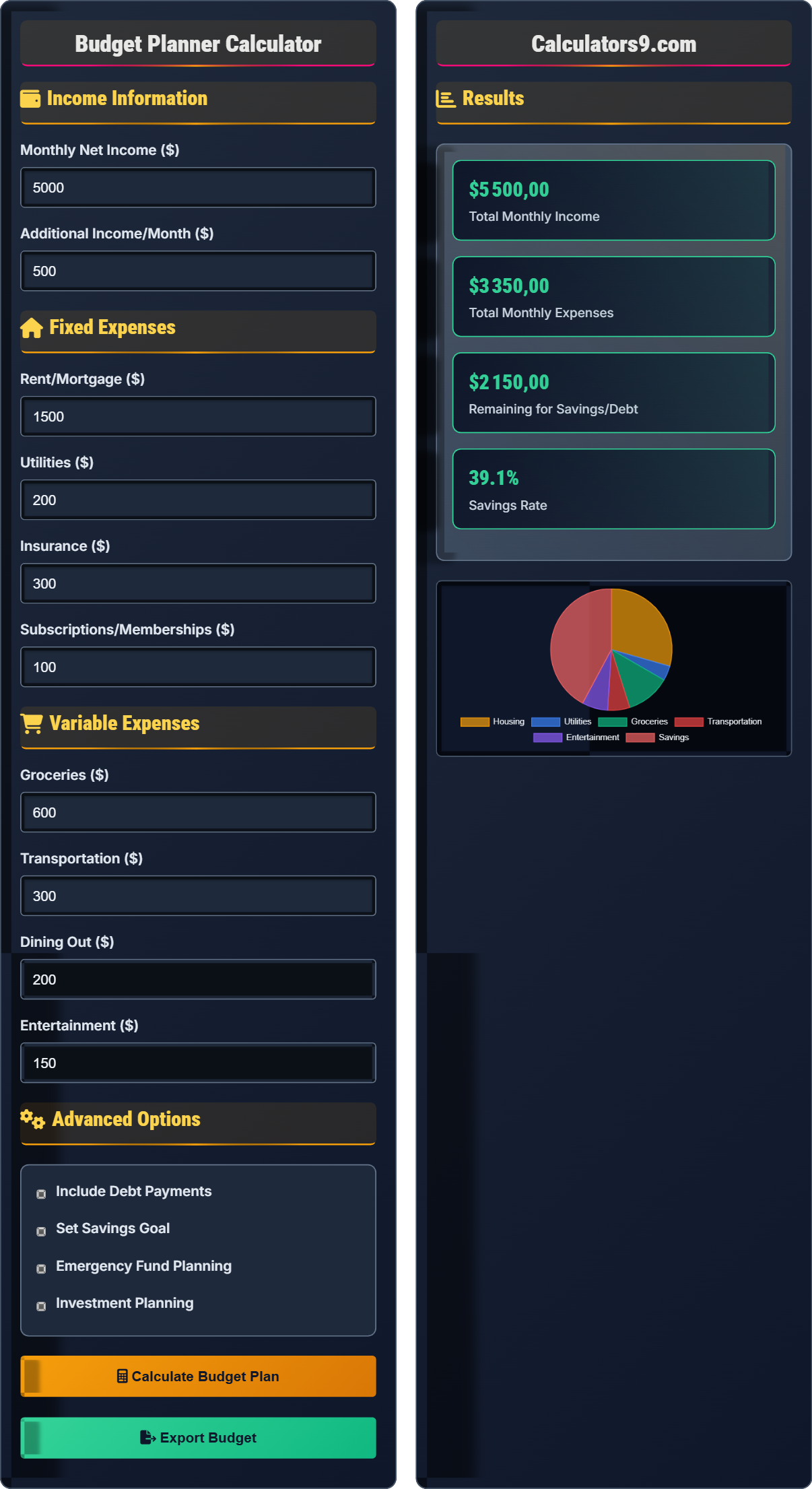
Results
| Category | Amount ($) | % of Income | Status |
|---|---|---|---|
| Housing | $1,500.00 | 27.3% | Good |
| Utilities | $200.00 | 3.6% | Good |
| Groceries | $600.00 | 10.9% | Good |
| Transportation | $300.00 | 5.5% | Good |
| Entertainment | $350.00 | 6.4% | Good |
| Savings | $1,950.00 | 35.5% | Excellent |
| Item | Budgeted | Spent | Difference |
|---|---|---|---|
| Salary | $5,000.00 | $5,000.00 | $0.00 |
| Freelance | $500.00 | $450.00 | -$50.00 |
| Rent | $1,500.00 | $1,500.00 | $0.00 |
| Groceries | $600.00 | $580.00 | $20.00 |
| Utilities | $200.00 | $210.00 | -$10.00 |
| Savings | $1,950.00 | $1,950.00 | $0.00 |
Comprehensive Budget Planning Guide
The 50/30/20 rule is a simple budgeting technique popularized by Senator Elizabeth Warren. It divides your after-tax income into three main categories: 50% for needs (essential expenses), 30% for wants (non-essential spending), and 20% for savings and debt repayment. This method provides a balanced approach to managing your finances while ensuring you're building wealth and reducing debt.
The core budget equation is: Total Income = Fixed Expenses + Variable Expenses + Savings + Debt Payments
Where:
- Total Income: All monthly income sources after taxes
- Fixed Expenses: Consistent monthly bills (rent, insurance, subscriptions)
- Variable Expenses: Fluctuating costs (groceries, entertainment, transportation)
- Debt Payments: Credit cards, loans, mortgages
- Remaining Funds: Available for savings and investments
Key financial ratios help assess your financial health:
- Debt-to-Income Ratio: Total monthly debt payments ÷ gross monthly income (aim for under 36%)
- Savings Rate: Monthly savings ÷ gross monthly income (aim for 20% or more)
- Emergency Fund: Liquid savings ÷ monthly essential expenses (aim for 3-6 months)
- Housing Ratio: Housing costs ÷ gross monthly income (aim for under 28%)
- Automate savings: Set up automatic transfers to savings accounts
- Track spending: Use apps or spreadsheets to monitor expenses
- Review monthly: Adjust categories based on changing needs
- Pay yourself first: Prioritize savings before discretionary spending
- Use the envelope method: Allocate cash for variable expenses
Budget Basics
A plan for your money that ensures expenses don't exceed income while building financial security.
\( \text{Needs} = \text{Income} \times 0.5 \), \( \text{Wants} = \text{Income} \times 0.3 \), \( \text{Savings} = \text{Income} \times 0.2 \)
Where income is your after-tax monthly earnings.
- Track all income and expenses
- Review and adjust monthly
- Build emergency fund first
Financial Health
Metrics that measure your financial stability and progress toward goals.
- Calculate monthly ratios
- Compare to benchmarks
- Identify improvement areas
- Set targets for next month
- Savings rate: 20% or higher
- Debt-to-income: Below 36%
- Emergency fund: 3-6 months expenses
Budget Planning Learning Quiz
According to the 50/30/20 budget rule, what percentage of your after-tax income should be allocated to savings and debt repayment?
The answer is A) 20%. The 50/30/20 rule allocates 50% of after-tax income to needs (essential expenses), 30% to wants (discretionary spending), and 20% to savings and debt repayment. This allocation provides a balanced approach to financial management while ensuring you're building wealth and reducing debt. The 20% for savings and debt repayment includes emergency fund contributions, retirement savings, and any debt payments above minimums.
The 50/30/20 rule is a foundational budgeting principle that simplifies financial planning. The 20% allocation to savings and debt repayment is crucial for long-term financial security. This percentage ensures you're consistently building wealth while reducing liabilities. The rule works because it provides flexibility within a structured framework, allowing adjustments based on individual circumstances while maintaining focus on financial goals.
After-tax Income: Your total income minus all taxes and deductions
Needs: Essential expenses required for basic living (housing, utilities, food)
Wants: Discretionary spending for enjoyment and comfort
• 50% for needs (essential expenses)
• 30% for wants (discretionary spending)
• 20% for savings and debt repayment
• Start with the 20% savings portion first ("pay yourself first")
• Adjust percentages based on your financial situation
• Review and adjust monthly as needed
• Confusing gross income with net income
• Including wants in the needs category
• Not accounting for irregular income
If someone has a monthly after-tax income of $4,500, calculate the dollar amounts for each category using the 50/30/20 rule. Then determine if they can meet their goal of saving $1,000 per month.
Calculating 50/30/20 allocations:
Needs (50%): $4,500 × 0.50 = $2,250
Wants (30%): $4,500 × 0.30 = $1,350
Savings/Debt (20%): $4,500 × 0.20 = $900
Analysis: With a monthly after-tax income of $4,500, the 50/30/20 rule allocates $900 to savings and debt repayment. Since their goal is to save $1,000 per month, they fall short by $100. To meet their goal, they could either: 1) Increase their income, 2) Reduce their wants by $100 (from $1,350 to $1,250), or 3) Reduce their needs by $100 (which would require careful budgeting).
This calculation demonstrates how to apply the 50/30/20 rule to a specific income amount. The formula is straightforward: multiply the after-tax income by 0.50, 0.30, and 0.20 respectively. When personal goals conflict with the rule, it's important to evaluate trade-offs. In this case, increasing savings beyond the 20% guideline requires reducing another category, showing the importance of flexibility in budgeting.
After-tax Income: Income after all taxes and deductions
Budget Allocation: Distribution of income across spending categories
Trade-offs: When increasing one budget category requires decreasing another
• Always use after-tax income for calculations
• The sum of all categories must equal total income
• Adjust allocations based on individual goals and circumstances
• Use the formula: Category Amount = Income × Percentage
• Round to nearest $5 or $10 for easier tracking
• Review allocations quarterly to ensure they still fit your needs
• Using gross income instead of net income
• Forgetting to account for irregular expenses
• Not adjusting for life changes or financial goals
FAQ
Q: How do I handle irregular income when budgeting with the 50/30-20 rule?
A: Irregular income requires a modified approach to the 50/30/20 rule. Instead of applying percentages to variable monthly income, establish baseline budgets based on your lowest expected monthly income:
Base Budget Formula: Base Income = Average of lowest 3 months' income
Apply 50/30/20 to this base income to ensure your needs are covered even in low-income months. During high-income months, allocate surplus funds as follows:
- 50% to emergency fund (until 6-month buffer is reached)
- 30% to savings/investments
- 20% to debt repayment or special goals
For example, if your base income is $3,000 (50/30/20 = $1,500/$900/$600) but you earn $5,000 in a good month, the extra $2,000 should be directed to financial priorities rather than increasing wants. This approach provides stability while maximizing opportunities during high-income periods.
Q: My debt payments are so high that I can't follow the 50/30/20 rule. How should I adjust my budget?
A: When debt payments exceed the typical 20% allocation, you need a modified approach. The key is to prioritize debt elimination while maintaining essential needs:
High Debt Formula: Debt-to-Income Ratio = Total Monthly Debt Payments ÷ Gross Monthly Income
If your debt-to-income ratio exceeds 40%, consider the modified 40/30/30 rule:
- 40% for needs (including minimum debt payments)
- 30% for debt repayment beyond minimums
- 30% for wants and remaining savings
Alternatively, use the debt snowball or avalanche method: allocate extra funds to the highest interest debt while maintaining minimum payments on all debts. Once debt is reduced below 20% of income, revert to the traditional 50/30/20 rule. For example, with $5,000 income and $1,500 in debt payments (30%), you'd need to adjust to approximately 45/25/30 until debt is reduced.