Expense Tracker Calculator
Budget management tool • 2026 finance standards
Budget Formula:
Show the calculator\( \text{Available Budget} = \text{Income} - \text{Total Expenses} \)
\( \text{Expense Percentage} = \frac{\text{Category Expense}}{\text{Total Expenses}} \times 100 \)
Where:
- \( \text{Income} \) = Monthly gross income
- \( \text{Total Expenses} \) = Sum of all monthly expenses
- \( \text{Category Expense} \) = Expenses in specific category
This formula helps track spending and maintain budget balance.
Example: With $5,000 income and $4,200 expenses:
Available Budget = $5,000 - $4,200 = $800
If rent is $1,500:
Rent Percentage = ($1,500 ÷ $4,200) × 100 = 35.7%
Therefore, $800 remains available and rent represents 35.7% of total expenses.
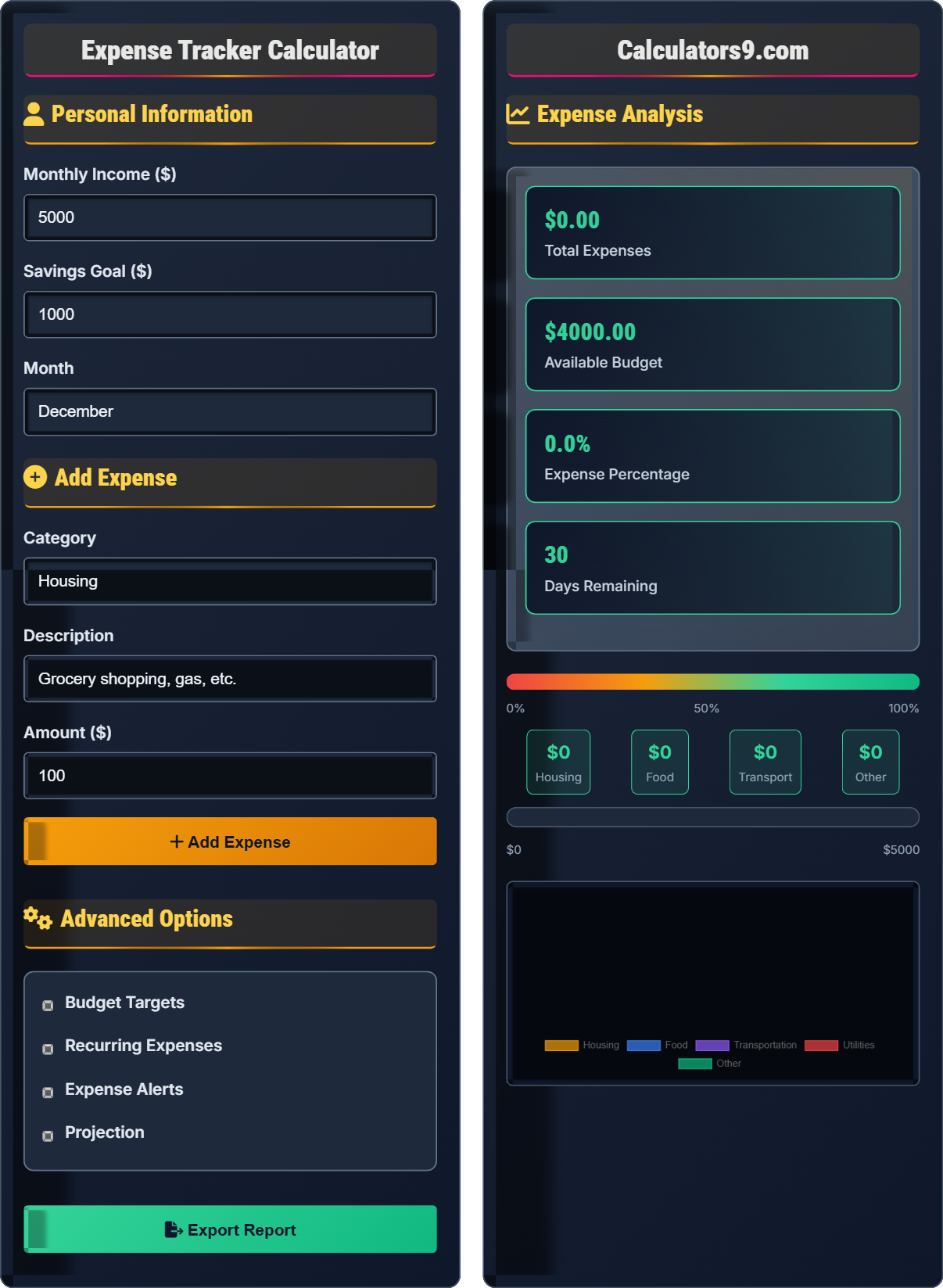
Personal Information
Add Expense
Advanced Options
Expense Analysis
| Date | Category | Description | Amount | Action |
|---|
| Category | Amount | % of Total | Status |
|---|
Comprehensive Expense Tracking Guide
Expenses are categorized into fixed and variable costs. Fixed expenses (rent, insurance, loan payments) remain consistent monthly, while variable expenses (food, entertainment, transportation) fluctuate. Tracking both types helps identify spending patterns and opportunities for savings.
The fundamental budget equation:
Expenses should typically not exceed 70-80% of income after savings.
- Housing: 25-30% of income
- Food: 10-15% of income
- Transportation: 10-15% of income
- Utilities: 5-10% of income
Common expense categories and their typical percentages:
- Essential: Housing, utilities, food, transportation
- Discretionary: Entertainment, dining out, shopping
- Financial: Savings, investments, debt payments
- Health: Insurance, medical expenses
- Automate Tracking: Use banking apps and financial tools
- Review Weekly: Don't wait until month-end
- Set Alerts: Get notifications when approaching limits
- Use Cash Envelopes: Physical separation of budgets
- Track Receipts: Keep digital records
Expense Tracking Fundamentals
Money spent on goods and services. Tracking reveals spending patterns and identifies areas for improvement.
\( \text{Available} = \text{Income} - \text{Expenses} - \text{Savings} \)
Accurate tracking requires categorization and regular review.
- Record expenses immediately
- Review regularly
- Track all spending
Budgeting Tips
Group expenses into meaningful categories for better analysis and control.
- Fixed vs Variable
- Essential vs Discretionary
- Needs vs Wants
- By Life Area
- By Payment Method
- Adjust categories over time
- Review monthly
- Set realistic targets
- Allow for flexibility
Expense Tracking Learning Quiz
Which of the following is an example of a fixed expense?
The answer is B) Rent or mortgage payment. Fixed expenses remain consistent from month to month regardless of usage. Rent/mortgage, insurance premiums, and loan payments are typically fixed expenses. In contrast, groceries, gasoline, and dining out are variable expenses that fluctuate based on consumption and needs.
Understanding the difference between fixed and variable expenses is fundamental to budgeting. Fixed expenses are predictable and easier to plan for, while variable expenses require more careful monitoring. Knowing which expenses are fixed helps determine your minimum monthly obligations and how much flexibility you have in your budget.
Fixed Expense: Cost that remains constant each month
Variable Expense: Cost that changes based on usage
Recurring Expense: Regularly scheduled payment
• Fixed expenses are predictable
• Variable expenses require monitoring
• Both types should be tracked
• Focus on fixed expenses first in budget planning
• Set limits for variable expenses
• Track both consistently
• Treating all expenses as variable
• Not accounting for seasonal variations
• Forgetting to track fixed expenses
Calculate the expense percentage if you spent $800 on food out of total monthly expenses of $3,200.
Step 1: Identify the formula
Expense Percentage = (Category Expense ÷ Total Expenses) × 100
Step 2: Insert the values
Expense Percentage = ($800 ÷ $3,200) × 100
Step 3: Calculate the result
Expense Percentage = 0.25 × 100 = 25%
Therefore, food expenses represent 25% of total monthly expenses.
This calculation helps understand the relative importance of different expense categories. A 25% allocation to food is quite high, as the typical recommendation is 10-15% of income. This percentage calculation is essential for budget analysis and identifying areas where spending may be excessive.
Expense Percentage: Relative size of category vs total
Budget Allocation: Distribution of money across categories
Spending Pattern: How money is distributed
• All percentages should sum to 100%
• Compare to recommended ranges
• Track changes over time
• Use percentages to compare budgets
• Look for categories exceeding norms
• Adjust based on life stage
• Forgetting to multiply by 100 for percentage
• Not comparing to benchmarks
• Ignoring seasonal variations
You earn $4,500 monthly and have allocated $1,000 for savings. Your total expenses are $3,800. What is your budget deficit, and what does this indicate about your spending?
Step 1: Calculate the budget formula
Available Money = Income - Expenses - Savings
Available Money = $4,500 - $3,800 - $1,000 = -$300
Step 2: Interpret the result
The negative $300 indicates a budget deficit.
Step 3: Analyze the situation
You are spending $300 more than your income allows after accounting for savings.
You have a $300 budget deficit, meaning you're spending more than your income.
This problem demonstrates the importance of ensuring your budget balances. A negative result indicates overspending that must be addressed either by reducing expenses or increasing income. The formula shows that savings should be treated as a priority expense that comes out of income before discretionary spending.
Budget Deficit: Spending exceeds income
Budget Surplus: Income exceeds spending
Budget Balance: Income equals spending
• Income must cover all expenses and savings
• Address deficits immediately
• Prioritize essential expenses
• Treat savings as a fixed expense
• Reduce variable expenses first
• Consider increasing income
• Not accounting for savings in budget
• Ignoring small deficits
• Not addressing overspending
You spend $1,200 on housing, $400 on food, $300 on transportation, and $600 on other expenses. If your total income is $4,000, what percentage of your income goes to housing, and is this within recommended limits?
Step 1: Calculate housing percentage of income
Housing % = (Housing Expense ÷ Income) × 100
Housing % = ($1,200 ÷ $4,000) × 100 = 30%
Step 2: Compare to recommended limits
Recommended housing: 25-30% of income
Your housing: 30% of income
Step 3: Analyze the result
Your housing expense is at the upper limit of the recommended range.
Housing represents 30% of your income, which is at the recommended maximum.
This example shows how to evaluate specific expense categories against financial guidelines. The 25-30% rule for housing is a widely accepted benchmark. Staying within this range helps ensure you have adequate funds for other expenses and savings. This type of analysis helps identify when spending in a category may be excessive.
Benchmark: Standard for comparison
Recommended Range: Financial guideline
Category Analysis: Evaluating individual spending
• Compare to established benchmarks
• Adjust for local costs
• Consider your life stage
• Use percentage of income for comparisons
• Adjust benchmarks for your situation
• Track trends over time
• Using absolute amounts instead of percentages
• Not adjusting for local cost of living
• Ignoring changing life circumstances
What is the primary benefit of tracking expenses regularly?
The answer is B) To identify spending patterns and opportunities for savings. Regular expense tracking reveals where money is going, helps identify unnecessary spending, and shows patterns that can inform better financial decisions. This awareness is essential for effective budgeting and financial planning.
Expense tracking is the foundation of good financial management. Without knowing where money goes, it's impossible to make informed decisions about spending and saving. Tracking provides visibility into spending habits and reveals areas where adjustments can be made to improve financial health. It's not about restricting spending, but about spending intentionally.
Financial Awareness: Knowledge of spending patterns
Spending Patterns: Recurring ways money is spent
Financial Control: Managing money intentionally
• Track consistently for accurate data
• Review regularly to identify patterns
• Use insights to improve financial health
• Use automated tools when possible
• Review weekly, not just monthly
• Set alerts for unusual spending
• Tracking inconsistently
• Not reviewing the data collected
• Not acting on insights gained
FAQ
Q: How do I calculate my expense percentage of income?
A: The formula for calculating expense percentage of income is:
\( \text{Expense Percentage} = \frac{\text{Category Expense}}{\text{Total Income}} \times 100 \)
For example, if your housing expense is $1,200 and your monthly income is $5,000:
Housing Percentage = ($1,200 ÷ $5,000) × 100 = 24%
This is within the recommended 25-30% range for housing expenses.
Q: Should I track every small purchase?
A: The mathematical principle is to track expenses that significantly impact your budget:
\( \text{Track if: } \text{Expense Amount} \geq \text{Budget Threshold} \)
Many financial advisors suggest tracking expenses over $10-20. Small purchases under this threshold can be estimated. The key is consistency in tracking significant expenses that add up over time. For example, daily $5 coffee purchases total $150 monthly, which is worth tracking.