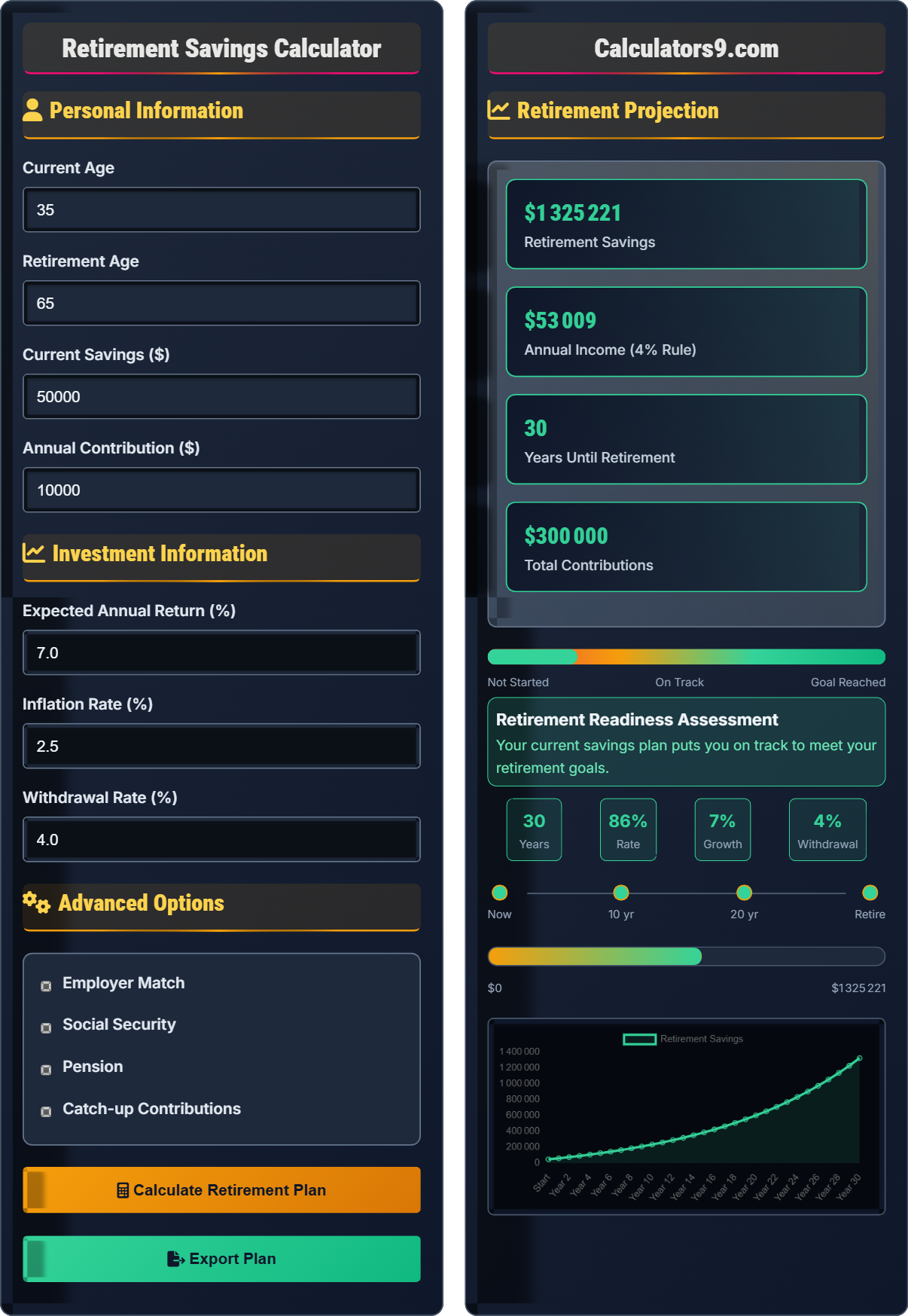
Retirement Savings Calculator
Financial planning tool • 2026 finance standards
Retirement Savings Formula:
Show the calculator\( \text{Future Value} = \text{PV} \times (1 + r)^n + \text{PMT} \times \frac{(1 + r)^n - 1}{r} \)
Where:
- \( \text{PV} \) = Present value (current savings)
- \( \text{PMT} \) = Periodic payment (annual contribution)
- \( r \) = Annual interest rate (as decimal)
- \( n \) = Number of years until retirement
This formula calculates the future value of retirement savings with regular contributions and compound interest.
Example: $50,000 current savings, $10,000 annual contributions, 7% return for 25 years:
Future Value = $50,000 × (1.07)^25 + $10,000 × [(1.07)^25 - 1] ÷ 0.07
= $50,000 × 5.4274 + $10,000 × [5.4274 - 1] ÷ 0.07
= $271,370 + $10,000 × 63.249 = $903,860
Therefore, the retirement account will have approximately $903,860 at retirement.
Personal Information
Investment Information
Advanced Options
Retirement Projection
Retirement Readiness Assessment
Your current savings plan puts you on track to meet your retirement goals.
| Year | Age | Contribution | Balance |
|---|
| Source | Monthly Income | Annual Income | Percentage of Total |
|---|
Comprehensive Retirement Planning Guide
Retirement planning involves accumulating sufficient funds to maintain your desired lifestyle after ceasing employment. The key to successful retirement planning is starting early, saving consistently, and investing wisely. The power of compound interest means that money saved today will grow significantly over time, making early contributions extremely valuable.
The future value of an investment with regular contributions:
Where:
- FV: Future Value
- PV: Present Value (current savings)
- PMT: Periodic Payment (annual contribution)
- r: Periodic Interest Rate
- n: Number of Periods
Common retirement income sources:
- 401(k) Plans: Employer-sponsored defined contribution plans
- IRA Accounts: Individual retirement accounts
- Social Security: Government-provided benefits
- Pensions: Defined benefit plans (decreasing)
- Taxable Accounts: General investment accounts
- Real Estate: Rental properties or sale proceeds
- Start Early: Leverage compound interest for maximum growth
- Maximize Employer Match: Contribute enough to get full match
- Automatic Contributions: Set up recurring transfers
- Diversify Investments: Spread risk across asset classes
- Review Regularly: Adjust plan as life circumstances change
Retirement Planning Fundamentals
Period of life after ceasing employment. Requires sufficient savings to maintain lifestyle. Planning essential for financial security.
\( \text{FV} = \text{PV} \times (1 + r)^n + \text{PMT} \times \frac{(1 + r)^n - 1}{r} \)
Compound interest formula for regular contributions.
- Start saving as early as possible
- Contribute consistently
- Take advantage of employer matches
Planning Tips
Safe withdrawal rate for retirement. Withdraw 4% of savings annually to maintain funds for 30+ years.
- Set retirement age goal
- Estimate retirement expenses
- Calculate required savings
- Choose appropriate investments
- Monitor and adjust regularly
- Healthcare costs in retirement
- Life expectancy
- Market volatility
- Inflation impact
Retirement Planning Learning Quiz
What is the primary purpose of the 4% rule in retirement planning?
The answer is B) To calculate safe withdrawal rate from retirement funds. The 4% rule suggests that retirees can withdraw 4% of their retirement savings annually, adjusted for inflation, with a high probability of not running out of money over a 30-year retirement period. This rule helps determine how much income can be safely drawn from retirement savings.
The 4% rule is a fundamental concept in retirement planning that addresses the critical question of how much income can be safely withdrawn from retirement savings. It balances the need for income during retirement with the risk of outliving your savings. The rule is based on historical market performance and assumes a diversified portfolio of stocks and bonds.
Safe Withdrawal Rate: Annual percentage that can be withdrawn without running out of money
Retirement Income: Money received during retirement years
Portfolio Sustainability: Ability to maintain value over time
• 4% is a starting point, not a guarantee
• Adjust for market conditions and personal needs
• Consider sequence of returns risk
• Start with 4%, adjust as needed
• Consider 3-3.5% in uncertain markets
• Plan for rising healthcare costs
• Withdrawing more than the safe rate
• Not adjusting for inflation
• Ignoring healthcare costs
Calculate the future value of $50,000 invested at 7% annual return for 25 years with no additional contributions.
Step 1: Identify the formula (no additional contributions)
Future Value = Present Value × (1 + r)^n
Step 2: Insert the values
Future Value = $50,000 × (1 + 0.07)^25
Future Value = $50,000 × (1.07)^25
Step 3: Calculate the exponent
(1.07)^25 = 5.4274
Step 4: Calculate the result
Future Value = $50,000 × 5.4274 = $271,370
Therefore, the investment will grow to $271,370 after 25 years.
This calculation demonstrates the power of compound interest over time. The initial $50,000 grows to over $271,000 due to compound growth at 7% annually for 25 years. The growth accelerates over time as interest is earned on previously earned interest. This illustrates why starting early is so important in retirement planning.
Compound Interest: Interest earned on both principal and accumulated interest
Time Value of Money: Money grows over time with compound interest
Future Value: Value of investment at future date
• Convert percentage to decimal (7% = 0.07)
• Apply exponent to the entire factor (1+r)
• Compound growth accelerates over time
• Use a financial calculator for exponents
• The Rule of 72: 72 ÷ rate ≈ doubling time
• Start early to maximize compounding
• Forgetting to convert percentage to decimal
• Misunderstanding the power of compounding
• Not accounting for inflation in planning
Jane plans to retire in 30 years. She has $25,000 saved and will contribute $8,000 annually. If she earns 6% annually, how much will she have at retirement?
Step 1: Calculate growth of current savings
Future Value of Current Savings = $25,000 × (1.06)^30
= $25,000 × 5.7435 = $143,587
Step 2: Calculate future value of annual contributions
FV of Annuity = PMT × [((1 + r)^n - 1) / r]
= $8,000 × [((1.06)^30 - 1) / 0.06]
= $8,000 × [(5.7435 - 1) / 0.06]
= $8,000 × [4.7435 / 0.06]
= $8,000 × 79.058 = $632,464
Step 3: Calculate total retirement savings
Total = $143,587 + $632,464 = $776,051
Jane will have approximately $776,051 at retirement.
This problem combines two calculations: the growth of current savings and the future value of regular contributions. The regular contributions have a significant impact on the final amount, demonstrating the importance of consistent saving. The combination of current savings growth and regular contributions creates a substantial retirement nest egg over the 30-year period.
Future Value of Annuity: Value of series of equal payments
Regular Contributions: Consistent annual additions to savingsRetirement Nest Egg: Total accumulated retirement savings
• Combine both calculations for total
• Regular contributions grow significantly
• Time is a critical factor in accumulation
• Start contributing early and consistently
• Take advantage of employer matches
• Increase contributions when possible
• Forgetting to include current savings
• Misapplying the annuity formula
• Not accounting for the time factor properly
Compare two savers: Alex starts saving $5,000 annually at age 25 for 10 years, then stops. Bob starts saving $5,000 annually at age 35 for 30 years. Both earn 7% annually. Who has more money at age 65?
Step 1: Calculate Alex's savings
Phase 1: 10 years of contributions (age 25-35)
FV of contributions = $5,000 × [((1.07)^10 - 1) / 0.07] = $5,000 × 13.8164 = $69,082
Phase 2: 30 years of compound growth (age 35-65)
Final amount = $69,082 × (1.07)^30 = $69,082 × 7.6123 = $525,894
Step 2: Calculate Bob's savings
30 years of contributions (age 35-65)
FV of contributions = $5,000 × [((1.07)^30 - 1) / 0.07] = $5,000 × 94.4608 = $472,304
Alex has $525,894 while Bob has $472,304. Alex wins despite saving for only 10 years!
This classic example demonstrates the incredible power of starting early. Alex contributed only $50,000 total ($5,000 × 10 years) but ended with $525,894 due to 30 years of compound growth. Bob contributed $150,000 total ($5,000 × 30 years) but only had 30 years of growth for each contribution. The early years of compounding make the biggest difference in long-term wealth accumulation.
Time Value of Money: Money available now is worth more than same amount later
Compounding Effect: Exponential growth from interest on interest
Early Advantage: Greater benefit from starting young
• Time is more valuable than money in investing
• Even small amounts early have huge impact
• Compounding accelerates over time
• Start saving immediately, even if small amounts
• Take advantage of employer matching
• Automate savings to maintain consistency
• Believing you can start saving later
• Underestimating the impact of time
• Delaying investments for "better" opportunities
How does inflation affect retirement planning?
The answer is B) It reduces the purchasing power of future money. Inflation is the rate at which prices for goods and services rise over time. If you plan to have $1 million at retirement but inflation averages 3% annually, that same $1 million will have the purchasing power of only about $412,000 in today's dollars after 30 years. This means you'll need more money to maintain the same standard of living.
Inflation erodes the value of money over time, which is particularly important in retirement planning due to the long time horizons involved. The real return on your investments is the nominal return minus inflation. If your investments earn 7% annually but inflation is 3%, your real purchasing power is only growing at 4% annually. This is why it's important to consider inflation when setting long-term retirement savings goals.
Inflation: Increase in price level of goods and services
Purchasing Power: Amount of goods/services money can buy
Real Return: Nominal return adjusted for inflation
• Inflation reduces future purchasing power
• Real return = Nominal return - Inflation
• Consider inflation in long-term planning
• Factor inflation into long-term goals
• Choose investments that outpace inflation
• Consider Treasury Inflation-Protected Securities (TIPS)
• Ignoring inflation in retirement calculations
• Assuming current prices will remain the same
• Not adjusting goals for purchasing power
FAQ
Q: How much should I save for retirement each year?
A: The general recommendation is to save 10-15% of your annual income for retirement. However, this varies based on your age and retirement goals:
\( \text{Target Savings Rate} = \frac{\text{Annual Contribution}}{\text{Annual Income}} \times 100 \)
For example, if you earn $80,000 and save $8,000 annually:
Savings Rate = ($8,000 ÷ $80,000) × 100 = 10%
Younger individuals can start with lower rates, while those closer to retirement may need to save more aggressively.
Q: What's the difference between a 401(k) and an IRA?
A: The main differences are:
- 401(k): Employer-sponsored, higher contribution limits ($23,000 in 2024)
- IRA: Individual account, lower limits ($6,500 in 2024)
Mathematical comparison for tax-advantaged growth:
\( \text{Future Value} = \text{Contributions} \times (1 + r)^n \)
Both offer tax advantages, but 401(k)s often include employer matching, which provides an immediate return on investment.