Customer Acquisition Cost Calculator
Calculate your marketing ROI & acquisition costs • 2026 edition
CAC Formula:
Show the calculator\( \text{CAC} = \frac{\text{Total Marketing & Sales Costs}}{\text{New Customers Acquired}} \)
\( \text{CAC Ratio} = \frac{\text{Customer Lifetime Value}}{\text{Customer Acquisition Cost}} \)
\( \text{Marketing ROI} = \frac{\text{Revenue from New Customers} - \text{Marketing Costs}}{\text{Marketing Costs}} \times 100 \)
Where:
- \( \text{Marketing Costs} = \text{Advertising, salaries, tools, campaigns, etc.} \)
- \( \text{Sales Costs} = \text{Commission, travel, events, CRM, etc.} \)
- \( \text{New Customers} = \text{Customers acquired during measurement period} \)
- \( \text{CAC Ratio} = \text{LTV:CAC ratio for profitability analysis} \)
This formula calculates the average cost to acquire a new customer, helping businesses evaluate marketing efficiency and optimize spending. A healthy LTV:CAC ratio is typically 3:1 or higher.
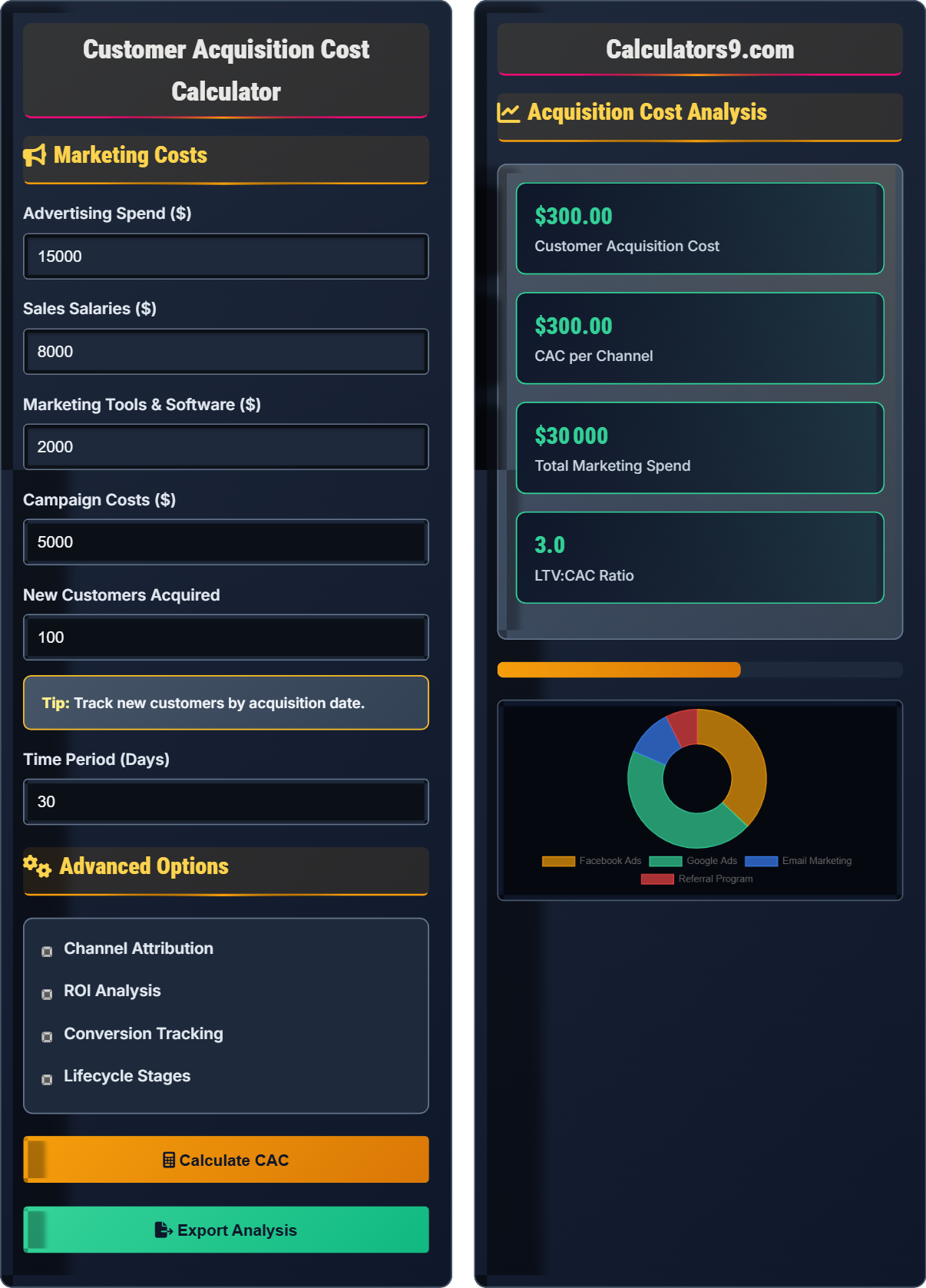
Example: If you spend $30,000 on marketing and acquire 100 new customers:
CAC = $30,000 ÷ 100 = $300 per customer
If the customer lifetime value is $900:
LTV:CAC Ratio = $900 ÷ $300 = 3:1
Therefore, the CAC is $300 with a healthy 3:1 LTV:CAC ratio.
Marketing Costs
Advanced Options
Acquisition Cost Analysis
| Metric | Value | Efficiency | Optimization |
|---|
Efficiency Metrics
Comprehensive Customer Acquisition Cost Guide
Customer Acquisition Cost (CAC) is the total cost associated with acquiring a new customer, including all marketing and sales expenses. It's a critical metric for understanding marketing efficiency and determining how much to invest in customer acquisition strategies.
The standard CAC calculation uses the following formula:
Where:
- \( \text{Total Marketing Costs} = \text{Advertising, salaries, tools, campaigns, etc.} \)
- \( \text{Sales Costs} = \text{Commission, travel, events, CRM, etc.} \)
- \( \text{New Customers} = \text{Customers acquired during measurement period} \)
- \( \text{CAC Ratio} = \frac{\text{Customer Lifetime Value}}{\text{CAC}} \)
Customer Acquisition Cost has several key applications:
- Budget Allocation: Determine optimal marketing spend distribution
- Channel Performance: Compare efficiency of different acquisition channels
- ROI Measurement: Evaluate return on marketing investments
- Scaling Decisions: Understand how much to invest in growth
- Profitability Analysis: Ensure acquisition costs are sustainable
- Track by Channel: Calculate CAC for each marketing channel separately
- Monitor Trends: Track CAC over time to identify changes
- Compare to LTV: Ensure LTV:CAC ratio is healthy (3:1 minimum)
- Optimize Conversion: Improve conversion rates to reduce CAC
- Focus on Retention: Lower churn increases customer value
CAC Basics
Total cost to acquire a new customer including marketing and sales.
\( \text{CAC} = \frac{\text{Total Marketing & Sales Costs}}{\text{New Customers Acquired}} \)
Where cost = total spend divided by customers acquired.
- LTV:CAC ratio should be ≥ 3:1
- Track CAC by channel for optimization
- Include all relevant costs in calculation
Optimization Strategies
Customer Lifetime Value to Customer Acquisition Cost ratio.
- Improve conversion rates
- Optimize marketing channels
- Reduce customer churn
- Increase average order value
- Seasonal variations affect CAC
- Early-stage companies may have higher CAC
- Competition affects acquisition costs
- Brand awareness impacts organic acquisition
Customer Acquisition Cost Learning Quiz
Which of the following should NOT be included in the calculation of Customer Acquisition Cost?
The answer is C) Product development costs. Product development costs are not directly tied to acquiring new customers and should not be included in CAC calculations. CAC should only include costs directly related to customer acquisition activities, such as advertising, sales salaries, marketing tools, and campaign expenses.
This question tests understanding of the scope of CAC calculation. CAC should only include costs that are directly attributable to customer acquisition. Product development costs are related to creating the product that customers purchase, not to acquiring the customers themselves. Only include costs that would decrease proportionally if customer acquisition decreased.
CAC: Customer Acquisition Cost - cost to acquire new customers
Attributable Costs: Costs directly tied to customer acquisition
Overhead Costs: Indirect costs not directly tied to acquisition
• Include only acquisition-related costs in CAC
• Exclude product development and general overhead
• Include marketing, sales, and tools costs
• Track costs by channel for granular analysis
• Include both direct and indirect acquisition costs
• Exclude costs not tied to acquisition
• Including product development costs in CAC
• Forgetting to include sales salaries
• Not allocating shared resource costs appropriately
Calculate the CAC for a company that spent $24,000 on marketing and sales activities and acquired 150 new customers. Show your work.
Step 1: Identify total marketing and sales costs = $24,000
Step 2: Identify number of new customers acquired = 150
Step 3: Apply the CAC formula:
CAC = Total Marketing & Sales Costs ÷ New Customers Acquired
CAC = $24,000 ÷ 150 = $160
Therefore, the Customer Acquisition Cost is $160 per customer.
This calculation demonstrates the basic CAC formula. The key is to ensure all relevant costs are included and only count customers acquired during the measurement period. The $160 CAC means the company spent $160 to acquire each new customer. This cost should be compared to the expected lifetime value of these customers to assess profitability.
CAC: Customer Acquisition Cost
Marketing Costs: Expenses related to customer acquisition
New Customers: First-time purchasers during measurement period
• Include all acquisition-related costs
• Count only new customers acquired
• Match time periods for costs and customers
• Calculate CAC monthly for trend analysis
• Compare CAC across different channels
• Include both direct and indirect costs
• Not including all relevant costs in calculation
• Counting existing customers instead of new ones
• Mismatching time periods for costs and customers
A company has a CAC of $200 and a Customer Lifetime Value (LTV) of $600. What is their LTV:CAC ratio, and what does this indicate about their customer acquisition efficiency? Is this ratio considered healthy?
Step 1: Calculate LTV:CAC ratio = LTV ÷ CAC
LTV:CAC = $600 ÷ $200 = 3:1
Step 2: Interpret the ratio
A 3:1 ratio means for every $1 spent acquiring a customer, the company earns $3 in lifetime value. This indicates good customer acquisition efficiency.
Step 3: Evaluate health of ratio
Industry benchmarks:
• Below 1:1 = Unprofitable acquisition
• 1:1 to 3:1 = Break-even or barely profitable
• 3:1 to 5:1 = Healthy acquisition strategy
• Above 5:1 = Excellent acquisition efficiency
Therefore, the 3:1 ratio is healthy and indicates the company is efficiently acquiring profitable customers.
The LTV:CAC ratio is critical for evaluating marketing efficiency. A 3:1 ratio means the company generates 3 times more value than it costs to acquire customers. This provides a reasonable return on acquisition investment while leaving room for marketing expansion. The ratio helps determine sustainable marketing spend levels.
LTV:CAC: Lifetime Value to Customer Acquisition Cost ratio
Marketing Efficiency: How effectively acquisition spend generates returns
Profitability Threshold: Minimum ratio needed for sustainable acquisition
• LTV:CAC = Customer Lifetime Value ÷ Customer Acquisition Cost
• Healthy ratio is 3:1 or higher
• Higher ratios indicate better efficiency
• Aim for 3:1 ratio as minimum threshold
• Target 5:1+ for excellent efficiency
• Calculate ratios by acquisition channel
• Not calculating LTV:CAC ratio regularly
• Accepting ratios below 3:1 without improvement plans
• Not segmenting by acquisition channel
A company tracks two marketing channels: Channel A costs $10,000 and acquires 50 customers, while Channel B costs $8,000 and acquires 20 customers. Calculate the CAC for each channel and determine which is more efficient. What additional factors should be considered?
Channel A:
CAC = $10,000 ÷ 50 = $200 per customer
Channel B:
CAC = $8,000 ÷ 20 = $400 per customer
Efficiency Comparison:
Channel A has a lower CAC ($200 vs $400), making it more cost-efficient for acquiring customers.
Additional factors to consider:
• Customer Quality: Are Channel A customers more valuable?
• Customer Lifetime Value: Do customers from different channels have different LTV?
• Retention Rates: Do customers from different channels have different retention?
• Scalability: Can Channel A be scaled to acquire more customers?
• Brand Alignment: Does Channel A attract the target customer demographic?
Therefore, Channel A is more cost-efficient with a CAC of $200 vs $400 for Channel B, but other factors should be evaluated for overall channel effectiveness.
This problem demonstrates that CAC alone doesn't tell the complete story. While Channel A is more cost-efficient, other factors like customer quality, lifetime value, and retention rates may make Channel B more valuable overall. The most cost-efficient channel isn't always the best channel if it attracts lower-value customers.
Channel Efficiency: How effectively each channel acquires customers
Customer Quality: Value and behavior of acquired customers
Channel Comparison: Evaluating different acquisition methods
• Compare CAC across different channels
• Consider customer quality beyond CAC
• Evaluate channels based on total value, not just cost
• Track CAC by channel separately
• Consider LTV along with CAC for channel evaluation
• Monitor channel performance trends over time
• Evaluating channels based on CAC alone
• Not considering customer lifetime value by channel
• Forgetting to account for different customer qualities
Which of the following strategies would be LEAST effective for reducing Customer Acquisition Cost?
The answer is C) Increasing marketing spend to acquire more customers. Simply increasing marketing spend without improving efficiency would likely increase CAC. The other strategies would reduce CAC: improving conversion rates means more customers from the same traffic, better rates reduce cost per impression, and better targeting improves conversion efficiency.
This question highlights the difference between scaling acquisition and optimizing efficiency. Simply spending more money doesn't improve efficiency - it may actually worsen CAC if the additional spend is not targeted effectively. True optimization focuses on getting more value from the same or less resources, not just increasing resources.
CAC Optimization: Improving acquisition efficiency
Scaling Acquisition: Increasing customer acquisition volume
Efficiency vs Volume: Quality vs quantity of acquisition
• Optimization focuses on efficiency
• Scaling should maintain efficiency
• More spend doesn't equal better CAC
• Focus on conversion rate optimization
• Negotiate for better rates with vendors
• Improve targeting and audience quality
• Confusing scaling with optimization
• Assuming more spend equals better results
• Not measuring efficiency metrics
FAQ
Q: How do I calculate CAC for different marketing channels?
A: Calculate CAC for each channel separately:
\( \text{Channel CAC} = \frac{\text{Channel-Specific Marketing Costs}}{\text{New Customers from Channel}} \)
For example, if Facebook ads cost $5,000 and acquire 25 customers:
Facebook CAC = $5,000 ÷ 25 = $200 per customer
If Google Ads cost $8,000 and acquire 40 customers:
Google CAC = $8,000 ÷ 40 = $200 per customer
Track costs and attribution carefully. Use UTM parameters, unique landing pages, or tracking pixels to accurately assign customers to channels. This allows for precise channel performance evaluation and budget optimization.
Q: What's the difference between CAC and CPA?
A: While often used interchangeably, there are subtle differences:
CAC (Customer Acquisition Cost):
- Focuses specifically on acquiring new customers
- Includes all costs to convert prospects to customers
- Measures the cost of gaining a paying customer relationship
- Used for customer lifetime value comparisons
CPA (Cost Per Action/Acquisition):
- Broader term that can refer to any action (sign-ups, downloads, leads)
- May include non-paying customers or leads
- Often used in advertising contexts for specific conversions
- May not include all downstream sales costs
In practice, both terms typically refer to the same concept when discussing customer acquisition, but CAC specifically emphasizes the customer relationship aspect.