Customer Lifetime Value Calculator
Calculate your customer profitability • 2026 edition
CLV Formula:
Show the calculator\( \text{CLV} = \frac{\text{Average Order Value} \times \text{Purchase Frequency} \times \text{Profit Margin}}{1 - \text{Retention Rate}} \)
\( \text{CLV} = \text{Average Revenue per User} \times \text{Gross Margin} \times \text{Lifetime Duration} \)
\( \text{Lifetime Duration} = \frac{1}{\text{Churn Rate}} \)
Where:
- \( \text{Average Order Value} = \frac{\text{Total Revenue}}{\text{Number of Orders}} \)
- \( \text{Purchase Frequency} = \frac{\text{Number of Orders}}{\text{Number of Customers}} \)
- \( \text{Retention Rate} = \frac{\text{Customers Retained}}{\text{Total Customers}} \)
- \( \text{Churn Rate} = 1 - \text{Retention Rate} \)
This formula calculates the total value a customer brings to your business over their entire relationship. It helps determine how much to invest in customer acquisition and retention strategies.
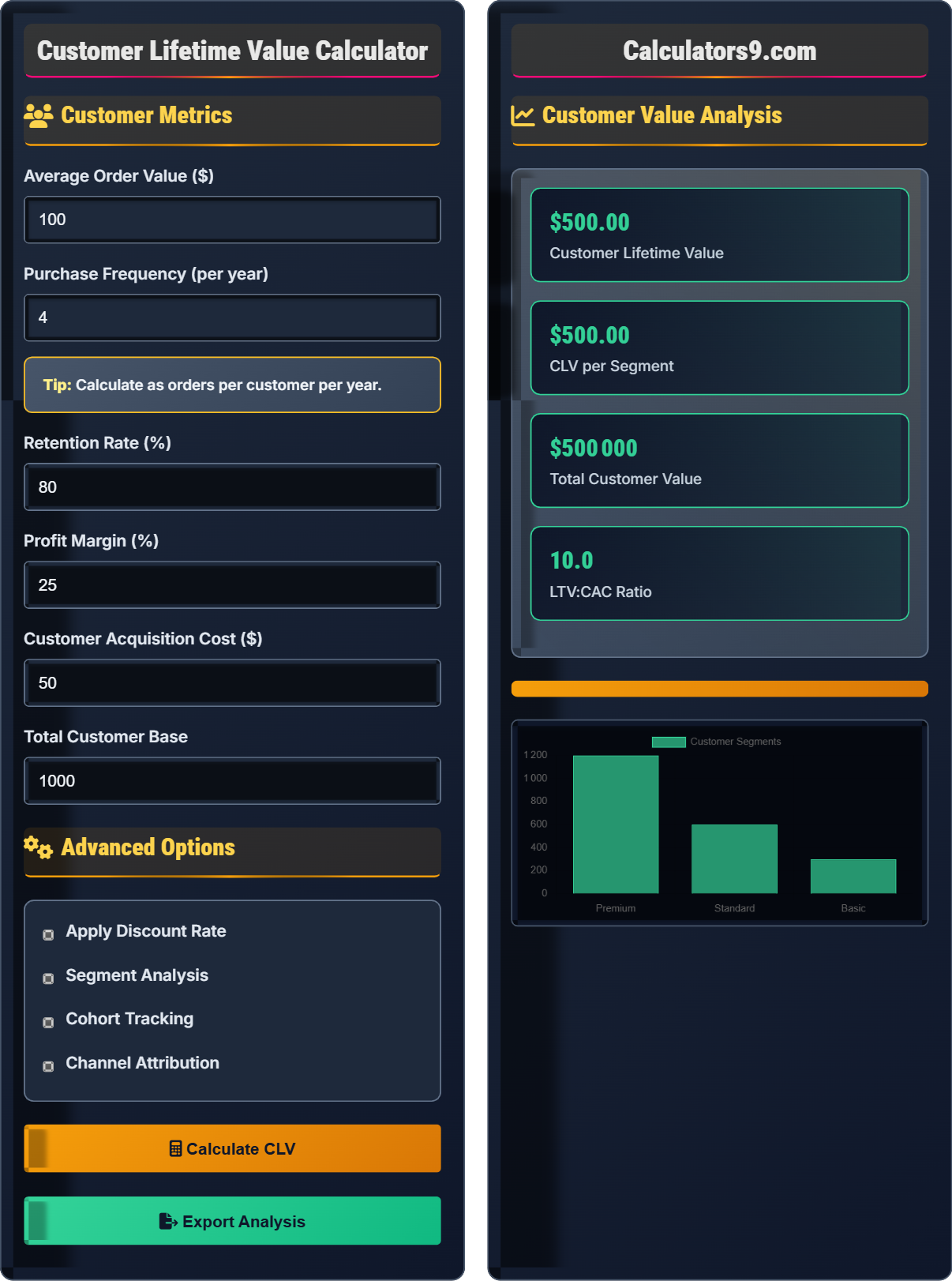
Example: For a customer with $100 average order value, 4 orders per year, 25% profit margin, and 80% retention rate:
Annual Revenue: $100 × 4 = $400
Annual Profit: $400 × 25% = $100
Churn Rate: 1 - 0.80 = 0.20
Lifetime Duration: 1 ÷ 0.20 = 5 years
CLV: $100 × 5 = $500
Therefore, the customer is worth $500 over their lifetime.
Customer Metrics
Advanced Options
Customer Value Analysis
| Metric | Value | Impact | Optimization |
|---|
Optimization Strategies
Comprehensive Customer Lifetime Value Guide
Customer Lifetime Value (CLV) is the total profit a business can expect to earn from a single customer over the entire duration of their relationship. It's a critical metric for understanding customer profitability and making informed decisions about marketing spend, customer acquisition, and retention strategies.
The standard CLV calculation uses the following formula:
Where:
- \( \text{Average Order Value} = \frac{\text{Total Revenue}}{\text{Number of Orders}} \)
- \( \text{Purchase Frequency} = \frac{\text{Number of Orders}}{\text{Number of Customers}} \)
- \( \text{Retention Rate} = \frac{\text{Customers Retained}}{\text{Total Customers}} \)
- \( \text{Profit Margin} = \frac{\text{Revenue} - \text{Cost}}{\text{Revenue}} \)
Customer Lifetime Value has several key applications:
- Marketing Budget: Determine how much to spend on customer acquisition
- Retention Programs: Justify investments in customer loyalty initiatives
- Segmentation: Identify most valuable customer segments
- Pricing Strategy: Understand value of premium offerings
- Resource Allocation: Optimize investments across customer touchpoints
- Track Cohorts: Monitor CLV by acquisition period to identify trends
- Segment Analysis: Calculate CLV by customer segments for targeted strategies
- Focus on Retention: Improving retention has exponential impact on CLV
- Measure CAC: Compare customer acquisition cost to CLV for profitability
- Update Regularly: Recalculate as business metrics change
CLV Basics
Total profit expected from a customer over their entire relationship.
\( \text{CLV} = \frac{\text{AOV} \times \text{PF} \times \text{PM}}{1 - \text{RR}} \)
Where AOV = Average Order Value, PF = Purchase Frequency, PM = Profit Margin, RR = Retention Rate.
- Higher retention rate = higher CLV
- Increasing AOV has multiplicative effect
- LTV:CAC ratio should be >3:1
Optimization Strategies
Customer Lifetime Value to Customer Acquisition Cost ratio.
- Increase average order value
- Boost purchase frequency
- Improve customer retention
- Enhance profit margins
- Seasonal variations affect metrics
- Discount rates impact long-term value
- Customer segments have different CLVs
- Market conditions affect behavior patterns
Customer Lifetime Value Learning Quiz
Which of the following is NOT a direct component of the basic CLV formula?
The answer is C) Customer Acquisition Cost. While CAC is important for understanding customer profitability and the LTV:CAC ratio, it's not a direct component of the basic CLV formula. The basic CLV formula includes Average Order Value, Purchase Frequency, Profit Margin, and Retention Rate.
This question tests the distinction between CLV calculation and profitability analysis. The CLV formula calculates the total value a customer will bring over their lifetime. CAC is used separately to determine the return on investment for acquiring customers. However, the LTV:CAC ratio is crucial for determining marketing effectiveness.
CLV: Customer Lifetime Value - total value over relationship
CAC: Customer Acquisition Cost - cost to acquire customer
LTV:CAC Ratio: Lifetime Value to Acquisition Cost ratio
• CLV = AOV × PF × PM ÷ (1-RR)
• CAC is separate from CLV calculation
• LTV:CAC ratio should be >3:1 for profitability
• Calculate CLV for different customer segments
• Track CLV:CAC ratio monthly
• Focus on retention improvements for maximum impact
• Including CAC in CLV calculation
• Not segmenting customers by value
• Forgetting to update metrics regularly
Calculate the CLV for a customer with $120 average order value, 6 purchases per year, 30% profit margin, and 85% retention rate. Show your work.
Step 1: Calculate annual revenue per customer = AOV × Purchase Frequency
Annual Revenue = $120 × 6 = $720
Step 2: Calculate annual profit per customer = Annual Revenue × Profit Margin
Annual Profit = $720 × 0.30 = $216
Step 3: Calculate lifetime duration = 1 ÷ Churn Rate
Churn Rate = 1 - Retention Rate = 1 - 0.85 = 0.15
Lifetime Duration = 1 ÷ 0.15 = 6.67 years
Step 4: Calculate CLV = Annual Profit × Lifetime Duration
CLV = $216 × 6.67 = $1,440
Alternatively, using the direct formula:
CLV = (AOV × PF × PM) ÷ (1 - RR) = ($120 × 6 × 0.30) ÷ (1 - 0.85) = $216 ÷ 0.15 = $1,440
Therefore, the customer lifetime value is $1,440.
This calculation demonstrates the relationship between the different components of CLV. The high retention rate (85%) significantly extends the customer's lifetime, multiplying the annual profit. The 85% retention rate means customers stay with the company for approximately 6.67 years on average, creating substantial value over time.
AOV: Average Order Value
PF: Purchase Frequency
PM: Profit Margin
RR: Retention Rate
• CLV = (AOV × PF × PM) ÷ (1 - RR)
• Higher retention rates exponentially increase CLV
• Small changes in retention have large CLV impacts
• Focus on improving retention for maximum impact
• Calculate CLV monthly to track trends
• Compare CLV across different channels
• Using churn rate instead of retention rate in denominator
• Forgetting to convert percentages to decimals
• Not accounting for profit margins
A company has a CLV of $1,200 and spends $200 to acquire each customer. What is their LTV:CAC ratio, and what does this indicate about their marketing efficiency? Is this ratio considered healthy?
Step 1: Calculate LTV:CAC ratio = CLV ÷ CAC
LTV:CAC = $1,200 ÷ $200 = 6:1
Step 2: Interpret the ratio
An LTV:CAC ratio of 6:1 indicates excellent marketing efficiency. For every $1 spent acquiring a customer, the company earns $6 in lifetime value.
Step 3: Evaluate health of ratio
Industry benchmarks:
• Below 3:1 = Unprofitable (CAC > 1/3 of LTV)
• 3:1 to 5:1 = Healthy (good return on acquisition)
• Above 5:1 = Excellent (very profitable acquisition)
Therefore, the 6:1 ratio is excellent and indicates the company is efficiently acquiring profitable customers.
The LTV:CAC ratio is crucial for evaluating marketing efficiency. A 6:1 ratio means the company is generating 6 times more value than it costs to acquire customers. This provides a healthy margin for marketing investments and indicates the business model is sustainable. The ratio helps determine how much can be spent on acquisition while maintaining profitability.
LTV:CAC: Lifetime Value to Customer Acquisition Cost ratio
Marketing Efficiency: How effectively acquisition spend generates returns
Profitability Threshold: Minimum ratio needed for profitability
• LTV:CAC = Customer Lifetime Value ÷ Customer Acquisition Cost
• Healthy ratio is 3:1 or higher
• Higher ratios indicate better efficiency
• Aim for 3:1 ratio as minimum threshold
• Target 5:1+ for excellent efficiency
• Calculate ratios by acquisition channel
• Not calculating LTV:CAC ratio regularly
• Accepting ratios below 3:1 without improvement plans
• Not segmenting by acquisition channel
A company currently has a 75% retention rate with a CLV of $400. If they can improve their retention rate to 85%, how much will their CLV increase? Calculate the percentage improvement in CLV.
Current situation:
Retention Rate = 75% = 0.75
Churn Rate = 1 - 0.75 = 0.25
Current CLV = $400
New situation:
Retention Rate = 85% = 0.85
Churn Rate = 1 - 0.85 = 0.15
Using the relationship: CLV ∝ 1/(1-RR)
Current: CLV = X ÷ (1 - 0.75) = X ÷ 0.25
New: New CLV = X ÷ (1 - 0.85) = X ÷ 0.15
Since X ÷ 0.25 = $400, then X = $400 × 0.25 = $100
New CLV = $100 ÷ 0.15 = $666.67
CLV Increase = $666.67 - $400 = $266.67
Percentage Improvement = ($266.67 ÷ $400) × 100 = 66.67%
Therefore, improving retention from 75% to 85% increases CLV by $266.67, representing a 66.67% improvement.
This problem demonstrates the exponential impact of retention on CLV. The improvement from 75% to 85% retention (a 10 percentage point increase) results in a 66.67% increase in CLV. This shows why retention is so crucial - small improvements in retention rates have disproportionately large impacts on customer value. The mathematical relationship shows that as retention approaches 100%, CLV approaches infinity.
Retention Impact: Effect of retention rate changes on CLV
Exponential Relationship: Non-linear effect of retention on CLV
Retention Leverage: Magnified impact of small retention improvements
• CLV increases exponentially with retention
• Small retention improvements have large CLV impacts
• Focus on retention for maximum efficiency
• Prioritize retention over acquisition for mature customers
• Measure retention by cohort and segment
• Invest in customer success programs
• Underestimating the exponential impact of retention
• Focusing only on acquisition, not retention
• Not calculating retention by customer segment
Which of the following strategies would have the GREATEST impact on increasing Customer Lifetime Value?
The answer is C) Improving retention rate by 5 percentage points. The retention rate has an exponential impact on CLV because it affects the denominator of the CLV formula (1 - retention rate). Small improvements in retention rate can dramatically extend customer lifetime and multiply the value calculation. This is why retention-focused strategies typically have the highest ROI.
This question highlights the different impacts of various CLV components. While AOV, purchase frequency, and profit margin have linear impacts on CLV, retention rate has an exponential impact. A 5% improvement in retention rate can double or triple the customer lifetime value, while the other metrics have more proportional effects. This is why retention is often the most valuable focus for CLV optimization.
Linear Impact: Proportional effect on CLV
Exponential Impact: Multiplicative effect on CLV
Retention Leverage: High impact of retention improvements
• Retention has exponential impact on CLV
• Other metrics have linear impacts
• Small retention improvements = large CLV gains
• Focus on retention for maximum CLV impact
• Implement customer success programs
• Track churn reasons and address them
• Not recognizing the exponential impact of retention
• Focusing on AOV improvements over retention
• Undervaluing customer retention initiatives
FAQ
Q: How do I calculate CLV for a subscription business?
A: For subscription businesses, use the simplified CLV formula:
\( \text{CLV} = \frac{\text{Monthly Recurring Revenue (MRR)} \times \text{Gross Margin}}{\text{Monthly Churn Rate}} \)
For example, if your MRR per customer is $50, gross margin is 80%, and monthly churn rate is 5%:
CLV = ($50 × 0.80) ÷ 0.05 = $40 ÷ 0.05 = $800
This approach works well for subscription models because revenue is predictable and churn can be measured monthly. The key is to track monthly churn rate accurately, as this directly affects the customer lifetime calculation.
Alternatively: \( \text{CLV} = \text{Average Revenue per User} \times \text{Gross Margin} \times \text{Average Customer Lifespan} \)
Q: What's the difference between CLV and LTV?
A: CLV (Customer Lifetime Value) and LTV (Lifetime Value) are often used interchangeably, but there are subtle differences:
CLV (Customer Lifetime Value):
- Focuses specifically on individual customer value
- Calculates profit over customer relationship
- Used for customer acquisition and retention decisions
LTV (Lifetime Value):
- Broadly encompasses customer, product, or business lifetime value
- May include multiple revenue streams
- Often used in investment and valuation contexts
In practice, both terms typically refer to the same concept: the total value a customer brings to your business over their entire relationship. The important thing is to use the metric consistently within your organization.