Depreciation Schedule Calculator
Asset value tracking • 2026 best practices
Depreciation Methods:
Show the calculatorStraight-Line: \( \text{Annual Depreciation} = \frac{\text{Cost} - \text{Salvage Value}}{\text{Useful Life}} \)
Declining Balance: \( \text{Annual Depreciation} = \text{Book Value} \times \text{Rate} \)
Sum-of-Years Digits: \( \text{Annual Depreciation} = \frac{\text{Remaining Life}}{\text{Sum of Years}} \times (\text{Cost} - \text{Salvage Value}) \)
Where:
- \( \text{Cost} \) = Initial cost of the asset
- \( \text{Salvage Value} \) = Expected residual value at end of useful life
- \( \text{Useful Life} \) = Expected years of productive use
- \( \text{Book Value} \) = Asset cost minus accumulated depreciation
Depreciation allocates the cost of tangible assets over their useful lives. Straight-line provides consistent annual expense, declining balance front-loads depreciation, and sum-of-years digits accelerates depreciation. Tax and book depreciation may differ based on regulations.
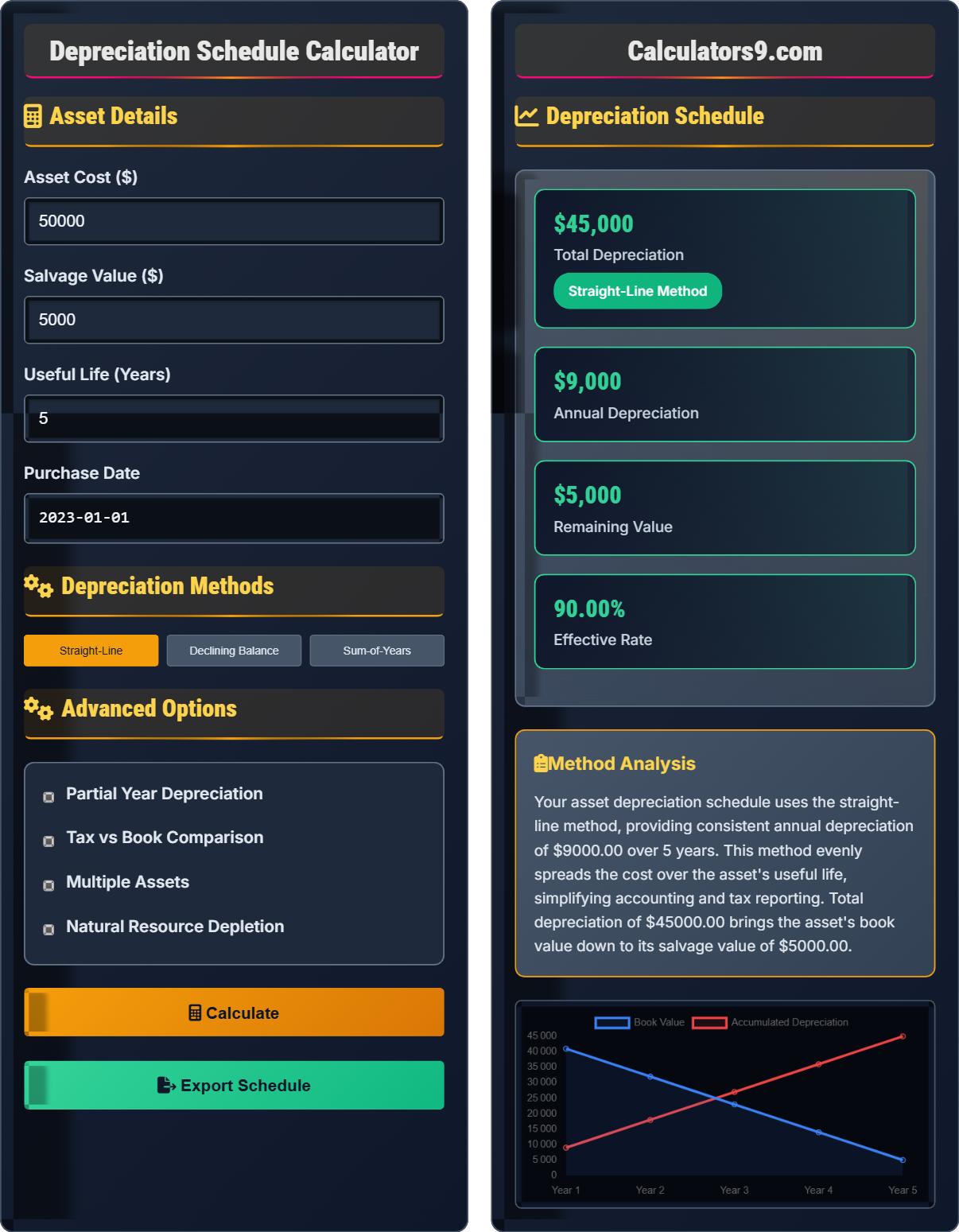
Example: For an asset costing $50,000 with $5,000 salvage value and 5-year useful life:
Straight-Line Annual Depreciation = ($50,000 - $5,000) ÷ 5 = $9,000 per year
This method provides consistent annual depreciation expense of $9,000 over the asset's 5-year life.
Asset Details
Depreciation Methods
Advanced Options
Depreciation Schedule
| Year | Opening Value | Depreciation | Accumulated | Closing Value |
|---|
| Method | Year 1 | Year 2 | Year 3 | Year 4 | Year 5 |
|---|
Comprehensive Depreciation Guide
Depreciation is the systematic allocation of an asset's cost over its useful life. It represents the decline in value due to wear and tear, obsolescence, or passage of time. Depreciation is a non-cash expense that reduces taxable income and matches expenses with revenues generated by the asset. It applies to tangible assets like buildings, equipment, and vehicles.
Three primary methods for calculating depreciation:
Declining Balance: Accelerated depreciation
Sum-of-Years Digits: Front-loaded depreciation
Each method affects financial statements differently and may be preferred for tax or book accounting purposes.
Important factors in depreciation accounting:
- Asset Cost: Includes purchase price and preparation costs
- Salvage Value: Estimated residual value at end of useful life
- Useful Life: Expected years of productive use
- Method Selection: Based on asset usage pattern
- Consistency: Apply same method to similar assets
- Documentation: Maintain detailed depreciation schedules
- Reviews: Update estimates annually
- Tax Planning: Consider MACRS for tax purposes
- Financial Reporting: Follow GAAP guidelines
Depreciation Basics
Systematic allocation of asset cost over useful life.
Straight-line, declining balance, sum-of-years digits.
Each method spreads cost differently over asset life.
- Depreciation stops at salvage value
- Methods must be applied consistently
- Estimates should be reviewed annually
Method Selection
Straight-line for even usage, declining for rapid value loss.
- Asset usage pattern
- Tax implications
- Financial reporting needs
- Asset type
- Match expenses with revenues
- Consider tax planning
- Follow accounting standards
- Update estimates regularly
Depreciation Learning Quiz
Which depreciation method results in the highest depreciation expense in the first year?
The answer is B) Declining balance method. The declining balance method applies a constant rate to the asset's book value, which is highest in the first year. This results in the highest depreciation expense in the first year, with decreasing amounts in subsequent years. For example, using double-declining balance (200%), the first-year rate is twice the straight-line rate.
Students should understand that depreciation methods affect the timing of expense recognition. The declining balance method front-loads depreciation, which can provide tax advantages in early years. The straight-line method provides consistent annual expenses, while sum-of-years digits offers moderate acceleration. This knowledge helps in selecting appropriate methods for different asset types.
Depreciation Method: Approach for allocating asset cost over useful life
Front-Loading: Recognizing higher expenses in early years
Book Value: Asset cost minus accumulated depreciation
• Declining balance = highest first-year expense
• Methods must be applied consistently
• Total depreciation equals cost minus salvage value
• Remember: Declining balance accelerates depreciation
• Straight-line provides consistent expense
• Sum-of-years digits is moderately accelerated
• Assuming all methods produce equal annual expenses
• Confusing book and tax depreciation methods
• Not understanding acceleration patterns
Calculate the annual depreciation expense for a machine that costs $75,000, has a salvage value of $5,000, and a useful life of 7 years using the straight-line method. Show your work.
Step 1: Apply the straight-line formula
Annual Depreciation = (Cost - Salvage Value) ÷ Useful Life
Annual Depreciation = ($75,000 - $5,000) ÷ 7
Annual Depreciation = $70,000 ÷ 7 = $10,000
Step 2: Calculate total depreciation over life
Total Depreciation = $10,000 × 7 = $70,000
Step 3: Verify ending book value
Ending Book Value = $75,000 - $70,000 = $5,000 (equals salvage value)
Therefore, the annual depreciation expense is $10,000.
This calculation demonstrates the simplicity of the straight-line method. The formula evenly distributes the depreciable amount ($70,000) over the asset's useful life (7 years). Students should note that the book value decreases by exactly the annual depreciation amount each year, reaching the salvage value at the end of the useful life. This method is commonly used for assets with consistent usage patterns.
Depreciable Amount: Cost minus salvage value
Book Value: Carrying value of asset on balance sheet
Straight-Line Method: Equal annual depreciation expense• Annual Depreciation = (Cost - Salvage) ÷ Life
• Total depreciation = Cost - Salvage value
• Book value reaches salvage value at end
• Remember: Cost - Salvage = Total Depreciation
• Divide by useful life for annual amount
• Verify book value reaches salvage value
• Forgetting to subtract salvage value
• Using book value instead of cost in denominator
• Not verifying final book value
A company purchases equipment for $40,000 with a 5-year useful life and $4,000 salvage value. Calculate the depreciation expense for the first two years using the double-declining balance method. What is the book value at the end of year 2?
Step 1: Calculate straight-line rate
Straight-line rate = 1 ÷ 5 = 20%
Step 2: Calculate double-declining rate
Double-declining rate = 20% × 2 = 40%
Step 3: Calculate Year 1 depreciation
Year 1 Depreciation = $40,000 × 40% = $16,000
Year 1 Book Value = $40,000 - $16,000 = $24,000
Step 4: Calculate Year 2 depreciation
Year 2 Depreciation = $24,000 × 40% = $9,600
Year 2 Book Value = $24,000 - $9,600 = $14,400
Therefore, Year 1 depreciation is $16,000, Year 2 depreciation is $9,600, and the book value at the end of year 2 is $14,400.
This problem demonstrates the accelerating nature of declining balance depreciation. The key insight is that the rate (40%) is applied to the book value each year, which decreases annually. This creates a compounding effect where depreciation amounts decrease each year. Students should note that the book value continues to decline but never goes below the salvage value.
Double-Declining Balance: Accelerated depreciation at 200% of straight-line rate
Book Value: Asset cost minus accumulated depreciation
Accelerated Depreciation: Higher expense in early years
• DB Rate = SL Rate × Multiplier (usually 2)
• Apply rate to current book value
• Stop depreciating at salvage value
• Calculate straight-line rate first
• Multiply by 2 for double-declining
• Apply to book value each year
• Applying rate to original cost each year
• Forgetting to stop at salvage value
• Miscalculating the double rate
A company purchases a delivery truck for $60,000 with a 5-year useful life and $10,000 salvage value. The truck will be used intensively in the first few years but less in later years. Which depreciation method would be most appropriate and why? Calculate the first year depreciation for each method.
Most appropriate method: Double-declining balance or sum-of-years digits, as they match the usage pattern.
Calculations:
Straight-line: ($60,000 - $10,000) ÷ 5 = $10,000
Double-declining: Rate = 2 ÷ 5 = 40%; $60,000 × 40% = $24,000
Sum-of-years digits: Sum = 1+2+3+4+5 = 15; Year 1 = 5/15 × $50,000 = $16,667
The double-declining balance method ($24,000) best matches the intensive first-year usage pattern, recognizing higher depreciation when the asset is used most heavily.
This problem illustrates the principle of matching expenses with revenues. When an asset is used more intensively in early years, accelerated depreciation methods better reflect the actual consumption of the asset's utility. The double-declining balance method provides the highest first-year expense, which aligns with the intensive usage pattern described. This selection ensures accurate matching of depreciation expense with the revenue-generating capacity of the asset.
Matching Principle: Matching expenses with related revenues
Utility Consumption: How quickly an asset's benefits are used
Expense Recognition: Timing of recording depreciation expense
• Match method to asset usage pattern
• Consider tax implications
• Follow consistency requirements
• Analyze asset usage patterns
• Consider tax planning benefits
• Evaluate financial statement impact
• Using straight-line regardless of usage pattern
• Not considering tax implications
• Changing methods inappropriately
For an asset with a 4-year useful life, what fraction would be used to calculate depreciation in the second year using the sum-of-years digits method?
The answer is B) 3/10. In sum-of-years digits method, the sum of years = 1+2+3+4 = 10. The remaining life in year 2 is 3 years (years 3, 4, and the remaining part of year 4). The fraction is 3/10. The pattern is: Year 1 = 4/10, Year 2 = 3/10, Year 3 = 2/10, Year 4 = 1/10.
Students must understand that the sum-of-years digits method uses the remaining useful life as the numerator. The denominator is always the sum of all years in the asset's life. In a 4-year life, the sum is 1+2+3+4=10. The remaining life decreases each year: 4 years in year 1, 3 years in year 2, 2 years in year 3, and 1 year in year 4. This creates a declining fraction that accelerates depreciation.
Sum-of-Years Digits: Accelerated method using remaining life fraction
Remaining Life: Years of useful life remaining at start of year
Accelerated Depreciation: Higher expense in early years
• Fraction = Remaining Life ÷ Sum of Years
• Remaining life decreases annually
• Sum = 1+2+...+n where n=useful life
• Calculate sum first: n(n+1)/2
• Remaining life = Total life - Years passed
• Numerator decreases each year
• Using years passed instead of remaining life
• Miscalculating the sum of years
• Reversing numerator and denominator
FAQ
Q: What's the difference between book and tax depreciation?
A: Book depreciation follows GAAP principles for financial reporting, while tax depreciation follows IRS guidelines for tax purposes. Differences include:
For example, book accounting might use straight-line over 10 years, while tax accounting uses MACRS over 7 years:
Book: \( \text{Annual Depreciation} = \frac{\text{Cost} - \text{Salvage}}{10} \)
Tax: Uses predetermined MACRS percentages over 7 years
This creates temporary differences that reverse over time, affecting deferred tax assets/liabilities. Companies must track both calculations separately.
Q: When should I switch from declining balance to straight-line?
A: Switch when straight-line depreciation would exceed declining balance depreciation. This occurs when the remaining book value approaches the salvage value.
Mathematically, switch when:
\( \frac{\text{Book Value} - \text{Salvage Value}}{\text{Remaining Life}} > \text{Book Value} \times \text{DB Rate} \)
For example, with a $10,000 asset, $1,000 salvage value, 5-year life:
- Continue declining balance while DB amount is higher
- Switch to straight-line when SL becomes greater
- This optimizes the depreciation benefit
This hybrid approach maximizes early-year deductions while ensuring proper depreciation to salvage value.