Discount Pricing Calculator
Savings & profit analysis • 2026 best practices
Discount Pricing Formulas:
Show the calculatorDiscount Amount: \( \text{Discount} = \text{Original Price} \times \frac{\text{Discount \%}}{100} \)
Discounted Price: \( \text{Discounted Price} = \text{Original Price} - \text{Discount} \)
Savings Percentage: \( \text{Savings \%} = \frac{\text{Discount}}{\text{Original Price}} \times 100 \)
Profit Impact: \( \text{New Profit} = \text{Discounted Price} - \text{Cost} \)
Where:
- \( \text{Original Price} \) = Price before discount
- \( \text{Discount \%} \) = Percentage discount offered
- \( \text{Discount} \) = Amount of discount
- \( \text{Discounted Price} \) = Price after discount
- \( \text{Cost} \) = Product cost or manufacturing cost
Discount pricing strategies help boost sales volume while managing profit margins. Understanding the relationship between discount percentage and profit impact is crucial for effective pricing. Deep discounts can increase volume but may reduce overall profitability if not managed properly.
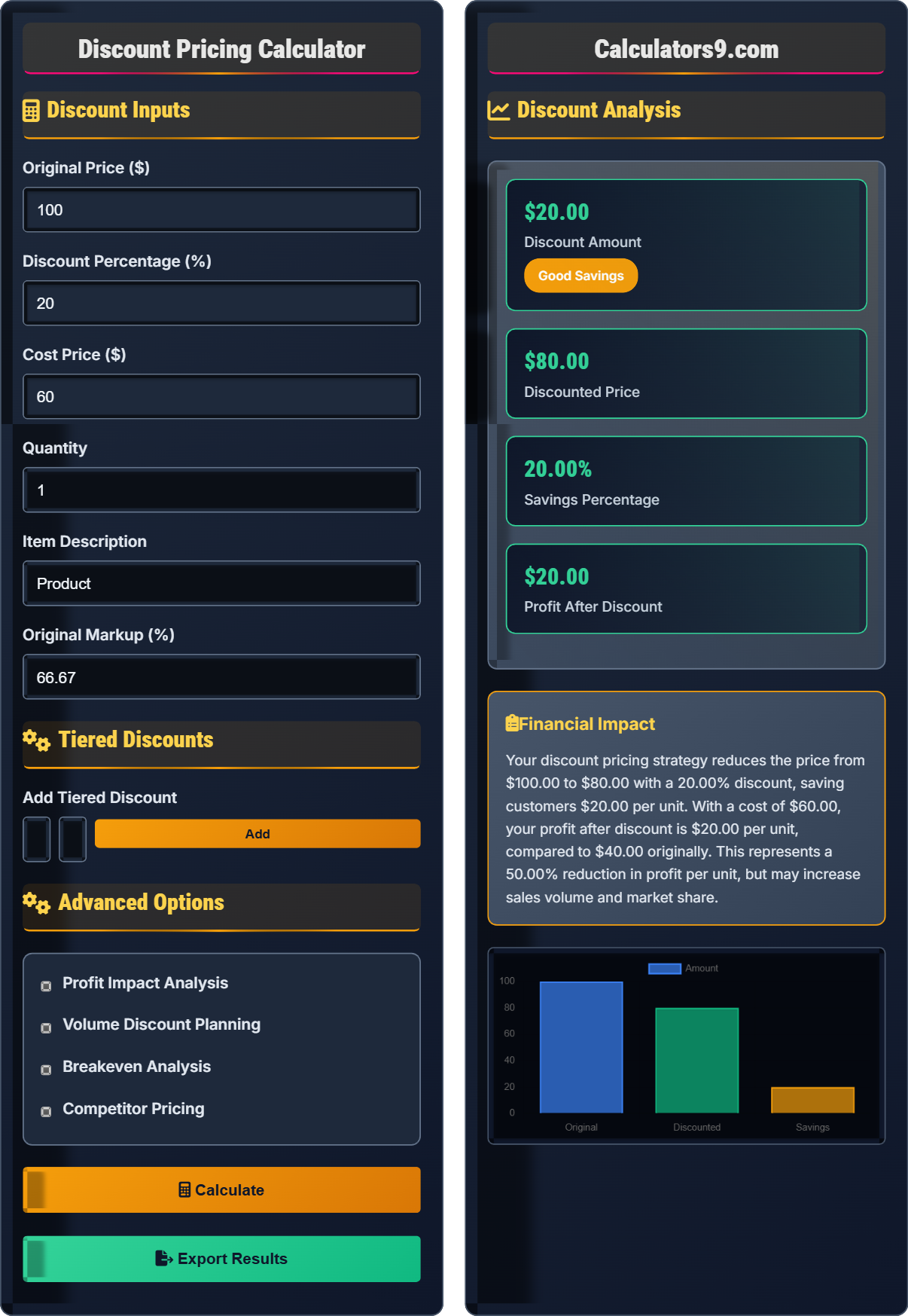
Example: For a $100 item with 20% discount:
Discount Amount = $100 × 0.20 = $20
Discounted Price = $100 - $20 = $80
Savings Percentage = ($20 ÷ $100) × 100 = 20%
This shows the straightforward calculation of discount pricing.
Discount Inputs
Tiered Discounts
Advanced Options
Discount Analysis
| Item | Original | Discounted | Difference |
|---|
| Metric | Before Discount | After Discount | Change |
|---|
Comprehensive Discount Pricing Guide
Discount pricing is a strategy where businesses reduce the original price of products or services to attract customers, increase sales volume, and gain market share. Discounts can be percentage-based, fixed dollar amounts, or conditional (buy-one-get-one). Effective discount pricing balances revenue generation with volume increases while maintaining acceptable profit margins.
Key formulas for discount pricing calculations:
Discounted Price = Original Price - Discount Amount
Savings % = (Discount Amount ÷ Original Price) × 100
New Profit = Discounted Price - Cost
These formulas help evaluate the financial impact of discount strategies.
Effects of discounts on business metrics:
- Revenue: May decrease per unit but increase overall with higher volume
- Profit Margins: Typically decrease but can be offset by increased volume
- Market Share: Often increases as discounts attract more customers
- Customer Loyalty: Can improve with perceived value and savings
- Inventory Turnover: Usually improves with discount promotions
- Calculate breakeven volumes to maintain profitability
- Limit discount duration to prevent expectation of constant deals
- Track profit margins during discount periods
- Segment customers for targeted discount offers
- Communicate value beyond just the discount
Discount Fundamentals
Reducing original price to increase sales volume and market share.
Discount Amount = Original Price × (Discount % ÷ 100)
Discounted Price = Original Price - Discount Amount
- Calculate breakeven volume for discounts
- Maintain minimum profit margins
- Limit discount duration appropriately
Profit Analysis
Discount reduces profit per unit but may increase total profit through volume.
- Calculate profit before discount
- Calculate profit after discount
- Determine breakeven volume increase
- Assess market demand potential
- Deep discounts can erode brand value
- Volume increases may offset margin decreases
- Consider competitor responses
- Factor in inventory and storage costs
Discount Pricing Learning Quiz
What happens to profit per unit when a discount is applied to a product?
The answer is B) Profit per unit always decreases. When a discount is applied, the selling price decreases while the cost remains the same, resulting in lower profit per unit. The formula is: New Profit = Discounted Price - Cost. Since Discounted Price is always less than Original Price (when discount > 0), profit per unit decreases.
Students must understand the direct relationship between discount and profit per unit. Since cost remains constant while selling price decreases, profit per unit necessarily decreases. However, total profit may still increase if volume increases sufficiently to offset the lower profit per unit.
Discount: Reduction in original selling price
Profit Per Unit: Revenue minus cost per item
Volume Effect: Impact of increased sales on total profit
• Profit per unit = Selling Price - Cost
• Discount reduces selling price
• Cost typically remains unchanged
• Calculate profit per unit before and after discount
• Consider volume effects on total profit
• Assess breakeven volume requirements
• Assuming discounts can increase profit per unit
• Forgetting to account for volume effects
• Not calculating breakeven volumes
Calculate the discounted price and savings for a $150 item with a 25% discount. Show your work.
Step 1: Calculate discount amount
Discount Amount = Original Price × (Discount % ÷ 100)
Discount Amount = $150 × (25 ÷ 100) = $150 × 0.25 = $37.50
Step 2: Calculate discounted price
Discounted Price = Original Price - Discount Amount
Discounted Price = $150 - $37.50 = $112.50
Step 3: Verify savings percentage
Savings % = (Discount Amount ÷ Original Price) × 100
Savings % = ($37.50 ÷ $150) × 100 = 25%
Therefore, the discounted price is $112.50 with savings of $37.50.
This calculation demonstrates the fundamental discount pricing formulas. The discount amount is calculated by multiplying the original price by the discount percentage (expressed as a decimal). The discounted price is simply the original price minus the discount amount. Verification ensures the calculations are correct.
Discount Amount: Dollar value of reduction
Discounted Price: Price after discount applied
Savings: Amount customers save
• Discount = Original × (Rate ÷ 100)
• Discounted Price = Original - Discount
• Always verify calculations
• Convert percentage to decimal
• Calculate discount first
• Verify with savings percentage
• Not converting percentage to decimal
• Adding instead of subtracting discount
• Incorrect arithmetic
A retailer sells a product for $80 with a cost of $50. They offer a 15% discount for purchases of 5+ units. If they normally sell 100 units per month, how many units would they need to sell at the discounted price to maintain the same total profit?
Step 1: Calculate original profit per unit
Original Profit per Unit = $80 - $50 = $30
Step 2: Calculate original total profit
Original Total Profit = $30 × 100 = $3,000
Step 3: Calculate discounted price
Discount Amount = $80 × 0.15 = $12
Discounted Price = $80 - $12 = $68
Step 4: Calculate profit per unit after discount
Discounted Profit per Unit = $68 - $50 = $18
Step 5: Calculate required volume to maintain profit
Required Volume = Original Total Profit ÷ Discounted Profit per Unit
Required Volume = $3,000 ÷ $18 = 166.67 units
Step 6: Round up to whole units
Required Volume = 167 units
Therefore, they need to sell 167 units at the discounted price to maintain the same total profit.
This problem demonstrates the volume effect of discounts. While profit per unit decreases from $30 to $18 (a 40% reduction), the retailer needs to increase volume by 67% (from 100 to 167) to maintain the same total profit. This illustrates why understanding breakeven volume is crucial for discount planning.
Volume Effect: Impact of sales quantity on total profit
Breakeven Volume: Units needed to maintain profit level
Profit Per Unit: Revenue minus cost per item
• Total Profit = Profit per Unit × Quantity
• Breakeven Volume = Original Profit ÷ New Profit per Unit
• Discount reduces profit per unit
• Calculate profit per unit before and after
• Use breakeven formula for volume
• Round up to ensure target is met
• Forgetting to calculate new profit per unit
• Not considering volume effects
• Incorrect division in breakeven calculation
A company has a product with $100 original price, $60 cost, and 30% original markup. They plan a 20% discount for a promotional campaign. The campaign is expected to increase sales volume by 40%. Calculate the impact on total profit and determine if the promotion is financially beneficial.
Original Scenario (per unit):
• Original Profit = $100 - $60 = $40
• Original Markup = ($40 ÷ $60) × 100 = 66.67%
Discounted Scenario (per unit):
• Discount Amount = $100 × 0.20 = $20
• Discounted Price = $100 - $20 = $80
• New Profit per Unit = $80 - $60 = $20
• New Markup = ($20 ÷ $60) × 100 = 33.33%
Volume Impact (assuming original 100 units):
• Original Total Profit = $40 × 100 = $4,000
• New Volume = 100 × 1.40 = 140 units
• New Total Profit = $20 × 140 = $2,800
Conclusion:
• Total Profit Decrease = $4,000 - $2,800 = $1,200
• The promotion reduces total profit by $1,200 despite the 40% volume increase.
Therefore, the promotion is not financially beneficial from a pure profit perspective.
This problem demonstrates that volume increases don't always compensate for profit per unit decreases. Even with a 40% volume increase, the 50% reduction in profit per unit (from $40 to $20) results in lower total profit. This highlights the importance of careful analysis before implementing discount promotions.
Total Profit: Profit per unit multiplied by quantity
Volume Impact: Effect of quantity changes on total profit
Strategic Discounting: Purposeful discounting for business objectives
• Total Profit = (Selling Price - Cost) × Quantity
• Consider both unit and volume effects
• Evaluate strategic objectives beyond profit
• Calculate both unit and total profit effects
• Consider non-financial objectives
• Plan for breakeven volume requirements
• Focusing only on volume increases
• Not calculating total profit impact
• Assuming volume always compensates for margin
What is the break-even volume increase needed to maintain profit when a 25% discount is applied to a product?
The answer is B) 33.33% increase. With a 25% discount, the new price is 75% of the original price. If the original profit per unit was P, the new profit per unit is 0.75P (assuming cost remains constant relative to the new price). To maintain the same total profit, volume must increase by: (1 ÷ 0.75) - 1 = 1.3333 - 1 = 0.3333 or 33.33%.
This problem demonstrates the mathematical relationship between discount percentage and required volume increase. When profit per unit decreases by a certain percentage, volume must increase by the reciprocal relationship to maintain total profit. The formula is: Required Volume Increase = (1 ÷ (1 - Discount Rate)) - 1.
Break-even Volume: Units needed to maintain profit level
Volume Increase: Required sales growth to maintain profit
Profit Preservation: Maintaining total profit despite discounts
• Required Volume = Original Profit ÷ New Profit per Unit
• Volume Increase = (1 ÷ (1 - Discount Rate)) - 1
• Higher discounts require greater volume increases
• Use reciprocal relationship for quick estimates
• Higher discounts need exponentially higher volume increases
• Plan for realistic volume expectations
• Assuming linear relationship between discount and volume
• Not understanding reciprocal relationship
• Expecting impossible volume increases
FAQ
Q: How do I determine the right discount percentage?
A: Determining the right discount percentage involves several factors:
- Cost structure and minimum required margins
- Competitor pricing analysis
- Expected volume increase
- Brand positioning considerations
Mathematically, if your cost is \( C \) and minimum required margin is \( M \), then:
\( \text{Minimum Selling Price} = \frac{C}{1 - M} \)
For example, with \( C = \$60 \) and \( M = 20\% \):
\( \text{Minimum Selling Price} = \frac{\$60}{1 - 0.20} = \frac{\$60}{0.80} = \$75 \)
If your original price is $100, the maximum discount is: \( \frac{\$100 - \$75}{\$100} = 25\% \)
Q: How do volume discounts affect profitability?
A: Volume discounts have complex effects on profitability:
With a 10% discount on 100 units vs. 20% on 200 units:
Scenario 1: 100 units at 10% discount
- Per unit profit decreases by 10%
- Total profit = 90% of original per unit × 100 units
- Total profit = 90% of original
Scenario 2: 200 units at 20% discount
- Per unit profit decreases by 20%
- Total profit = 80% of original per unit × 200 units
- Total profit = 160% of original
Volume discounts can increase total profit despite lower margins per unit.