Freelancer Hourly Rate Calculator
Professional pricing tool • 2026 best practices
Freelancer Hourly Rate Formula:
Show the calculator\( \text{Hourly Rate} = \frac{\text{Desired Annual Income} + \text{Business Expenses} + \text{Tax Buffer}}{\text{Billable Hours}} \)
Where:
- \( \text{Desired Annual Income} \) = Your target yearly salary
- \( \text{Business Expenses} \) = Equipment, software, office, etc.
- \( \text{Tax Buffer} \) = Self-employment tax and income tax
- \( \text{Billable Hours} \) = Productive hours available for client work
Freelancers must account for all business expenses, taxes, and non-billable time when setting rates. The standard calculation assumes 2,080 hours per year (full-time) minus vacation, sick days, and business development time. A realistic billable hour estimate is typically 1,200-1,500 hours annually.
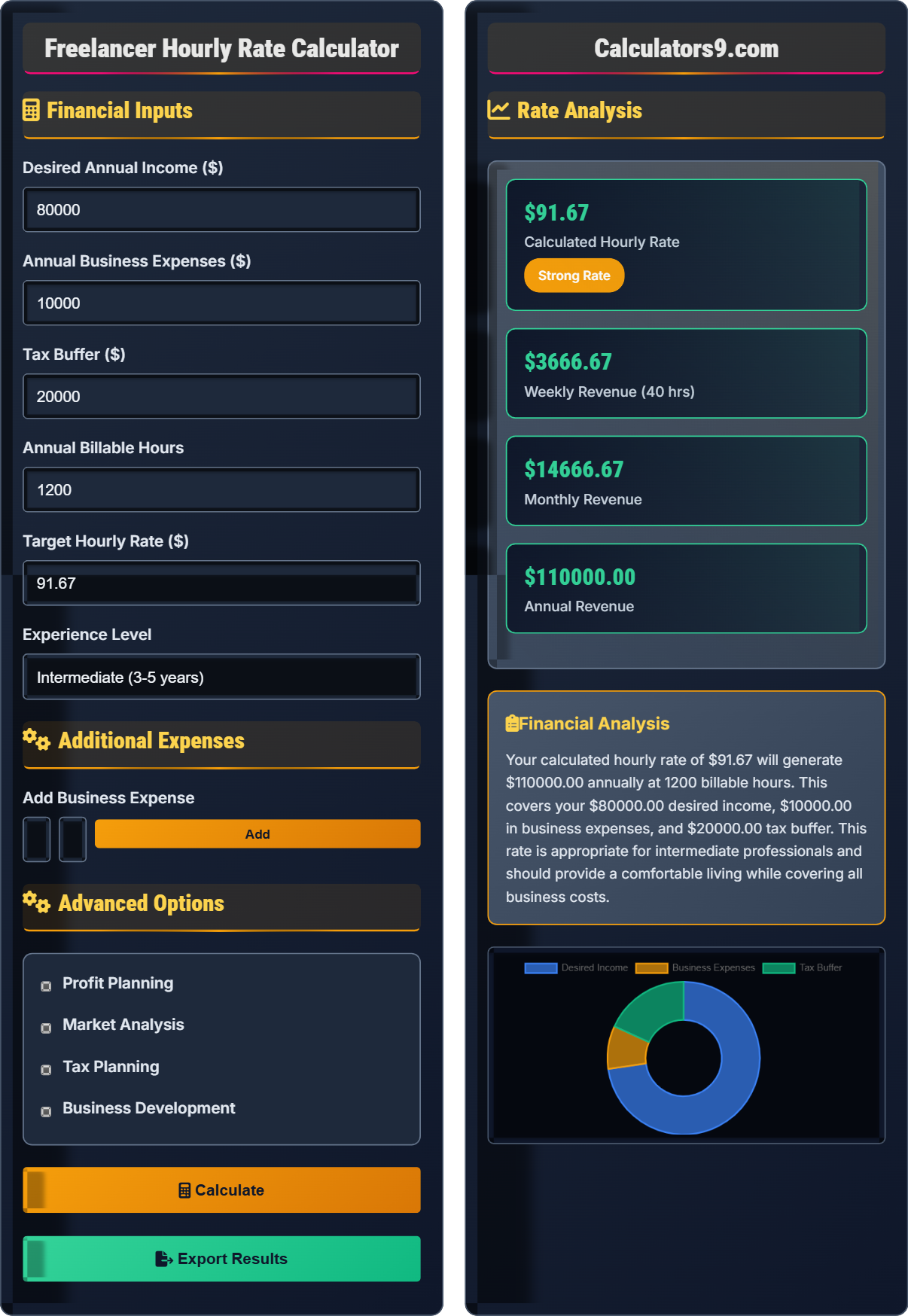
Example: For a freelancer wanting $80,000 annual income with $10,000 in expenses, $20,000 tax buffer, and 1,200 billable hours:
Hourly Rate = ($80,000 + $10,000 + $20,000) ÷ 1,200 = $91.67
This $91.67 rate ensures all costs and desired income are covered.
Financial Inputs
Additional Expenses
Advanced Options
Rate Analysis
| Category | Amount | % of Rate | Hours |
|---|
| Level | Market Rate | Your Rate | Comparison |
|---|
Comprehensive Freelancer Pricing Guide
Freelancer hourly rate is the price you charge clients per hour of work. It must cover your desired income, business expenses, taxes, and non-billable time. Setting the right rate ensures financial sustainability while remaining competitive. The rate should reflect your skills, experience, market demand, and business costs.
Key components for freelancer rate calculation:
Business Expenses: Equipment, software, office costs
Tax Buffer: Self-employment and income taxes
Billable Hours: Actual productive client hours
These components ensure your rate covers all costs and achieves your income goals.
Typical rates by experience level:
- Entry Level: $25-50/hour (0-2 years)
- Intermediate: $50-100/hour (3-5 years)
- Senior: $100-150/hour (6-10 years)
- Expert: $150+/hour (10+ years)
- Review rates annually to account for experience and inflation
- Track actual vs. projected hours to refine estimates
- Consider project-based pricing for certain engagements
- Build rate increases into contracts for long-term projects
- Justify rates with value delivered rather than time spent
Rate Fundamentals
Price per hour that covers income, expenses, taxes, and non-billable time.
Hourly Rate = (Desired Income + Expenses + Tax Buffer) ÷ Billable Hours
Ensures all costs and desired income are covered.
- Include all business costs in calculation
- Account for non-billable time
- Research market rates
Rate Analysis
Above $100 = Premium, $75-100 = Strong, $50-75 = Moderate, Below $50 = Entry level.
- Develop specialized skills
- Build portfolio of successes
- Focus on high-value services
- Specialize in niche markets
- Geographic market differences
- Industry-specific rates
- Client budget constraints
- Value delivered vs. time spent
Freelancer Rate Learning Quiz
Which of the following should NOT be included in freelancer hourly rate calculations?
The answer is C) Personal living expenses. The freelancer hourly rate should only include business-related costs. Personal living expenses (housing, food, entertainment, etc.) should be covered by the desired annual income component. The rate calculation focuses on business sustainability and professional compensation.
Students must understand that freelancer rates cover business costs and desired income, not personal lifestyle expenses. The rate calculation separates business from personal finances. Personal expenses should be factored into the desired annual income component, not added separately to the hourly rate.
Business Expenses: Costs related to providing services
Desired Income: Target annual compensation
Tax Buffer: Amount for self-employment and income taxes
• Include only business-related costs
• Personal expenses go in desired income
• Cover all business costs in rate
• Separate business and personal expenses
• Include equipment and software costs
• Account for non-billable time
• Including personal living expenses in rate
• Forgetting to account for taxes
• Not considering non-billable time
Calculate the hourly rate for a freelancer who wants $75,000 annual income, has $8,000 in business expenses, $18,000 tax buffer, and expects 1,250 billable hours. Show your work.
Step 1: Calculate total amount needed
Total = Desired Income + Business Expenses + Tax Buffer
Total = $75,000 + $8,000 + $18,000 = $101,000
Step 2: Calculate hourly rate
Hourly Rate = Total ÷ Billable Hours
Hourly Rate = $101,000 ÷ 1,250 = $80.80
Step 3: Verify calculation
Revenue at rate = $80.80 × 1,250 = $101,000
This covers desired income, expenses, and tax buffer.
Therefore, the hourly rate should be $80.80.
This calculation demonstrates the fundamental rate formula. The freelancer needs $101,000 total to cover their desired income ($75,000), business expenses ($8,000), and tax buffer ($18,000). Dividing this by expected billable hours (1,250) gives the rate needed to achieve all financial goals.
Billable Hours: Actual time spent on client work
Tax Buffer: Amount reserved for tax obligations
Business Expenses: Costs of operating as freelancer
• Rate = (Income + Expenses + Taxes) ÷ Hours
• Include all business costs
• Account for non-billable time
• Calculate total needs first
• Divide by billable hours
• Verify with revenue calculation
• Forgetting to include all costs
• Using total hours instead of billable hours
• Not accounting for taxes
A freelancer initially calculated their rate at $65/hour based on $50,000 desired income, $5,000 expenses, $12,000 tax buffer, and 1,000 billable hours. After gaining experience, they want to increase their desired income to $65,000. What should their new rate be?
Step 1: Verify original calculation
Original Total = $50,000 + $5,000 + $12,000 = $67,000
Original Rate = $67,000 ÷ 1,000 = $67.00
(Close to stated $65, likely rounded)
Step 2: Calculate new total
New Total = $65,000 + $5,000 + $12,000 = $82,000
Step 3: Calculate new rate
New Rate = $82,000 ÷ 1,000 = $82.00
Step 4: Calculate increase
Rate Increase = $82.00 - $65.00 = $17.00
Percentage Increase = ($17.00 ÷ $65.00) × 100 = 26.15%
Therefore, the new rate should be $82.00 per hour.
This problem demonstrates how rate adjustments should reflect changes in desired income while maintaining coverage of expenses and taxes. The freelancer's rate increased by 26.15% to accommodate a 30% increase in desired income ($50,000 to $65,000). This reflects the proper proportional adjustment needed.
Rate Adjustment: Changing rate to reflect changed circumstances
Experience Value: Premium for increased skill level
Income Growth: Increased compensation for expertise
• Adjust rates for changed income goals
• Maintain coverage of all costs
• Consider experience value
• Recalculate when circumstances change
• Consider annual rate reviews
• Factor in experience gains
• Not adjusting for increased income needs
• Forgetting to maintain cost coverage
• Not considering experience value
A consultant with 8 years experience calculates a rate of $120/hour using the formula. The market rate for their experience level is $100-140/hour. However, their region typically pays 15% below national average. What should they consider when setting their final rate?
Market Analysis:
• Calculated Rate: $120/hour (meets financial needs)
• National Market: $100-140/hour (appropriate for experience)
• Regional Adjustment: 15% below national average
Regional Market Range = $100-140 × (1 - 0.15) = $85-119/hour
Considerations:
- Start at $115-120 if confident in value proposition
- Consider $105-110 to align with regional norms
- Emphasize unique value to justify premium
- Be prepared to negotiate within regional range
Recommendation: Set rate at $110-115/hour, balancing financial needs with market realities.
This problem demonstrates the balance between financial necessity and market reality. While the consultant's calculated rate of $120 meets their financial needs, regional market conditions suggest a lower range. The solution shows how to blend financial requirements with market considerations to find an optimal rate.
Market Reality: Actual rates clients are willing to pay
Value Proposition: Unique benefits offered to clients
Regional Adjustment: Local market rate variations
• Balance financial needs with market reality
• Consider regional differences
• Emphasize unique value
• Research local market rates
• Consider value-based pricing
• Be prepared to justify rates
• Ignoring market conditions
• Not considering regional differences
• Failing to justify premium rates
What is the most important factor to ensure a freelancer's rate is sustainable?
The answer is B) It covers all business costs and desired income. A sustainable rate must cover all business expenses, taxes, and provide the freelancer with their desired income. Without covering these fundamental costs, the business cannot be sustained long-term, regardless of market conditions or competitor rates.
Students must understand that sustainability comes from covering all business costs and achieving income goals. While market rates and competitor pricing are important considerations, the fundamental requirement is that the rate enables the freelancer to operate profitably. This forms the foundation for all other pricing decisions.
Rate Sustainability: Ability to maintain business long-term
Business Viability: Financial health of freelance operation
Cost Coverage: Meeting all business expenses
• Cover all costs before considering market
• Ensure desired income is achieved
• Sustainable rates enable long-term success
• Calculate minimum sustainable rate first
• Then consider market positioning
• Regularly review and adjust
• Setting rates based on market only
• Not accounting for all costs
• Forgetting to include desired income
FAQ
Q: How often should I update my hourly rate?
A: Review and potentially update your rate annually, considering:
- Increased experience and skills
- Inflation and cost increases
- Market rate changes
- Value delivered to clients
Mathematically, if your costs increase by \( C \% \) and you want to maintain the same profit, your rate should increase by approximately \( C \% \). For example, with a 3% inflation rate:
\( \text{New Rate} = \text{Current Rate} \times (1 + 0.03) \)
For a current rate of $80/hour: \( \$80 \times 1.03 = \$82.40 \)
Consider increasing rates by 10-15% annually to stay competitive.
Q: Should I use hourly or project-based pricing?
A: The choice depends on your service type:
Hourly Pricing: Best for uncertain scope, ongoing work, or when client needs are evolving.
Project Pricing: Best for well-defined deliverables with clear scope.
Convert between models using: \( \text{Project Rate} = \text{Hourly Rate} \times \text{Estimated Hours} \)
For example, with $90/hour and 40-hour project:
- Project Rate = $90 × 40 = $3,600
- Add buffer for scope changes (typically 10-20%)
- Final Project Rate = $3,600 × 1.15 = $4,140
Consider both models for different engagement types.