Markup vs Margin Calculator
Pricing strategy analysis • 2026 best practices
Markup vs Margin Formulas:
Show the calculatorMarkup: \( \text{Markup \%} = \frac{\text{Selling Price} - \text{Cost}}{\text{Cost}} \times 100 \)
Margin: \( \text{Margin \%} = \frac{\text{Selling Price} - \text{Cost}}{\text{Selling Price}} \times 100 \)
Conversion: \( \text{Margin} = \frac{\text{Markup}}{1 + \text{Markup}} \) and \( \text{Markup} = \frac{\text{Margin}}{1 - \text{Margin}} \)
Where:
- \( \text{Markup} \) = Percentage added to cost to get selling price
- \( \text{Margin} \) = Percentage of selling price that is profit
- \( \text{Cost} \) = Product cost or manufacturing cost
- \( \text{Selling Price} \) = Price at which product is sold
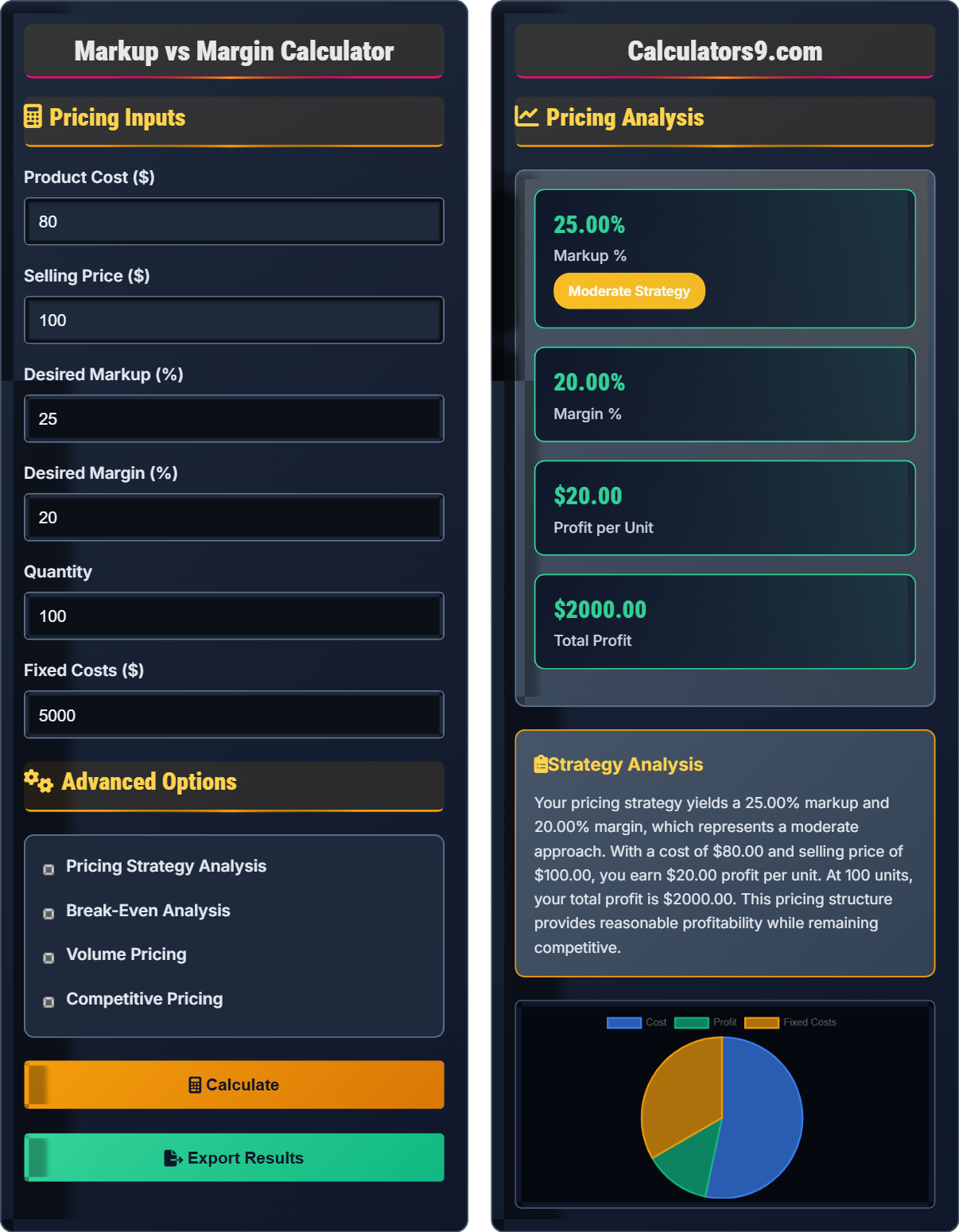
Markup and margin are distinct concepts with different calculations. Markup is based on cost, while margin is based on selling price. For example, a 25% markup on cost results in a 20% margin on selling price. Understanding both is crucial for pricing strategy and profit optimization.
Example: For a product with $80 cost and $100 selling price:
Markup = (($100 - $80) ÷ $80) × 100 = 25%
Margin = (($100 - $80) ÷ $100) × 100 = 20%
This shows that markup (25%) is always higher than margin (20%) for the same profit amount.
Pricing Inputs
Advanced Options
Pricing Analysis
| Item | Amount | % of Revenue | Description |
|---|
| Calculation | Formula | Result | Explanation |
|---|
Comprehensive Pricing Strategy Guide
Markup and margin are two different ways to express profitability. Markup is the percentage added to cost to determine selling price, while margin is the percentage of selling price that represents profit. Understanding both is crucial for effective pricing strategy. Markup is based on cost, while margin is based on selling price, resulting in different values for the same transaction.
Key formulas for pricing analysis:
Margin = (Selling Price - Cost) ÷ Selling Price × 100
Markup to Margin Conversion: M = U ÷ (1 + U)
These metrics help evaluate business pricing effectiveness and compare against industry standards.
Typical markup and margin by industry:
- Retail: 50-100% markup (33-50% margin) - High markup for consumer goods
- Wholesale: 20-30% markup (17-23% margin) - Lower markup due to volume
- Manufacturing: 25-50% markup (20-33% margin) - Varies by product complexity
- Software: 80-95% markup (44-49% margin) - High margins due to low marginal costs
- Restaurants: 300-600% markup (75-86% margin) - Food service premium
- Understand both markup and margin for accurate pricing
- Monitor competitor pricing for market positioning
- Review costs regularly to maintain margins
- Consider volume discounts for bulk orders
- Test different price points for optimal profitability
Pricing Fundamentals
Markup: % added to cost; Margin: % of selling price that is profit.
Markup = (Selling Price - Cost) ÷ Cost × 100
Margin = (Selling Price - Cost) ÷ Selling Price × 100
- Markup is always higher than margin for same profit
- Margin is based on selling price
- Markup is based on cost
Strategy Analysis
Under 20% = Low, 20-40% = Moderate, 40-60% = High, Above 60% = Premium.
- Analyze cost structure
- Research market prices
- Determine target margins
- Test pricing sensitivity
- Market competition affects pricing
- Volume impacts cost structure
- Brand positioning influences pricing
- Customer value perception matters
Pricing Strategy Learning Quiz
Which of the following statements about markup and margin is TRUE?
The answer is C) Markup is based on cost, margin is based on selling price. Markup calculates the percentage added to cost to get selling price, while margin calculates the percentage of selling price that represents profit. This fundamental difference means they will always yield different values for the same transaction.
Students must understand that markup and margin are fundamentally different calculations. Markup uses cost as the base (denominator), while margin uses selling price as the base. This creates different percentage values even for identical transactions. For example, a $100 selling price with $80 cost gives 25% markup but 20% margin.
Markup: Percentage added to cost to determine selling price
Margin: Percentage of selling price that represents profit
Cost: Product cost or manufacturing cost
• Markup = (Selling Price - Cost) ÷ Cost × 100
• Margin = (Selling Price - Cost) ÷ Selling Price × 100
• Markup is always higher than margin for same profit
• Remember: Markup uses cost as base
• Margin uses selling price as base
• Markup is always higher than margin
• Confusing the base for calculations
• Assuming markup and margin are the same
• Using wrong denominator in formulas
Calculate the markup and margin for a product with $60 cost and $80 selling price. Show your work.
Step 1: Calculate markup
Markup = (Selling Price - Cost) ÷ Cost × 100
Markup = ($80 - $60) ÷ $60 × 100
Markup = $20 ÷ $60 × 100 = 33.33%
Step 2: Calculate margin
Margin = (Selling Price - Cost) ÷ Selling Price × 100
Margin = ($80 - $60) ÷ $80 × 100
Margin = $20 ÷ $80 × 100 = 25%
Step 3: Verify the relationship
As expected, markup (33.33%) is higher than margin (25%) for the same profit amount.
Therefore, markup is 33.33% and margin is 25%.
This calculation demonstrates the fundamental difference between markup and margin. Both measure the same profit ($20) but relative to different bases. The markup of 33.33% means we added 33.33% of the cost to get the selling price. The margin of 25% means 25% of the selling price is profit. This shows why markup is always higher than margin.
Markup: Profit expressed as percentage of cost
Margin: Profit expressed as percentage of selling price
Financial Performance: How well a company generates returns
• Markup = (Price - Cost) ÷ Cost × 100
• Margin = (Price - Cost) ÷ Price × 100
• Markup is always higher than margin
• Calculate markup first
• Then calculate margin
• Remember markup is always higher
• Using wrong denominator in formulas
• Forgetting to multiply by 100 for percentage
• Confusing the two calculations
A retailer wants to achieve a 40% margin on a product that costs $120. What should the selling price be? Also calculate the equivalent markup percentage.
Step 1: Calculate selling price for 40% margin
If Margin = (Selling Price - Cost) ÷ Selling Price × 100
Then 40% = (Selling Price - $120) ÷ Selling Price × 100
0.40 = (Selling Price - $120) ÷ Selling Price
0.40 × Selling Price = Selling Price - $120
$120 = Selling Price - 0.40 × Selling Price
$120 = 0.60 × Selling Price
Selling Price = $120 ÷ 0.60 = $200
Step 2: Calculate equivalent markup
Markup = (Selling Price - Cost) ÷ Cost × 100
Markup = ($200 - $120) ÷ $120 × 100
Markup = $80 ÷ $120 × 100 = 66.67%
Therefore, the selling price should be $200 with an equivalent markup of 66.67%.
This problem demonstrates how to work backwards from a target margin to determine selling price. The algebraic manipulation shows how to isolate the selling price variable. The resulting markup (66.67%) is significantly higher than the target margin (40%), illustrating the mathematical relationship between the two metrics. This is essential for pricing strategy planning.
Pricing Strategy: Approach to setting product prices
Target Margin: Desired profit percentageCost-Plus Pricing: Adding markup to product cost
• Margin = (Price - Cost) ÷ Price
• Markup = (Price - Cost) ÷ Cost
• Markup is always higher than margin
• Rearrange formulas to solve for unknowns
• Check your answers
• Understand the relationship
• Incorrect algebraic manipulation
• Using wrong formula for target
• Not understanding the relationship
A manufacturer currently sells a product for $150 with a $100 cost, achieving a 50% markup and 33.33% margin. A competitor sells a similar product for $140 with a 40% markup. What should the manufacturer do to compete while maintaining their margin?
Current Situation:
Current Markup = ($150 - $100) ÷ $100 × 100 = 50%
Current Margin = ($150 - $100) ÷ $150 × 100 = 33.33%
Competitor's Cost = $140 ÷ 1.40 = $100 (assuming 40% markup on cost)
To maintain 33.33% margin at $140 selling price:
Cost = Selling Price × (1 - Margin)
Cost = $140 × (1 - 0.3333) = $140 × 0.6667 = $93.33
Alternative: To match competitor's markup of 40% at $140:
Cost = $140 ÷ 1.40 = $100
Resulting Margin = ($140 - $100) ÷ $140 × 100 = 28.57%
Recommendations:
- Reduce cost to $93.33 to maintain 33.33% margin
- Accept 28.57% margin to match competitor's markup
- Differentiate product to justify higher price
- Focus on value proposition
This problem demonstrates real-world pricing challenges. The manufacturer faces a trade-off between maintaining margin and competing on price. The calculations show that to maintain the same margin as the current situation, the manufacturer must reduce costs. This highlights the importance of cost management in competitive pricing strategies and the relationship between cost, price, and profitability.
Competitive Pricing: Setting prices based on competitor rates
Price Competition: Competing primarily on price
Cost Management: Controlling and optimizing expenses
• Compare to market prices for context
• Consider value proposition
• Balance margin with competitiveness
• Research competitor pricing
• Calculate equivalent metrics
• Consider value differentiation
• Not understanding competitor pricing
• Ignoring value proposition
• Failing to consider cost implications
Which statement about the relationship between markup and margin is correct?
The answer is C) Markup is always higher than margin. This is because markup divides by the smaller base (cost), while margin divides by the larger base (selling price). For the same profit amount, dividing by a smaller number yields a higher percentage. For example, $20 profit on $80 cost is 25% markup, but $20 profit on $100 selling price is 20% margin.
Students must understand the mathematical relationship between markup and margin. Since markup uses cost as the denominator and margin uses selling price (which is always higher than cost when there's profit), markup will always be numerically higher than margin for the same transaction. This is a fundamental principle in pricing strategy that affects all pricing decisions.
Markup: Profit percentage based on cost
Margin: Profit percentage based on selling price
Pricing Relationship: Mathematical connection between metrics
• Markup is always higher than margin
• Both measure same profit differently
• Understanding both is crucial
• Remember: Markup uses smaller base
• Higher base = lower percentage
• Practice conversions
• Assuming they are the same
• Not understanding the relationship
• Confusing which is higher
FAQ
Q: What's a good markup for my retail business?
A: Good retail markups vary by product category:
- Consumer Electronics: 20-30% markup
- Fashion: 50-100% markup
- Books: 40-55% markup
- Groceries: 15-25% markup
Mathematically, if your cost is \( C \) and markup is \( M \), then:
\( \text{Selling Price} = C \times (1 + M) \)
For example, with \( C = \$50 \) and \( M = 50\% \):
\( \text{Selling Price} = \$50 \times (1 + 0.50) = \$75 \)
The equivalent margin would be: \( \frac{\$75 - \$50}{\$75} = 33.33\% \)
Q: How do I convert markup to margin?
A: To convert markup to margin, use the formula:
\( \text{Margin} = \frac{\text{Markup}}{1 + \text{Markup}} \)
For example, with a 25% markup:
\( \text{Margin} = \frac{0.25}{1 + 0.25} = \frac{0.25}{1.25} = 0.20 = 20\% \)
Conversely, to convert margin to markup:
\( \text{Markup} = \frac{\text{Margin}}{1 - \text{Margin}} \)
With a 20% margin: \( \text{Markup} = \frac{0.20}{1 - 0.20} = \frac{0.20}{0.80} = 0.25 = 25\% \)
This conversion is essential for pricing strategy and financial reporting.