Payroll Tax Estimator
Calculate employee & employer taxes • 2026 edition
Payroll Tax Formula:
Show the estimator\( \text{Employee Tax} = \text{Gross Pay} \times \text{Tax Rate} \)
\( \text{Employer Tax} = \text{Gross Pay} \times \text{Employer Tax Rate} \)
\( \text{Total Tax Obligation} = \text{Employee Tax} + \text{Employer Tax} \)
Where:
- \( \text{Federal Withholding} = \text{Based on W-4 form and IRS tables} \)
- \( \text{Social Security} = \text{Gross Pay} \times 6.2\% \text{ (employee)} + 6.2\% \text{ (employer)} \)
- \( \text{Medicare} = \text{Gross Pay} \times 1.45\% \text{ (employee)} + 1.45\% \text{ (employer)} \)
- \( \text{State Tax} = \text{Gross Pay} \times \text{State Tax Rate (varies by state)} \)
This formula calculates federal, state, and local payroll taxes for employees and employers. It helps businesses estimate their tax obligations and ensure proper withholding.
Example: For an employee earning $50,000 annually in a state with 5% tax rate:
Social Security: $50,000 × 6.2% = $3,100 (employee) + $3,100 (employer)
Medicare: $50,000 × 1.45% = $725 (employee) + $725 (employer)
State Tax: $50,000 × 5% = $2,500 (employee)
Total Employee: $6,325, Total Employer: $3,825
Therefore, the total payroll tax obligation is $10,150.
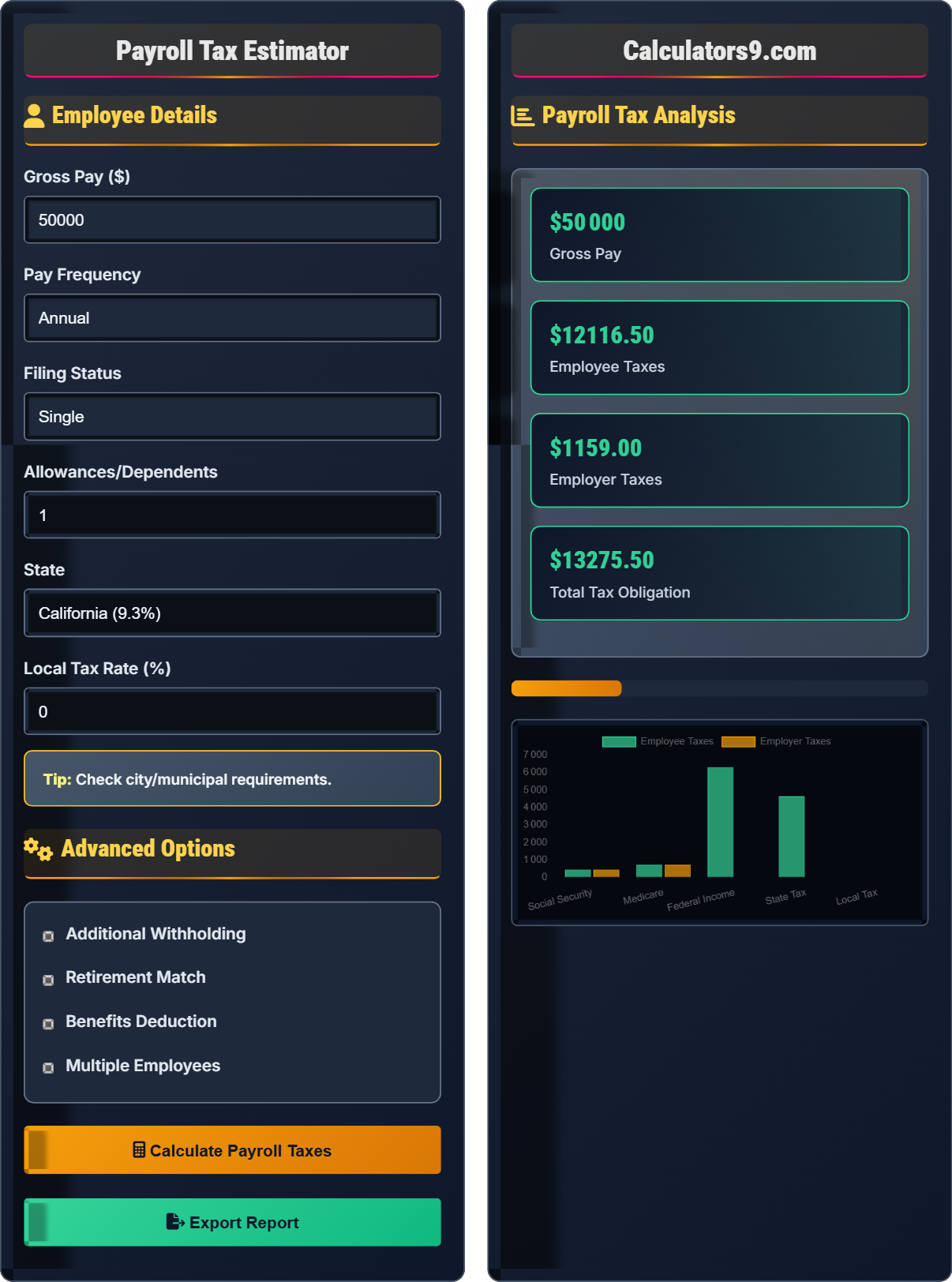
Employee Details
Advanced Options
Payroll Tax Analysis
| Tax Type | Employee | Employer | Total |
|---|
Compliance Requirements
Comprehensive Payroll Tax Guide
Payroll taxes are mandatory deductions from employee wages and matching contributions from employers. They fund Social Security, Medicare, unemployment insurance, and other government programs. Employers must withhold and remit these taxes according to federal, state, and local regulations.
The standard payroll tax calculation uses the following formulas:
Where:
- \( \text{Social Security Tax} = \text{Gross Pay} \times 6.2\% \text{ (employee)} + 6.2\% \text{ (employer)} \)
- \( \text{Medicare Tax} = \text{Gross Pay} \times 1.45\% \text{ (employee)} + 1.45\% \text{ (employer)} \)
- \( \text{Federal Income Tax} = \text{Based on W-4 form and IRS tax brackets} \)
- \( \text{State Income Tax} = \text{Gross Pay} \times \text{State Tax Rate} \)
Effective payroll tax management involves several key requirements:
- Accurate Withholding: Properly calculate and deduct taxes from employee paychecks
- Timely Remittance: Deposit taxes with appropriate agencies by due dates
- Correct Reporting: File required forms (W-2, 941, 940) accurately and on time
- Record Keeping: Maintain detailed payroll and tax records for audit purposes
- Stay Updated: Monitor changes in tax rates, thresholds, and regulations
- Use Payroll Software: Automate calculations and filings to reduce errors
- Quarterly Filings: Submit Form 941 quarterly to report taxes
- Annual Forms: Prepare W-2 forms for employees and 1099s for contractors
- Deposit Schedules: Follow semi-weekly or monthly deposit requirements
- Penalty Prevention: Stay current with payments to avoid penalties
Payroll Tax Basics
Mandatory deductions from employee wages and employer contributions.
\( \text{Employee Tax} = \text{Gross Pay} \times \text{Tax Rate} \)
Where taxes = pay × rate for each component.
- Employers must match certain taxes
- Taxes must be withheld and remitted
- Records must be maintained for audits
Compliance Strategies
Calculating and deducting taxes from employee paychecks.
- Verify W-4 forms are completed properly
- Update calculations for tax law changes
- Use IRS withholding tables
- File required reports on time
- State tax requirements vary
- Local taxes may apply
- Penalties for late filing
- Annual wage base limits
Payroll Tax Learning Quiz
What is the current Social Security tax rate for employees?
The answer is B) 6.2%. The Social Security tax rate is 6.2% for employees and 6.2% for employers (12.4% total). This tax funds retirement, disability, and survivor benefits. Note that this rate only applies up to the annual wage base limit (which changes annually).
It's important to distinguish between different payroll tax rates. The 6.2% Social Security tax is separate from the 1.45% Medicare tax. Together they make up 7.65% of employee payroll taxes (15.3% total including employer share). The Social Security tax has a wage base limit, meaning it only applies to earnings up to a certain threshold ($160,200 in 2023, subject to change).
Social Security Tax: Payroll tax funding retirement and disability programs
Wage Base Limit: Maximum earnings subject to Social Security tax
Payroll Tax: Tax on employee wages and salaries
• Social Security rate is 6.2% for employee and employer
• Applies only up to annual wage base limit
• Combined with Medicare for total FICA tax
• Remember: 6.2% Social Security + 1.45% Medicare = 7.65%
• Social Security has a wage cap
• Medicare has no wage cap
• Confusing Social Security rate with Medicare rate
• Forgetting the wage base limit applies to Social Security
• Not understanding the employer match requirement
Calculate the total FICA tax (Social Security + Medicare) for an employee earning $60,000 annually. Show your work.
Step 1: Calculate Social Security tax = $60,000 × 6.2% = $60,000 × 0.062 = $3,720
Step 2: Calculate Medicare tax = $60,000 × 1.45% = $60,000 × 0.0145 = $870
Step 3: Calculate total FICA tax = Social Security tax + Medicare tax = $3,720 + $870 = $4,590
Step 4: Calculate total including employer match = $4,590 × 2 = $9,180
Therefore, the total FICA tax obligation is $4,590 from the employee and $4,590 from the employer, for a total of $9,180.
This calculation demonstrates the FICA tax components: Social Security (6.2%) and Medicare (1.45%). For most employees, the total FICA tax rate is 7.65%. The employer must match this amount, doubling the total tax burden. For our example, the employee pays $4,590 and the employer pays $4,590, totaling $9,180 in FICA taxes.
FICA: Federal Insurance Contributions Act (Social Security and Medicare)
Employer Match: Required employer contribution equal to employee amount
Payroll Tax Rate: Percentage of wages subject to tax
• FICA = Social Security (6.2%) + Medicare (1.45%)
• Employer must match employee contributions
• Social Security has wage base limit
• FICA total is 7.65% of wages
• Employer match doubles the total cost
• Check annual wage base for Social Security
• Forgetting the employer match requirement
• Not understanding the wage base limit
• Confusing FICA with federal income tax
An employee in California earns $75,000 annually. California has a state income tax rate of 9.3%. Calculate the state income tax for this employee, and explain how this differs from federal income tax.
Step 1: Calculate California state income tax = $75,000 × 9.3% = $75,000 × 0.093 = $6,975
Step 2: Compare to federal income tax (using 22% bracket for simplicity): $75,000 × 22% = $16,500
Differences between federal and state income tax:
• Federal tax rates are progressive with multiple brackets
• State tax rates vary by state (some have no income tax)
• Federal withholding uses W-4 form, state uses state-specific form
• Federal tax funds national programs, state tax funds state programs
Therefore, the California employee would owe $6,975 in state income tax in addition to federal income tax.
This problem demonstrates the additional tax burden from state income taxes. Unlike federal tax, which all states must collect, state income taxes are optional (several states have no income tax). The rates vary significantly between states, from 0% in states like Texas and Florida to over 13% in states like California and New York. This creates varying tax burdens depending on location.
State Income Tax: Tax collected by state governments
Progressive Tax: Tax rate increases with higher income
Withholding Form: Document directing tax deduction amounts
• State tax rates vary significantly by state
• Some states have no income tax
• State tax is separate from federal tax
• Research state tax rates when moving
• Some states have flat rates, others are progressive
• Local taxes may also apply
• Assuming all states have income tax
• Forgetting to account for state tax in calculations
• Confusing state tax with local tax
A company has 10 employees each earning $45,000 annually. The federal unemployment tax (FUTA) rate is 6% on the first $7,000 of wages. Calculate the company's annual FUTA tax obligation. Also explain how state unemployment tax (SUTA) differs from FUTA.
Step 1: Calculate FUTA taxable wages per employee = $7,000 (wage base limit)
Step 2: Calculate total FUTA taxable wages = $7,000 × 10 employees = $70,000
Step 3: Calculate FUTA tax = $70,000 × 6% = $70,000 × 0.06 = $4,200
Differences between FUTA and SUTA:
• FUTA is a federal tax at 6% (usually reduced to 0.6% with SUTA credits)
• SUTA rates vary by state and employer experience rating
• Both fund unemployment benefits but collected by different authorities
• FUTA has a uniform wage base, SUTA bases vary by state
Therefore, the company's annual FUTA tax obligation is $4,200.
This demonstrates the calculation for FUTA tax, which has a much lower wage base than Social Security. The FUTA tax is primarily an employer responsibility, unlike Social Security and Medicare which are shared. The FUTA tax rate is typically reduced to 0.6% when employers pay their state unemployment taxes on time (SUTA credit). This shows how federal and state unemployment systems work together.
FUTA: Federal Unemployment Tax Act
SUTA: State Unemployment Tax Act
Wage Base: Maximum earnings subject to tax
• FUTA applies only to first $7,000 of wages
• FUTA is employer-only tax
• SUTA rates vary by state and employer history
• FUTA rate is usually 0.6% after SUTA credit
• SUTA rates depend on employer's layoff history
• Both fund unemployment compensation
• Applying FUTA to full wages instead of wage base
• Confusing FUTA with SUTA responsibilities
• Not understanding the SUTA credit system
Which of the following is NOT a required employer responsibility for payroll taxes?
The answer is D) Calculate employee's personal tax liability. Employers are responsible for withholding taxes based on the information provided by employees on their W-4 forms, but they do not calculate the employee's total annual tax liability. That responsibility belongs to the employee when filing their personal tax return.
This question clarifies the distinction between employer payroll tax responsibilities and employee personal tax responsibilities. Employers must withhold the correct amounts based on employee W-4 information and pay their share of payroll taxes, but they don't calculate the employee's total annual tax liability. The W-4 form helps employers determine appropriate withholding amounts, but employees must still reconcile their actual tax liability when filing personal returns.
Withholding: Deducting taxes from employee paychecks
Employer Responsibility: Obligations for payroll tax managementEmployee Liability: Individual's ultimate tax obligation
• Employers must withhold and remit taxes
• Employers must match certain taxes
• Employees calculate final tax liability
• Use payroll software to manage requirements
• File forms on time to avoid penalties
• Keep detailed records for audits
• Confusing employer and employee responsibilities
• Missing filing deadlines
• Not understanding W-4 form purpose
FAQ
Q: What's the difference between FICA and federal income tax?
A: FICA (Federal Insurance Contributions Act) taxes fund Social Security and Medicare:
- Social Security: 6.2% employee + 6.2% employer (12.4% total) up to annual wage base limit
- Medicare: 1.45% employee + 1.45% employer (2.9% total) with no wage base limit
Federal Income Tax is based on income level and filing status:
- Progressive rates from 10% to 37% (as of 2023)
- Withheld based on W-4 form information
- Does not include employer contribution
For example, on a $50,000 salary:
FICA: $50,000 × 7.65% = $3,825 (employee portion)
Federal Income Tax: Depends on W-4, roughly $5,000-$7,000 for single filer
So an employee might pay about $8,825-$10,825 in federal taxes total.
Q: What are the key payroll tax filing deadlines?
A: Key payroll tax filing deadlines:
Form 941 (Quarterly Federal Tax Return):
- Due by last day of month following quarter end
- April 30: Q1 (Jan-Mar)
- July 31: Q2 (Apr-Jun)
- October 31: Q3 (Jul-Sep)
- January 31: Q4 (Oct-Dec)
Form 940 (Annual Federal Unemployment Tax):
- Due by January 31 for prior calendar year
- For deposits over $500, quarterly payments required
W-2 Forms:
- Provide to employees by January 31
- File with Social Security Administration by February 28 (March 31 if filing electronically)
State Requirements:
- Varies by state but typically monthly or quarterly
- Check your state's Department of Revenue for specific deadlines
Missing deadlines can result in significant penalties and interest charges.