Sales Tax Collector
Tax compliance & calculation • 2026 best practices
Sales Tax Formulas:
Show the calculatorTax Amount: \( \text{Tax Amount} = \text{Subtotal} \times \text{Tax Rate} \)
Total with Tax: \( \text{Total} = \text{Subtotal} + \text{Tax Amount} \)
Reverse Calculation: \( \text{Subtotal} = \frac{\text{Total}}{1 + \text{Tax Rate}} \)
Where:
- \( \text{Subtotal} \) = Price before tax
- \( \text{Tax Rate} \) = Decimal form of percentage (e.g., 8.5% = 0.085)
- \( \text{Tax Amount} \) = Tax collected
- \( \text{Total} \) = Price including tax
Sales tax collection involves understanding jurisdictional requirements, exemption rules, and filing deadlines. Tax rates vary by state, county, and city. Proper collection and remittance are critical for compliance. Businesses must track tax collected, maintain records, and file returns with tax authorities.
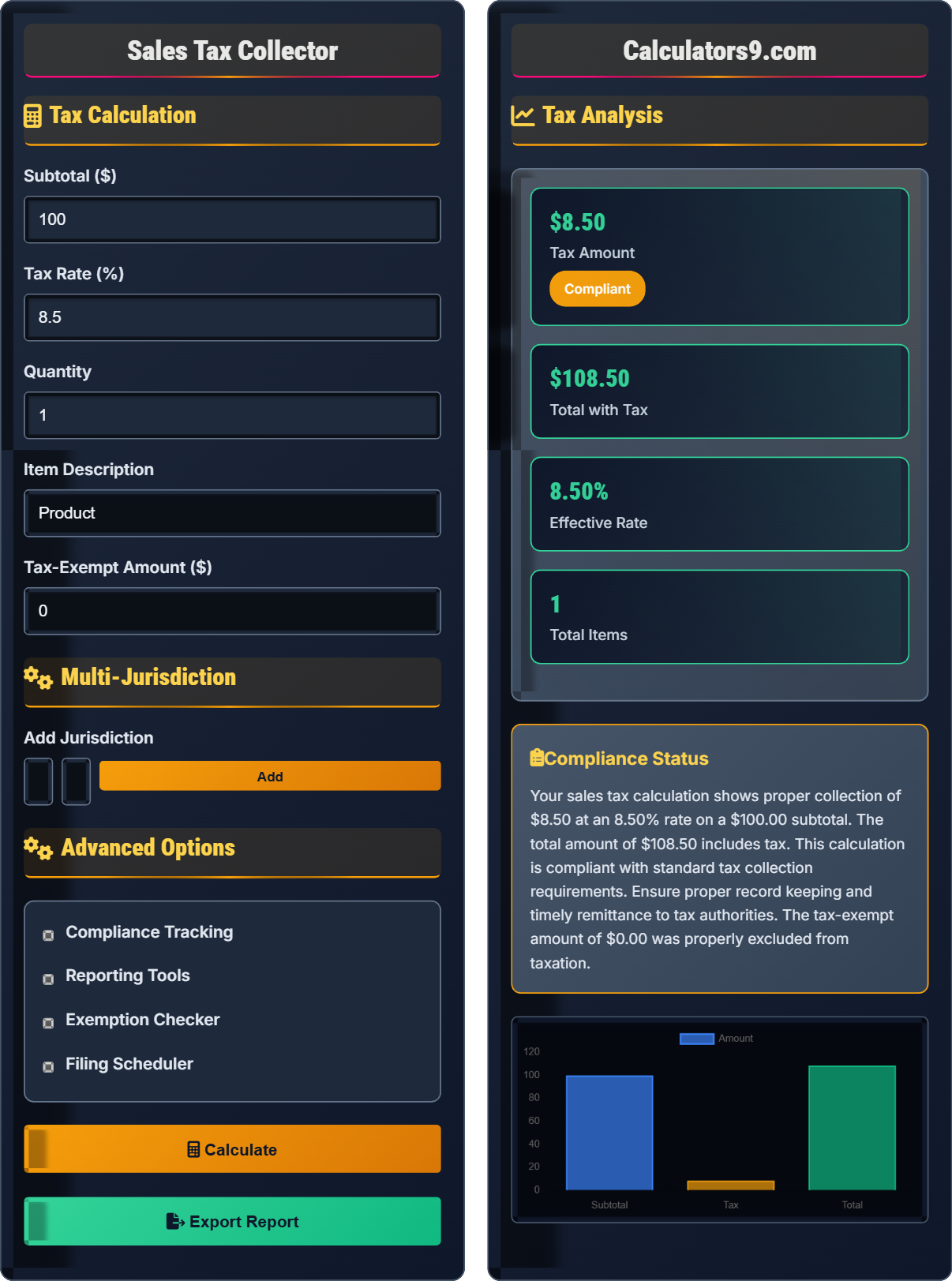
Example: For a $100 purchase with 8.5% tax:
Tax Amount = $100 × 0.085 = $8.50
Total = $100 + $8.50 = $108.50
This demonstrates the standard calculation method used across all jurisdictions.
Tax Calculation
Multi-Jurisdiction
Advanced Options
Tax Analysis
| Item | Amount | Quantity | Total |
|---|
| Jurisdiction | Rate | Base Amount | Tax Collected |
|---|
Comprehensive Sales Tax Guide
Sales tax collection involves charging, calculating, and remitting taxes to appropriate authorities. Businesses must understand their nexus obligations, applicable rates, exempt items, and filing requirements. Proper collection ensures compliance and avoids penalties. Sales tax is typically charged on retail sales, leases, and rentals of tangible personal property and certain services.
Key formulas for sales tax calculations:
Total = Subtotal + Tax
Reverse: Subtotal = Total ÷ (1 + Rate)
These methods ensure accurate tax calculation for compliance and reporting.
Common sales tax exemptions by category:
- Food: Many states exempt groceries
- Medical: Prescription medications, medical devices
- Educational: Textbooks, educational materials
- Industrial: Machinery, raw materials
- Non-profit: Purchases by qualifying organizations
- Automate tax collection to ensure accuracy
- Stay updated on changing tax rates and rules
- Maintain detailed records for compliance
- File returns on time to avoid penalties
- Consult professionals for complex situations
Tax Fundamentals
Charging, collecting, and remitting taxes to authorities.
Tax Amount = Subtotal × Tax Rate
Total = Subtotal + Tax Amount
- Collect tax on taxable sales
- Remit to appropriate authorities
- Keep detailed records
Compliance Tracking
Registration, collection, remittance, and record keeping.
- Register for tax permits
- Calculate correct tax
- Collect and store tax
- File returns timely
- Multi-state businesses have complex requirements
- Exemptions vary by state
- Penalties for non-compliance can be severe
- Professional guidance is recommended
Sales Tax Compliance Learning Quiz
Which of the following is NOT a responsibility of businesses collecting sales tax?
The answer is D) Setting their own tax rates. Sales tax rates are determined by government authorities, not businesses. Businesses must charge the correct rate as mandated by law. Other responsibilities include registering for permits, collecting taxes, maintaining records, and filing returns with tax authorities.
Students must understand that sales tax collection involves compliance with government regulations. Tax rates are prescribed by state and local authorities, not set by individual businesses. Businesses act as tax collectors for the government, passing through the tax to consumers and remitting it to authorities.
Sales Tax: Tax on retail sales collected by businesses
Tax Nexus: Connection that creates tax obligation
Compliance: Following all tax collection requirements
• Businesses must collect prescribed rates
• Rates are set by government authorities
• Proper registration is required
• Stay updated on rate changes
• Register in all required jurisdictions
• Maintain detailed records
• Assuming businesses can set their own rates
• Not understanding nexus requirements
• Poor record keeping
Calculate the sales tax and total amount for a $150 purchase with an 8.25% tax rate. Show your work.
Step 1: Calculate tax amount
Tax Amount = Subtotal × Tax Rate
Tax Amount = $150 × 0.0825 = $12.375
Tax Amount = $12.38 (rounded to nearest cent)
Step 2: Calculate total amount
Total = Subtotal + Tax Amount
Total = $150 + $12.38 = $162.38
Step 3: Verify calculation
Check: $162.38 ÷ (1 + 0.0825) = $150
Therefore, tax amount is $12.38 and total is $162.38.
This calculation demonstrates the standard sales tax formula. The tax amount is calculated by multiplying the subtotal by the tax rate (expressed as a decimal). The total is then the sum of the subtotal and tax amount. Rounding to the nearest cent is important for financial accuracy.
Subtotal: Price before tax
Tax Amount: Tax collected
Total: Price including tax
• Tax = Subtotal × Rate
• Total = Subtotal + Tax
• Round to nearest cent
• Convert percentage to decimal
• Always round tax amount
• Verify calculations
• Not converting percentage to decimal
• Incorrect rounding
• Forgetting to add tax to subtotal
A business ships a $200 product from a state with 6% sales tax to a customer in a state with 9.5% sales tax. What tax rate should be applied, and what is the total amount collected?
Step 1: Determine applicable tax rate
Generally, the destination state's tax rate applies to shipped goods.
Applicable Rate = 9.5%
Step 2: Calculate tax amount
Tax Amount = $200 × 0.095 = $19.00
Step 3: Calculate total amount
Total = $200 + $19.00 = $219.00
Step 4: Consider nexus implications
The business must have nexus in the destination state to collect tax there.
Therefore, the 9.5% rate applies, with tax of $19.00 and total of $219.00.
This problem demonstrates destination-based taxation, where the customer's location determines the applicable tax rate. For shipped goods, the destination state's rate typically applies. However, businesses must have nexus (connection) in that state to legally collect tax. This is important for online sellers and multi-state businesses.
Destination-Based Tax: Tax rate determined by customer location
Nexus: Connection that creates tax obligation
Origin-Based Tax: Tax rate determined by seller location
• Shipped goods: destination rate applies
• Must have nexus to collect tax
• Rates vary by jurisdiction
• Research destination tax rates
• Check nexus requirements
• Use tax automation tools
• Applying origin state rate to shipped goods
• Not considering nexus requirements
• Assuming uniform rates across states
A customer purchases $500 worth of items, where $150 is tax-exempt groceries and $350 is taxable merchandise. The tax rate is 7.25%. What is the total tax collected and final amount?
Step 1: Identify taxable amount
Taxable Amount = Total Purchase - Exempt Amount
Taxable Amount = $500 - $150 = $350
Step 2: Calculate tax on taxable amount
Tax Amount = $350 × 0.0725 = $25.375
Tax Amount = $25.38 (rounded to nearest cent)
Step 3: Calculate total amount
Total = Taxable Amount + Exempt Amount + Tax
Total = $350 + $150 + $25.38 = $525.38
Step 4: Verify calculation
Check: $350 × 1.0725 + $150 = $375.28 + $150 = $525.28 (rounding difference)
Therefore, tax collected is $25.38 and total is $525.38.
This problem demonstrates handling tax-exempt items in a mixed purchase. Only the taxable portion is subject to sales tax. The exempt amount is added to the taxable amount plus tax to get the final total. Proper identification of exempt items is crucial for compliance.
Tax-Exempt: Items not subject to sales tax
Taxable: Items subject to sales tax
Mixed Purchase: Transaction with both exempt and taxable items
• Only taxable items are taxed
• Exempt items are added to total
• Proper categorization is required
• Identify exempt items separately
• Apply tax only to taxable portion
• Keep detailed records
• Applying tax to exempt items
• Not identifying exempt items properly
• Incorrect calculation of totals
How often are businesses typically required to file sales tax returns?
The answer is B) Monthly or quarterly. Most states require sales tax returns to be filed monthly or quarterly, depending on the volume of sales. Some states may require monthly filing for higher-volume businesses and quarterly for lower-volume ones. Annual filing is rare for active businesses.
Students must understand that sales tax compliance involves regular filing schedules. The frequency is typically based on sales volume, with higher-volume businesses filing more frequently. Timely filing is crucial to avoid penalties and maintain compliance. Businesses should check specific requirements in each jurisdiction where they have nexus.
Filing Frequency: How often returns must be submitted
Compliance: Meeting all tax obligations
Nexus: Connection that creates tax obligation
• Monthly or quarterly filing is standard
• Frequency may depend on sales volume
• Late filing may incur penalties
• Check specific state requirements
• Set up calendar reminders
• Consider automation tools
• Assuming annual filing is sufficient
• Missing filing deadlines
• Not understanding volume-based requirements
FAQ
Q: Do I need to collect sales tax in every state?
A: No, you only need to collect sales tax in states where you have nexus. Nexus is established through physical presence, economic activity, or other connections to a state. The 2018 Wayfair decision allows states to require remote sellers to collect tax based on economic thresholds (typically $100,000 in sales or 200+ transactions).
Mathematically, if your economic activity in State X exceeds the threshold:
If \( \text{Sales} > \$100{,}000 \) OR \( \text{Transactions} > 200 \), then nexus exists
For example, with \( \text{Sales} = \$120{,}000 \) and \( \text{Transactions} = 150 \), nexus exists because sales exceed the threshold.
You must register, collect, and remit tax only in states where nexus exists.
Q: How do I calculate tax when shipping to different states?
A: For shipped goods, the destination-based rule typically applies, meaning you charge the tax rate of the customer's location:
Tax Rate = Customer Location Rate
For example, if selling a $100 item from California (7.25% rate) to New York (8.25% rate):
- Tax Amount = $100 × 0.0825 = $8.25
- Total = $100 + $8.25 = $108.25
However, you must have nexus in the destination state to legally collect tax there. Some states have different rules for digital goods versus physical goods.