Bond Yield Calculator
Calculate bond returns • 2026 rates
Bond Yield Formulas:
Show the calculatorCurrent Yield = (Annual Coupon Payment / Current Bond Price) × 100
Yield to Maturity (YTM) = Complex iterative calculation solving: Bond Price = Σ [Coupon / (1+YTM)^t] + [Face Value / (1+YTM)^n]
Yield to Call (YTC) = Similar to YTM but uses call date instead of maturity date
Where:
- Annual Coupon Payment: Face Value × Coupon Rate
- Current Bond Price: Market price of the bond
- Face Value: Principal amount returned at maturity
- YTM: Internal rate of return if held to maturity
These formulas help investors evaluate bond investments by comparing yields to market rates. YTM accounts for time value of money and provides a comprehensive return measure.
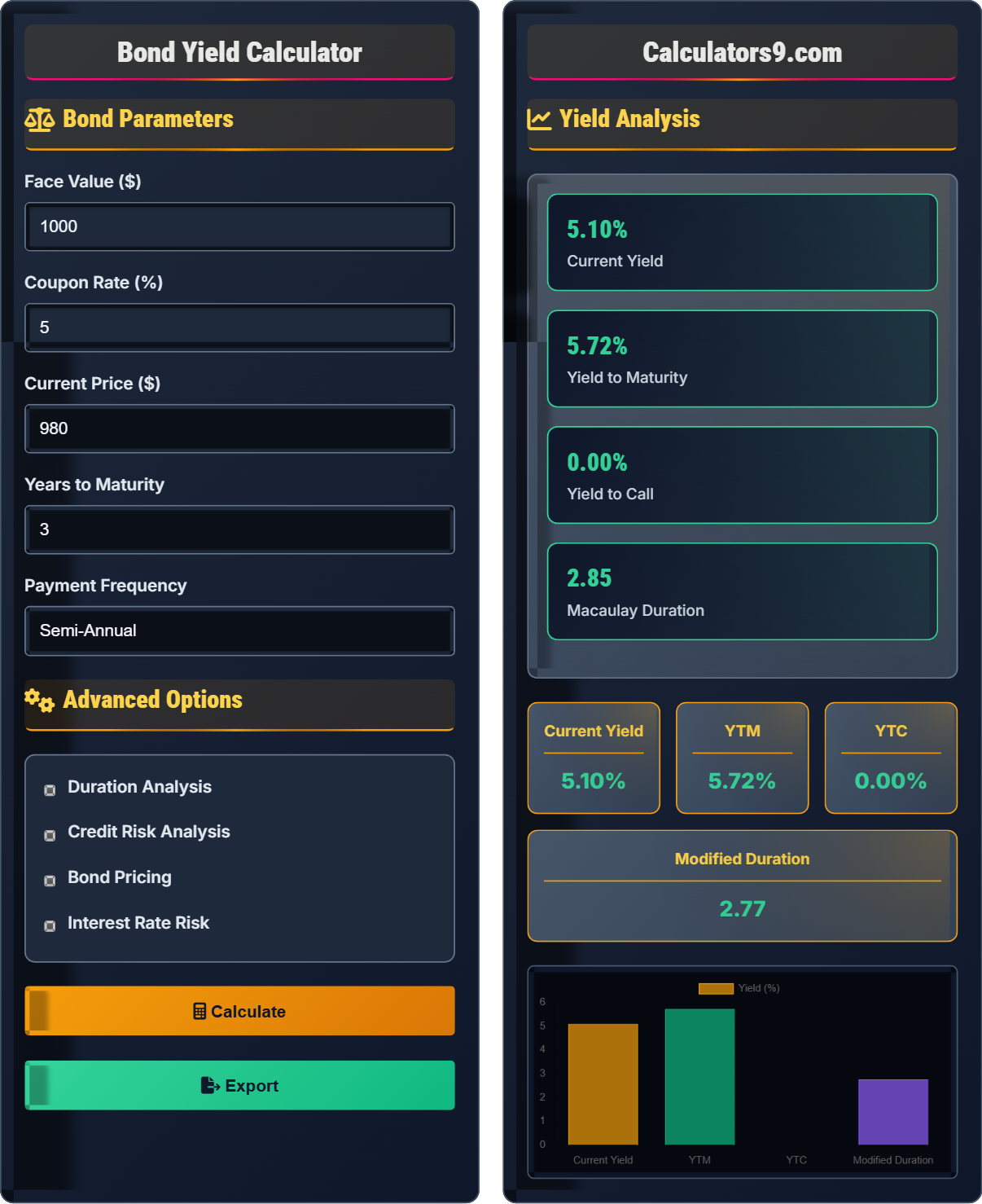
Example: A $1,000 face value bond with 5% coupon, 3 years to maturity, selling for $980:
Annual Coupon = $1,000 × 0.05 = $50
Current Yield = ($50 / $980) × 100 = 5.10%
YTM ≈ 5.74% (solved iteratively considering all future cash flows)
Bond Parameters
Advanced Options
Yield Analysis
Duration Analysis
Credit Risk Analysis
Bond Pricing
Interest Rate Risk
Comprehensive Bond Yield Guide
Bond yield represents the return an investor can expect from holding a bond. It's expressed as a percentage and varies depending on the calculation method. Different yield measures provide various perspectives on a bond's return potential, helping investors make informed decisions about fixed-income securities.
Multiple methods exist for calculating bond yields:
Where:
- Current Yield: Simple annual return measure
- YTM: Comprehensive return including time value of money
- YTC: Return if bond is called before maturity
Bond investments face various risks:
- Interest Rate Risk: Prices fall when rates rise
- Credit Risk: Issuer may default on payments
- Inflation Risk: Real returns eroded by inflation
- Reinvestment Risk: Coupons reinvested at lower rates
- Laddering: Stagger maturity dates to manage reinvestment risk
- Barbell: Combine short and long-term bonds
- Duration Matching: Match bond duration to investment horizon
- Credit Quality: Diversify across credit ratings
- Tax Considerations: Compare taxable vs tax-free yields
Bond Yield Fundamentals
Return expected from holding a bond investment.
Current Yield = (Annual Coupon / Current Price) × 100
Where yield = return percentage, coupon = annual payment, price = market value.
- Higher yields often mean higher risk
- Yield inversely related to price
- YTM accounts for time value of money
Risk Management
Measures price sensitivity to interest rate changes.
- Match duration to investment horizon
- Diversify across maturities
- Consider credit ratings
- Monitor interest rate trends
- Longer duration = higher rate sensitivity
- Callable bonds add complexity
- Tax implications vary by bond type
- Market liquidity affects pricing
Bond Yield Learning Quiz
Which yield measure accounts for the time value of money and all future cash flows?
The answer is B) Yield to Maturity. YTM is the internal rate of return that accounts for all future cash flows (coupons and principal) and discounts them back to the present value. It considers the time value of money, making it the most comprehensive yield measure for bond investments.
Yield to Maturity is the most important yield measure because it captures the total return an investor will receive if they hold the bond to maturity. Unlike current yield, which only considers the annual coupon relative to current price, YTM accounts for the bond's entire cash flow stream, including the return of principal at maturity.
Yield to Maturity (YTM): Total return if held to maturity
Time Value of Money: Present value of future cash flows
Internal Rate of Return: Discount rate making NPV zero
• YTM considers all future cash flows
• Accounts for time value of money
• Assumes coupons reinvested at same rate
• YTM = Most comprehensive yield measure
• Used for comparing bonds with different maturities
• Requires iterative calculation
• Confusing current yield with YTM
• Forgetting to account for principal repayment
• Not considering time value of money
A $1,000 face value bond with a 6% annual coupon is selling for $950. What is the current yield? Show your work.
Step 1: Calculate annual coupon payment = Face Value × Coupon Rate
Annual Coupon = $1,000 × 0.06 = $60
Step 2: Apply current yield formula = (Annual Coupon / Current Price) × 100
Current Yield = ($60 / $950) × 100 = 0.06316 × 100 = 6.32%
Therefore, the current yield is 6.32%.
This calculation demonstrates the simplest bond yield measure. Current yield only considers the annual income relative to the current market price. It doesn't account for the time value of money or the return of principal at maturity. While easy to calculate, it provides an incomplete picture of total return potential.
Current Yield: Annual income relative to market price
Annual Coupon: Interest payment per year
Face Value: Principal amount returned at maturity
• Current Yield = (Annual Coupon / Current Price) × 100
• Doesn't account for time value of money
• Simplest yield measure to calculate
• CY = (Annual Coupon / Current Price) × 100
• Useful for comparing income-producing bonds
• Incomplete measure of total return
• Using face value instead of current price
• Forgetting to multiply by 100 for percentage
• Confusing current yield with YTM
A bond has a modified duration of 5 years. If market interest rates increase by 1%, approximately how much will the bond's price change? Show your work.
Step 1: Understand the duration approximation formula:
Price Change ≈ -Modified Duration × Rate Change
Step 2: Apply the values:
Price Change ≈ -5 × 0.01 = -0.05 = -5%
Step 3: Interpret the result: The bond's price will decrease by approximately 5%
Therefore, a 1% increase in rates leads to approximately a 5% decrease in bond price.
This demonstrates the inverse relationship between bond prices and interest rates. Duration measures this sensitivity. Modified duration provides a direct way to estimate price changes for small interest rate movements. The negative sign indicates that price and rates move in opposite directions.
Modified Duration: Measure of price sensitivity to rate changes
Interest Rate Risk: Risk of price decline when rates rise
Inverse Relationship: Bond prices fall when rates rise
• Price Change ≈ -Modified Duration × Rate Change
• Longer duration = higher rate sensitivity
• Price and rates move inversely
• Duration = Approximate % price change per 1% rate change
• Higher duration = More volatile bond
• Zero-coupon bonds have duration = maturity
• Forgetting the negative sign in the relationship
• Confusing Macaulay duration with modified duration
• Not accounting for convexity in large rate changes
You're considering a callable bond with 5 years to maturity, 6% coupon, selling for $1,020. The bond is callable in 2 years at $1,010. If you believe it will be called, which yield measure should you use and why? Calculate it approximately.
Step 1: If the bond is likely to be called, use Yield to Call (YTC)
Step 2: Calculate the approximate YTC using simplified formula:
Annual Coupon = $1,000 × 0.06 = $60
Time to Call = 2 years
Call Price = $1,010
Current Price = $1,020
Step 3: Approximate YTC ≈ [($60 + ($1,010 - $1,020)/2] / [($1,010 + $1,020)/2]
≈ [$60 + (-$5)] / [$1,015] ≈ $55 / $1,015 ≈ 5.42%
Therefore, use YTC of approximately 5.42%.
For callable bonds, investors should consider both YTM and YTC. If interest rates decline, the issuer is likely to call the bond to refinance at lower rates. Using the lower of YTM and YTC provides a more conservative estimate of returns. This is known as "yield to worst."
Callable Bond: Bond that issuer can redeem early
Yield to Call: Return if bond is called
Yield to Worst: Lowest possible yield measure
• Use YTC for callable bonds if likely to be called
• Compare YTM and YTC
• Consider yield to worst for conservative estimates
• If rates fall, callable bonds likely to be called
• YTC usually lower than YTM
• Yield to worst = minimum possible return
• Only calculating YTM for callable bonds
• Not considering call risk
• Ignoring call provisions in analysis
Which factor would most likely result in a higher yield for a corporate bond compared to a Treasury bond of the same maturity?
The answer is B) Credit risk premium. Corporate bonds carry credit risk (possibility of default) that Treasury bonds do not. To compensate investors for this additional risk, corporate bonds must offer a higher yield than comparable Treasury bonds. This additional yield is called the credit spread or credit risk premium.
The yield difference between corporate and Treasury bonds is primarily due to credit risk. Treasury bonds are considered risk-free, so any additional yield on corporate bonds represents compensation for credit risk. This relationship is fundamental to fixed income investing and affects bond pricing and yield comparisons.
Credit Risk Premium: Extra yield for credit risk
Credit Spread: Yield difference between corporate and Treasury
Risk-Free Rate: Treasury bond yield
• Corporate yields = Treasury yield + Credit spread
• Higher credit risk = Higher yield premium
• Credit rating affects spread size
• Corporate Yield = Treasury Yield + Credit Spread
• AAA bonds have smallest spreads
• High-yield bonds have largest spreads
• Thinking Treasury bonds have higher yields
• Not accounting for credit risk in comparisons
• Confusing interest rate risk with credit risk
FAQ
Q: What's the difference between coupon rate and yield to maturity?
A: The coupon rate and yield to maturity (YTM) are fundamentally different:
Coupon Rate:
- Fixed percentage of face value paid annually
- Set at bond issuance and never changes
- Doesn't consider market price fluctuations
- Example: A bond with $1,000 face value and 5% coupon pays $50 annually regardless of market price
Yield to Maturity:
- Current return based on market price
- Changes as bond price fluctuates
- Accounts for time value of money
- Includes both coupon payments and principal repayment
- Example: If the same bond trades at $950, YTM will be higher than 5% because you'll earn a $50 capital gain at maturity
Essentially, coupon rate is historical, while YTM reflects current market conditions.
Q: How does duration help me manage bond portfolio risk?
A: Duration is a crucial risk management tool that measures a bond's sensitivity to interest rate changes:
Duration Basics:
- Approximately tells you the percentage price change for a 1% change in interest rates
- Example: A bond with 5-year duration will drop about 5% if rates rise 1%
Portfolio Management Applications:
- Matching: Align portfolio duration with your investment horizon
- Hedging: Use shorter-duration bonds when expecting rate increases
- Diversification: Mix durations to balance risk and return
- Liability Matching: Match duration to future obligations
By managing portfolio duration, you can better control interest rate risk exposure and align your bond investments with your risk tolerance and investment timeline.