Compound Interest Calculator
Investment growth analysis • 2026 best practices
Compound Interest Formula:
Show the calculator\( A = P(1 + \frac{r}{n})^{nt} \)
Where:
- \( A \) = Final amount (future value)
- \( P \) = Principal (initial investment)
- \( r \) = Annual interest rate (decimal)
- \( n \) = Number of times interest is compounded per year
- \( t \) = Number of years
Compound interest is the interest calculated on both the initial principal and accumulated interest from previous periods. This exponential growth effect accelerates over time, making it a powerful tool for wealth building. The more frequent the compounding, the greater the growth. Starting early maximizes the benefit of compound interest.
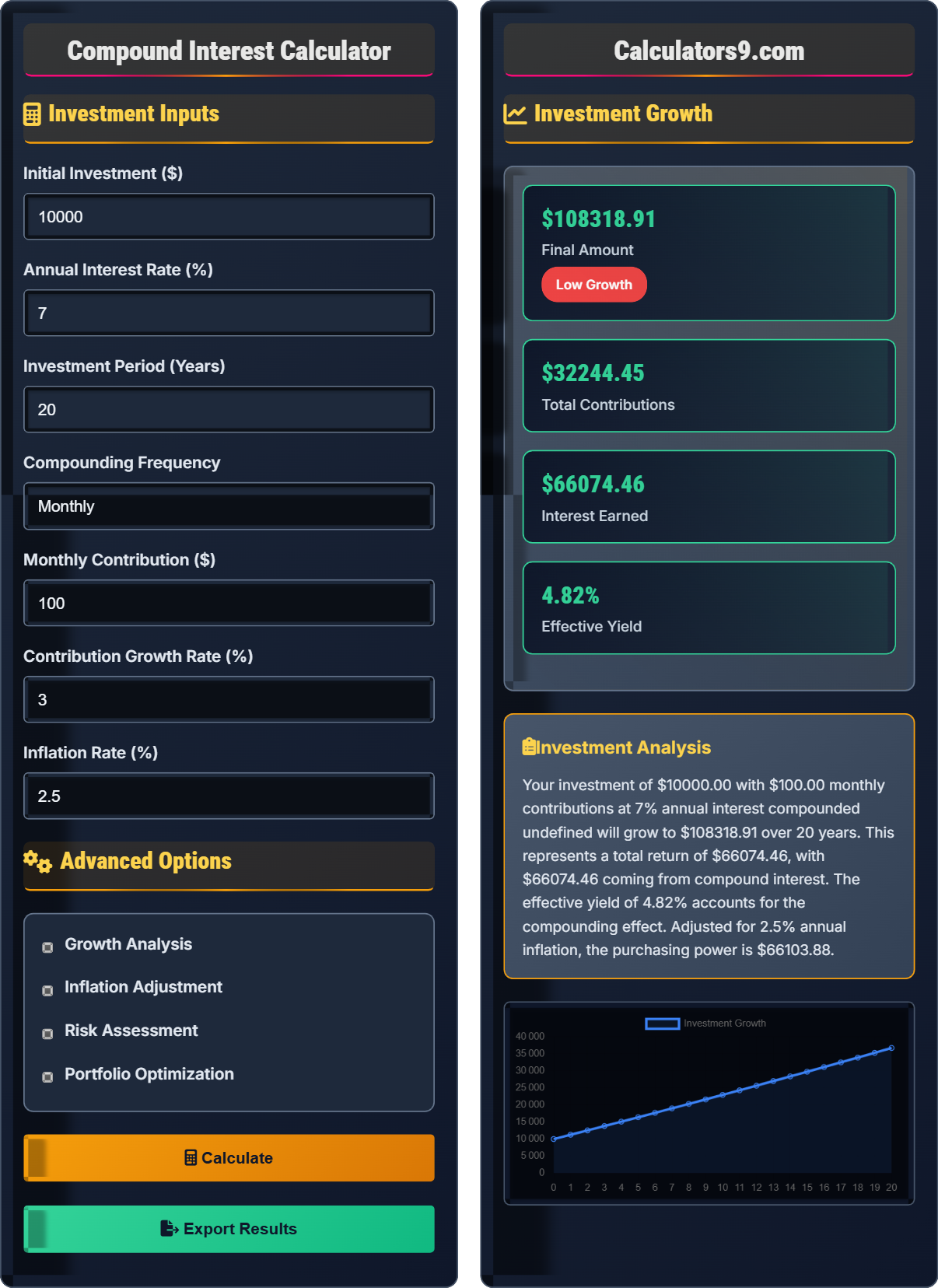
Example: For $10,000 invested at 7% annual interest, compounded monthly for 20 years:
\( A = 10000(1 + \frac{0.07}{12})^{12 \times 20} = 10000(1.005833)^{240} = \$40,387.25 \)
This demonstrates the power of compound interest, growing $10,000 to over $40,000 through reinvestment of earnings.
Investment Inputs
Advanced Options
Investment Growth
| Year | Balance | Contributions | Interest Earned |
|---|
| Component | Amount | % of Total | Growth Factor |
|---|
Comprehensive Compound Interest Guide
Compound interest is interest calculated on both the initial principal and accumulated interest from previous periods. This creates exponential growth where your investment earns returns on returns. The effect accelerates over time, making it a powerful tool for wealth building. Albert Einstein reportedly called compound interest "the eighth wonder of the world" and said "he who understands it, earns it; he who doesn't, pays it."
Key factors affecting compound interest growth:
Rate: Annual interest rate
Time: Investment period
Frequency: Compounding intervals
These factors determine the growth trajectory of your investment.
Common investment options for compound growth:
- Stock Market: Historical 7-10% annual returns
- Bonds: Lower risk, 3-5% annual returns
- REITs: Real estate exposure, 6-8% returns
- CDs: Guaranteed returns, 1-3% annually
- Retirement Accounts: Tax advantages for long-term growth
- Automate investments to maintain consistency
- Reinvest dividends to maximize compound growth
- Diversify investments to manage risk
- Stay invested long-term to benefit from compounding
- Adjust contributions as income increases
Compound Interest Fundamentals
Interest earned on both principal and accumulated interest (exponential growth).
A = P(1 + r/n)^(nt)
Calculates future value with compound interest.
- Time is the most important factor
- Higher rates accelerate growth
- More frequent compounding increases returns
Growth Analysis
Exponential growth accelerates over time, with most growth in later years.
- Start investing early
- Increase contributions regularly
- Choose higher-yielding investments
- Minimize fees and taxes
- Market volatility affects returns
- Inflation reduces purchasing power
- Taxes impact net returns
- Risk increases with higher returns
Compound Interest Learning Quiz
What makes compound interest different from simple interest?
The answer is B) Compound interest is calculated on principal and accumulated interest. This is the fundamental difference between compound and simple interest. Simple interest is calculated only on the original principal amount, while compound interest earns returns on both the principal and previously earned interest, creating exponential growth over time.
Students must understand that compound interest creates a "snowball effect" where earnings generate their own earnings. This exponential growth accelerates over time, making it the foundation of long-term wealth building. The difference between simple and compound interest becomes dramatic over extended periods.
Compound Interest: Interest earned on principal and accumulated interest
Simple Interest: Interest earned only on principal amount
Exponential Growth: Growth that accelerates over time
• Compound interest = Principal + Interest × Rate
• Simple interest = Principal × Rate × Time
• Compound interest grows exponentially
• Remember: Compound = Principal + Interest
• Simple = Principal only
• Exponential growth accelerates over time
• Confusing compound with simple interest
• Not understanding exponential growth
• Underestimating long-term effects
Calculate the final amount for $5,000 invested at 6% annual interest, compounded quarterly, for 10 years. Show your work.
Step 1: Identify the formula components
A = P(1 + r/n)^(nt)
P = $5,000 (principal)
r = 0.06 (annual rate as decimal)
n = 4 (quarterly compounding)
t = 10 (years)
Step 2: Apply the formula
A = $5,000(1 + 0.06/4)^(4×10)
A = $5,000(1 + 0.015)^40
A = $5,000(1.015)^40
A = $5,000 × 1.814018
A = $9,070.09
Step 3: Verify the result
The investment grows from $5,000 to $9,070.09, representing 81.4% growth.
Therefore, the final amount is $9,070.09.
This calculation demonstrates the compound interest formula with quarterly compounding. The interest rate is divided by the number of compounding periods per year (0.06 ÷ 4 = 0.015), and the total number of periods is the number of years multiplied by compounding frequency (10 × 4 = 40). This results in more frequent compounding than annually, leading to higher final returns.
Principal (P): Initial investment amount
Annual Rate (r): Interest rate as decimal
Compounding Frequency (n): Times interest is applied per year
• A = P(1 + r/n)^(nt)
• Convert percentage to decimal
• More frequent compounding = higher returns
• Convert rate to decimal (6% = 0.06)
• Calculate total periods (n × t)
• Verify with estimation
• Forgetting to convert percentage to decimal
• Using wrong number of compounding periods
• Miscalculating the exponent
Person A invests $10,000 at age 25, while Person B invests $10,000 at age 35. Both earn 7% annually compounded monthly. How much more will Person A have at age 65? Show your calculations.
Person A: Invests at age 25 for 40 years
P = $10,000, r = 0.07, n = 12, t = 40
A = $10,000(1 + 0.07/12)^(12×40)
A = $10,000(1.005833)^480
A = $10,000 × 16.44887 = $164,488.70
Person B: Invests at age 35 for 30 years
P = $10,000, r = 0.07, n = 12, t = 30
A = $10,000(1 + 0.07/12)^(12×30)
A = $10,000(1.005833)^360
A = $10,000 × 8.116497 = $81,164.97
Difference = $164,488.70 - $81,164.97 = $83,323.73
Person A will have $83,323.73 more despite investing the same amount.
This problem dramatically illustrates the power of time in compound interest. Person A invested for 10 additional years but ended up with over twice as much money. The extra decade allowed for significantly more compounding cycles, demonstrating why starting early is crucial for wealth building. This is often called the "time value of money" principle.
Time Value of Money: Value of money increases with time due to earning potential
Compounding Periods: Number of times interest is applied
Exponential Growth: Growth that accelerates over time
• Time is the most important factor
• Earlier investments have exponential advantage
• Small time differences can create large outcome differences
• Start investing as early as possible
• Even small amounts benefit from time
• The difference compounds over time
• Underestimating the power of time
• Thinking small differences don't matter
• Not considering compounding effects
Compare the final amounts for $10,000 invested at 6% annual interest for 10 years, compounded annually vs. monthly. What is the difference and why does it occur?
Annual Compounding:
A = $10,000(1 + 0.06/1)^10
A = $10,000(1.06)^10
A = $10,000 × 1.790848 = $17,908.48
Monthly Compounding:
A = $10,000(1 + 0.06/12)^120
A = $10,000(1.005)^120
A = $10,000 × 1.819397 = $18,193.97
Difference = $18,193.97 - $17,908.48 = $285.49
The monthly compounding yields $285.49 more due to more frequent interest application, allowing interest to earn interest more often.
Explanation: Monthly compounding applies interest 120 times vs. 10 times annually, accelerating growth through more frequent compounding cycles.
This problem demonstrates how compounding frequency affects returns. More frequent compounding (monthly vs. annually) results in higher final amounts because interest is applied more often, allowing for more compounding cycles. The effect becomes more pronounced over longer time periods and with higher interest rates.
Compounding Frequency: How often interest is calculated and added
Interest Cycles: Number of times interest is applied
Effective Rate: Actual rate earned due to compounding
• More frequent compounding = higher returns
• Difference increases with time
• Higher rates amplify the difference
• Choose investments with more frequent compounding
• The effect is more pronounced with higher rates
• Long-term investments benefit most
• Assuming all compounding is equal
• Not considering frequency in comparisons
• Underestimating the cumulative effect
According to the Rule of 72, how long will it take for an investment to double at 8% annual interest?
The answer is C) 9 years. The Rule of 72 is a quick way to estimate how long it takes for an investment to double: Years to Double = 72 ÷ Interest Rate. So, 72 ÷ 8 = 9 years. This is an approximation that works well for interest rates between 6-10%.
The Rule of 72 is a valuable shortcut for estimating compound growth. It's particularly useful for mental calculations and understanding the relationship between interest rates and doubling time. The rule becomes less accurate for very high or low interest rates but provides a good approximation for typical investment returns.
Rule of 72: Approximation for time to double investment
Exponential Growth: Growth that accelerates over time
Investment Doubling: When investment value doubles
• Years to Double = 72 ÷ Interest Rate
• Works best for 6-10% rates
• Higher rates = shorter doubling time
• Quick mental calculation tool
• Higher rates halve the time
• Useful for investment comparisons
• Using for very high or low rates
• Confusing with exact calculation
• Forgetting it's an approximation
FAQ
Q: How does compound interest work in real investments?
A: In real investments, compound interest works through:
- Stock dividends: Reinvested dividends purchase additional shares
- Bond interest: Interest payments can be reinvested
- Index funds: Automatic reinvestment of distributions
- CDs: Interest compounds if rolled over
Mathematically, if your investment grows by \( r \% \) annually:
\( \text{Future Value} = \text{Present Value} \times (1 + \frac{r}{100})^t \)
For example, with \( r = 7\% \) and \( t = 20 \) years:
\( \text{Future Value} = PV \times (1.07)^{20} = PV \times 3.87 \)
This means your investment would grow by 287% over 20 years.
Q: What's the difference between nominal and effective interest rates?
A: The nominal rate is the stated annual interest rate, while the effective rate accounts for compounding:
\( \text{Effective Rate} = (1 + \frac{\text{Nominal Rate}}{n})^n - 1 \)
For example, with a 6% nominal rate compounded monthly:
- Nominal Rate = 6%
- Effective Rate = (1 + 0.06/12)^12 - 1 = 6.17%
- The effective rate is higher due to monthly compounding
The effective rate represents the actual annual return considering compounding frequency.