Dividend Yield Calculator
Annual return analysis • 2026 market strategy
Dividend Yield Formula:
Show Calculator\( \text{Dividend Yield} = \frac{\text{Annual Dividend Per Share}}{\text{Current Stock Price}} \times 100\% \)
Where:
- \( \text{Annual Dividend Per Share} = \text{Dividend Per Share} \times \text{Number of Payments Per Year} \)
- \( \text{Dividend Growth Rate} = \frac{\text{New DPS} - \text{Old DPS}}{\text{Old DPS}} \times 100\% \)
- \( \text{Future Dividend} = \text{Current DPS} \times (1 + \text{Growth Rate})^n \)
This formula calculates the percentage return on investment from dividends alone, helping investors evaluate income-generating stocks.
Example: A stock trading at $100 with an annual dividend of $5 per share has a dividend yield of ($5/$100) × 100% = 5%.
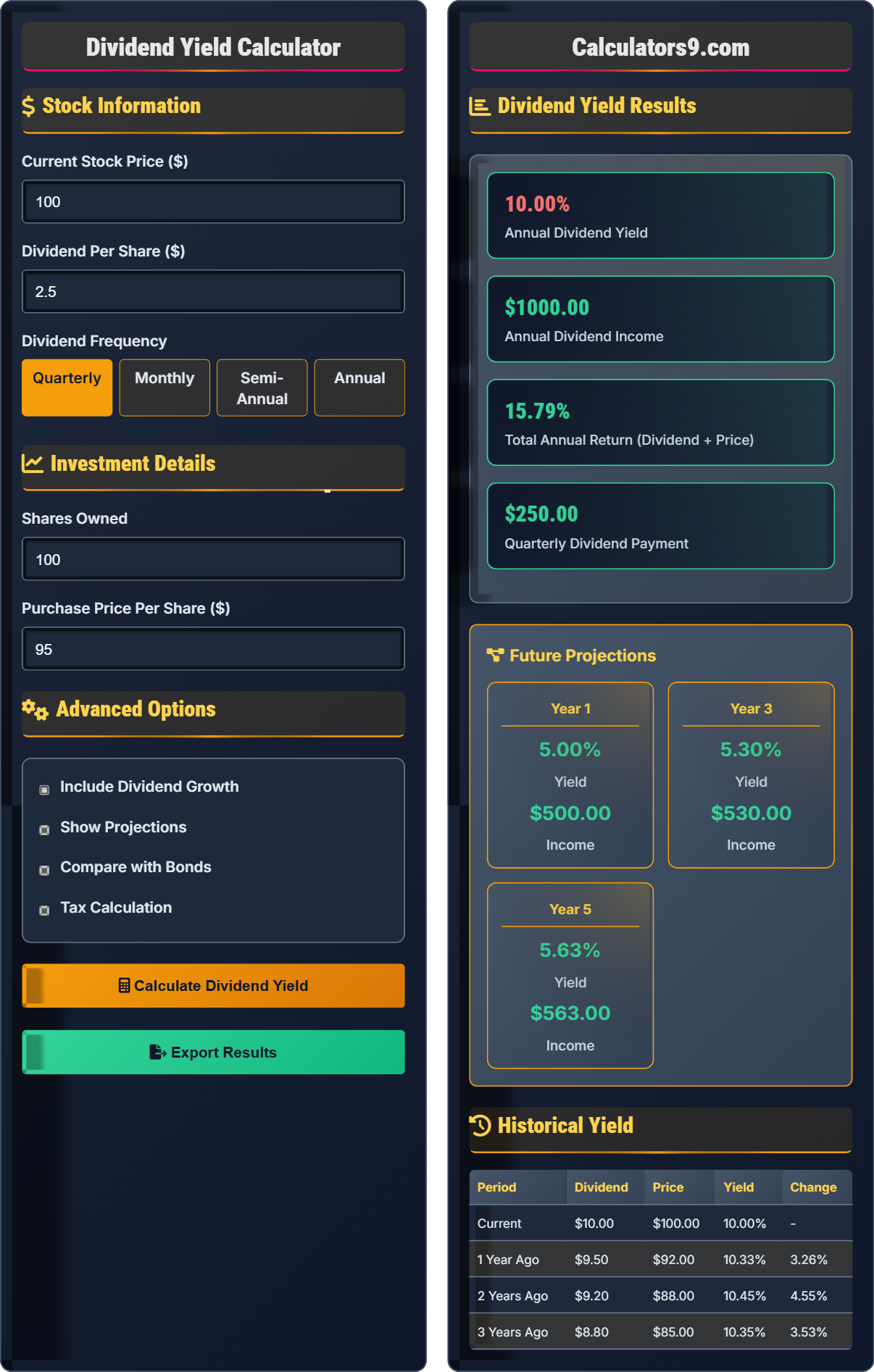
Stock Information
Investment Details
Advanced Options
Dividend Yield Results
Historical Yield
| Period | Dividend | Price | Yield | Change |
|---|
Dividend Yield Investment Strategy Guide
Dividend yield is a financial ratio that shows how much a company pays out in dividends each year relative to its stock price. It's an indicator of the income generated from an investment, expressed as a percentage. This metric is particularly important for income-focused investors who rely on dividend payments for regular cash flow.
The formula for calculating dividend yield:
Where Annual Dividend Per Share is the total dividends paid per share over a year.
Factors to evaluate when analyzing dividend yields:
- Dividend Sustainability: Whether the company can maintain payments during economic downturns
- Dividend Growth: Historical trend of increasing dividend payments over time
- Payout Ratio: Percentage of earnings paid as dividends (lower ratios are more sustainable)
- Industry Standards: Compare yields within the same sector for context
- Diversify Holdings: Don't concentrate all investments in high-yield stocks
- Check Payout Ratios: Avoid companies with payout ratios above 80%
- Review History: Look for companies with consistent dividend payment records
- Consider Growth: Balance high yield with dividend growth potential
- Assess Fundamentals: Ensure strong financials beyond just the dividend yield
Dividend Yield Basics
Annual dividend income as a percentage of stock price.
\( \text{Dividend Yield} = \frac{\text{Annual Dividend Per Share}}{\text{Current Stock Price}} \times 100\% \)
Calculate percentage return from dividends alone.
- Higher yields aren't always better
- Check dividend sustainability
- Compare within industry sectors
- Consider dividend growth trends
Yield Analysis
High (4%+), Medium (2-4%), Low (0-2%), None (0%)
- Calculate current yield
- Assess payout ratio
- Review dividend history
- Compare with peers
- Very high yields may be unsustainable
- Yield can fluctuate with stock price
- Dividends can be cut
- Focus on total return, not just yield
Dividend Yield Learning Quiz
A stock is trading at $80 per share and pays a quarterly dividend of $1.00 per share. What is the annual dividend yield?
The answer is B) 5.00%. First, calculate the annual dividend: $1.00 per quarter × 4 quarters = $4.00 per year. Then, calculate the dividend yield: ($4.00 ÷ $80) × 100% = 5.00%.
This problem demonstrates the importance of converting periodic dividends to an annual amount before calculating yield. Many stocks pay dividends quarterly, semi-annually, or monthly, so you must annualize the payments first. The formula requires the total annual dividend per share divided by the current stock price.
Dividend Yield: Annual dividend income as a percentage of stock price
Annualization: Converting periodic payments to an annual equivalent
Dividend Per Share (DPS): The amount paid per share during a specific period
• Always annualize periodic dividends before calculating yield
• Quarterly dividends: multiply by 4
• Monthly dividends: multiply by 12
• Remember: Annual Dividend = DPS × Number of Payments Per Year
• Quarterly = 4 payments, Monthly = 12 payments
• Always double-check the dividend frequency
• Using the quarterly dividend directly instead of annualizing
• Confusing dividend yield with total return
• Forgetting to convert the decimal to a percentage
If you own 200 shares of a stock purchased at $50 per share, and the stock now trades at $55 with an annual dividend yield of 4%, what is your total annual return (including both dividends and price appreciation)? Show your work.
div class="solution-section">Step 1: Calculate the current dividend per share using yield:
Dividend Yield = Annual Dividend / Current Price
4% = Annual Dividend / $55
Annual Dividend = $55 × 0.04 = $2.20 per share
Step 2: Calculate annual dividend income:
Annual Income = 200 shares × $2.20 = $440
Step 3: Calculate price appreciation:
Gain per share = $55 - $50 = $5
Total gain = 200 × $5 = $1,000
Step 4: Calculate total return:
Total Return = ($440 + $1,000) ÷ (200 × $50) = $1,440 ÷ $10,000 = 14.4%
Therefore, your total annual return is 14.4%.
This problem demonstrates the difference between dividend yield and total return. Dividend yield only considers income from dividends, while total return includes both dividend income and capital appreciation. Investors should consider both components when evaluating an investment's performance.
Total Return: Combined return from both capital appreciation and dividend income
Capital Appreciation: Increase in stock price over time
Dividend Income: Cash payments received from owning dividend-paying stock
• Total Return = (Dividend Income + Capital Gains) ÷ Initial Investment
• Dividend yield is just one component of total return
• Both components contribute to overall investment performance
• Calculate dividend income separately from capital gains
• Use the formula: Total Return = (Dividends + Price Change) ÷ Cost Basis
• Consider both income and growth components in your analysis
• Confusing dividend yield with total return
• Only considering dividend income and ignoring capital appreciation
• Using current price instead of cost basis in return calculation
Jane owns 150 shares of a company currently trading at $60 per share with an annual dividend of $3 per share (yield of 5%). If the company maintains a 6% annual dividend growth rate, what will be the dividend yield after 3 years assuming the stock price remains constant? What if the stock price increases to $70?
Scenario 1 - Stock price remains at $60:
Step 1: Calculate future dividend after 3 years of 6% growth:
Future Dividend = Current Dividend × (1 + Growth Rate)^Years
Future Dividend = $3 × (1.06)^3 = $3 × 1.191 = $3.57 per share
Step 2: Calculate new yield with constant price:
Yield = ($3.57 ÷ $60) × 100% = 5.95%
Scenario 2 - Stock price increases to $70:
Yield = ($3.57 ÷ $70) × 100% = 5.10%
Therefore, if the stock price stays constant, the yield will be 5.95%. If the stock price increases to $70, the yield will be 5.10%.
This example illustrates how dividend yield is inversely related to stock price. As the stock price increases, the yield decreases (assuming constant dividend), and vice versa. This is important for investors to understand when comparing stocks or evaluating the attractiveness of dividend yields at different price levels.
Dividend Growth Rate: The annual percentage increase in dividend payments
Compounding Effect: Growth applied to the growing dividend amount each year
Yield Compression: Decrease in yield due to rising stock prices
• Dividend yield = Annual Dividend ÷ Stock Price
• Higher stock prices result in lower yields (all else equal)
• Dividend growth can offset yield compression
• Use the compound growth formula: Future Value = Present Value × (1 + r)^n
• Monitor both dividend growth and price movement
• Consider the sustainability of dividend growth rates
• Forgetting to account for stock price changes affecting yield
• Assuming dividend growth will continue indefinitely
• Not using compound growth formula for multi-year projections
A company pays an annual dividend of $4 per share and has earnings per share of $6. The stock trades at $80 per share. Calculate the dividend yield and payout ratio. Is this dividend sustainable? If the company's earnings drop by 25%, what would be the new payout ratio?
Step 1: Calculate dividend yield:
Yield = ($4 ÷ $80) × 100% = 5.00%
Step 2: Calculate payout ratio:
Payout Ratio = (Annual Dividend Per Share ÷ Earnings Per Share) × 100%
Payout Ratio = ($4 ÷ $6) × 100% = 66.67%
Step 3: Assess sustainability:
With a payout ratio of 66.67%, the dividend appears reasonably sustainable. Generally, ratios below 80% are considered sustainable, though this varies by industry.
Step 4: Calculate new payout ratio with 25% earnings drop:
New EPS = $6 × (1 - 0.25) = $4.50
New Payout Ratio = ($4 ÷ $4.50) × 100% = 88.89%
With a new payout ratio of 88.89%, the dividend becomes less sustainable as it approaches the warning threshold of 90%.
This problem demonstrates the importance of the payout ratio in assessing dividend sustainability. The payout ratio measures what percentage of earnings is paid out as dividends. A lower ratio indicates more room for the company to maintain or increase dividends even if earnings decline. Investors should look for companies with reasonable payout ratios that provide a buffer against earnings volatility.
Payout Ratio: Percentage of earnings paid out as dividends
Sustainability: Ability to maintain dividend payments under various conditions
Earnings Per Share (EPS): Company's profit allocated to each outstanding share
• Payout Ratio = (Dividends Per Share ÷ Earnings Per Share) × 100%
• Ratios below 80% are generally considered sustainable
• Higher ratios indicate greater risk of dividend cuts
• Compare payout ratios within the same industry
• Look for companies with consistent payout ratios over time
• Consider the business cycle and earnings stability
• Only looking at dividend yield without considering payout ratio
• Assuming high yields are always better
• Not adjusting for industry-specific payout ratio norms
Which of the following dividend yields should raise the most concern about sustainability?
The answer is D) 12.0%. Extremely high dividend yields (typically above 7-8%) often signal potential problems with dividend sustainability. Such high yields can occur when stock prices fall dramatically due to company troubles, making the yield appear artificially high. Investors should investigate the underlying reasons for high yields, including the company's financial health and ability to maintain payments.
This question addresses the "dividend yield trap" where extremely high yields may actually indicate financial distress rather than attractive investment opportunities. High yields can result from falling stock prices rather than increasing dividends, which is often a sign of underlying problems. Investors should always investigate the cause of unusually high yields before investing.
Dividend Yield Trap: Attractive high yield that masks underlying financial problems
Sustainability: Company's ability to continue dividend payments
Financial Distress: Difficulty meeting financial obligations
• Very high yields may indicate financial trouble
• Investigate the cause of high dividend yields
• Consider payout ratio alongside yield
• Be cautious of yields above 7-8% without thorough research
• Check the company's dividend history and financials
• Look for consistent dividend growth patterns
• Being attracted to high yields without investigating the cause
• Not considering the company's financial health
• Assuming higher yield always means better investment
FAQ
Q: How do I know if a dividend yield is sustainable?
A: To assess dividend sustainability, focus on the payout ratio: \( \text{Payout Ratio} = \frac{\text{Dividends Per Share}}{\text{Earnings Per Share}} \times 100\% \)
Generally, payout ratios below 60-70% indicate strong sustainability. Ratios above 80-90% suggest potential risk, especially if earnings decline. Additionally, examine:
- Free Cash Flow: Does the company generate enough cash to cover dividends?
- Dividend History: Has the company maintained payments during economic downturns?
- Debt Levels: Excessive debt can strain dividend capacity
- Industry Norms: Compare with sector peers
For example, if a company has EPS of $4 and pays $2.40 in dividends, the payout ratio is 60%, suggesting reasonable sustainability.
Q: What's the difference between dividend yield and total return?
A: Dividend yield measures only the income component of investment returns:
\( \text{Dividend Yield} = \frac{\text{Annual Dividends Per Share}}{\text{Current Stock Price}} \times 100\% \)
Total return encompasses both income and capital appreciation:
\( \text{Total Return} = \frac{\text{Dividend Income} + \text{Capital Gain}}{\text{Initial Investment}} \times 100\% \)
For example, if you invest $100 in a stock, receive $4 in dividends, and the stock appreciates to $105, your dividend yield is 4% but your total return is 9% (($4 + $5) ÷ $100). For long-term wealth building, total return is more important than dividend yield alone.