Inflation Adjusted Return Calculator
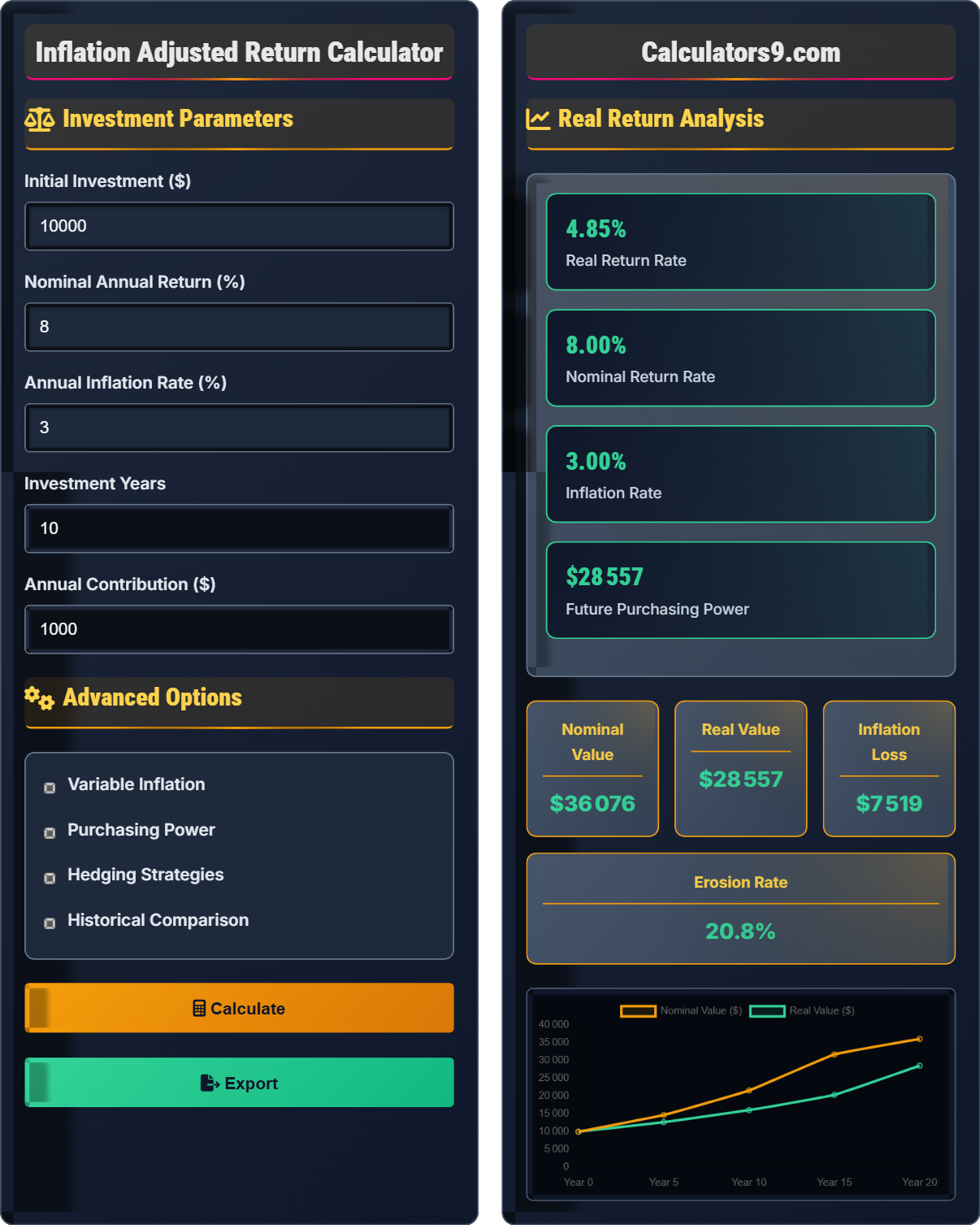
Real investment performance • 2026 rates
Inflation Adjusted Return Formula:
Show the calculatorReal Return = (1 + Nominal Return) / (1 + Inflation Rate) - 1
Approximate Real Return = Nominal Return - Inflation Rate
Where:
- Nominal Return: Investment return before inflation
- Inflation Rate: Rate of price increases
- Real Return: Investment return after inflation
These formulas calculate the true purchasing power of investment returns. The exact formula is more accurate for higher inflation rates, while the approximation works well for low inflation environments.
Example: 8% nominal return with 3% inflation:
Exact: (1.08 / 1.03) - 1 = 4.85%
Approximation: 8% - 3% = 5%
The real return of 4.85% represents the actual growth in purchasing power.
Investment Parameters
Advanced Options
Real Return Analysis
Purchasing Power Analysis
Inflation Impact
Real Return Analysis
Hedging Strategies
Comprehensive Inflation Adjusted Return Guide
Inflation adjusted return (real return) measures investment performance after accounting for the erosion of purchasing power caused by inflation. It represents the true growth of wealth in terms of what goods and services the money can actually buy, rather than just the nominal increase in dollar amount.
The standard real return calculation uses the Fisher equation:
Where:
- Nominal Return: Investment return before inflation adjustment
- Inflation Rate: Rate of general price level increases
- Real Return: True purchasing power growth
Several investment strategies can help protect against inflation:
- TIPS: Treasury Inflation-Protected Securities
- Real Estate: Property values often rise with inflation
- Commodities: Natural hedge against price increases
- REITs: Real Estate Investment Trusts
- Stocks: Companies can raise prices to maintain margins
- Focus on Real Returns: Prioritize after-inflation returns
- Asset Allocation: Include inflation-protected assets
- Duration Matching: Consider inflation impact on time horizons
- International Diversification: Spread across different inflation environments
- Regular Review: Adjust strategies as inflation expectations change
Real Return Fundamentals
Investment return after accounting for purchasing power erosion.
Real Return = (1 + Nominal) / (1 + Inflation) - 1
Where real = true return, nominal = stated return, inflation = price increase rate.
- Real return shows true wealth growth
- High inflation reduces real returns
- Focus on real, not nominal returns
Inflation Protection
Maintaining the ability to buy the same goods/services over time.
- Invest in inflation-protected securities
- Include real assets in portfolio
- Monitor inflation expectations
- Adjust allocations accordingly
- Even low inflation erodes purchasing power
- Time amplifies inflation impact
- Some assets naturally hedge inflation
- Tax implications may increase with inflation
Inflation Adjusted Return Learning Quiz
Why is real return more important than nominal return for long-term investment planning?
The answer is B) Real return accounts for purchasing power changes. Real return measures actual wealth growth by adjusting for inflation. Nominal return only shows the increase in dollar amount without considering that those dollars may buy less due to rising prices. For long-term planning, real return is crucial because it indicates whether your investment is truly growing in value.
Real return is the true measure of investment success because it accounts for the changing value of money over time. If you earn 8% on an investment but inflation is 3%, your real return is only about 4.85%. This means your purchasing power increases by 4.85%, not 8%. Understanding this difference is essential for accurate long-term financial planning.
Nominal Return: Investment return without inflation adjustment
Real Return: Investment return adjusted for inflation
Purchasing Power: Ability to buy goods and services
• Real return = True wealth growth
• Nominal return = Stated dollar growth
• Inflation erodes purchasing power
• Always consider real returns for long-term planning
• Use real returns when comparing investments
• Inflation compounds over time
• Focusing only on nominal returns
• Not accounting for inflation in projections
• Underestimating long-term inflation impact
If an investment earns 12% nominal return and inflation is 4%, what is the real return using the exact formula? Show your work.
Step 1: Apply the exact real return formula
Real Return = (1 + Nominal Return) / (1 + Inflation Rate) - 1
Step 2: Substitute the values
Real Return = (1 + 0.12) / (1 + 0.04) - 1
Real Return = 1.12 / 1.04 - 1
Step 3: Calculate
Real Return = 1.0769 - 1 = 0.0769
Real Return = 7.69%
Therefore, the real return is 7.69%.
This calculation shows the exact method for finding real return. The formula accounts for the compounding effect of inflation on purchasing power. While the approximation (12% - 4% = 8%) is close, the exact formula is more accurate, especially with higher inflation rates. The 0.31% difference may seem small but compounds significantly over time.
Exact Formula: (1+N)/(1+I) - 1
Approximation: N - I (less accurate for high inflation)
Compounding Effect: Inflation affects returns over time
• Exact formula: (1+N)/(1+I) - 1
• Approximation: N - I (for quick estimates)
• Use exact formula for precision
• Exact: (1 + Nominal)/(1 + Inflation) - 1
• Approximation good for low inflation
• Exact better for high inflation
• Forgetting to add 1 to both rates
• Not subtracting 1 at the end
• Using percentages instead of decimals
You invest $10,000 earning 7% nominal return annually. If inflation averages 3% per year, what will be the real value of your investment after 20 years?
Step 1: Calculate nominal future value
Nominal FV = $10,000 × (1.07)^20 = $10,000 × 3.870 = $38,700
Step 2: Calculate real return rate
Real Return = (1.07/1.03) - 1 = 0.0388 = 3.88%
Step 3: Calculate real future value
Real FV = $10,000 × (1.0388)^20 = $10,000 × 2.147 = $21,470
Step 4: Calculate inflation erosion
Erosion = $38,700 - $21,470 = $17,230
Therefore, the real value will be $21,470 after 20 years.
This example dramatically shows inflation's impact over time. While your investment grows to $38,700 in nominal terms, its real purchasing power is only $21,470. The $17,230 difference represents the purchasing power lost to inflation. This demonstrates why considering real returns is crucial for long-term investment planning and retirement savings.
Real Value: Future value adjusted for inflation
Purchasing Power: What the money can buy
Inflation Erosion: Loss of purchasing power
• Inflation compounds over time
• Long-term impact is exponential
• Real value = True wealth growth
• Calculate real return first for accuracy
• Use real returns for long-term projections
• Inflation impact grows exponentially
• Only calculating nominal future value
• Not accounting for inflation in projections
• Underestimating long-term erosion
You're comparing two investments: Investment A offers 6% nominal return with 3% inflation, Investment B offers 8% nominal return with 5% inflation. Which investment provides a better real return and why?
Step 1: Calculate real return for Investment A
Real Return A = (1.06/1.03) - 1 = 1.0291 - 1 = 0.0291 = 2.91%
Step 2: Calculate real return for Investment B
Real Return B = (1.08/1.05) - 1 = 1.0286 - 1 = 0.0286 = 2.86%
Step 3: Compare results
Investment A: 2.91% real return
Investment B: 2.86% real return
Step 4: Conclusion
Investment A provides a slightly better real return despite having a lower nominal return.
This example shows why focusing on nominal returns can be misleading. Investment B appears better with 8% vs 6% nominal return, but Investment A is actually better after adjusting for inflation. Investment A has a 0.05% higher real return. This demonstrates that the investment with the highest nominal return isn't always the best choice when inflation is considered.
Real Return Comparison: Adjusted for inflation effects
Inflation Adjusted: Accounts for purchasing power
True Value: Actual wealth growth
• Compare real returns, not nominal
• High inflation reduces real returns
• Lower inflation preserves returns better
• Always calculate real returns for comparison
• High nominal return ≠ better investment
• Consider inflation when evaluating investments
• Comparing nominal returns only
• Not adjusting for different inflation rates
• Assuming higher nominal = better
Which of the following best describes the relationship between inflation rate and real return?
The answer is B) Higher inflation always decreases real return. According to the real return formula (Real = (1+N)/(1+I) - 1), as the inflation rate (I) increases, the denominator increases, making the fraction smaller, thus reducing the real return. Higher inflation always reduces real returns, all else being equal.
Inflation acts as a drag on investment returns by reducing purchasing power. Even if your investment grows in dollar terms, if prices rise faster than your investment, you're actually getting poorer in real terms. This is why inflation is often called "the invisible tax" on investment returns. The relationship is mathematically inverse.
Inflation Erosion: Reduction in purchasing power
Invisible Tax: Inflation's effect on returns
Mathematical Relationship: Inverse correlation
• Higher inflation = Lower real return
• Inflation erodes purchasing power
• Relationship is mathematically inverse
• Inflation is always the enemy of real returns
• Higher inflation = worse real returns
• Consider inflation when setting return expectations
• Thinking inflation helps investment returns
• Not understanding the inverse relationship
• Assuming inflation only affects some investments
FAQ
Q: What's the difference between nominal return and real return, and why should I care about both?
A: The distinction is crucial for understanding true investment performance:
Nominal Return:
- The stated percentage gain on your investment
- Shows the increase in dollar amount
- Doesn't account for changes in purchasing power
- Example: If you earn 8% on a $10,000 investment, your account grows to $10,800
Real Return:
- The return after adjusting for inflation
- Shows the true increase in purchasing power
- Accounts for the fact that money buys less over time
- Example: With 3% inflation, your 8% nominal return becomes about 4.85% real return
You need to care about both because nominal returns tell you how much your money grew in dollar terms, but real returns tell you whether you actually got richer in terms of what you can buy.
Q: How can I protect my investments from inflation, and what are the most effective strategies?
A: Several strategies can help protect against inflation:
Government Securities:
- TIPS (Treasury Inflation-Protected Securities): Principal adjusts with inflation
- I-Bonds: Interest rate adjusts with inflation
Real Assets:
- Real Estate: Property values and rents often rise with inflation
- REITs: Provide exposure to real estate without direct ownership
- Commodities: Natural inflation hedges
Equities:
- Companies can raise prices to maintain margins
- Look for businesses with pricing power
- Energy and materials sectors often perform well
Asset Allocation:
- Include 10-20% inflation-protected assets in portfolio
- Consider international diversification
- Review allocation as inflation expectations change
The most effective approach is diversification across these categories, with TIPS being particularly effective for conservative investors.