IRR Calculator
Calculate investment returns • 2026 markets
IRR Formula:
Show the calculatorNPV = Σ [Cash Flowt / (1 + IRR)t] = 0
Where t = time period (0, 1, 2, ... n)
IRR is the discount rate that makes NPV = 0
Where:
- Cash Flowt: Cash flow at time t
- IRR: Internal Rate of Return (solved iteratively)
- t: Time period (0 = initial investment)
- NPV: Net Present Value
This formula calculates the discount rate that makes the net present value of all cash flows equal to zero. It represents the annualized effective compounded return rate of an investment.
Example: Initial investment of -$1000, followed by $400, $500, $600 over 3 years:
-$1000 + $400/(1+IRR)¹ + $500/(1+IRR)² + $600/(1+IRR)³ = 0
Solving iteratively: IRR ≈ 23.38%
The IRR of 23.38% represents the annualized return of this investment.
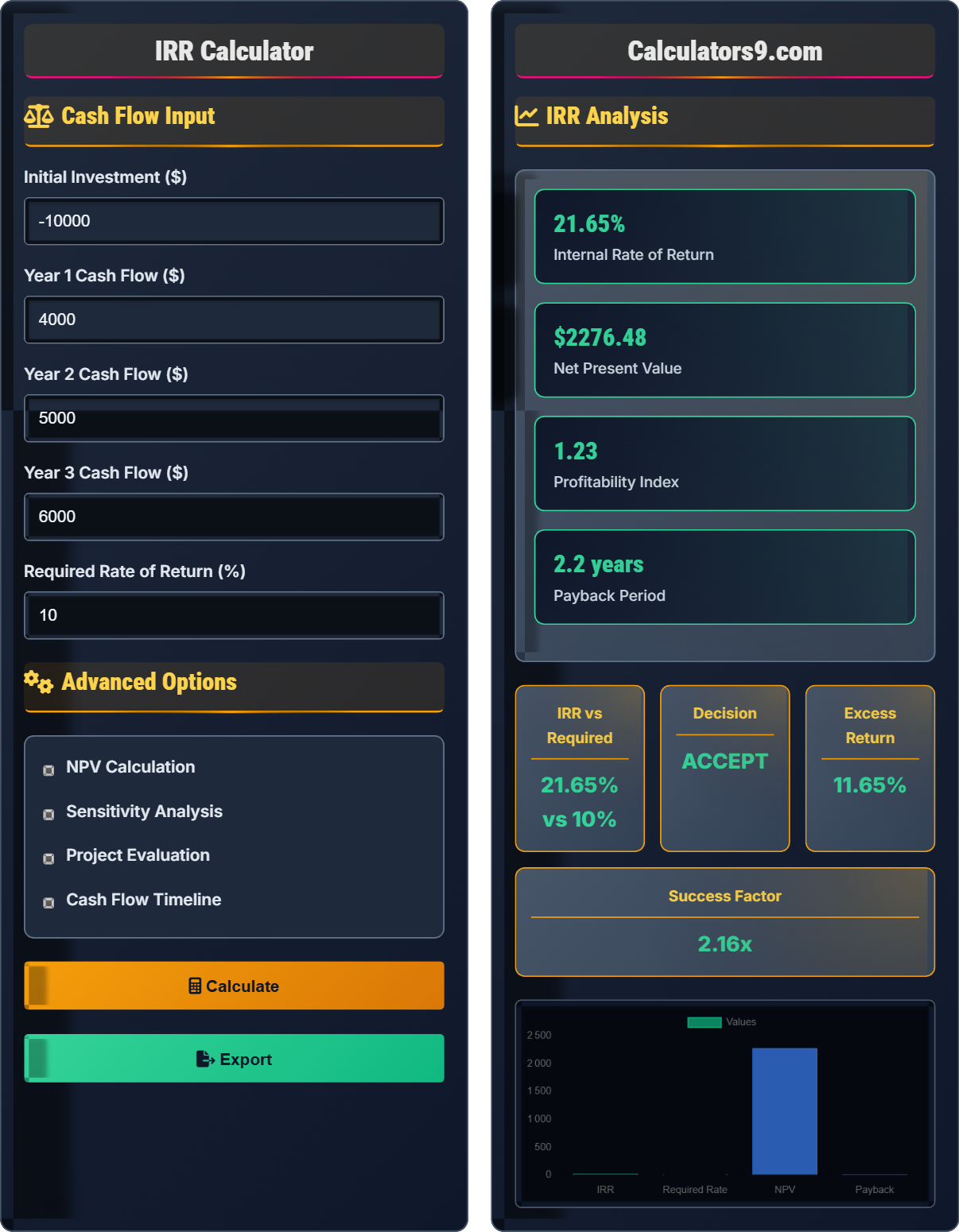
Cash Flow Input
Advanced Options
IRR Analysis
Cash Flow Analysis
NPV Analysis
Project Evaluation
Sensitivity Analysis
Comprehensive IRR Guide
Internal Rate of Return (IRR) is a financial metric used to evaluate the profitability of potential investments. It represents the annualized effective compounded return rate of an investment. IRR is the discount rate that makes the net present value (NPV) of all cash flows equal to zero.
The standard IRR calculation uses the following formula:
Where:
- Cash Flowt: Cash flow at time t
- IRR: Internal Rate of Return (solved iteratively)
- t: Time period (0 = initial investment)
- NPV: Net Present Value
Advantages:
- Provides percentage return that's easy to interpret
- Considers time value of money
- Uses all cash flows in analysis
- Helps rank projects of different sizes
Disadvantages:
- Multiple IRRs possible with alternating cash flows
- Assumes reinvestment at IRR rate
- Can conflict with NPV for mutually exclusive projects
- Complex calculation requiring iteration
- Project Evaluation: Assess investment opportunities
- Capital Budgeting: Rank competing projects
- Real Estate: Evaluate property investments
- Private Equity: Measure fund performance
- Business Expansion: Justify growth initiatives
IRR Fundamentals
Discount rate that makes NPV equal to zero.
NPV = Σ [CFt / (1+IRR)^t] = 0
Where NPV = net present value, CFt = cash flow at time t, IRR = internal rate.
- IRR > Required Rate = Accept
- IRR < Required Rate = Reject
- Higher IRR = Better investment
Investment Analysis
Using IRR to evaluate investment opportunities.
- Calculate IRR for each project
- Compare to required rate of return
- Consider NPV for confirmation
- Check for multiple IRRs
- IRR assumes reinvestment at same rate
- Can conflict with NPV ranking
- May have multiple solutions
- Works best for conventional cash flows
IRR Learning Quiz
What does IRR represent in financial analysis?
The answer is B) The discount rate that makes NPV equal to zero. IRR is defined as the discount rate at which the net present value of all cash flows (both positive and negative) from an investment equals zero. This represents the break-even discount rate where the present value of cash inflows equals the present value of cash outflows.
IRR is a fundamental concept in finance that helps investors determine the profitability of an investment. The key insight is that IRR finds the rate where the investment breaks even in present value terms. This rate can then be compared to required rates of return or other investment opportunities. Understanding this relationship between IRR and NPV is crucial for making sound investment decisions.
IRR: Internal Rate of Return
NPV: Net Present Value
Discount Rate: Rate used to calculate present value
• IRR makes NPV = 0
• IRR represents annualized return
• Compare IRR to required rate
• IRR = Rate where NPV = 0
• Higher IRR = Better investment
• Use with NPV for confirmation
• Confusing IRR with simple return
• Not understanding NPV relationship
• Forgetting time value of money
How do you determine if an investment with an IRR of 15% should be accepted when the required rate of return is 12%?
Step 1: Compare IRR to required rate of return
IRR = 15%
Required Rate = 12%
Step 2: Apply decision rule
Since IRR (15%) > Required Rate (12%), accept the investment
Step 3: Calculate excess return
Excess Return = 15% - 12% = 3%
Therefore, the investment should be accepted as it provides a 3% excess return over the required rate.
The fundamental decision rule for IRR is straightforward: accept investments where IRR exceeds the required rate of return. This means the investment generates returns above the minimum acceptable threshold. The excess represents additional value creation for investors. This rule ensures that capital is allocated to investments that create shareholder value.
Required Rate: Minimum acceptable return
Excess Return: Return above required rate
Value Creation: Returns above cost of capital• Accept: IRR > Required Rate
• Reject: IRR < Required Rate
• IRR = Annualized return rate
• IRR > Required Rate = ACCEPT
• IRR < Required Rate = REJECT
• Higher IRR = Better investment
• Accepting investments with IRR < required rate
• Not comparing to required rate
• Confusing acceptance criteria
You're evaluating two mutually exclusive projects. Project A has an IRR of 18% and Project B has an IRR of 22%. If the required rate of return is 15%, which project should you choose and why?
Step 1: Check if both projects meet the minimum requirement
Project A: 18% > 15%
Project B: 22% > 15% ✓
Step 2: Compare IRRs since both are acceptable
Project B has higher IRR (22%) than Project A (18%)
Step 3: Apply ranking rule for mutually exclusive projects
Choose the project with the highest IRR
Step 4: Calculate excess returns
Project A excess: 18% - 15% = 3%
Project B excess: 22% - 15% = 7%
Therefore, choose Project B because it provides a higher return (7% excess) compared to Project A (3% excess).
When comparing mutually exclusive projects (where you can only choose one), the project with the higher IRR is generally preferred, provided both exceed the required rate of return. Project B not only meets the minimum threshold but also provides 4% more excess return than Project A. However, it's important to also consider NPV as IRR can sometimes conflict with NPV rankings for mutually exclusive projects.
Mutually Exclusive: Only one project can be chosen
Excess Return: Return above required rate
Project Ranking: Ordering by preference
• Both must exceed required rate
• Choose highest IRR for mutually exclusive
• Consider NPV for confirmation
• Check minimum threshold first
• Higher IRR = Better for same risk
• Use NPV as tiebreaker if needed
• Choosing lower IRR project
• Not checking minimum threshold
• Forgetting NPV considerations
An investment has an IRR of 14%. What is the NPV when the discount rate is 14%? What happens to NPV if the discount rate increases to 16%?
Step 1: Understand IRR definition
IRR is the discount rate that makes NPV = 0
Step 2: Calculate NPV at IRR rate (14%)
NPV at 14% = $0 (by definition of IRR)
Step 3: Determine NPV at higher discount rate (16%)
When discount rate > IRR, NPV becomes negative
NPV at 16% < $0 (negative)
Step 4: Explain the relationship
NPV decreases as discount rate increases above IRR
Therefore, NPV = $0 at 14% discount rate, and NPV < $0 at 16% discount rate.
This demonstrates the fundamental relationship between IRR and NPV. At the IRR, NPV equals zero because the discount rate exactly compensates for the investment's returns. As the discount rate increases above the IRR, the present value of future cash flows decreases, making NPV negative. Conversely, when the discount rate is below the IRR, NPV is positive. This relationship is crucial for understanding investment decisions.
IRR-NPV Relationship: IRR makes NPV = 0
Discount Rate: Rate used to calculate present value
Present Value: Current value of future cash flows
• At IRR: NPV = 0
• Discount rate > IRR: NPV < 0
• Discount rate < IRR: NPV > 0
• IRR is the breakeven discount rate
• NPV and discount rate have inverse relationship
• Use this relationship for sensitivity analysis
• Thinking IRR and NPV are independent
• Not understanding the inverse relationship
• Forgetting NPV = 0 at IRR
Which of the following is a limitation of using IRR for investment decisions?
The answer is B) It can result in multiple solutions for unconventional cash flows. IRR can produce multiple solutions when cash flows change signs more than once (unconventional cash flows). This occurs because the IRR equation is polynomial and can have multiple roots. This is one of the significant limitations of IRR analysis.
One of the key limitations of IRR is its behavior with unconventional cash flows (cash flows that change signs more than once). For example, if an investment has an initial outflow, followed by inflows, and then another outflow (perhaps for cleanup costs), the IRR equation can have multiple valid solutions. This creates ambiguity in decision-making. Additionally, IRR assumes that intermediate cash flows are reinvested at the IRR rate, which may not be realistic.
Conventional Cash Flows: One sign change only
Unconventional Cash Flows: Multiple sign changes
Multiple IRRs: More than one valid solution
• IRR works best with conventional cash flows
• Multiple IRRs create decision ambiguity
• Consider NPV when IRR is problematic
• Check for multiple sign changes
• Use NPV when IRR is ambiguous
• Be cautious with unconventional cash flows
• Not checking for unconventional cash flows
• Assuming IRR always has unique solution
• Ignoring reinvestment rate assumption
FAQ
Q: What's the difference between IRR and ROI?
A: IRR and ROI are both measures of investment performance but differ significantly:
IRR (Internal Rate of Return):
- Discount rate that makes NPV equal to zero
- Considers time value of money
- Uses all cash flows over investment period
- Represents annualized compound return
- Calculated using iterative methods
- Example: An investment with IRR of 15% provides 15% annualized return
ROI (Return on Investment):
- (Net Profit ÷ Investment Cost) × 100
- Simple percentage gain
- Does not consider timing of cash flows
- Does not account for time value of money
- Calculated with simple arithmetic
- Example: Investment of $1,000 yielding $1,200 has ROI of 20%
IRR is more sophisticated as it accounts for when cash flows occur, making it better for comparing investments with different timelines.
Q: When should I use IRR versus NPV for investment decisions?
A: The choice between IRR and NPV depends on your specific situation:
Use NPV When:
- Comparing projects of different sizes
- Projects have different risk profiles
- Capital rationing is a concern
- Reinvestment rate assumptions are uncertain
- You need absolute value creation in dollars
- Mutually exclusive projects with different lifespans
Use IRR When:
- Comparing projects of similar size
- Communicating with stakeholders (easier to understand)
- Standardized required rate of return exists
- Projects have conventional cash flows
- Relative ranking is sufficient
- Quick comparison needed
Best Practice: Use both metrics together. NPV is theoretically superior for value maximization, but IRR is more intuitive for communication. When they conflict, NPV should take precedence for mutually exclusive projects.