NPV Discount Calculator
Calculate investment value • 2026 markets
NPV Formula:
Show the calculatorNPV = Σ [Cash Flowt / (1 + r)t]
Where t = time period (0, 1, 2, ... n)
Where r = discount rate (required rate of return)
Where:
- Cash Flowt: Cash flow at time t
- r: Discount rate (cost of capital)
- t: Time period (0 = initial investment)
- NPV: Net Present Value
This formula calculates the present value of all future cash flows minus the initial investment. It represents the value created for shareholders by accepting the project.
Example: Initial investment of -$1000, followed by $400, $500, $600 over 3 years at 10% discount rate:
NPV = -$1000 + $400/(1.1)¹ + $500/(1.1)² + $600/(1.1)³
NPV = -$1000 + $363.64 + $413.22 + $450.79 = $227.65
The NPV of $227.65 indicates the project creates value for shareholders.
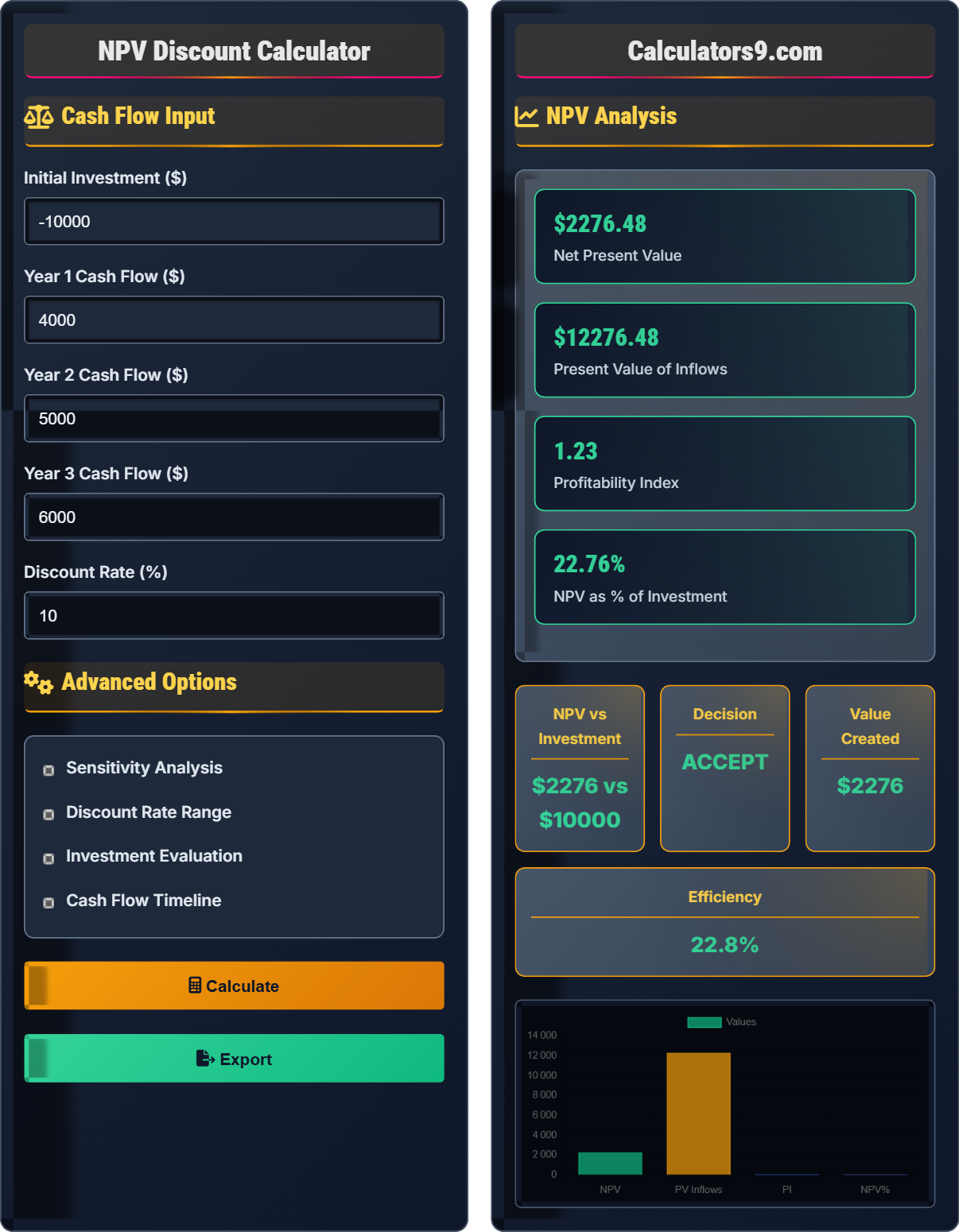
Cash Flow Input
Advanced Options
NPV Analysis
Cash Flow Analysis
Discount Rate Analysis
Investment Evaluation
Sensitivity Analysis
Comprehensive NPV Guide
Net Present Value (NPV) is a financial metric used to evaluate the profitability of an investment or project. It represents the difference between the present value of cash inflows and the present value of cash outflows over a period of time. NPV takes into account the time value of money, discounting future cash flows to their present value.
The standard NPV calculation uses the following formula:
Where:
- Cash Flowt: Cash flow at time t
- r: Discount rate (required rate of return)
- t: Time period (0 = initial investment)
- Σ: Summation over all time periods
Advantages:
- Considers time value of money
- Uses all cash flows in analysis
- Provides dollar value of benefit
- Considers risk through discount rate
Disadvantages:
- Requires accurate estimation of cash flows
- Requires appropriate discount rate selection
- Cannot easily compare projects of different sizes
- Complex to explain to non-financial stakeholders
- Capital Budgeting: Evaluate long-term investments
- Project Selection: Choose between competing projects
- Merger & Acquisition: Assess deal value
- Real Estate: Property investment analysis
- Business Expansion: Growth initiative evaluation
NPV Fundamentals
Difference between present value of inflows and outflows.
NPV = Σ [CFt / (1+r)^t]
Where NPV = net present value, CFt = cash flow at time t, r = discount rate.
- NPV > 0 = Accept
- NPV < 0 = Reject
- NPV = 0 = Indifferent
Investment Analysis
Using NPV to evaluate investment opportunities.
- Estimate all cash flows
- Select appropriate discount rate
- Calculate present value of each cash flow
- Sum all present values
- Accurate cash flow projections are critical
- Discount rate should reflect project risk
- NPV is additive for independent projects
- Consider qualitative factors as well
NPV Learning Quiz
What does a positive NPV indicate about an investment project?
The answer is B) The project creates value for shareholders. A positive NPV means that the present value of cash inflows exceeds the present value of cash outflows, indicating that the project generates returns above the required rate of return. This excess value accrues to shareholders, making it a value-creating investment.
NPV is fundamentally a value creation metric. When NPV is positive, it means the investment generates returns that exceed the cost of capital. This excess return represents value created for shareholders. The higher the positive NPV, the greater the value creation. Understanding this relationship is crucial for making sound investment decisions.
NPV: Net Present Value
Value Creation: Generating returns above cost of capital
Shareholder Value: Increase in shareholder wealth
• Positive NPV = Value Creation
• Negative NPV = Value Destruction
• Zero NPV = Break-even
• Positive NPV = ACCEPT
• Higher NPV = Better investment
• NPV measures absolute value creation
• Confusing positive NPV with negative value
• Not understanding value creation concept
• Forgetting time value of money
Calculate the NPV for an investment with an initial outlay of $10,000 and expected cash flows of $4,000 per year for 3 years at a discount rate of 10%.
Step 1: Apply the NPV formula
NPV = -$10,000 + $4,000/(1.1)¹ + $4,000/(1.1)² + $4,000/(1.1)³
Step 2: Calculate present values
Year 1: $4,000 / 1.1 = $3,636.36
Year 2: $4,000 / 1.21 = $3,305.79
Year 3: $4,000 / 1.331 = $3,005.26
Step 3: Sum the present values
NPV = -$10,000 + $3,636.36 + $3,305.79 + $3,005.26
NPV = -$10,000 + $9,947.41 = -$52.59
Therefore, the NPV is -$52.59, indicating the project should be rejected.
This calculation demonstrates the NPV methodology. Each cash flow is discounted back to present value using the discount rate. The initial investment is subtracted from the sum of discounted cash inflows. In this case, despite positive cash flows, the present value of inflows is slightly less than the initial investment, resulting in a negative NPV.
Present Value: Current value of future cash flows
Discounting: Converting future values to present value
Time Value of Money: Money today worth more than tomorrow
• Discount each cash flow separately
• Subtract initial investment from total PV
• Negative NPV = Reject
• PV = CF / (1+r)^t
• Always subtract initial investment
• Higher discount rate = Lower NPV
• Forgetting to discount cash flows
• Not subtracting initial investment
• Using incorrect time periods
An investment has cash flows of -$10,000 (initial), $4,000 (Year 1), $5,000 (Year 2), $6,000 (Year 3). Calculate NPV at 8% and 12% discount rates. How does the NPV change?
Step 1: Calculate NPV at 8%
NPV₈% = -$10,000 + $4,000/(1.08)¹ + $5,000/(1.08)² + $6,000/(1.08)³
= -$10,000 + $3,703.70 + $4,286.69 + $4,763.20 = $2,753.59
Step 2: Calculate NPV at 12%
NPV₁₂% = -$10,000 + $4,000/(1.12)¹ + $5,000/(1.12)² + $6,000/(1.12)³
= -$10,000 + $3,571.43 + $3,985.97 + $4,270.68 = $1,828.08
Step 3: Compare results
Change in NPV = $2,753.59 - $1,828.08 = $925.51
Therefore, increasing the discount rate from 8% to 12% decreases NPV by $925.51.
This example demonstrates the inverse relationship between discount rate and NPV. As the discount rate increases, the present value of future cash flows decreases, resulting in a lower NPV. This relationship is crucial because it shows how risk assessment (through the discount rate) affects investment decisions. Higher perceived risk leads to higher discount rates and lower NPVs.
Discount Rate: Rate used to calculate present value
Risk-Return Relationship: Higher risk = higher discount rateNPV Sensitivity: How NPV changes with discount rate
• Higher discount rate = Lower NPV
• Lower discount rate = Higher NPV
• NPV and discount rate have inverse relationship
• NPV decreases as discount rate increases
• Riskier projects use higher discount rates
• Sensitivity analysis is important
• Thinking higher discount rates increase NPV
• Not understanding risk-return relationship
• Forgetting to adjust for risk
You're evaluating two mutually exclusive projects: Project A with NPV of $5,000 and Project B with NPV of $7,500. If both projects require the same initial investment, which should you choose and why?
Step 1: Compare NPVs of both projects
Project A NPV = $5,000
Project B NPV = $7,500
Step 2: Apply NPV decision rule for mutually exclusive projects
Choose the project with the higher NPV
Step 3: Calculate difference in value creation
Value difference = $7,500 - $5,000 = $2,500
Step 4: Make decision
Choose Project B because it creates $2,500 more value than Project A.
When comparing mutually exclusive projects (where only one can be chosen), the project with the higher NPV should be selected. This is because NPV represents the absolute dollar value created for shareholders. In this case, Project B creates $2,500 more value than Project A, making it the superior choice. NPV is theoretically the best criterion for project selection because it maximizes shareholder wealth.
Mutually Exclusive: Only one project can be chosen
Value Maximization: Choose option that creates most value
Shareholder Wealth: Total value to shareholders
• For mutually exclusive: Choose highest NPV
• NPV measures absolute value creation
• Higher NPV = Better investment
• Choose highest NPV for mutually exclusive
• NPV measures value in dollar terms
• Consider qualitative factors as well
• Choosing lower NPV project
• Confusing with other metrics like IRR
• Not understanding value maximization principle
Which of the following is a limitation of using NPV for investment decisions?
The answer is B) It cannot easily compare projects of different sizes. NPV provides an absolute measure of value creation in dollar terms, which makes it difficult to compare projects of different sizes. A larger project might have a higher NPV simply due to its scale, even if it's less efficient than a smaller project.
While NPV is theoretically the best investment criterion, it has limitations. The size problem occurs because NPV is an absolute measure. To address this limitation, analysts often use the Profitability Index (PI = PV of inflows / PV of outflows) or IRR alongside NPV. These relative measures help compare projects of different sizes more effectively.
Absolute Measure: Value in dollar terms
Relative Measure: Efficiency ratio
Scale Problem: Difficulty comparing different-sized projects
• NPV = Absolute value measure
• Use PI or IRR for size comparison
• NPV is theoretically superior
• Use PI for size comparison
• NPV best for value maximization
• Consider multiple metrics
• Not understanding the size limitation
• Using only NPV for all comparisons
• Forgetting to consider project scale
FAQ
Q: How do I choose the right discount rate for NPV calculations?
A: Selecting the appropriate discount rate is crucial for accurate NPV analysis:
Cost of Capital Approach:
- Use Weighted Average Cost of Capital (WACC) for firm-wide projects
- WACC = (E/V × Re) + (D/V × Rd × (1-T))
- Where E = equity value, D = debt value, V = total value, Re = cost of equity, Rd = cost of debt, T = tax rate
Project-Specific Approach:
- Adjust for project-specific risk
- Add risk premium for high-risk projects
- Subtract for low-risk projects
- Example: If WACC is 10% and project is high-risk, use 12-15%
Opportunity Cost Approach:
- Use rate of return on equivalent-risk alternatives
- Reflects the return that could be earned elsewhere
- Ensures projects meet minimum return expectations
The discount rate should reflect the risk of the specific project and the opportunity cost of capital.
Q: When should I use NPV versus IRR for investment decisions?
A: The choice depends on your specific situation and analysis goals:
Use NPV When:
- Comparing projects of different sizes
- Projects have different risk profiles
- Capital rationing is a concern
- You need absolute value creation in dollars
- Mutually exclusive projects with different lifespans
- Projects have unconventional cash flows
Use IRR When:
- Comparing projects of similar size
- Communicating with stakeholders (easier to understand)
- Standardized required rate of return exists
- Projects have conventional cash flows
- Relative ranking is sufficient
- Quick comparison needed
Best Practice: Use both metrics together. NPV is theoretically superior for value maximization, but IRR provides percentage returns that are more intuitive for communication. When they conflict, NPV should take precedence for mutually exclusive projects.