Option Profit Calculator
Options trading profit/loss analysis • 2026 data
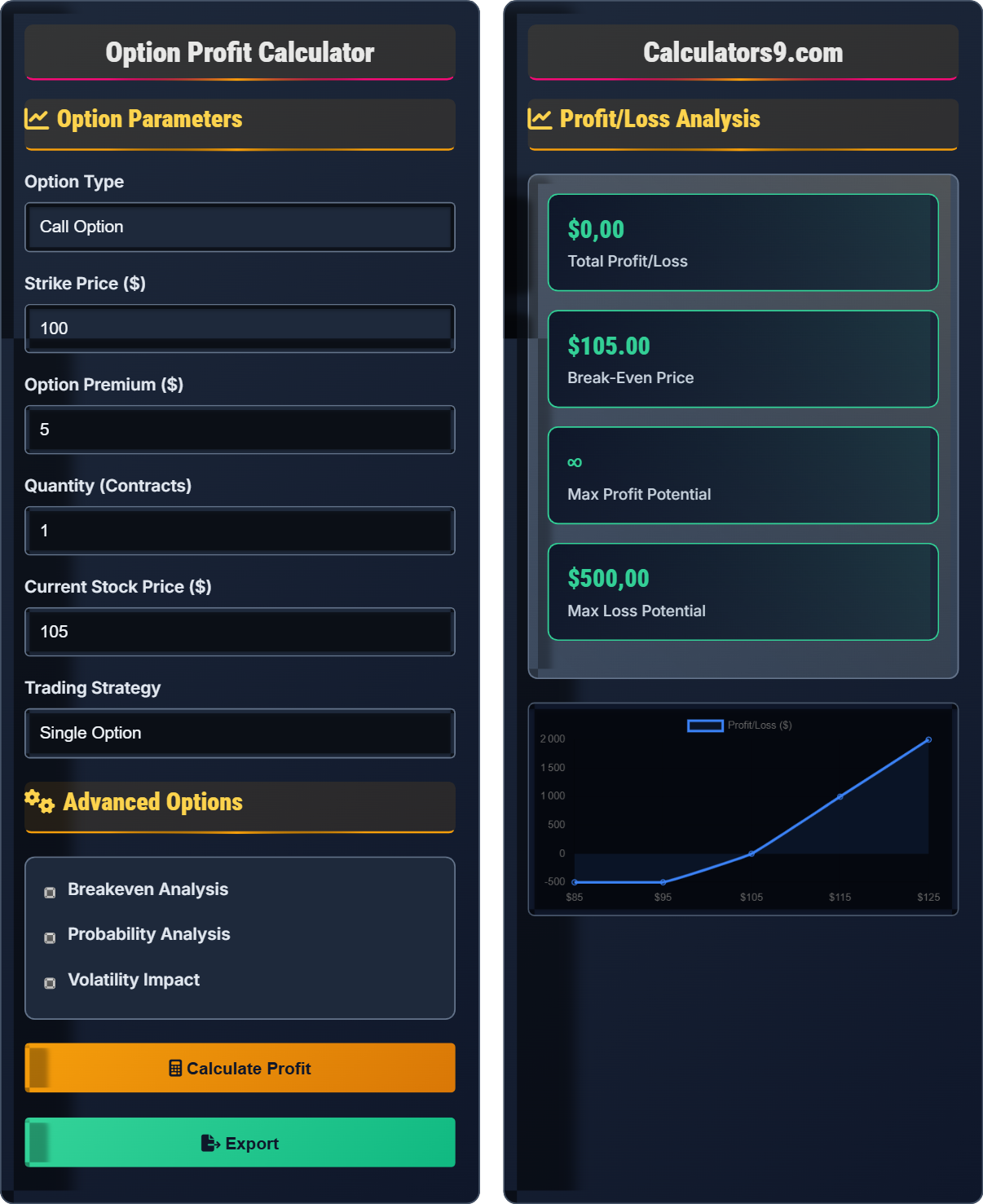
Option Profit Formulas:
Show the calculatorCall Option Profit: \( P = Max(S - X, 0) - C \)
Put Option Profit: \( P = Max(X - S, 0) - P \)
Break-Even (Call): \( BE = X + C \)
Break-Even (Put): \( BE = X - P \)
Where:
- \( P \) = Profit
- \( S \) = Stock price at expiration
- \( X \) = Strike price
- \( C \) = Call premium paid
- \( P \) = Put premium paid
Example: For a call option with strike $100, premium $5, stock at $110:
Profit = Max($110 - $100, 0) - $5 = $10 - $5 = $5
Break-even = $100 + $5 = $105
Therefore, profit is $5 per share and break-even is at $105.
Option Parameters
Advanced Options
Profit/Loss Analysis
| Stock Price | Profit/Loss | % Return |
|---|
| Metric | Value | Description |
|---|
Comprehensive Options Trading Guide
Options give traders the right (but not obligation) to buy or sell an underlying asset at a predetermined price before expiration. Understanding profit/loss calculations is crucial for successful options trading.
Option profit formulas differ by type:
Remember that options represent 100 shares each.
Popular options strategies for different market outlooks:
- Bullish: Long Calls, Covered Calls
- Bearish: Long Puts, Protective Puts
- Neutral: Straddles, Strangles, Iron Condors
- Income: Cash-Secured Puts, Covered Calls
- Hedging: Protective Puts, Collars
- Understand Greeks: Delta, Gamma, Theta, Vega affect option prices
- Time Decay: Sell options when theta is high
- Volatility: Buy low, sell high volatility
- Position Sizing: Risk only 1-2% of account per trade
- Exit Strategy: Plan exits before entering trades
Options Basics
Calculating profit/loss for options trades.
\( P = Max(S - X, 0) - C \) (Call)
\( P = Max(X - S, 0) - P \) (Put)
Where P=profit, S=stock price, X=strike, C/P=premium.
- Options represent 100 shares
- Max loss is premium paid
- Time decay affects value
Strategies
Maximize returns with strategic options trading.
- Analyze market direction
- Assess volatility levels
- Consider time horizon
- Manage risk appropriately
- Directional vs. neutral outlook
- Time-sensitive nature
- Volatility plays a role
- Commission costs matter
Options Trading Learning Quiz
What does an option contract give the holder?
The answer is B) Right but not obligation to buy or sell. Options give the holder the right to buy (call) or sell (put) an underlying asset at a specified price before expiration, but there's no obligation to exercise the option.
This fundamental concept distinguishes options from futures contracts. With options, the holder can choose whether to exercise based on market conditions, limiting downside risk to the premium paid. This flexibility is reflected in the option premium.
Right vs Obligation: Choice to act, not requirement
Exercise: Using the option to buy/sell
Expiration: Deadline to exercise
• Options holder has right to exercise
• Seller has obligation to fulfill
• Exercise is optional for holder
• Remember: "Right to buy/sell"
• Contrast with futures obligations
• Understand both sides of trade
• Confusing rights with obligations
• Not understanding both parties' roles
• Assuming automatic execution
Calculate the profit for a call option with strike price $50, premium $3, if the stock price at expiration is $55. Show your work.
Using the call option profit formula: P = Max(S - X, 0) - C
Where:
- S = $55 (stock price at expiration)
- X = $50 (strike price)
- C = $3 (premium paid)
Step 1: Calculate intrinsic value = Max($55 - $50, 0) = Max($5, 0) = $5
Step 2: Calculate profit = $5 - $3 = $2 per share
For 1 contract (100 shares): $2 × 100 = $200 profit
This calculation shows how to determine option profitability. The intrinsic value represents the option's value at expiration, while the premium paid reduces the overall profit. Remember that options contracts typically represent 100 shares.
Intrinsic Value: Value of option if exercised immediately
Time Value: Premium above intrinsic value
Contract Size: Typically 100 shares per option
• Profit = Intrinsic value - Premium paid
• Options represent 100 shares
• Negative results = loss of premium
• Remember 100 shares per contract
• Calculate per share first
• Consider breakeven point
• Forgetting 100-share multiplier
• Not accounting for premium paid
• Confusing strike and stock prices
Sarah buys a put option with a strike price of $80 for $4 premium. At expiration, the stock price is $75. What is her profit? What is the break-even point?
Put Option Profit Calculation:
P = Max(X - S, 0) - P
P = Max($80 - $75, 0) - $4
P = Max($5, 0) - $4 = $5 - $4 = $1 per share
For 1 contract: $1 × 100 = $100 profit
Break-even Point:
BE = X - Premium = $80 - $4 = $76
Sarah profits $100, and the break-even point is $76.
This example shows put option mechanics. Put options profit when stock prices fall below the strike price minus premium. The break-even point for puts is strike price minus premium paid.
Put Option: Right to sell stock at strike price
Bearish Strategy: Profits from declining prices
Downside Protection: Limited loss potential
• Put profit = Max(strike - stock, 0) - premium
• Break-even = Strike - Premium
• Profits when stock < strike - premium
• Puts profit from price declines
• Calculate break-even first
• Consider time decay effects
• Confusing put and call formulas
• Wrong break-even calculation
• Not accounting for premium
Mike buys a call option with 60 days to expiration. If the stock price stays the same, how does the option value change as expiration approaches? What is this phenomenon called?
As expiration approaches, the option value decreases even if the stock price remains unchanged. This is called time decay (theta). The option loses extrinsic value daily, accelerating as expiration nears.
Example: Option worth $5 with 60 days, $3 with 30 days, $1 with 7 days, $0 at expiration (if out of the money).
This is known as theta decay or time decay.
Time decay is a critical options concept. Options lose value as expiration approaches because there's less time for the stock to move favorably. This affects option buyers negatively and option sellers positively.
Time Decay: Loss of option value over time
Theta: Greek measuring time decay
Extrinsic Value: Value above intrinsic value
• Time decay accelerates near expiration
• Hurts buyers, helps sellers
• Out-of-the-money options decay fastest
• Consider days to expiration
• Sell options with high theta
• Buy options with time on your side
• Ignoring time decay impact
• Not considering expiration dates
• Assuming value remains stable
How does high implied volatility affect option premiums?
The answer is B) Increases premiums. High implied volatility indicates expectations of large price movements, making options more valuable. This increases option premiums because there's a higher probability of profitable moves.
Implied volatility reflects market expectations of future price movement. Higher volatility means greater uncertainty and potential for large moves, making options more valuable. This is measured by the Greek "vega."
Implied Volatility: Expected future price volatility
Vega: Greek measuring volatility sensitivity
Uncertainty Premium: Extra value for uncertain outcomes
• High IV = Higher premiums
• Low IV = Lower premiums
• Buy when IV is low, sell when high
• Buy options when IV is low
• Sell options when IV is high
• Monitor IV rank/rating
• Ignoring volatility impact
• Not considering IV rank
• Buying high-IV options
FAQ
Q: How do I calculate option profit/loss?
A: Use these formulas:
Call Profit: \( Max(Stock\ Price - Strike\ Price, 0) - Premium \)
Put Profit: \( Max(Strike\ Price - Stock\ Price, 0) - Premium \)
For a $50 call with $3 premium, stock at $55:
Profit = Max($55 - $50, 0) - $3 = $5 - $3 = $2 per share
Remember options represent 100 shares, so $200 total for 1 contract.
Q: What are the Greeks and why do they matter?
A: The Greeks measure option price sensitivity:
- Delta: Price change per $1 stock move (0-1 for calls, -1 to 0 for puts)
- Gamma: Delta change per $1 stock move (acceleration)
- Theta: Time decay per day (negative for long options)
- Vega: Volatility sensitivity (positive for long options)
Understanding Greeks helps manage risk and predict option price movements.