Portfolio Beta Tracker
Calculate & optimize investment risk • 2026 edition
\( \beta_p = \sum_{i=1}^{n} w_i \beta_i \)
Where:
- \( \beta_p \) = Portfolio Beta
- \( w_i \) = Weight of asset i in portfolio
- \( \beta_i \) = Beta of asset i
- \( n \) = Number of assets in portfolio
Portfolio beta measures the systematic risk of a portfolio relative to the market. A beta of 1 indicates market-level risk, below 1 indicates lower risk, and above 1 indicates higher risk.
Example: For a portfolio with 60% in stock A (β=1.2) and 40% in stock B (β=0.8):
\( \beta_p = 0.6 \times 1.2 + 0.4 \times 0.8 = 0.72 + 0.32 = 1.04 \)
Thus, the portfolio has slightly higher risk than the market average.
Portfolio Holdings
Advanced Options
Portfolio Analysis
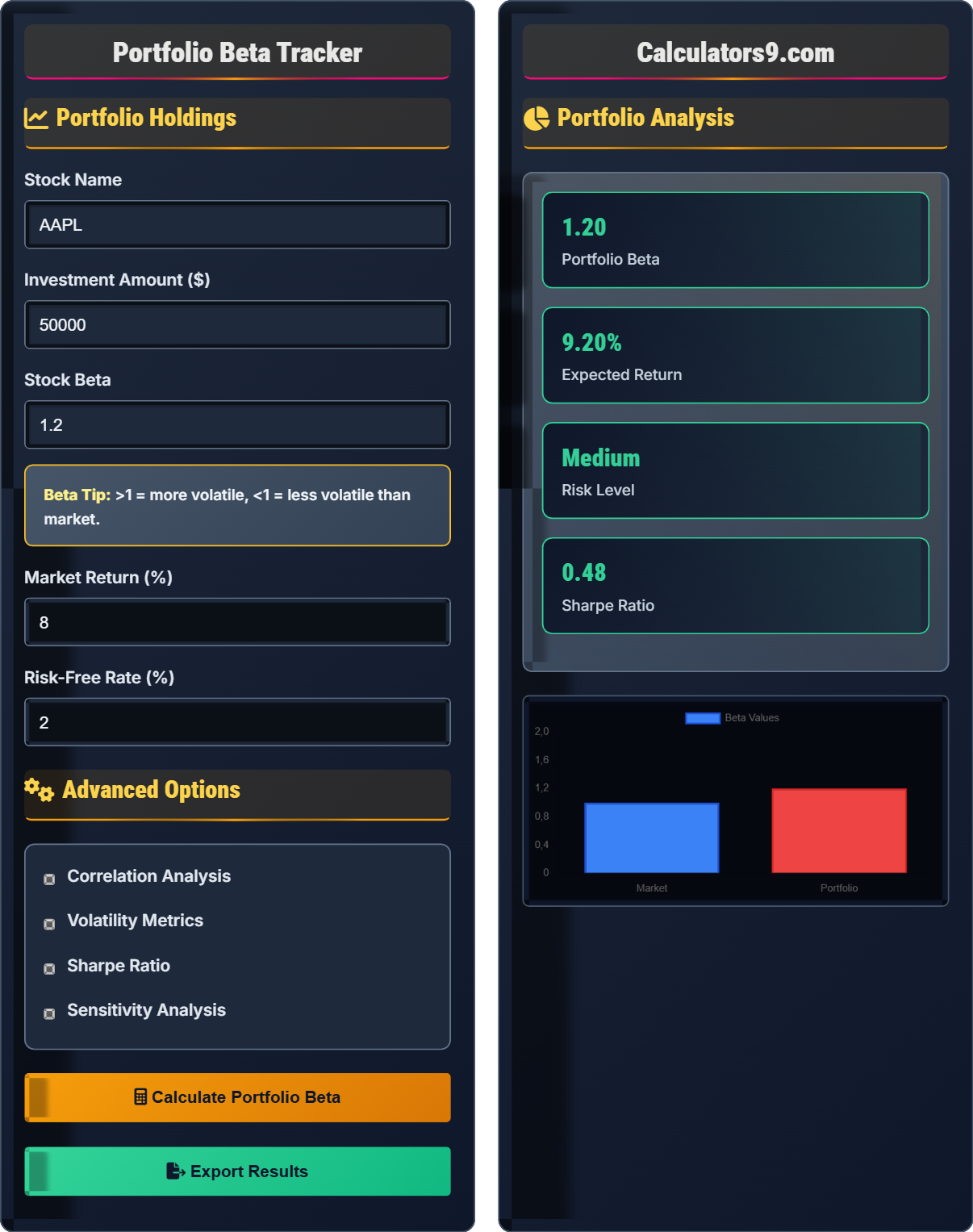
| Symbol | Amount | Beta | Weight | Contribution |
|---|---|---|---|---|
| AAPL | $50,000 | 1.20 | 100.00% | 1.20 |
| Metrics | Value | Status |
|---|---|---|
| Beta Coefficient | 1.04 | Market Level |
| Risk Assessment | Medium | Acceptable |
| Diversification | Low | Needs Improvement |
Comprehensive Portfolio Beta Guide
Portfolio beta is a measure of the systematic risk of a portfolio relative to the market. It quantifies how much a portfolio's returns are expected to move compared to the overall market. A beta of 1 means the portfolio moves in line with the market, above 1 indicates higher volatility, and below 1 indicates lower volatility.
The standard portfolio beta calculation uses the following formula:
Where:
- \( \beta_p \) = Portfolio Beta
- \( w_i \) = Weight of asset i in portfolio
- \( \beta_i \) = Beta of asset i
- \( n \) = Number of assets in portfolio
Effective portfolio beta management involves several strategies:
- Diversification: Spread investments across different sectors and asset classes
- Beta Hedging: Use inverse ETFs or options to offset portfolio beta
- Rebalancing: Adjust holdings periodically to maintain target beta
- Asset Allocation: Mix high and low beta assets for desired risk level
- Historical Data: Beta based on past performance may not predict future risk
- Linear Assumption: Assumes linear relationship between portfolio and market
- Market Focus: Only measures systematic risk, ignores idiosyncratic risk
- Time Period: Different time periods yield different beta values
Beta Fundamentals
Measure of systematic risk relative to market benchmark.
\( \beta_p = \sum_{i=1}^{n} w_i \beta_i \)
Where βp=portfolio beta, wi=weight of asset i, βi=beta of asset i.
- Beta measures sensitivity to market movements
- Higher beta = higher risk and potential return
- Diversification reduces portfolio beta
Risk Management
Total risk = systematic risk (beta) + unsystematic risk (diversifiable).
- Add low-correlation assets
- Reduce high-beta holdings
- Include defensive stocks
- Use hedging instruments
- Target beta depends on risk tolerance
- Rebalance quarterly
- Monitor sector exposure
- Consider economic cycles
Portfolio Beta Learning Quiz
If a portfolio has a beta of 1.5, what does this indicate about its risk compared to the market?
The answer is B) 50% more risky than the market. A beta of 1.5 means the portfolio is expected to be 50% more volatile than the market. If the market increases by 10%, the portfolio is expected to increase by 15% (10% × 1.5). Conversely, if the market decreases by 10%, the portfolio is expected to decrease by 15%.
Beta is a measure of systematic risk, which is the risk inherent to the entire market or market segment. It measures how much a portfolio's returns are expected to move relative to the market. A beta greater than 1 indicates higher volatility than the market, while a beta less than 1 indicates lower volatility. Understanding beta helps investors assess whether a portfolio aligns with their risk tolerance.
Beta: Measure of systematic risk relative to market benchmark
Systematic Risk: Market-wide risk that cannot be diversified away
Variance: Statistical measure of spread in returns
• Beta = 1 means portfolio moves with market
• Beta > 1 means portfolio is more volatile than market
• Beta < 1 means portfolio is less volatile than market
• Remember: Beta = Covariance(Portfolio,Market) / Variance(Market)
• Use the acronym "BET" for Beta = Expected returns vs Time
• Confusing beta with alpha (alpha measures excess return)
• Assuming beta predicts exact returns (it only measures relative volatility)
A portfolio consists of 60% Stock X (β = 1.3) and 40% Stock Y (β = 0.7). Calculate the portfolio beta and determine its risk characteristics. Also explain how adding a third asset with β = 2.0 and weight of 20% would affect the portfolio.
Initial Portfolio Beta Calculation:
Portfolio Beta = (0.60 × 1.3) + (0.40 × 0.7) = 0.78 + 0.28 = 1.06
Risk Characteristics: With a beta of 1.06, the portfolio has slightly higher systematic risk than the market. It's expected to be about 6% more volatile than the market.
With Third Asset Added: To maintain 100% allocation, we need to adjust weights. If we add 20% in the new asset (β = 2.0), we have 80% remaining for Stocks X and Y. Maintaining the original 60:40 ratio within the remaining 80% gives us 48% in Stock X and 32% in Stock Y.
New Portfolio Beta = (0.48 × 1.3) + (0.32 × 0.7) + (0.20 × 2.0) = 0.624 + 0.224 + 0.40 = 1.248
Effect: Adding the high-beta asset increases the portfolio's overall systematic risk from 1.06 to 1.248, making it significantly more volatile than the market.
This example demonstrates how individual asset betas combine according to their weights in the portfolio. The weighted average approach is fundamental to portfolio theory. When adding a high-beta asset, even with a modest weight, the portfolio beta increases proportionally. This illustrates the importance of considering not just individual asset risks but also their impact on the overall portfolio when making investment decisions.
Portfolio Beta: Weighted average of individual asset betas
Systematic Risk: Market-related risk that affects all assets
Weighted Average: Sum of (weight × value) for all components
• Portfolio Beta = Σ(Weight × Individual Beta)
• Higher beta assets increase portfolio risk disproportionately
• Portfolio weights must sum to 100%
• Always verify weights sum to 100%
• High-beta additions have outsized impact on portfolio risk
• Forgetting to recalculate weights when adding new assets
• Misunderstanding that portfolio beta is simply the sum of individual betas
FAQ
Q: How does portfolio beta help in making investment decisions?
A: Portfolio beta is a critical tool for investment decision-making as it quantifies the systematic risk of your portfolio relative to the market. Here's how it helps:
1. Risk Assessment: A portfolio with β = 1.2 is expected to be 20% more volatile than the market. If the market drops 10%, expect your portfolio to drop approximately 12%. This helps investors understand potential losses during market downturns.
2. Target Setting: Investors can set target betas based on their risk tolerance. Conservative investors might aim for β = 0.6-0.8, while aggressive investors might accept β = 1.3-1.5.
3. Rebalancing: When portfolio beta deviates from target (due to price changes), investors know to rebalance by buying/selling assets to restore desired risk level.
4. Performance Attribution: Beta helps separate market-related returns from manager skill (alpha). Using CAPM: Expected Return = Risk-Free Rate + β(Market Return - Risk-Free Rate)
For example, if your portfolio has β = 1.2, risk-free rate = 2%, and market return = 8%: Expected Return = 2% + 1.2(8% - 2%) = 9.2%
Q: Can portfolio beta be negative, and what would that mean?
A: Yes, portfolio beta can be negative, though it's relatively uncommon in traditional equity portfolios. A negative beta means the portfolio moves inversely to the market. When the market goes up, a negative beta portfolio tends to go down, and vice versa.
Examples of Negative Beta Assets:
- Gold mining stocks (when gold prices rise during market downturns)
- Inverse ETFs (designed to move opposite to indices)
- Certain utility stocks during specific economic conditions
Mathematical Representation: If a portfolio has β = -0.3, when the market increases by 10%, the portfolio is expected to decrease by 3%. This creates a hedging effect against market risk.
Practical Applications: Negative beta assets can be used for hedging purposes, reducing overall portfolio volatility, or profiting from market declines. However, they typically offer lower long-term returns since they provide insurance-like protection against market downturns.