Portfolio Rebalancer
Asset allocation optimization • 2026 strategy
Portfolio Rebalancing Formula:
Show Calculator\( \text{Target Allocation} = \frac{\text{Target Dollar Amount}}{\text{Total Portfolio Value}} \)
Where:
- \( \text{Target Dollar Amount} = \text{Total Portfolio Value} \times \text{Target Percentage} \)
- \( \text{Current Allocation} = \frac{\text{Current Value}}{\text{Total Portfolio Value}} \)
- \( \text{Rebalancing Action} = \text{Target Dollar Amount} - \text{Current Value} \)
This formula calculates the target allocation for each asset class and determines how much to buy or sell to achieve the desired allocation. Positive values indicate assets to buy, negative values indicate assets to sell.
Example: Portfolio worth $100,000 with 60% stock allocation. Target = $60,000. If current stock value is $70,000, need to sell $10,000 to rebalance.
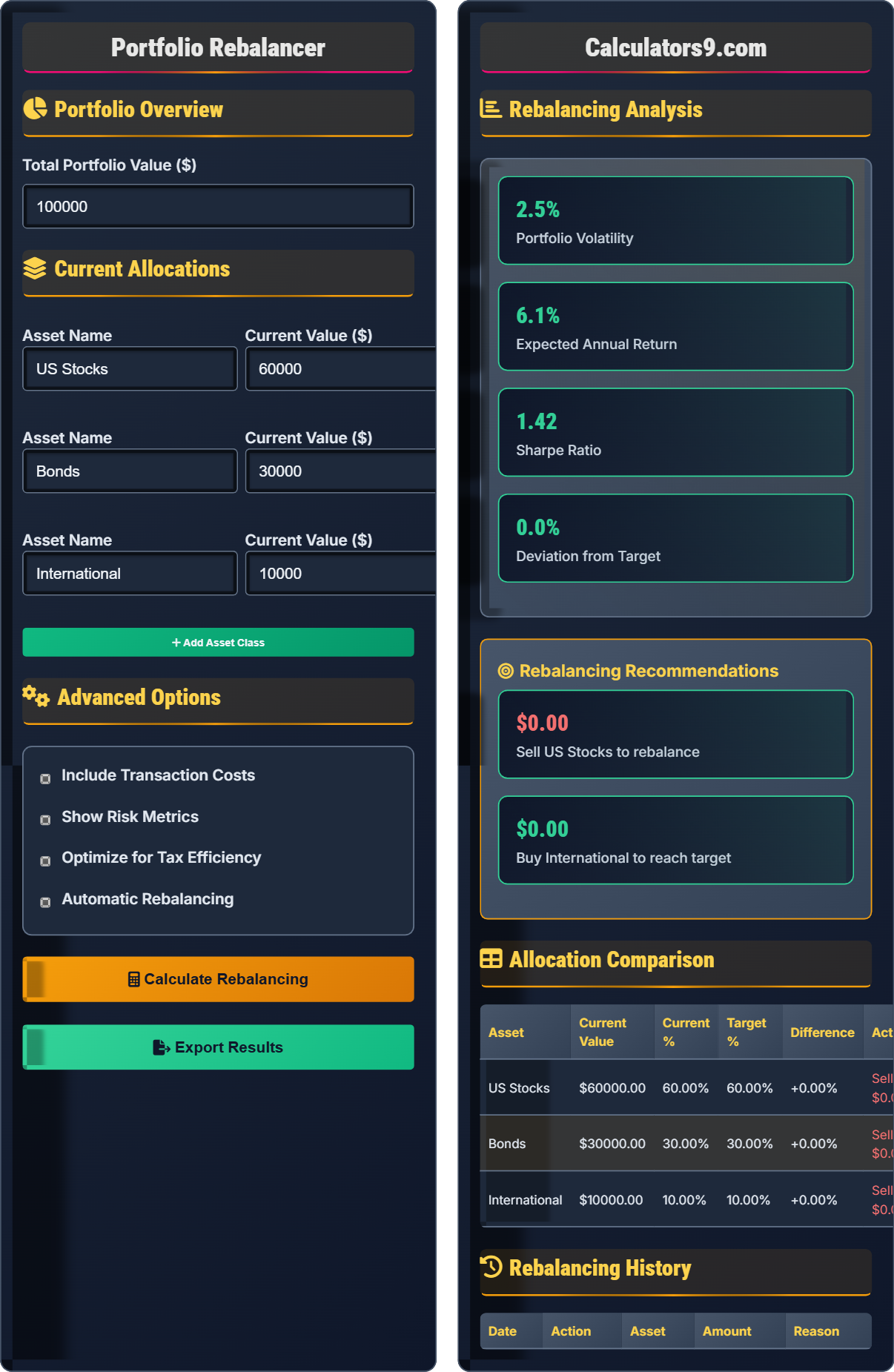
Portfolio Overview
Current Allocations
Advanced Options
Rebalancing Analysis
Allocation Comparison
| Asset | Current Value | Current % | Target % | Difference | Action |
|---|
Rebalancing History
| Date | Action | Asset | Amount | Reason |
|---|
Portfolio Rebalancing Strategy Guide
Portfolio rebalancing is the process of realigning the weightings of assets in an investment portfolio. Over time, due to market fluctuations, the actual allocation of assets can drift from the intended target allocation. Rebalancing brings the portfolio back to its desired asset mix, helping maintain risk levels and investment discipline.
The formula for calculating rebalancing needs:
Positive results indicate assets to buy, negative results indicate assets to sell.
Advantages of maintaining proper asset allocation:
- Disciplined Investing: Maintains risk profile according to investment goals
- Buy Low, Sell High: Forces selling overvalued assets and buying undervalued ones
- Reduced Volatility: Helps maintain desired risk levels
- Goal Alignment: Keeps portfolio aligned with financial objectives
- Set Appropriate Thresholds: Common ranges are 5-10% deviation from target
- Consider Tax Implications: Use tax-advantaged accounts when possible
- Factor in Costs: Weigh rebalancing costs against benefits
- Review Periodically: Adjust targets based on changing life circumstances
- Stay Consistent: Follow a systematic approach rather than emotional decisions
Rebalancing Basics
Process of realigning portfolio weights to target allocations.
\( \text{Rebalancing Action} = (\text{Target \%} \times \text{Total Value}) - \text{Current Value} \)
Determine buy/sell amounts to reach target allocation.
- Rebalance when allocation deviates beyond threshold
- Consider transaction costs in decision-making
- Align with investment goals and risk tolerance
- Use systematic approach consistently
Strategy Considerations
Common thresholds: 5-10% deviation from target allocation.
- Annual rebalancing
- Quarterly rebalancing
- Threshold-triggered
- Hybrid approach
- Transaction fees and commissions
- Tax implications
- Market timing considerations
- Opportunity costs
Portfolio Rebalancing Learning Quiz
Your portfolio is worth $100,000 with a target allocation of 60% stocks and 40% bonds. Currently, stocks are worth $70,000 and bonds are worth $30,000. How much should you sell from stocks and buy in bonds to rebalance?
The answer is A) Sell $10,000 stocks, Buy $10,000 bonds. First, calculate target amounts: Stocks target = $100,000 × 60% = $60,000. Bonds target = $100,000 × 40% = $40,000. Current allocation: Stocks = $70,000, Bonds = $30,000. Difference: Stocks need to decrease by $10,000 ($70,000 - $60,000), Bonds need to increase by $10,000 ($40,000 - $30,000).
This problem demonstrates the basic principle of portfolio rebalancing. You calculate the target dollar amount for each asset class by multiplying the total portfolio value by the target percentage. Then, compare with current values to determine the necessary adjustments. The key insight is that rebalancing moves the portfolio from current allocations back to target allocations.
Target Allocation: Desired percentage of portfolio for each asset class
Current Allocation: Actual percentage of portfolio for each asset class
Rebalancing: Process of adjusting portfolio to match target allocation
• Target Amount = Total Portfolio Value × Target Percentage
• Rebalancing Action = Target Amount - Current Value
• Positive values indicate buying, negative values indicate selling
• Remember: Target - Current = Action needed
• If result is negative, sell that asset
• If result is positive, buy that asset
• Confusing which asset to buy vs. sell in rebalancing
• Not accounting for the total portfolio value in calculations
• Forgetting that rebalancing affects all asset classes simultaneously
If your target allocation is 70% stocks and 30% bonds, and your portfolio is worth $150,000, at what dollar values would you trigger rebalancing if you use a 5% threshold? Show your work.
First, calculate target dollar amounts:
Stocks target = $150,000 × 70% = $105,000
Bonds target = $150,000 × 30% = $45,000
Next, calculate threshold boundaries (±5% of target):
Stocks upper bound = $105,000 × 1.05 = $110,250
Stocks lower bound = $105,000 × 0.95 = $99,750
Bonds upper bound = $45,000 × 1.05 = $47,250
Bonds lower bound = $45,000 × 0.95 = $42,750
Therefore, rebalancing would be triggered when:
Stocks exceed $110,250 OR fall below $99,750
Bonds exceed $47,250 OR fall below $42,750
This problem demonstrates threshold-based rebalancing, which is more efficient than regular time-based rebalancing. Instead of rebalancing at fixed intervals, you only rebalance when allocations deviate significantly from targets. This approach reduces transaction costs while maintaining discipline. The threshold acts as a buffer zone around target allocations.
Threshold Rebalancing: Rebalancing only when allocations deviate beyond a set percentage
Buffer Zone: Range around target allocation where no action is taken
Efficient Rebalancing: Balancing between maintaining discipline and minimizing costs
• Threshold = Target Amount ± (Target Amount × Threshold %)
• Common thresholds range from 5% to 10%
• Lower thresholds mean more frequent rebalancing
• Calculate upper and lower bounds for each asset class
• Use 5% threshold for active portfolios, 10% for conservative
• Consider transaction costs when setting thresholds
• Only calculating one boundary instead of both upper and lower
• Applying threshold to percentages instead of dollar amounts
• Not considering that rebalancing affects multiple asset classes
Sarah has a $200,000 portfolio with target allocations of 50% US stocks, 25% international stocks, and 25% bonds. Current values are: $120,000 US stocks, $40,000 international stocks, and $40,000 bonds. Calculate the rebalancing actions needed for each asset class.
Step 1: Calculate target dollar amounts:
US Stocks target = $200,000 × 50% = $100,000
International Stocks target = $200,000 × 25% = $50,000
Bonds target = $200,000 × 25% = $50,000
Step 2: Compare with current values and calculate actions:
US Stocks: $100,000 - $120,000 = -$20,000 (Sell $20,000)
International Stocks: $50,000 - $40,000 = $10,000 (Buy $10,000)
Bonds: $50,000 - $40,000 = $10,000 (Buy $10,000)
Verification: -$20,000 + $10,000 + $10,000 = $0
Therefore, Sarah should sell $20,000 of US stocks and buy $10,000 each of international stocks and bonds.
This example shows rebalancing with multiple asset classes. The key principle is that the total rebalancing action should sum to zero - money sold from overweighted assets funds purchases in underweighted assets. This maintains the total portfolio value while achieving target allocations. The verification step ensures the math is correct.
Multi-Asset Rebalancing: Rebalancing across three or more asset classes
Overweighted Assets: Assets exceeding target allocation
Underweighted Assets: Assets below target allocation
• Sum of all rebalancing actions should equal zero
• Sell from overweighted assets, buy underweighted assets
• Verify calculations to ensure portfolio value remains constant
• Create a table to organize multiple asset classes
• Always verify that rebalancing actions sum to zero
• Consider tax implications when selling appreciated assets
• Forgetting to account for all asset classes in the rebalancing
• Not verifying that total rebalancing equals zero
• Mixing up which assets to buy vs. sell in multi-asset rebalancing
John has $100,000 in taxable accounts and $100,000 in tax-advantaged accounts. His target allocation is 60% stocks and 40% bonds. Currently, taxable has 70% stocks ($70,000) and tax-advantaged has 50% stocks ($50,000). Should he rebalance within each account or across accounts? Calculate the optimal approach.
Step 1: Calculate combined portfolio allocation:
Total portfolio = $200,000
Total stocks = $70,000 + $50,000 = $120,000 (60% ✓)
Total bonds = $30,000 + $50,000 = $80,000 (40% ✓)
Step 2: Analyze individual accounts:
Taxable: 70% stocks (overweight by 10%), 30% bonds (underweight by 10%)
Tax-advantaged: 50% stocks (underweight by 10%), 50% bonds (overweight by 10%)
Step 3: Optimal rebalancing strategy:
Move $10,000 from stocks to bonds in taxable account
Move $10,000 from bonds to stocks in tax-advantaged account
This maintains overall allocation while optimizing for tax efficiency by keeping tax-inefficient assets (bonds) in tax-advantaged accounts and tax-efficient assets (stocks) in taxable accounts.
This problem demonstrates sophisticated portfolio management considering both asset allocation and tax efficiency. The key insight is that optimal rebalancing considers the tax treatment of different asset classes. Tax-inefficient assets (like bonds with regular interest) should be held in tax-advantaged accounts, while tax-efficient assets (like index funds with minimal distributions) can be held in taxable accounts.
Tax-Efficient Rebalancing: Considering tax implications in rebalancing decisions
Tax-Advantaged Accounts: IRAs, 401(k)s with tax benefits
Tax-Inefficient Assets: Assets generating regular taxable income
• Hold tax-inefficient assets in tax-advantaged accounts
• Consider tax consequences before rebalancing
• Maintain overall allocation while optimizing location
• Use tax-advantaged accounts for bonds, REITs, and actively managed funds
• Use taxable accounts for index funds and tax-efficient ETFs
• Consider asset location as part of overall strategy
• Only considering individual account allocations without tax efficiency
• Placing tax-inefficient assets in taxable accounts
• Not considering the interaction between accounts in rebalancing
Which rebalancing frequency typically offers the best balance between maintaining target allocation and minimizing transaction costs?
The answer is C) Threshold-based (5-10% deviation). Threshold-based rebalancing offers the best balance because it: 1) Maintains discipline by ensuring allocations don't drift too far from targets, 2) Minimizes transaction costs by only acting when necessary, 3) Adapts to market conditions (more frequent rebalancing during volatile periods), and 4) Provides systematic discipline without rigid timing. Daily and monthly rebalancing incur excessive costs, while annual rebalancing may allow excessive drift from targets.
This question addresses the trade-off between rebalancing frequency and transaction costs. Too-frequent rebalancing increases costs without significant benefit, while infrequent rebalancing allows excessive drift from targets. Threshold-based rebalancing dynamically adjusts frequency based on market movements, providing optimal balance between maintaining discipline and controlling costs.
Threshold-Based Rebalancing: Rebalancing when allocations exceed preset limits
Transaction Costs: Fees associated with buying and selling securities
Discipline vs. Costs: Balancing systematic investing with cost control
• 5-10% threshold balances discipline and costs
• More volatile portfolios may need tighter thresholds
• Consider total costs in rebalancing decisions
• Use 5% threshold for volatile portfolios, 10% for stable
• Consider tax implications in frequency decisions
• Adjust thresholds based on transaction costs
• Using rigid time-based rebalancing without considering market conditions
• Not accounting for transaction costs in frequency decisions
• Assuming more frequent rebalancing is always better
FAQ
Q: How do I decide between time-based and threshold-based rebalancing?
A: The choice depends on your portfolio characteristics and preferences:
- Threshold-Based: Better when transaction costs matter and you want to minimize unnecessary trading. Formula: \( \text{Action Required} = |\text{Current \%} - \text{Target \%}| > \text{Threshold} \)
- Time-Based: Better for maintaining discipline and ensuring regular review. Works well with low-cost index funds.
- Hybrid: Annual review with threshold triggers for significant deviations.
For example, if your threshold is 5% and you have a target of 60% stocks, rebalancing triggers when stock allocation goes above 65% or below 55%. This approach adapts to market volatility while maintaining discipline.
Q: What's the difference between rebalancing and market timing?
A: Rebalancing and market timing are fundamentally different approaches:
Rebalancing: Systematic process of returning to predetermined target allocations regardless of market conditions. Formula: \( \text{Rebalancing Action} = \text{Target Amount} - \text{Current Amount} \)
Market Timing: Attempting to predict market movements to adjust allocations accordingly.
Rebalancing is disciplined and rule-based, selling assets that have appreciated and buying those that have declined. Market timing is speculative and relies on predictions. Academic research consistently shows rebalancing outperforms market timing over long periods because it removes emotion and follows a systematic approach.