Risk Reward Ratio Calculator
Optimize investment returns • 2026 strategies
Risk Reward Ratio Formula:
Show the calculatorRisk Reward Ratio = Potential Loss / Potential Profit
Where:
- Potential Loss = Amount at risk per trade
- Potential Profit = Expected gain per trade
This formula calculates the relationship between potential loss and potential gain in trading. A favorable ratio (e.g., 1:2) means potential profits are twice the potential losses.
Example: If risking $100 to potentially gain $200:
Risk Reward Ratio = $100 / $200 = 0.5 or 1:2
This means the trader is risking $1 to potentially gain $2, indicating a 1:2 risk reward ratio.
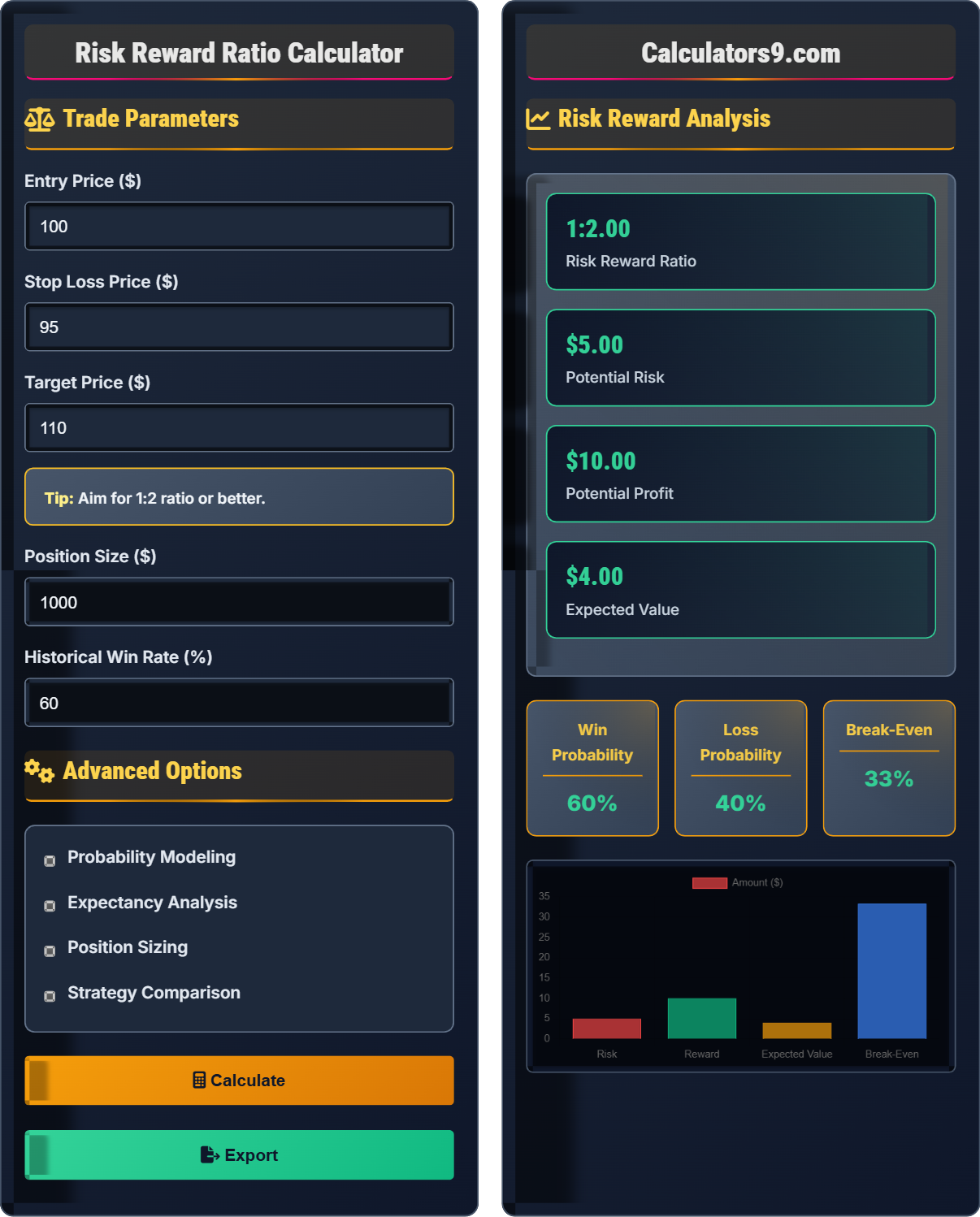
Trade Parameters
Advanced Options
Risk Reward Analysis
Expected Value Formula
Position Sizing
Risk Assessment
Comprehensive Risk Reward Guide
The risk reward ratio is a critical trading metric that compares the potential loss to the potential gain in a trade. It helps traders evaluate whether a trade is worth taking based on the relationship between risk and potential return. A favorable risk reward ratio ensures that winning trades compensate for losing trades.
The standard risk reward ratio calculation uses the following formula:
Where:
- Potential Risk = Entry Price - Stop Loss Price
- Potential Reward = Target Price - Entry Price
Beyond basic risk reward, consider these advanced metrics:
- Expected Value: Average profit/loss per trade
- Profit Factor: Gross profits / Gross losses
- Sharpe Ratio: Risk-adjusted returns
- Maximum Drawdown: Largest peak-to-trough decline
- Position Sizing: Limit risk to 1-2% of account per trade
- Diversification: Spread risk across different instruments
- Stop Losses: Always use predetermined exit points
- Win Rate Balance: Combine with risk reward for profitability
- Backtesting: Validate strategies with historical data
Risk Reward Fundamentals
Relationship between potential loss and potential gain.
Risk Reward Ratio = Risk Amount / Reward Amount
Where ratio = risk/reward relationship, risk = potential loss, reward = potential gain.
- Higher ratios are better
- Aim for 1:2 minimum
- Combine with win rate
Trading Strategies
Average profit/loss per trade considering win rate.
- Set stop losses before entering trades
- Define profit targets clearly
- Backtest your ratios
- Adjust for market conditions
- High ratios require patience
- Lower win rates acceptable with good ratios
- Always use stop losses
- Consider transaction costs
Risk Reward Learning Quiz
According to professional trading standards, what is the minimum recommended risk reward ratio?
The answer is B) 1:2. Professional traders recommend a minimum risk reward ratio of 1:2, meaning potential profits should be at least twice the potential losses. While 1:1 is the absolute minimum, 1:2 provides a buffer for fees and market slippage while ensuring profitability even with lower win rates.
Understanding risk reward standards is crucial for sustainable trading. A 1:2 ratio allows for a 50% win rate while still being profitable. Higher ratios provide more flexibility with win rates but require more patience and skill to achieve. The 1:2 standard balances achievable profit targets with reasonable risk levels.
Risk Reward Ratio: Relationship between potential loss and gain
Minimum Standard: 1:2 ratio (risk:reward)
Sustainable Trading: Long-term profitable approach
• Minimum 1:2 ratio for professional trading
• Higher ratios allow for lower win rates
• Ratios must account for transaction costs
• Remember: 1:2 means risking $1 to gain $2
• Use the "2x rule" as a baseline
• Adjust ratios based on market volatility
• Accepting 1:1 ratios consistently
• Not accounting for fees in calculations
• Setting unrealistic profit targets
If a trader enters a position at $50, sets a stop loss at $45, and targets $60, what is the risk reward ratio? Show your work.
Step 1: Calculate potential risk = Entry - Stop Loss = $50 - $45 = $5
Step 2: Calculate potential reward = Target - Entry = $60 - $50 = $10
Step 3: Calculate risk reward ratio = Risk / Reward = $5 / $10 = 0.5
Step 4: Express as ratio = 1:2
Therefore, the risk reward ratio is 1:2, meaning the trader risks $1 to potentially gain $2.
This calculation demonstrates the core principle of risk reward ratios. The ratio shows the relationship between what you risk and what you expect to gain. A 1:2 ratio is considered the minimum standard because it allows for profitability even with a 50% win rate. The calculation is straightforward: subtract stop loss from entry for risk, subtract entry from target for reward.
Potential Risk: Amount at risk per trade
Potential Reward: Expected gain per trade
Risk Reward Ratio: Relationship between risk and reward
• Always calculate risk before setting reward targets
• Risk is determined by stop loss placement
• Reward is determined by profit target
• Risk = Entry Price - Stop Loss Price
• Reward = Target Price - Entry Price
• Ratio = Risk : Reward (expressed as 1:X)
• Calculating reward before setting stop loss
• Forgetting to express as a ratio
• Mixing up entry and stop loss calculations
A trader has a 1:3 risk reward ratio with a 40% win rate. If the average loss is $200, what is the expected value per trade?
Step 1: Calculate average win = Risk × Reward Ratio = $200 × 3 = $600
Step 2: Calculate win rate = 40% = 0.40
Step 3: Calculate loss rate = 1 - win rate = 1 - 0.40 = 0.60
Step 4: Apply expectancy formula:
Expected Value = (Win Rate × Avg Win) - (Loss Rate × Avg Loss)
Expected Value = (0.40 × $600) - (0.60 × $200)
Expected Value = $240 - $120 = $120
Therefore, the expected value per trade is $120, making this a profitable strategy.
This example shows how risk reward ratio and win rate combine to determine profitability. Even with a relatively low win rate of 40%, the 1:3 ratio makes the strategy profitable. The expected value of $120 per trade indicates the strategy is sound. This demonstrates why focusing on risk reward is often more important than win rate alone.
Expected Value: Average profit/loss per trade
Win Rate: Percentage of winning trades
Profitability: Positive expected value over time
• Expected value = (Win Rate × Avg Win) - (Loss Rate × Avg Loss)
• Positive expected value indicates profitability
• High ratios can offset low win rates
• Expected value = (WR × AW) - (LR × AL)
• Where WR=Win Rate, AW=Average Win, LR=Loss Rate, AL=Average Loss
• Aim for positive expected value in all strategies
• Forgetting to convert percentages to decimals
• Not accounting for loss rate in calculations
• Confusing average win with risk reward ratio
You have a $10,000 trading account and follow the 2% risk rule. If you want to maintain a 1:4 risk reward ratio with a stop loss $2 below your entry price, what should be your position size in shares?
Step 1: Calculate max risk per trade = Account × Risk % = $10,000 × 0.02 = $200
Step 2: Determine risk per share = $2 (given stop loss distance)
Step 3: Calculate position size = Max risk ÷ Risk per share = $200 ÷ $2 = 100 shares
Step 4: Verify target price = Entry + (Risk × Reward Ratio) = Entry + ($2 × 4) = Entry + $8
Therefore, you should buy 100 shares to maintain 2% risk and a 1:4 risk reward ratio.
This problem combines position sizing with risk reward ratios. The 2% rule limits risk to 2% of your account per trade. By knowing your maximum risk and stop loss distance, you can calculate the exact number of shares to buy. The 1:4 ratio means for every $2 risked, you aim to make $8 profit. This systematic approach ensures consistent risk management.
Position Sizing: Determining how much to trade
2% Rule: Risk no more than 2% per trade
Risk Management: Controlling potential losses
• Position Size = (Account Size × Risk %) ÷ Risk Per Share
• Never risk more than 2% per trade
• Maintain consistent risk reward ratios
• PS = (AS × R%) ÷ RPS (where PS=Position Size, AS=Account Size, R%=Risk %, RPS=Risk Per Share)
• Use this formula to determine exact share counts
• Adjust for fractional shares if needed
• Not accounting for stop loss distance in calculations
• Forgetting to limit risk to 2% of account
• Miscalculating risk per share
Which of the following statements about risk reward ratios is TRUE?
The answer is B) High ratios can compensate for low win rates. This is demonstrated by the expectancy formula: (Win Rate × Avg Win) - (Loss Rate × Avg Loss). A trader with a 1:3 ratio can be profitable even with a 30% win rate, whereas a trader with a 1:1 ratio needs a 51% win rate to be profitable. High ratios provide more room for error.
Understanding the relationship between risk reward ratios and win rates is crucial for developing profitable trading systems. High ratios allow traders to be wrong more often while still maintaining profitability. This is why many successful traders focus on quality setups with excellent risk reward ratios rather than trying to predict market direction perfectly.
Profitability: Positive expected value over time
Quality Setups: Trades with excellent risk reward
System Development: Creating consistent trading approaches
• High ratios provide more flexibility with win rates
• Risk reward and win rate are interdependent
• Focus on quality over quantity
• High ratio = more forgiving of low win rate
• Low ratio = need higher win rate to be profitable
• Always consider both metrics together
• Focusing only on win rate and ignoring ratios
• Thinking high ratios are always achievable
• Not understanding the mathematical relationship
FAQ
Q: How do I determine my stop loss and target prices for calculating risk reward ratios?
A: Stop loss and target prices should be determined before entering a trade based on technical and/or fundamental analysis.
Stop Loss Placement:
- Below support levels (for long positions)
- Above resistance levels (for short positions)
- Based on volatility (ATR-based stops)
- At predetermined percentage levels (e.g., 5-8% below entry)
Target Price Setting:
- At resistance levels (for long positions)
- At support levels (for short positions)
- Based on technical patterns (fibonacci levels, chart patterns)
- Using risk reward ratios (e.g., 1:2 or 1:3)
The key is having objective criteria for both exit points before entering the trade, ensuring your risk reward ratio aligns with your trading plan.
Q: Is it better to have a high win rate or a good risk reward ratio?
A: Both are important, but the risk reward ratio often matters more for long-term profitability. The mathematical relationship is shown in the expectancy formula:
Expected Value = (Win Rate × Average Win) - (Loss Rate × Average Loss)
For example, consider two traders:
- Trader A: 70% win rate, 1:1 ratio → Expected Value = (0.70 × $100) - (0.30 × $100) = $40
- Trader B: 40% win rate, 1:3 ratio → Expected Value = (0.40 × $300) - (0.60 × $100) = $60
Trader B, despite the lower win rate, has a higher expected value per trade. This demonstrates why focusing on risk reward ratios can be more profitable than chasing high win rates.