ROI Calculator
Investment performance analysis • 2026 best practices
ROI Formula:
Show the calculator\( \text{ROI} = \frac{\text{Net Profit}}{\text{Investment Cost}} \times 100 \)
Where:
- \( \text{ROI} \) = Return on Investment percentage
- \( \text{Net Profit} \) = Total returns minus investment cost
- \( \text{Investment Cost} \) = Initial investment amount
Return on Investment measures the profitability of an investment relative to its cost. It's a key metric for evaluating investment performance and comparing different investment opportunities. Positive ROI indicates profit, while negative ROI indicates loss. Higher percentages represent better returns.
Example: For an investment of $10,000 that returns $12,000:
Net Profit = $12,000 - $10,000 = $2,000
ROI = ($2,000 ÷ $10,000) × 100 = 20%
This 20% ROI indicates a profitable investment with a 20% return on the original investment.
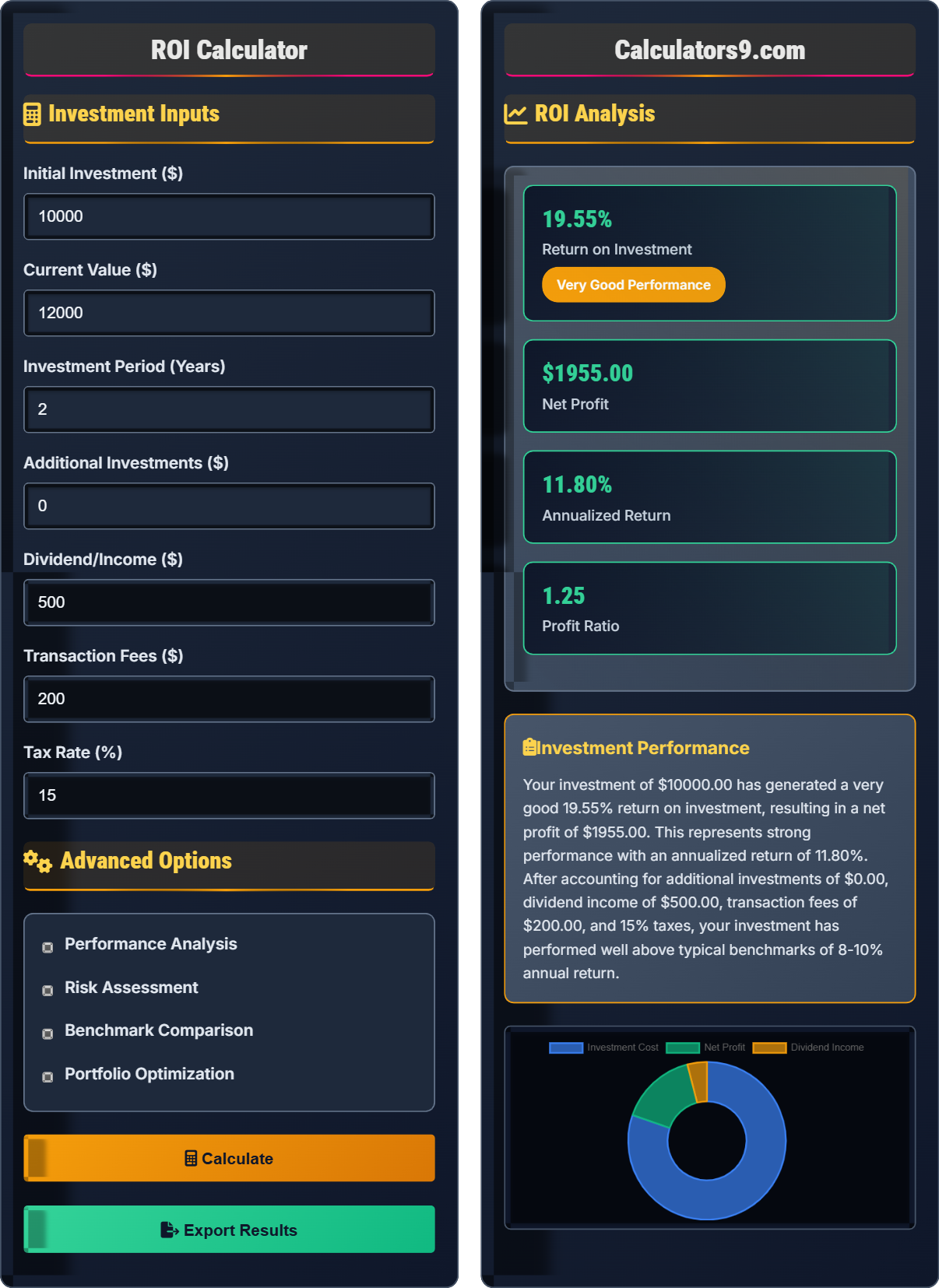
Investment Inputs
Advanced Options
ROI Analysis
| Metric | Value | Industry Benchmark | Status |
|---|
| Component | Amount | % of Investment | Impact |
|---|
Comprehensive ROI Analysis Guide
Return on Investment (ROI) measures the profitability of an investment relative to its cost. It's calculated by dividing net profit by the initial investment cost and expressing it as a percentage. ROI is a fundamental metric for evaluating investment performance and comparing different investment opportunities. A positive ROI indicates profit, while a negative ROI indicates loss.
Key formulas for ROI analysis:
Annualized ROI: ((Final Value ÷ Initial Value)^(1/years) - 1) × 100
Profit Ratio: Final Value ÷ Initial Value
These metrics help evaluate investment performance and compare against industry standards.
Typical ROI benchmarks by asset class:
- Stock Market: 7-10% annually (long-term average)
- Bonds: 3-5% annually (lower risk)
- Real Estate: 8-12% annually (appreciation + rental income)
- Cryptocurrency: Highly volatile (can range from -50% to +300%)
- Savings Accounts: 1-2% annually (very low risk)
- Calculate ROI regularly to track performance
- Compare to relevant benchmarks for context
- Consider risk-adjusted returns when evaluating
- Factor in all costs including fees and taxes
- Look at long-term trends rather than short-term fluctuations
ROI Fundamentals
Profitability measure relative to investment cost (net profit ÷ investment × 100).
ROI = (Net Profit ÷ Investment Cost) × 100
Measures return generated per dollar invested.
- Positive ROI indicates profit
- Higher percentages indicate better performance
- Compare to relevant benchmarks
Performance Analysis
Above 20% = Excellent, 15-20% = Very Good, 10-15% = Good, 5-10% = Average, Below 5% = Concerning.
- Reassess investment strategy
- Diversify portfolio
- Optimize asset allocation
- Reduce unnecessary fees
- Risk levels affect expected returns
- Market conditions impact performance
- Time horizon affects ROI calculation
- Taxes and fees reduce net returns
ROI Analysis Learning Quiz
Which of the following is the correct formula for calculating ROI?
The answer is B) (Net Profit ÷ Investment Cost) × 100. ROI measures the return generated relative to the amount invested. The numerator is net profit (what you gained), and the denominator is the investment cost (what you put in). Multiplying by 100 converts the ratio to a percentage, making it easier to interpret and compare.
Students must understand that ROI represents the efficiency of an investment. The formula shows the percentage return relative to the investment cost. A higher percentage indicates better efficiency in generating returns from the invested capital. The division by investment cost normalizes the return across different investment sizes.
Return on Investment (ROI): Percentage return relative to investment cost
Net Profit: Total returns minus investment cost and expenses
Investment Cost: Initial amount invested
• ROI = (Net Profit ÷ Investment Cost) × 100
• Higher ROI indicates better performance
• Include all costs in net profit calculation
• Remember: Profit divided by Cost
• Always multiply by 100 for percentage
• Include all fees and taxes
• Reversing numerator and denominator
• Forgetting to multiply by 100
• Not accounting for all costs
Calculate the ROI for an investment of $5,000 that generates $6,200 in total returns. Show your work.
Step 1: Calculate net profit
Net Profit = Total Returns - Investment Cost
Net Profit = $6,200 - $5,000 = $1,200
Step 2: Apply the ROI formula
ROI = (Net Profit ÷ Investment Cost) × 100
ROI = ($1,200 ÷ $5,000) × 100
ROI = 0.24 × 100 = 24%
Step 3: Interpret the result
This means the investment generated a 24% return on the original investment.
Therefore, the ROI is 24%.
This calculation demonstrates the fundamental ROI formula. The investor put in $5,000 and received $6,200 back, resulting in a $1,200 profit. The ROI of 24% indicates that for every dollar invested, the investor earned $0.24 in profit. This is considered a good return, especially when compared to typical benchmarks.
Net Profit: Investment gain after all costs
ROI: Percentage return on investment
Investment Performance: How well an investment performs
• ROI = (Net Profit ÷ Investment Cost) × 100
• Net Profit = Total Returns - Investment Cost
• Higher percentages indicate better performance
• Calculate net profit first
• Divide by original investment
• Multiply by 100 for percentage
• Using total returns instead of net profit
• Forgetting to convert to percentage
• Not accounting for fees and taxes
Investment A has a cost of $10,000 and generates $12,500 in returns. Investment B costs $15,000 and generates $17,000 in returns. Which investment has the higher ROI, and by how much?
Investment A:
Net Profit = $12,500 - $10,000 = $2,500
ROI = ($2,500 ÷ $10,000) × 100 = 25%
Investment B:
Net Profit = $17,000 - $15,000 = $2,000
ROI = ($2,000 ÷ $15,000) × 100 = 13.33%
Difference = 25% - 13.33% = 11.67%
Investment A has a higher ROI by 11.67 percentage points.
Although Investment B generated more absolute profit ($2,000 vs $2,500), Investment A provided a better return relative to the amount invested.
Therefore, Investment A has the higher ROI by 11.67%.
This problem demonstrates why ROI is important for comparing investments of different sizes. Investment A had a higher ROI despite generating less absolute profit because it required a smaller initial investment. ROI normalizes returns across different investment sizes, allowing for fair comparison. This is crucial for capital allocation decisions.
Relative Performance: How investments compare to each other
Capital Allocation: Deciding how to distribute investment funds
Investment Comparison: Evaluating different investment options
• ROI allows comparison across different investment sizes
• Higher ROI indicates better efficiency
• Absolute profit doesn't determine ROI
• Use ROI for size-independent comparisons
• Consider both ROI and absolute returns
• Account for time horizon in analysis
• Comparing absolute profits instead of ROI
• Not considering investment size differences
• Forgetting to normalize for comparison
An investor has two options: Option A offers 15% ROI with low risk, Option B offers 22% ROI with high risk. If the investor's required return is 12% for low-risk investments and 18% for high-risk investments, which option should they choose based on risk-adjusted returns?
Analysis of Option A:
Actual ROI: 15%
Required ROI (low risk): 12%
Excess Return: 15% - 12% = 3%
Option A exceeds the required return by 3 percentage points.
Analysis of Option B:
Actual ROI: 22%
Required ROI (high risk): 18%
Excess Return: 22% - 18% = 4%
Option B exceeds the required return by 4 percentage points.
Recommendation:
Option B provides a higher risk-adjusted return (4% excess vs 3% excess), meaning it generates more return relative to its risk level compared to Option A.
However, the investor should also consider their risk tolerance and whether the additional risk is acceptable for the 1% higher excess return.
This problem introduces risk-adjusted returns, which consider both return and risk. Simply choosing the highest ROI might not be optimal if it involves excessive risk. Risk-adjusted analysis evaluates whether the additional return justifies the additional risk. This is fundamental to portfolio theory and investment management.
Risk-Adjusted Return: Return adjusted for investment risk
Required Return: Minimum acceptable return given risk level
Excess Return: Return above required minimum
• Higher risk should justify higher returns
• Consider risk tolerance in decisions
• Risk-adjusted analysis provides better comparison
• Always consider risk with returns
• Know your risk tolerance
• Use risk-adjusted metrics for comparison
• Ignoring risk in ROI analysis
• Not considering risk tolerance
• Chasing high returns without risk consideration
Which ROI indicates the best investment performance?
The answer is D) 20%. ROI measures the percentage return on investment, so higher percentages indicate better performance. A 20% ROI means the investment generated 20 cents of profit for every dollar invested, which is better than the other options. However, context matters - a 20% ROI might be excellent for bonds but low for stocks.
Students must understand that ROI works directly - higher is better. A 20% ROI means for every dollar invested, there are 20 cents of profit, representing excellent performance. However, it's important to compare ROI to relevant benchmarks and consider risk levels. What's considered "good" varies by asset class and market conditions.
Investment Performance: How well an investment performs
Return Efficiency: How effectively returns are generated
ROI Interpretation: Understanding what values mean
• Higher ROI = Better performance
• Compare to relevant benchmarks
• Consider risk levels
• Remember: Higher ROI = Better
• Consider benchmark context
• Look at risk-adjusted returns
• Assuming lower ROI is better
• Not considering asset class context
• Ignoring risk levels
FAQ
Q: What's a good ROI for my investments?
A: Good ROI varies by asset class:
- Stock market: 7-10% annually (long-term average)
- Bonds: 3-5% annually (lower risk)
- Real estate: 8-12% annually (appreciation + income)
- High-growth stocks: 15%+ (higher risk)
Mathematically, if your investment cost is \( IC \) and net profit is \( NP \), then:
\( \text{ROI} = \left(\frac{NP}{IC}\right) \times 100 \)
For example, with \( IC = \$10{,}000 \) and \( NP = \$1{,}200 \):
\( \text{ROI} = \left(\frac{1{,}200}{10{,}000}\right) \times 100 = 12\% \)
This 12% would be excellent for bonds but average for stocks.
Q: How do I calculate ROI with multiple investments?
A: For a portfolio, calculate weighted average ROI:
\( \text{Portfolio ROI} = \sum (\text{Individual ROI} \times \text{Weight}) \)
Where Weight = Investment Amount ÷ Total Portfolio Value
For example, with two investments:
- Investment A: $5,000, ROI = 15%
- Investment B: $15,000, ROI = 10%
- Total: $20,000
Weights: A = 25%, B = 75%
Portfolio ROI = (15% × 0.25) + (10% × 0.75) = 3.75% + 7.5% = 11.25%
The portfolio's overall ROI is 11.25%.