Stop Loss Positioner
Optimize trading protection • 2026 strategies
Stop Loss Formulas:
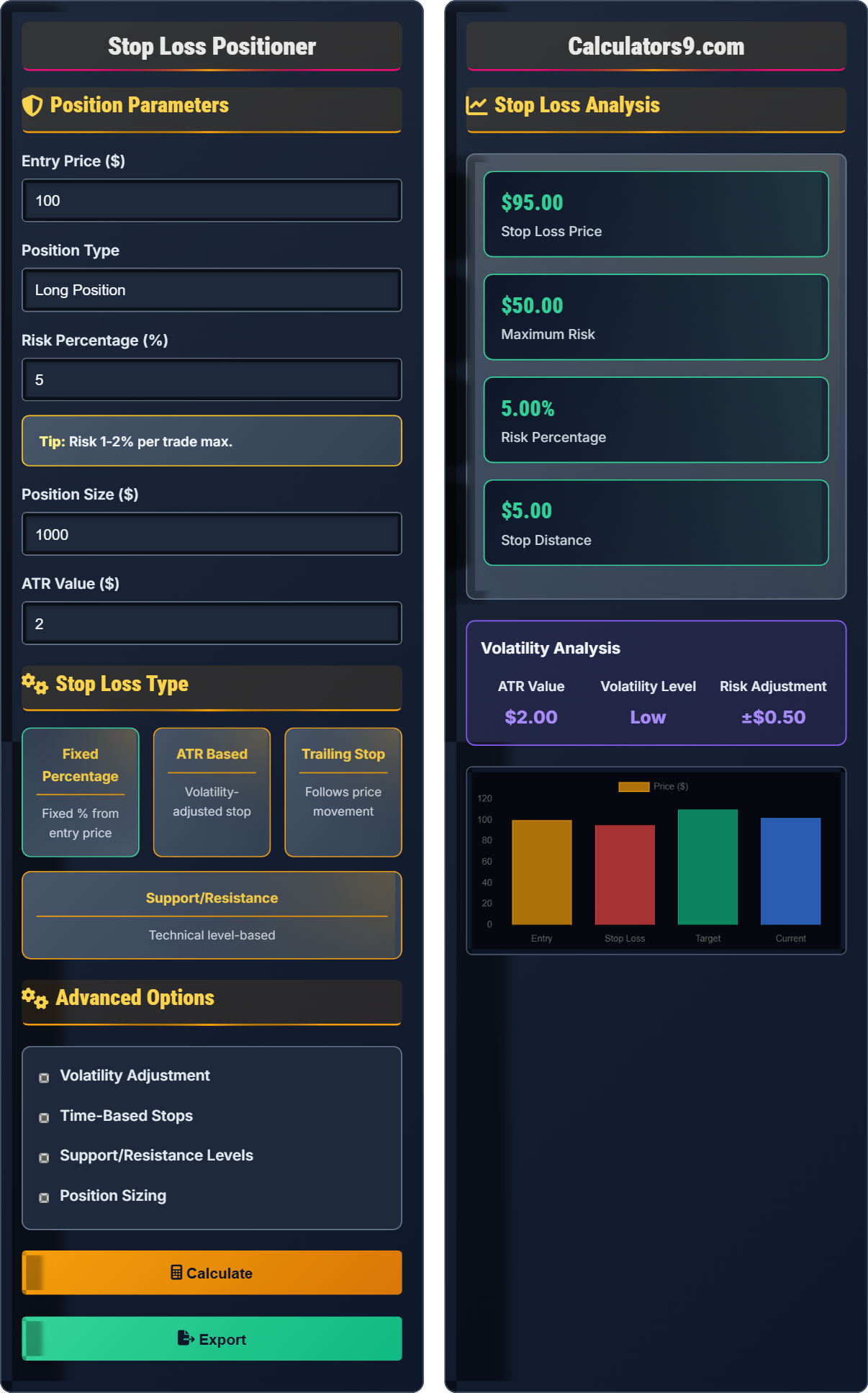
Show the calculatorFixed Percentage Stop: Stop Price = Entry Price × (1 - Risk Percentage)
ATR-Based Stop: Stop Price = Entry Price ± (ATR Multiplier × Average True Range)
Where:
- Fixed Percentage: Simple percentage of entry price
- ATR-Based: Uses volatility-adjusted stops
- Trailing Stops: Follows price movement to lock in gains
These formulas help determine optimal stop loss placement based on risk tolerance and market volatility. Proper stop placement protects capital while allowing for normal price fluctuations.
Example: For a $100 entry with 5% risk:
Fixed Stop = $100 × (1 - 0.05) = $95 (long position)
For ATR-based stop with ATR of $2 and multiplier of 2:
Stop = $100 - (2 × $2) = $96 (long position)
Position Parameters
Stop Loss Type
Advanced Options
Stop Loss Analysis
Volatility Analysis
Position Risk
Trailing Stop Control
Support/Resistance Levels
Time Frame Analysis
Comprehensive Stop Loss Guide
A stop loss is a predetermined exit point that automatically closes a trade when the price reaches a specific level, limiting potential losses. It's a critical risk management tool that protects capital and prevents emotional decision-making during volatile market conditions.
There are several methods for calculating stop loss levels:
Where:
- Fixed Percentage: Simple percentage-based approach
- ATR-Based: Uses Average True Range for volatility adjustment
- Trailing: Dynamic stop that follows price movement
Effective stop loss usage follows these principles:
- Position Sizing: Risk 1-2% of account per trade
- Volatility Adjustment: Account for market conditions
- Technical Levels: Respect key support/resistance
- Time-Based Stops: Exit if trade isn't working
- Set Before Entering: Plan exits before entering trades
- Don't Move Closer: Never tighten stops during trade
- Respect Volatility: Adjust for market conditions
- Use Trailing Stops: Lock in profits when possible
- Review Regularly: Adjust based on new information
Stop Loss Fundamentals
Predefined exit point to limit losses.
Fixed: Entry × (1 - Risk %) | ATR: Entry ± (ATR × Multiplier)
Where fixed = percentage-based, ATR = volatility-adjusted, trailing = dynamic.
- Set before entering trade
- Risk 1-2% per trade
- Respect technical levels
Risk Management
Determine trade size based on risk tolerance.
- Calculate risk before entry
- Set appropriate stop levels
- Use volatility adjustments
- Implement trailing stops
- Never move stops closer to entry
- Account for market volatility
- Consider slippage in fast markets
- Use multiple stop types strategically
Stop Loss Learning Quiz
Which stop loss type adjusts automatically based on market volatility?
The answer is B) ATR-Based. ATR (Average True Range) stops adjust based on market volatility. When volatility increases, the stop moves further from the entry price; when volatility decreases, the stop moves closer. This provides dynamic risk protection that adapts to changing market conditions.
ATR-based stops are superior in volatile markets because they account for normal price fluctuations. Fixed percentage stops might get triggered by normal volatility, while ATR stops adapt to the market's natural movement patterns. Understanding different stop types helps traders choose the most appropriate protection method for their strategy.
ATR: Average True Range - volatility measurement
Volatility: Degree of price variation over time
Dynamic Protection: Adapting stops to market conditions
• ATR stops adjust automatically to market volatility
• Higher ATR = wider stop distance
• Lower ATR = tighter stop distance
• Use ATR multiplier of 2-3 for most strategies
• Monitor ATR values for adjustment timing
• Combine with other stop types for redundancy
• Using fixed stops in highly volatile markets
• Setting ATR multiplier too tight
• Not adjusting for different timeframes
If you enter a long position at $80 with a 6% risk tolerance, what is your stop loss price? Show your work.
For a long position, the stop loss is below the entry price:
Step 1: Calculate risk amount = Entry Price × Risk Percentage
Risk Amount = $80 × 0.06 = $4.80
Step 2: Calculate stop loss price = Entry Price - Risk Amount
Stop Loss = $80 - $4.80 = $75.20
Therefore, the stop loss should be placed at $75.20.
This calculation demonstrates the basic fixed percentage stop loss method. The risk percentage determines how far the stop is placed from the entry. For long positions, the stop is below the entry; for short positions, it's above the entry. The percentage represents the maximum capital you're willing to lose on the trade.
Risk Tolerance: Maximum percentage willing to lose
Long Position: Buying expecting price to rise
Stop Loss: Exit point to limit losses
• Long positions: Stop below entry price
• Short positions: Stop above entry price
• Risk percentage determines stop distance
• Stop = Entry × (1 - Risk %) for long positions
• Stop = Entry × (1 + Risk %) for short positions
• Always calculate before entering trade
• Placing stops too tight (normal volatility triggers them)
• Moving stops closer during trade (increases risk)
• Not calculating stops before entering trade
You're entering a long position at $120 with an ATR of $3.50 and want to use a 2.5x ATR multiplier. What is your stop loss price?
Step 1: Calculate stop distance = ATR × Multiplier
Stop Distance = $3.50 × 2.5 = $8.75
Step 2: Calculate stop loss price = Entry Price - Stop Distance
Stop Loss = $120 - $8.75 = $111.25
Therefore, the ATR-based stop loss should be placed at $111.25.
ATR stops account for the asset's natural volatility. The ATR multiplier determines how many times the average daily range the stop should be placed away from the entry. A 2.5x multiplier is commonly used, providing enough room for normal price fluctuations while still offering protection. Higher multipliers give more room but increase risk exposure.
ATR: Average True Range - volatility indicator
Multiplier: Factor applied to ATR value
Volatility Adjustment: Stop based on market movement
• ATR stops adjust with market volatility
• Common multipliers range from 1.5x to 3x
• Higher multipliers = wider stops
• Use 2x ATR for moderate volatility
• Use 3x ATR for high volatility assets
• Recalculate ATR regularly for accuracy
• Using outdated ATR values
• Setting multipliers too tight for asset class
• Not adjusting for different timeframes
You have a $25,000 trading account and follow the 1% risk rule. If you enter a position at $50 with a stop loss at $47, how many shares should you buy?
Step 1: Calculate maximum risk per trade = Account × Risk %
Max Risk = $25,000 × 0.01 = $250
Step 2: Calculate risk per share = Entry - Stop = $50 - $47 = $3
Step 3: Calculate position size = Max Risk ÷ Risk Per Share
Shares = $250 ÷ $3 = 83.33 shares
Step 4: Round down to whole shares = 83 shares
Therefore, you should buy 83 shares to maintain 1% risk.
This demonstrates the relationship between stop loss placement and position sizing. The 1% rule limits risk to 1% of your account per trade. By determining your stop loss first, you can calculate exactly how many shares to buy to maintain consistent risk. This systematic approach ensures you never risk more than your predetermined percentage.
Position Sizing: Determining how much to trade
1% Rule: Risk no more than 1% per trade
Consistent Risk: Same percentage per trade
• Position Size = (Account × Risk %) ÷ Risk Per Share
• Always round down to avoid exceeding risk
• Calculate risk before entering trade
• PS = (A × R%) ÷ RPS (Position Size = Account × Risk % ÷ Risk Per Share)
• Set stops before calculating position size
• Use this formula for all trades
• Deciding position size before setting stops
• Not accounting for risk percentage
• Rounding up instead of down
Which statement about trailing stops is CORRECT?
The answer is B) They follow price to lock in profits. Trailing stops move in the direction of profitable trades, maintaining a fixed distance from the highest price reached (for long positions) or lowest price reached (for short positions). This allows traders to capture more profits while still protecting against reversals.
Trailing stops are dynamic stop losses that adjust automatically as the trade moves in your favor. For long positions, the stop follows the highest price achieved, moving up as the price rises but never moving down. For short positions, it follows the lowest price achieved. This technique helps maximize profits while maintaining downside protection.
Trailing Stop: Dynamic stop that follows price movement
Profit Locking: Capturing gains while protecting capital
Dynamic Protection: Stops that adjust during trade
• Trailing stops only move in profit direction
• They never move closer to entry price
• They help maximize profits in trending moves
• Use 8-10% trailing for volatile assets
• Use ATR-based trailing for volatility adjustment
• Combine with profit targets for complete exits
• Thinking trailing stops eliminate all risk
• Setting trailing distance too tight
• Confusing trailing stops with regular stops
FAQ
Q: Should I use a fixed percentage stop or an ATR-based stop?
A: The choice depends on your trading style and the asset's volatility characteristics.
Fixed Percentage Stops:
- Simple to calculate and understand
- Consistent risk percentage across all trades
- Best for stable, predictable assets
- May be triggered by normal volatility in volatile markets
ATR-Based Stops:
- Adjust automatically to market volatility
- Provide more room during high volatility periods
- More sophisticated risk management
- Require ongoing ATR calculation
Many experienced traders use a combination approach, starting with ATR-based stops and adjusting based on technical levels.
Q: How do I know if my stop loss is too tight or too wide?
A: The appropriateness of your stop loss depends on several factors:
Signs Your Stop is Too Tight:
- Frequent stop-outs during normal market fluctuations
- Stop losses triggered by minor pullbacks in trending moves
- Consistently exiting trades that later resume the intended direction
Signs Your Stop is Too Wide:
- Allowing excessive losses on bad trades
- Not respecting key technical levels
- Violating your risk management rules
The ideal stop loss should be based on technical analysis (support/resistance levels) while respecting your risk management parameters. Backtesting your stop loss strategy on historical data can help determine the optimal distance for your particular approach.