50/30/20 Rule Calculator
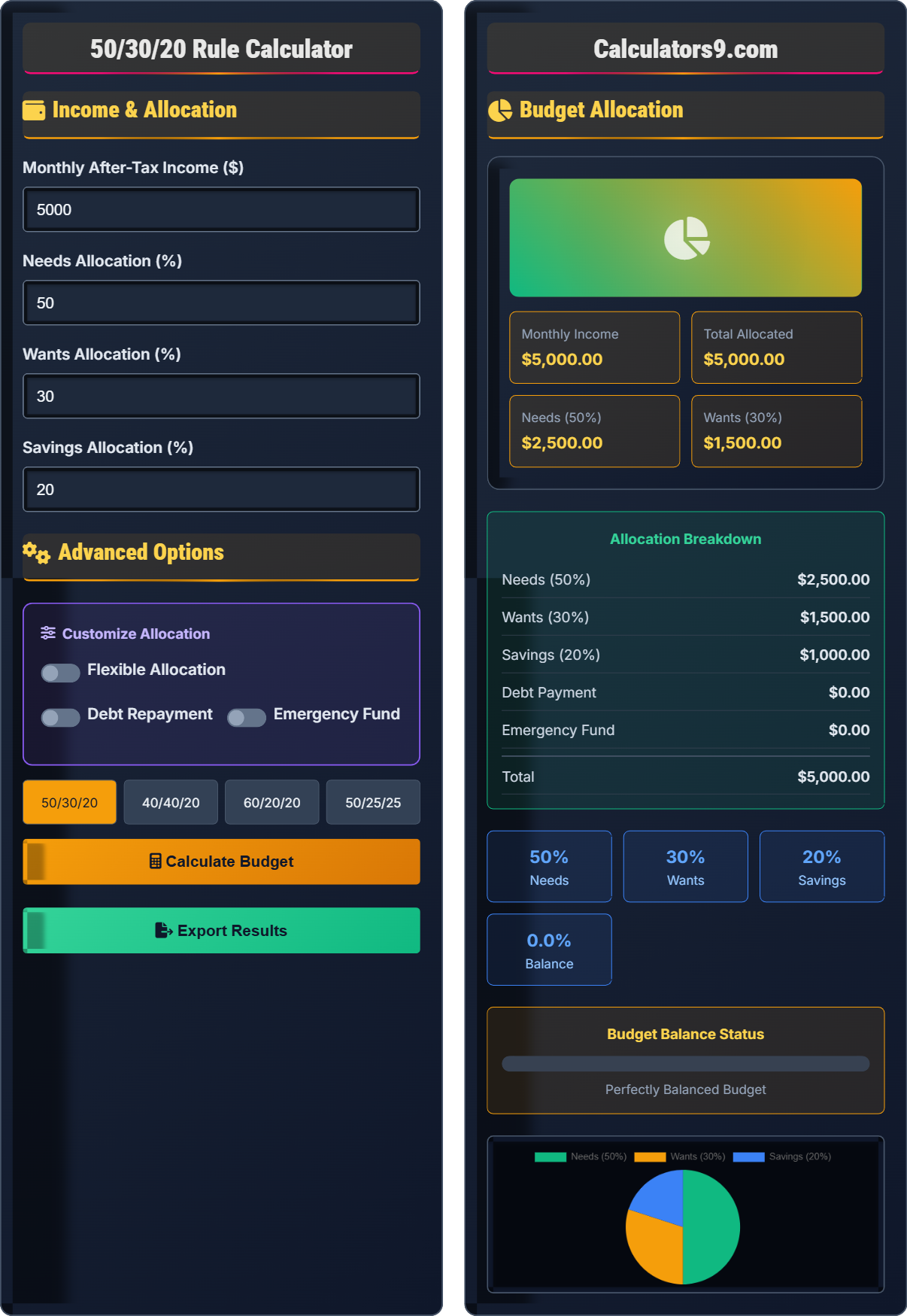
Balance your budget • Plan finances
50/30/20 Budget Formula:
Show Calculator\( N = I \times 0.50 \)
\( W = I \times 0.30 \)
\( S = I \times 0.20 \)
Where:
- \( N \) = Needs allocation (50%)
- \( W \) = Wants allocation (30%)
- \( S \) = Savings allocation (20%)
- \( I \) = After-tax income
Total: \( I = N + W + S \)
Example: Monthly income of $5,000:
\( N = 5000 \times 0.50 = \$2,500 \) (Needs)
\( W = 5000 \times 0.30 = \$1,500 \) (Wants)
\( S = 5000 \times 0.20 = \$1,000 \) (Savings)
Verification: \( 2500 + 1500 + 1000 = \$5,000 \)
Income & Allocation
Advanced Options
Budget Allocation
50/30/20 Rule Basics
The 50/30/20 rule is a simple budgeting method that divides after-tax income into three categories: 50% for needs, 30% for wants, and 20% for savings and debt repayment.
\(N = I \times 0.50\), \(W = I \times 0.30\), \(S = I \times 0.20\)
Where N=needs, W=wants, S=savings, I=income.
- 50% for essential needs
- 30% for discretionary wants
- 20% for savings and debt
- Apply to after-tax income
Budget Categories
Understanding what belongs in each category is crucial for effective budgeting.
- Needs (50%): Essential expenses
- Wants (30%): Discretionary spending
- Savings (20%): Future financial security
- Adjust percentages based on needs
- Priority debt repayment
- Emergency fund first
- Retirement savings
50/30/20 Rule Learning Quiz
According to the 50/30/20 rule, what percentage of income should be allocated to savings?
The answer is B) 20%. The 50/30/20 rule allocates 20% of after-tax income to savings and debt repayment combined. This portion is crucial for building financial security and achieving long-term financial goals.
The 50/30/20 rule provides a simple framework for managing money. The 20% savings allocation is intentionally substantial to ensure consistent progress toward financial goals. This percentage covers both debt repayment and savings, emphasizing the importance of financial responsibility.
After-tax Income: Income after tax deductions
Savings Allocation: Money set aside for future goals
Debt Repayment: Money to pay down debts
• 50% for needs (essential expenses)
• 30% for wants (discretionary spending)
• 20% for savings and debt repayment
• Remember: 50-30-20
• Apply to after-tax income
• Adjust based on personal needs
• Applying to gross income instead of after-tax
• Not including debt in savings allocation
• Misclassifying needs as wants
If someone has a monthly after-tax income of $4,000, how much should they allocate to needs, wants, and savings according to the 50/30/20 rule?
Using the formulas:
Needs (50%): $4,000 × 0.50 = $2,000
Wants (30%): $4,000 × 0.30 = $1,200
Savings (20%): $4,000 × 0.20 = $800
Verification: $2,000 + $1,200 + $800 = $4,000
Therefore, they should allocate $2,000 to needs, $1,200 to wants, and $800 to savings.
This calculation demonstrates how to apply the 50/30/20 rule mathematically. The formulas N = I × 0.50, W = I × 0.30, and S = I × 0.20 provide exact amounts for each category. Always verify that the sum equals total income.
Needs: Essential expenses for survival
Wants: Desirable but non-essential expenses
Savings: Money for future security
• Calculate each category separately
• Verify total equals income
• Use after-tax income
• Use: Needs = Income × 0.50
• Use: Wants = Income × 0.30
• Use: Savings = Income × 0.20
• Using gross instead of after-tax income
• Forgetting to verify total allocation
• Miscalculating percentages
Maria has identified the following monthly expenses: rent ($1,200), groceries ($400), gym membership ($50), dining out ($200), and student loan payment ($300). Using the 50/30/20 rule, which category would each expense fall under?
Needs (50%):
- Rent: $1,200 (housing necessity)
- Groceries: $400 (food necessity)
Wants (30%):
- Gym membership: $50 (discretionary fitness)
- Dining out: $200 (non-essential food)
Savings/Debt (20%):
- Student loan payment: $300 (debt repayment)
Correct classification helps ensure proper budget allocation.
Properly categorizing expenses is crucial for the 50/30/20 rule to work effectively. Needs include essential expenses for survival and basic living. Wants are discretionary expenses that enhance quality of life but aren't essential. Debt payments are part of the savings category.
Essential Expenses: Necessary for basic living
Discretionary Expenses: Optional spending
Debt Repayment: Obligatory financial commitments
• Needs include housing, food, utilities, transport
• Wants include entertainment, dining, hobbies
• Savings include debt payments and savings
• Ask: Is this essential for survival?
• Consider: Could this be postponed?
• Think: Does this build financial security?
• Classifying wants as needs
• Not including debt in savings category
• Misunderstanding essential vs. convenient
David has a monthly after-tax income of $6,000 but needs to allocate $800 per month to high-interest debt repayment. He also wants to build an emergency fund. How should he adjust his 50/30/20 allocation to accommodate these priorities? (Hint: Debt and emergency fund come from savings allocation)
Standard 50/30/20 allocation:
- Needs: $6,000 × 0.50 = $3,000
- Wants: $6,000 × 0.30 = $1,800
- Savings: $6,000 × 0.20 = $1,200
Adjusted allocation with debt and emergency fund:
- Debt repayment: $800
- Emergency fund: $400 (remaining from savings)
- Total for savings category: $1,200
David should prioritize debt repayment first, then emergency fund building, within his 20% savings allocation.
This example shows how to adapt the 50/30/20 rule to personal circumstances. The savings category (20%) includes both debt repayment and savings. When debt payments are high, it may require temporarily reducing other savings until debt is paid down.
Flexible Allocation: Adapting rules to personal needs
Debt Priority: Addressing high-interest debt first
Emergency Fund: Reserve for unexpected expenses
• Prioritize high-interest debt
• Build emergency fund first
• Adjust allocations as needed
• Focus on high-interest debt first
• Build emergency fund to 3-6 months expenses
• Return to standard allocation when possible
• Not prioritizing high-interest debt
• Skipping emergency fund for other savings
• Not adjusting for special circumstances
Which of the following is the BEST approach to the 50/30/20 rule?
The answer is B) Use as a guideline but adjust based on personal needs. The 50/30/20 rule is a flexible framework, not a rigid rule. Different life circumstances may require adjustments. For example, someone with high debt might need to save more than 20% initially, or someone with expensive housing might need to adjust the needs percentage.
The 50/30/20 rule provides a starting point for budgeting, but personal circumstances vary greatly. The key is to maintain the spirit of the rule—balancing essential needs, reasonable wants, and financial security—while adapting to individual situations like high debt, expensive housing, or irregular income.
Financial Framework: Guideline for money management
Personal Circumstances: Individual financial situation
Flexible Guidelines: Adaptable financial rules
• Treat as guidelines, not rules
• Adjust for special circumstances
• Maintain balance between categories
• Start with 50/30/20 as baseline
• Adjust for high debt or expenses
• Return to standard allocation when possible
• Treating percentages as absolute
• Not adjusting for special circumstances
• Ignoring the need for flexibility
FAQ
Q: What exactly counts as "needs" in the 50/30/20 rule?
A: Needs are essential expenses required for basic living and maintaining employment. These include:
- Housing: Rent/mortgage, property taxes, insurance
- Utilities: Electricity, water, heating, internet
- Food: Groceries (not dining out)
- Transportation: Car payment, fuel, public transit
- Insurance: Health, auto, disability
- Minimum debt payments
The formula is: \(N = I \times 0.50\), where \(N\) is needs and \(I\) is after-tax income.
Q: How do I handle the 50/30/20 rule if my housing costs exceed 50% of my income?
A: If housing exceeds 50%, adjust the rule accordingly. For example, if housing is 60% of income, consider a modified approach like 60/25/15 or 60/20/20.
Example with $4,000 income and $2,400 housing (60%):
- Needs (60%): $2,400 (housing) + $0 other = $2,400
- Wants (25%): $1,000
- Savings (15%): $600
The key is maintaining the balance between necessities, wants, and financial security even when standard percentages don't apply.