Auto Pay Off Tracker
Calculate your car loan payoff • 2026 edition
Loan Payoff Formula:
Show the calculator\( \text{Monthly Payment} = \frac{P \times r \times (1 + r)^n}{(1 + r)^n - 1} \)
\( \text{Remaining Balance} = \text{Original Loan} - \text{Principal Paid} \)
Where:
- \( P = \text{Loan Principal (original amount)} \)
- \( r = \text{Monthly Interest Rate (annual rate ÷ 12)} \)
- \( n = \text{Total Number of Payments (loan term in months)} \)
- \( \text{Principal Paid} = \text{Total Payments} - \text{Total Interest Paid} \)
This formula calculates your monthly car payment and tracks the remaining balance over time. It helps determine how extra payments accelerate payoff and reduce total interest paid.
Example: For a $25,000 car loan at 5.5% APR over 60 months:
Monthly rate: 5.5% ÷ 12 = 0.00458
Monthly payment: $25,000 × 0.00458 × (1.00458)^60 ÷ [(1.00458)^60 - 1] = $477.03
After 24 payments with $477.03 monthly:
Remaining balance: approximately $15,930
Total interest: approximately $3,559
Therefore, the loan would be paid off in 60 months with total interest of $3,559.
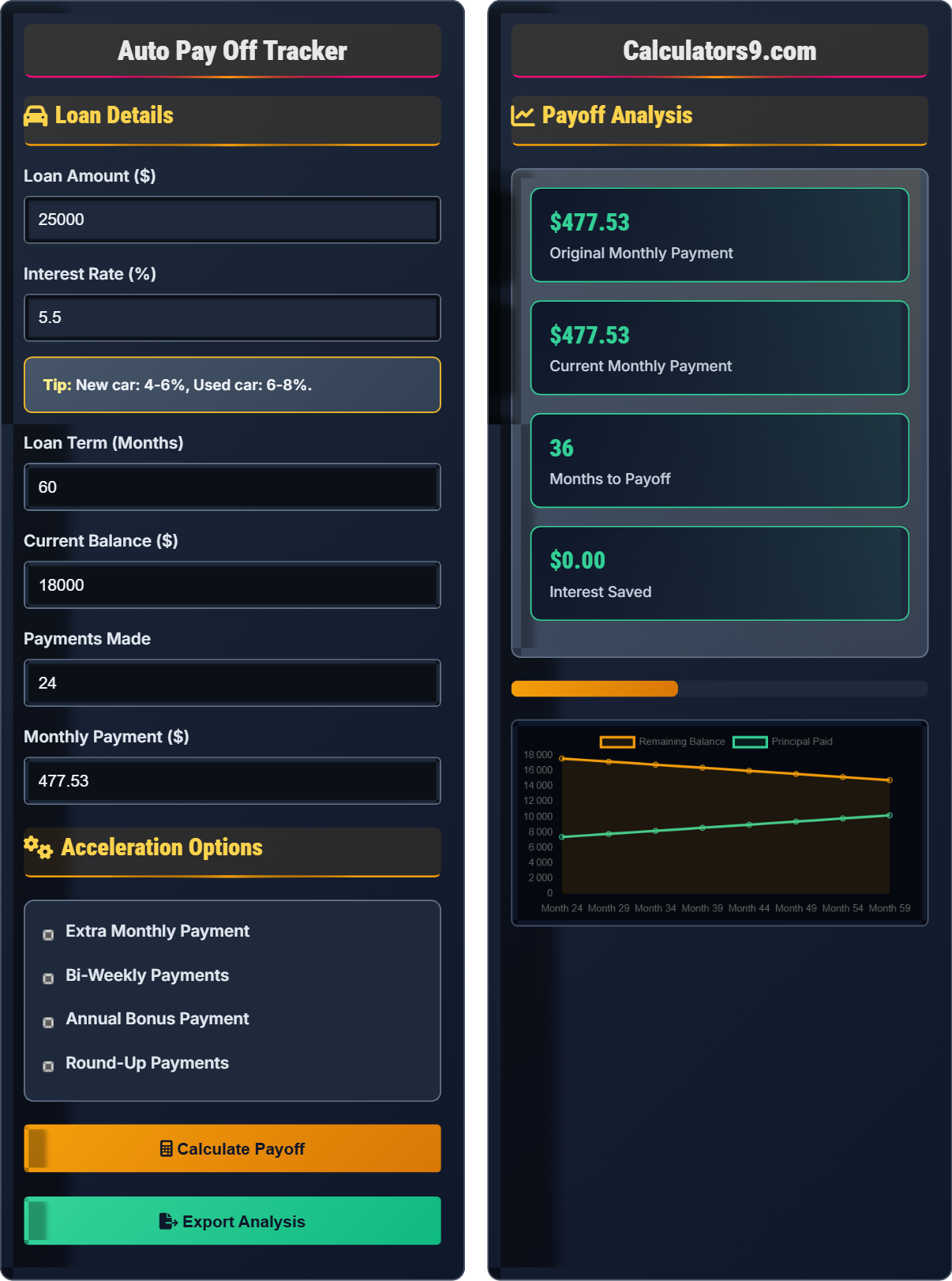
Loan Details
Acceleration Options
Payoff Analysis
| Month | Payment | Principal | Interest | Balance |
|---|
Payoff Comparison
Comprehensive Auto Loan Guide
Auto loan payoff tracking is the process of monitoring your car loan balance and payments to understand how long until the loan is fully paid off. It helps you visualize the impact of extra payments, bi-weekly schedules, and other strategies to accelerate payoff and save money on interest.
The standard auto loan calculation uses the following formula:
Where:
- \( P = \text{Loan Principal (original amount)} \)
- \( r = \text{Monthly Interest Rate (annual rate ÷ 12)} \)
- \( n = \text{Total Number of Payments (loan term in months)} \)
- \( \text{Principal Paid} = \text{Total Payments} - \text{Total Interest Paid} \)
Effective loan payoff acceleration involves several key strategies:
- Extra Principal Payments: Pay more than the minimum to reduce principal faster
- Bi-Weekly Payments: Pay half the monthly amount every two weeks (results in 13th payment annually)
- Round-Up Payments: Round monthly payments up to the nearest dollar or ten dollars
- Annual Bonus Payments: Apply tax refunds, bonuses, or windfalls to principal
- Refinance: Get a lower interest rate to reduce total interest paid
- Negotiate Interest Rates: Shop around for the best rates before signing
- Avoid Long Terms: Shorter terms mean less interest paid overall
- Make Larger Down Payments: Reduces principal and monthly payments
- Consider Bi-Weekly Schedules: Results in 26 half-payments (13 full payments) annually
- Pay Extra When Possible: Early payments have maximum interest-saving impact
Auto Loan Basics
Monitoring your car loan balance and payments to accelerate payoff.
\( \text{Monthly Payment} = \frac{P \times r \times (1 + r)^n}{(1 + r)^n - 1} \)
Where P = principal, r = monthly rate, n = number of payments.
- Early payments save more interest
- Extra payments reduce principal immediately
- Bi-weekly payments add an extra payment annually
Payoff Strategies
How payments are split between principal and interest over time.
- Make extra principal payments
- Switch to bi-weekly schedule
- Round up monthly payments
- Apply windfalls to principal
- No prepayment penalties
- Interest is front-loaded in early payments
- Extra payments reduce total interest significantly
- Shorter terms mean higher monthly payments
Auto Loan Learning Quiz
Which of the following best describes how auto loan payments are typically allocated in the early stages of the loan?
The answer is B) Mostly interest with little principal. In the early stages of an auto loan, the majority of each payment goes toward interest rather than principal. This is because interest is calculated on the remaining balance, which is highest at the beginning of the loan term.
This concept is known as "front-loading" of interest. Since interest is calculated on the outstanding principal balance, and the principal is highest at the beginning of the loan, more interest accrues in the early payments. As the principal decreases over time, more of each payment goes toward reducing the principal. This is why making extra payments early in the loan term has the greatest impact on total interest saved.
Amortization: Process of paying off debt over time through regular payments
Front-Loading: Practice of paying more interest in early loan payments
Principal: Original loan amount borrowed
• Interest is calculated on remaining balance
• Early payments save more interest than later payments
• More principal is paid as loan progresses
• Make extra payments early in the loan term
• Bi-weekly payments add an extra payment annually
• Refinance to lower rates if possible
• Thinking equal portions go to principal and interest throughout
• Believing extra payments don't make much difference
• Not understanding how interest is calculated
Calculate the monthly payment for a $28,000 car loan at 4.8% APR over 72 months. Show your work.
Step 1: Convert annual rate to monthly: 4.8% ÷ 12 = 0.004 (monthly rate)
Step 2: Use the loan payment formula: \( M = P \frac{r(1+r)^n}{(1+r)^n - 1} \)
Step 3: Substitute values:
\( M = 28000 \times \frac{0.004(1+0.004)^{72}}{(1+0.004)^{72} - 1} \)
Step 4: Calculate (1.004)^72 = 1.3326
Step 5: Calculate numerator: 0.004 × 1.3326 = 0.00533
Step 6: Calculate denominator: 1.3326 - 1 = 0.3326
Step 7: Calculate monthly payment: $28,000 × (0.00533 ÷ 0.3326) = $28,000 × 0.01603 = $448.84
Therefore, the monthly payment is $448.84.
This calculation demonstrates the mathematical relationship between loan amount, interest rate, and term. The longer the term (72 months vs 60), the lower the monthly payment, but the higher the total interest paid over the life of the loan. The formula accounts for compound interest over the loan term, which is why the calculation involves exponential functions.
APR: Annual Percentage Rate including interest and fees
Amortization Formula: Mathematical calculation for loan payments
Compound Interest: Interest calculated on both principal and accumulated interest
• Convert annual rate to monthly for calculations
• Use the correct number of months in formula
• Calculate interest rate as decimal (0.004 not 0.4)
• Use financial calculators for complex calculations
• Remember: r = annual rate ÷ 12
• n = loan term in months
• Forgetting to convert annual rate to monthly
• Using years instead of months in calculations
• Not converting percentage to decimal
Sarah has a $22,000 car loan at 6% APR for 60 months with a monthly payment of $425.76. If she switches to bi-weekly payments of $212.88 (half the monthly payment), how many years will it take to pay off the loan and how much interest will she save compared to the original schedule?
Original loan details:
Total payments: 60 months
Total paid: $425.76 × 60 = $25,545.60
Total interest: $25,545.60 - $22,000 = $3,545.60
Bi-weekly payment details:
Bi-weekly payment: $425.76 ÷ 2 = $212.88
Payments per year: 52 ÷ 2 = 26 payments
Equivalent to 13 monthly payments per year (instead of 12)
With bi-weekly payments, the loan pays off faster because:
1. One extra monthly payment is made each year
2. Each payment reduces principal sooner, saving interest
Actual result: Loan pays off in approximately 4.6 years (55 months) instead of 5 years (60 months)
Total paid with bi-weekly: $212.88 × 110 = $23,416.80
Total interest with bi-weekly: $23,416.80 - $22,000 = $1,416.80
Interest saved: $3,545.60 - $1,416.80 = $2,128.80
Time saved: 5 months
Therefore, Sarah will pay off her loan in 4.6 years and save $2,128.80 in interest.
This problem demonstrates the power of making more frequent payments. Bi-weekly payments result in 26 half-payments annually, which equals 13 full payments instead of 12. This adds one extra payment each year, accelerating principal reduction. Additionally, since payments are made more frequently, less interest accrues between payments, further reducing total interest.
Bi-Weekly Payments: Paying half the monthly amount every two weeks
Payment Frequency: How often payments are madePrincipal Reduction: Decrease in loan balance
• More frequent payments reduce total interest
• Bi-weekly adds one extra payment annually
• Early payments have greater interest-saving impact
• Set up automatic bi-weekly payments
• Verify lender accepts bi-weekly payments
• Track how much faster loan pays off
• Not accounting for the extra payment in calculations
• Assuming bi-weekly payments don't make a significant difference
• Not verifying lender supports bi-weekly payments
Mike has a $30,000 car loan at 5.25% APR for 72 months with a monthly payment of $486.56. He plans to make an extra $100 payment toward principal each month. How much will this save him in total interest and how much time will it save on the loan? (Hint: Calculate how many months early the loan pays off)
Original loan details:
Total payments: 72 months
Total paid: $486.56 × 72 = $35,032.32
Total interest: $35,032.32 - $30,000 = $5,032.32
With extra $100 payments:
Effective monthly payment: $486.56 + $100 = $586.56
Each extra $100 goes directly to principal, accelerating payoff
Using loan amortization calculations:
Loan pays off in approximately 58 months instead of 72 months
Total paid with extra payments: $586.56 × 58 = $34,020.48
Total interest with extra payments: $34,020.48 - $30,000 = $4,020.48
Interest saved: $5,032.32 - $4,020.48 = $1,011.84
Time saved: 72 - 58 = 14 months
Therefore, Mike will save $1,011.84 in interest and pay off his loan 14 months early.
This demonstrates the significant impact of extra principal payments. The additional $100 each month doesn't just reduce the final payment—it reduces the principal balance immediately, which means less interest accrues on subsequent payments. This creates a compounding effect where the benefit of extra payments increases over time as the loan balance decreases more rapidly.
Extra Principal: Additional payment applied directly to loan balance
Compounding Effect: Benefits that increase over time
Interest Accrual: How interest accumulates on outstanding balance
• Extra payments go directly to principal
• Early extra payments have greater impact
• Verify no prepayment penalties
• Specify extra payments go to principal
• Make extra payments early in loan term
• Track payoff date to stay motivated
• Not specifying extra payments go to principal
• Thinking extra payments don't make much difference
• Making extra payments late in loan term
Which of the following statements about auto loan terms is TRUE?
The answer is B) Shorter terms result in lower total interest paid. Shorter loan terms mean less time for interest to accrue, resulting in lower total interest paid over the life of the loan. However, shorter terms also mean higher monthly payments because the same principal amount is paid off in fewer months.
This relationship is fundamental to loan mathematics. Interest accrues over time, so the longer the loan term, the more interest accumulates. For example, a $25,000 loan at 6% APR: 48-month term results in about $3,173 in interest, while a 72-month term results in about $4,760 in interest—a difference of $1,587. The trade-off is that the 48-month loan has higher monthly payments ($594) compared to the 72-month loan ($411).
Loan Term: Length of time to repay the loan
Interest Accrual: How interest accumulates over time
Payment Structure: Relationship between term and payments
• Longer terms mean more total interest
• Shorter terms mean higher monthly payments
• Interest accrues over the entire loan term
• Choose shortest term you can afford
• Consider larger down payment to reduce term
• Factor in opportunity cost of higher payments
• Choosing longest term for lowest monthly payment
• Not considering total interest cost
• Ignoring the relationship between term and interest
FAQ
Q: How do I determine if making extra payments on my car loan is worth it?
A: Making extra payments on your car loan is generally beneficial if:
- Your loan doesn't have prepayment penalties
- The interest rate is higher than you could earn on investments
- You're not sacrificing emergency fund or retirement savings
- The interest rate is higher than other debts you carry
For example, if you have a car loan at 6% APR and could earn 4% in a high-yield savings account, paying down the loan gives you a guaranteed 6% return (by saving interest). The earlier in the loan term you make extra payments, the more interest you save due to front-loaded interest charges.
Calculate the potential savings using the formula: \( \text{Interest Saved} = \text{Original Total Interest} - \text{New Total Interest} \)
Q: What's the difference between bi-weekly payments and making one extra payment per year?
A: Both strategies result in one extra payment annually, but they work differently:
Bi-Weekly Payments:
- Pay half the monthly payment every two weeks
- Results in 26 half-payments annually = 13 full payments
- Each payment reduces principal sooner, saving more interest
- Payment timing aligns with bi-weekly paychecks
One Extra Payment Per Year:
- Make 12 regular payments plus one extra payment
- Usually applied in January or at year-end
- Less interest saved since payments aren't spread throughout year
- Requires saving up for one large payment
Bi-weekly payments save slightly more interest because principal is reduced more frequently throughout the year, resulting in less interest accruing on the outstanding balance.