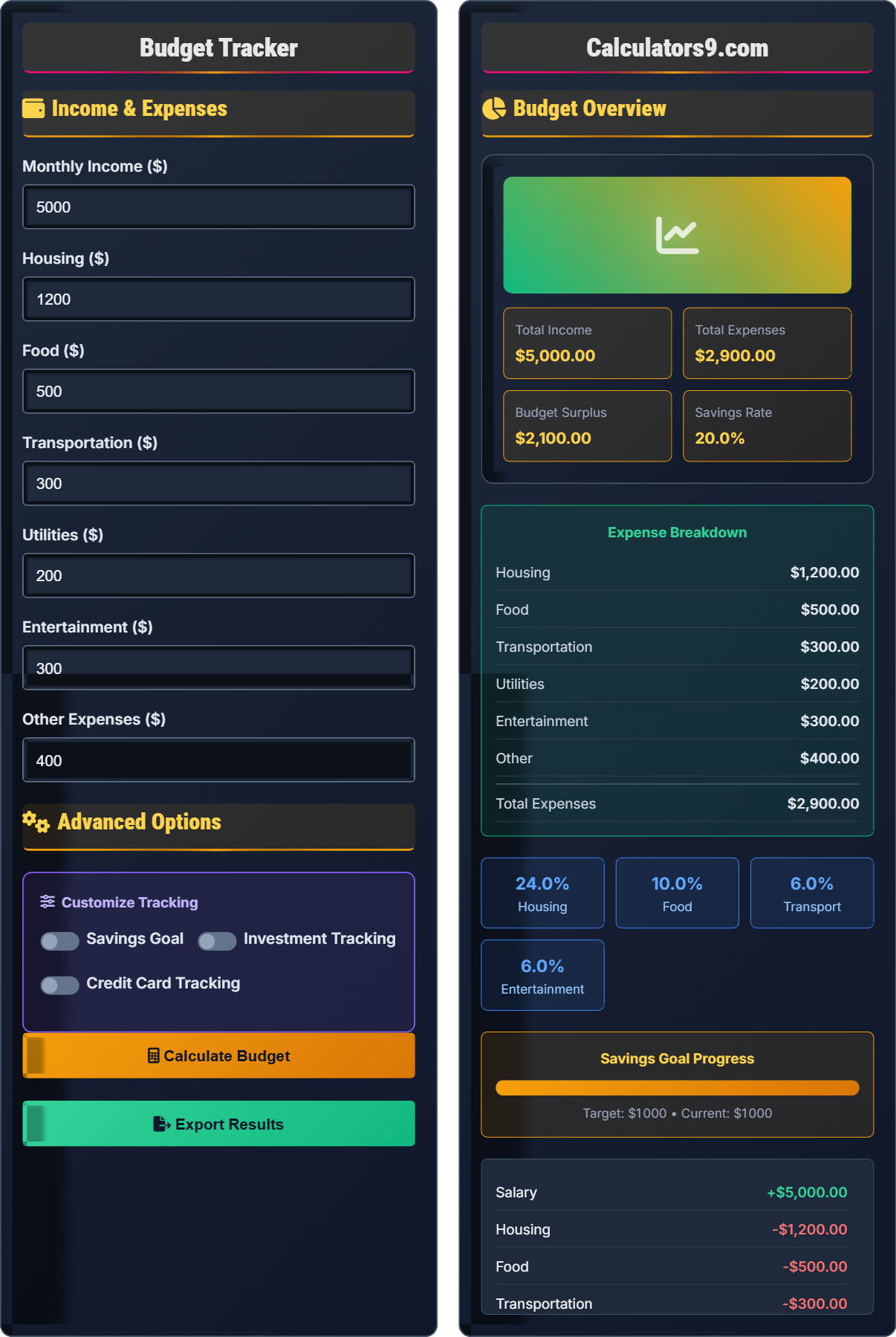
Budget Tracker
Track expenses • Plan savings
Budget Tracking Formula:
Show Calculator\( B = I - E \)
Where:
- \( B \) = Budget surplus/deficit
- \( I \) = Total income
- \( E \) = Total expenses
For monthly budget: \( B_{monthly} = I_{monthly} - E_{monthly} \)
Savings rate: \( SR = \frac{S}{I} \times 100 \)
Where S = Savings amount
Example: Monthly income of $5,000 and expenses of $4,200:
\( B = 5000 - 4200 = \$800 \)
If $600 is saved: \( SR = \frac{600}{5000} \times 100 = 12\% \)
Thus, the budget shows a $800 surplus with a 12% savings rate.
Income & Expenses
Advanced Options
Budget Overview
Budget Planning Basics
Budget tracking is the process of monitoring income and expenses to ensure spending aligns with financial goals and priorities.
\(B = I - E\)
Where B=budget surplus/deficit, I=income, E=expenses.
- Expenses should not exceed income
- Save at least 10-20% of income
- Track spending regularly
- Review budgets monthly
Financial Strategies
Focus on reducing unnecessary expenses and increasing savings rate for financial stability.
- 50% Needs (housing, food, utilities)
- 30% Wants (entertainment, dining)
- 20% Savings/Debt
- Emergency fund priority
- Debt reduction
- Investment allocation
- Tax planning
Budget Planning Learning Quiz
What is the fundamental equation of personal budgeting?
The answer is B) Budget = Income - Expenses. This fundamental equation shows whether you have a surplus (positive budget) or deficit (negative budget). The budget represents the difference between what you earn and what you spend.
This basic equation forms the foundation of all personal finance management. It helps identify if you're living within your means. A positive result means you're spending less than you earn, while a negative result indicates overspending that needs correction.
Budget Surplus: When income exceeds expenses
Budget Deficit: When expenses exceed income
Net Income: Income after taxes and deductions
• Budget = Income - Expenses
• Positive values indicate surplus
• Negative values indicate deficit
• Track income and expenses separately
• Use: Budget = Income - Expenses
• Aim for positive budget values
• Not tracking all income sources
• Forgetting to include all expenses
• Confusing gross and net income
If someone has a monthly income of $4,500 and monthly expenses of $3,800, what is their monthly budget surplus and what percentage of income are they saving if they put all surplus into savings?
Using the budget formula: Budget = Income - Expenses
Given:
- Income = $4,500
- Expenses = $3,800
Step 1: Calculate budget surplus = $4,500 - $3,800 = $700
Step 2: Calculate savings rate = ($700 ÷ $4,500) × 100
Step 3: Calculate savings rate = 0.1556 × 100 = 15.56%
Therefore, the monthly budget surplus is $700 with a 15.56% savings rate.
This calculation demonstrates how to determine both surplus and savings rate. The savings rate of 15.56% is considered healthy and exceeds the recommended minimum of 10%. This surplus provides financial flexibility and helps build wealth over time.
Savings Rate: Percentage of income saved
Monthly Surplus: Amount left after expenses
Recommended Savings: 10-20% of income
• Savings rate = (Savings ÷ Income) × 100
• Budget surplus = Income - Expenses
• Higher savings rates lead to faster wealth accumulation
• Use: Savings Rate = (Surplus ÷ Income) × 100
• Aim for 10-20% savings rate
• Automate savings transfers
• Dividing by expenses instead of income
• Forgetting to multiply by 100 for percentage
• Not accounting for all expenses
Jane has a monthly after-tax income of $6,000. Using the 50/30/20 rule, how much should she allocate to needs, wants, and savings respectively? If her housing cost is $1,800, does this fit within the 50% needs allocation?
Step 1: Calculate 50% for needs: $6,000 × 0.50 = $3,000
Step 2: Calculate 30% for wants: $6,000 × 0.30 = $1,800
Step 3: Calculate 20% for savings: $6,000 × 0.20 = $1,200
Step 4: Housing ($1,800) as percentage of income: ($1,800 ÷ $6,000) × 100 = 30%
Step 5: Since 30% < 50% needs allocation, housing fits within the rule.
Therefore, Jane should allocate $3,000 to needs, $1,800 to wants, and $1,200 to savings. Her housing cost fits within the 50% needs allocation.
The 50/30/20 rule is a simple budgeting guideline that helps maintain financial balance. Needs include essentials like housing, food, and utilities. Wants cover discretionary spending like entertainment and dining out. Savings encompass emergency funds, retirement, and debt repayment.
Needs: Essential expenses for basic living
Wants: Discretionary spending for enjoyment
Savings: Money set aside for future goals
• 50% for needs (housing, food, utilities)
• 30% for wants (entertainment, dining)
• 20% for savings and debt repayment
• Calculate allocations before spending
• Track spending in each category
• Adjust categories based on needs
• Confusing needs with wants
• Not calculating exact percentages
• Overspending in want categories
David wants to build an emergency fund equivalent to 6 months of expenses. His monthly expenses are $2,500. If he can save $400 per month, how long will it take to reach his emergency fund goal? (Hint: Calculate total goal amount first)
Step 1: Calculate emergency fund goal = $2,500 × 6 = $15,000
Step 2: Calculate time to reach goal = $15,000 ÷ $400/month = 37.5 months
Step 3: Convert to years = 37.5 ÷ 12 = 3.125 years
Therefore, it will take David 37.5 months (approximately 3 years and 2 months) to build his emergency fund.
Emergency funds provide financial security during unexpected events like job loss or medical emergencies. The 3-6 month expense recommendation balances preparedness with opportunity cost. Building this fund systematically ensures financial stability and peace of mind.
Emergency Fund: Savings for unexpected expenses
Opportunity Cost: Benefit lost by choosing one option
Financial Security: Protection against unexpected events
• Emergency fund = 3-6 months of expenses
• Keep in easily accessible account
• Replenish after use
• Start with smaller goal (3 months)
• Automate monthly contributions
• Use high-yield savings account
• Not having emergency fund
• Keeping too little or too much
• Using for non-emergencies
Which of the following is the BEST approach to optimizing a personal budget?
The answer is C) Balance expense reduction with quality of life. Effective budget optimization involves making strategic choices about spending while maintaining financial goals and personal satisfaction. Extreme cost-cutting can lead to budget failure, while ignoring quality of life makes budgets unsustainable.
Successful budgeting requires sustainable practices that align with personal values and goals. The best approach identifies areas where spending can be optimized without significantly impacting lifestyle. This includes negotiating bills, finding cheaper alternatives, and eliminating truly unnecessary expenses while preserving valued activities.
Budget Optimization: Improving budget effectiveness
Sustainable Budgeting: Maintaining budget long-term
Quality of Life: Satisfaction with living standards
• Budgets should be realistic and achievable
• Balance financial goals with personal values
• Review and adjust regularly
• Prioritize high-impact, low-effort changes
• Use budgeting apps for tracking
• Plan for occasional indulgences
• Creating unrealistic budget constraints
• Not accounting for irregular expenses
• Forgetting to review and adjust
FAQ
Q: How much should I save each month for a healthy budget?
A: The general recommendation is to save 10-20% of your income. The formula is: \(SR = \frac{S}{I} \times 100\), where \(SR\) is savings rate, \(S\) is savings amount, and \(I\) is income.
For example, with monthly income of $5,000:
- 10% target: $5,000 × 0.10 = $500/month
- 20% target: $5,000 × 0.20 = $1,000/month
Start with whatever you can manage and gradually increase the percentage as your financial situation improves.
Q: What is the 50/30/20 rule and how does it work?
A: The 50/30/20 rule allocates post-tax income as follows:
- 50% for Needs: Essentials like housing, food, utilities, transportation
- 30% for Wants: Discretionary spending like entertainment, dining, hobbies
- 20% for Savings: Emergency fund, retirement, debt repayment
For example, with $4,000 monthly income:
- Needs: $2,000
- Wants: $1,200
- Savings: $800
This rule provides a simple framework for balanced spending.