Cash Flow Forecaster
Forecast cash • Plan finances
Cash Flow Forecast Formula:
Show Calculator\( CF_t = I_t - E_t \)
\( CF_{cumulative} = \sum_{i=1}^{t} (I_i - E_i) \)
\( CF_{forecast} = I_{forecast} - E_{forecast} \)
Where:
- \( CF_t \) = Cash flow at time t
- \( I_t \) = Income at time t
- \( E_t \) = Expenses at time t
- \( CF_{cumulative} \) = Cumulative cash flow
- \( CF_{forecast} \) = Projected cash flow
Net Cash Flow: \( NCF = Total\ Income - Total\ Expenses \)
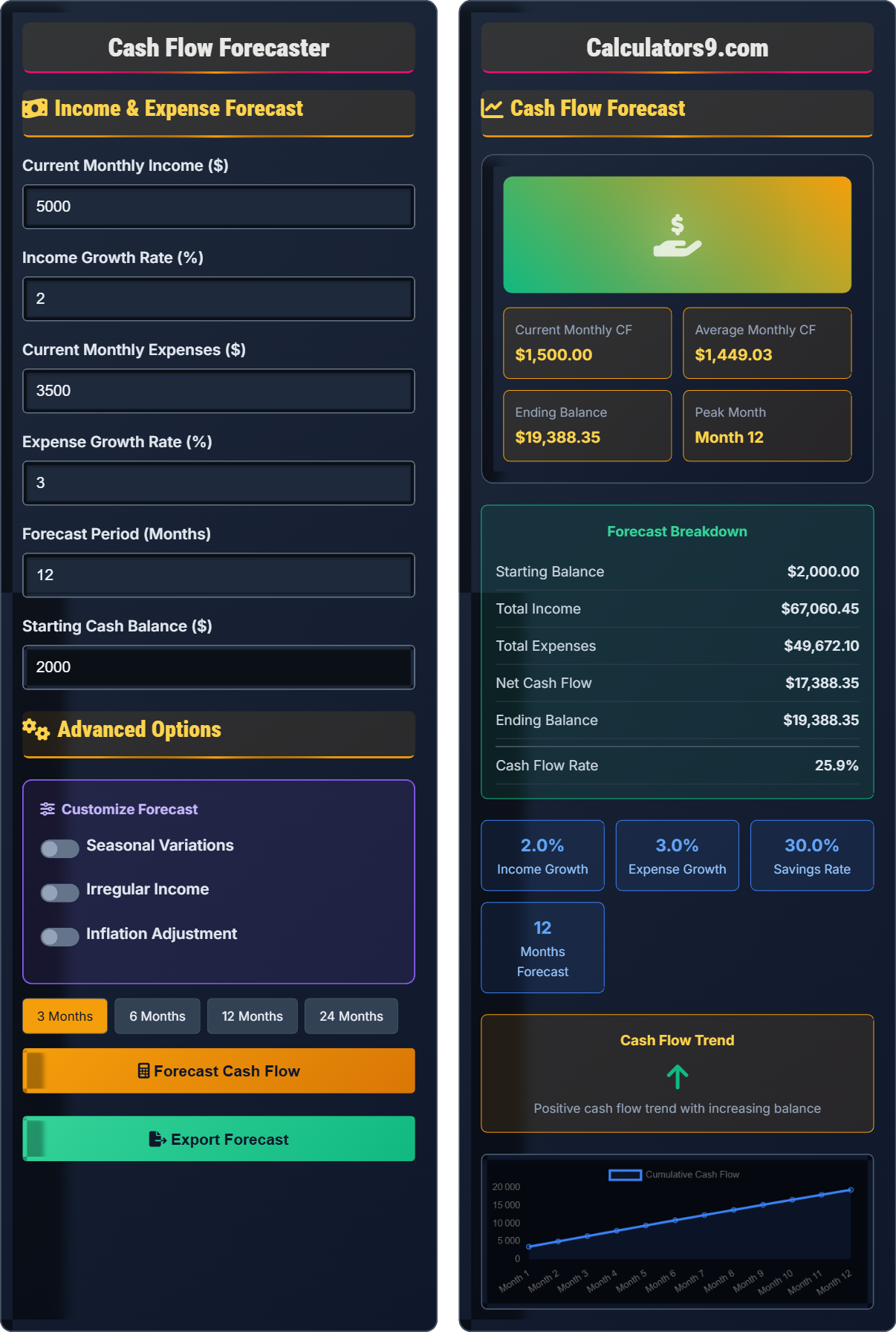
Example: Monthly income of $5,000 and expenses of $3,500:
\( CF = 5000 - 3500 = \$1,500 \)
If this continues for 6 months: \( CF_{cumulative} = 1500 \times 6 = \$9,000 \)
Income & Expense Forecast
Advanced Options
Cash Flow Forecast
Cash Flow Forecasting Basics
Cash flow forecasting is the process of predicting future cash inflows and outflows to anticipate financial positions over time.
\(CF = I - E\)
Where CF=cash flow, I=income, E=expenses.
- Track all income sources
- Account for all expenses
- Consider timing of flows
- Update forecasts regularly
Forecasting Strategies
Use historical data, trends, and assumptions to predict future cash flows accurately.
- Historical analysis
- Trend projection
- Scenario planning
- Sensitivity analysis
- Regular updates
- Seasonal variations
- Economic conditions
- Life changes
- Unexpected events
Cash Flow Forecasting Learning Quiz
What is the basic formula for calculating cash flow?
The answer is B) Income - Expenses. Cash flow is calculated by subtracting total expenses from total income. This represents the net amount of cash moving in and out of your accounts.
The cash flow formula is fundamental to financial planning. It shows whether you're generating more money than you're spending. Positive cash flow indicates surplus funds, while negative cash flow indicates a shortfall that needs addressing.
Cash Flow: Net amount of money flowing in and out
Positive Cash Flow: Income exceeds expenses
Negative Cash Flow: Expenses exceed income
• Cash Flow = Income - Expenses
• Positive values indicate surplus
• Negative values indicate deficit
• Remember: Income minus Expenses
• Track monthly for consistency
• Forecast regularly to plan ahead
• Adding instead of subtracting
• Forgetting to include all income
• Not accounting for all expenses
If someone has monthly income of $4,500 and monthly expenses of $3,800, what is their monthly cash flow? If this pattern continues for 6 months, what will be their cumulative cash flow?
Monthly cash flow: $4,500 - $3,800 = $700
Cumulative cash flow over 6 months: $700 × 6 = $4,200
Therefore, they will have a monthly cash flow of $700 and cumulative cash flow of $4,200 over 6 months.
This calculation demonstrates both monthly and cumulative cash flow. Monthly cash flow shows immediate financial position, while cumulative cash flow shows the total accumulation over time. Both metrics are important for financial planning.
Monthly Cash Flow: Cash flow for one month
Cumulative Cash Flow: Total cash flow over time
Financial Position: Current state of finances
• Calculate monthly first
• Multiply by number of periods
• Consider growth rates over time
• Use: Monthly CF = Income - Expenses
• Use: Cumulative CF = Monthly CF × Periods
• Factor in growth rates for accuracy
• Confusing monthly with cumulative
• Forgetting to account for growth
• Not considering timing differences
Sarah's current monthly income is $6,000 and expenses are $4,200. If her income grows by 1.5% per month and expenses grow by 2% per month, what will her cash flow be after 3 months?
Month 1:
- Income: $6,000
- Expenses: $4,200
- Cash flow: $6,000 - $4,200 = $1,800
Month 2:
- Income: $6,000 × 1.015 = $6,090
- Expenses: $4,200 × 1.02 = $4,284
- Cash flow: $6,090 - $4,284 = $1,806
Month 3:
- Income: $6,090 × 1.015 = $6,181.35
- Expenses: $4,284 × 1.02 = $4,369.68
- Cash flow: $6,181.35 - $4,369.68 = $1,811.67
Her cash flow after 3 months will be $1,811.67.
This example shows how growth rates affect cash flow over time. Even though both income and expenses are growing, the difference between them (cash flow) is also growing slightly because income growth rate (1.5%) is lower than expense growth rate (2%). This demonstrates the importance of monitoring growth trends.
Growth Rate: Percentage increase over time
Compounding Growth: Growth on previous growth
Cash Flow Trend: Direction of cash flow over time
• Apply growth rates to previous values
• Calculate period by period
• Monitor growth rate differences
• Use: New Value = Old Value × (1 + Growth Rate)
• Calculate each period separately
• Watch for rate differentials
• Applying growth rate to original value each time
• Forgetting to compound growth
• Not calculating period by period
David has a stable monthly income of $5,000 but experiences 20% higher expenses in summer months (June-August) due to travel. If his normal monthly expenses are $3,500, what is his annual cash flow considering these seasonal variations? (Hint: Calculate normal months and summer months separately)
Normal months (9 months):
- Monthly CF: $5,000 - $3,500 = $1,500
- Total for 9 months: $1,500 × 9 = $13,500
Summer months (3 months):
- Summer expenses: $3,500 × 1.20 = $4,200
- Monthly CF: $5,000 - $4,200 = $800
- Total for 3 months: $800 × 3 = $2,400
Annual cash flow: $13,500 + $2,400 = $15,900
Therefore, his annual cash flow is $15,900.
This example demonstrates how seasonal variations affect annual cash flow. Even with higher summer expenses, David still maintains positive cash flow throughout the year. Seasonal forecasting helps plan for these variations and ensures adequate reserves during high-expense periods.
Seasonal Variations: Regular periodic changes
Annual Cash Flow: Total cash flow over a year
Seasonal Planning: Budgeting for periodic changes
• Account for seasonal variations
• Plan reserves for high-expense periods
• Calculate different periods separately
• Identify seasonal patterns
• Build reserves for high-expense periods
• Average seasonal effects for planning
• Ignoring seasonal variations
• Not planning for high-expense periods
• Using average values for all periods
Which of the following is the BEST approach to maintain accurate cash flow forecasts?
The answer is B) Update forecasts regularly with actual results. Regular updates ensure forecasts remain accurate as circumstances change. Comparing forecasted values with actual results helps refine future predictions and identify patterns.
Accurate forecasting requires ongoing refinement. Regular updates incorporate real-world changes and improve prediction accuracy. The feedback loop between forecasts and actual results helps identify trends and adjust assumptions, leading to better financial planning.
Forecast Accuracy: How close predictions match reality
Regular Updates: Periodic forecast revisions
Feedback Loop: Using results to improve predictions
• Update forecasts regularly
• Compare with actual results
• Refine assumptions based on data
• Review forecasts monthly
• Compare forecast vs. actual
• Adjust assumptions as needed
• Not updating forecasts regularly
• Ignoring forecast errors
• Using outdated assumptions
FAQ
Q: How far ahead should I forecast my cash flow?
A: For personal finance, forecast 3-12 months ahead for regular planning. Use longer-term forecasts (2-5 years) for major financial goals.
The formula for forecasting is: \(CF_{forecast} = I_{forecast} - E_{forecast}\)
Where \(CF_{forecast}\) is projected cash flow, \(I_{forecast}\) is projected income, and \(E_{forecast}\) is projected expenses.
Regular updates ensure accuracy as circumstances change.
Q: How do I account for irregular income in cash flow forecasting?
A: For irregular income, calculate an average monthly amount based on historical data or use conservative estimates.
Example with irregular income of $3,000 in Month 1 and $7,000 in Month 2:
- Average: ($3,000 + $7,000) ÷ 2 = $5,000 per month
- Or use: Conservative estimate = $4,000 per month
The formula becomes: \(CF = (I_{regular} + I_{irregular}) - E\)
Build larger reserves during high-income periods to smooth out variations.