College Fund Estimator
Plan your child's education budget • 2026 edition
College Savings Formula:
Show the calculator\( \text{Future Tuition Cost} = \text{Current Tuition} \times (1 + \text{Inflation Rate})^{\text{Years Until College}} \)
\( \text{Monthly Savings} = \frac{\text{Future Tuition Cost} - \text{Current Savings}}{\text{Months Until College}} \)
Where:
- \( \text{Future Tuition Cost} = \text{Projected cost adjusted for inflation} \)
- \( \text{Years Until College} = \text{Time until child enrolls} \)
- \( \text{Monthly Savings} = \text{Amount to save each month} \)
This formula calculates the monthly savings required to meet future college costs, accounting for tuition inflation. It helps parents plan ahead to avoid student debt and ensure educational opportunities.
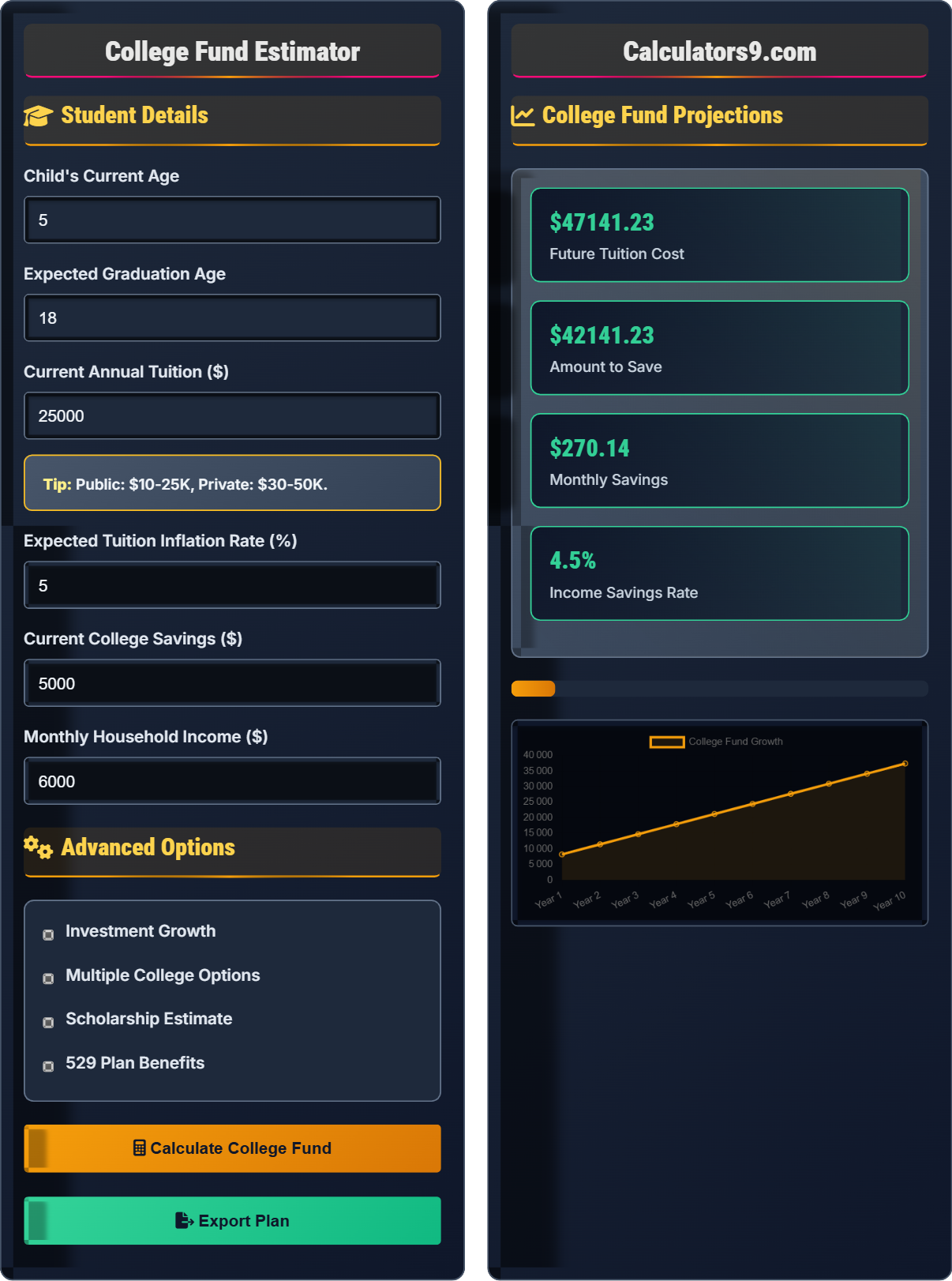
Example: For a current tuition of $25,000 with 5% annual inflation over 15 years:
Future cost: $25,000 × (1.05)^15 = $51,970
If you have $5,000 saved and 15 years (180 months) until college:
Monthly savings: ($51,970 - $5,000) ÷ 180 = $261
Therefore, you need to save $261 per month to meet your goal.
Student Details
Advanced Options
College Fund Projections
| Scenario | Future Cost | Monthly Savings | Investment Growth |
|---|
Savings Timeline
Comprehensive College Fund Guide
College fund planning is the process of saving and investing money systematically to cover future education expenses. It involves estimating future tuition costs, accounting for inflation, and creating a consistent savings strategy to ensure your child can attend college without excessive debt.
The standard college savings calculation uses the following formula:
Where:
- \( \text{Future Tuition Cost} = \text{Projected cost adjusted for inflation} \)
- \( \text{Years Until College} = \text{Time from today until enrollment} \)
- \( \text{Monthly Savings} = \frac{\text{Future Cost} - \text{Current Savings}}{\text{Months Until College}} \)
Effective college savings involves several key strategies:
- Start Early: Take advantage of compound growth over time
- Use Tax-Advantaged Accounts: 529 plans offer tax-free growth
- Automate Savings: Set up automatic monthly contributions
- Research Financial Aid: Understand grants, scholarships, and loans
- Consider State Plans: Many states offer benefits for residents
- Choose the Right Account: 529 plans for education, Coverdell ESAs for K-12
- Maximize Employer Benefits: Some employers offer education assistance
- Apply for Scholarships: Start early and apply to multiple programs
- Consider Community College: Transfer pathway can reduce costs
- Plan for Inflation: Tuition increases faster than general inflation
College Fund Basics
Systematic approach to saving for future education expenses.
\( \text{Future Cost} = \text{Current Cost} \times (1 + \text{Inflation Rate})^{\text{Years}} \)
Where cost = tuition adjusted for inflation over time.
- Start saving as early as possible
- Account for tuition inflation
- Use tax-advantaged accounts
Savings Strategies
Tax-advantaged accounts for education expenses.
- Start early for compound growth
- Choose appropriate investments
- Take advantage of tax benefits
- Research state-specific incentives
- Don't compromise retirement savings
- Consider your child's interests
- Factor in scholarship opportunities
- Plan for various college scenarios
College Fund Learning Quiz
On average, how much does college tuition increase annually compared to general inflation?
The answer is C) Tuition increases faster than general inflation. On average, college tuition increases by 5-8% annually, while general inflation typically runs 2-4%. This means that tuition costs double approximately every 10 years, making long-term planning essential.
The disparity between tuition inflation and general inflation is a critical factor in college planning. If general inflation is 3% but tuition rises 6%, the cost of college will grow significantly faster than your income. This is why planning for college expenses requires more aggressive savings strategies than planning for other goals with lower inflation rates.
Tuition Inflation: Rate at which college costs increase annually
General Inflation: Rate at which overall prices increase
Compound Growth: Exponential increase over time
• Tuition inflation exceeds general inflation
• Plan for 5-8% annual increases
• Start saving early to combat compound growth
• Use 5-7% for planning purposes
• Research historical trends for your state
• Consider more conservative investment returns
• Using general inflation rate instead of tuition inflation
• Underestimating future college costs
• Not accounting for compound growth effects
Calculate the future tuition cost if current tuition is $20,000, inflation averages 6% annually, and your child will start college in 12 years. Show your work.
Step 1: Use the compound growth formula: Future Cost = Current Cost × (1 + Inflation Rate)^Years
Step 2: Substitute values: Future Cost = $20,000 × (1 + 0.06)^12
Step 3: Calculate: Future Cost = $20,000 × (1.06)^12
Step 4: Calculate (1.06)^12 = 2.012
Step 5: Final calculation: Future Cost = $20,000 × 2.012 = $40,240
Therefore, the future tuition cost will be approximately $40,240.
This calculation demonstrates the powerful effect of compound growth over time. Even with a moderate 6% annual increase, the original $20,000 doubles to $40,000 over 12 years. This exponential growth is why starting early is so crucial for college savings. Each additional year of growth significantly increases the total amount needed.
Compound Growth: Exponential increase where growth builds on previous growth
Future Value: Value of money at a future date considering growth
Present Value: Current value of future money
• Use compound growth formula for accurate projections
• Higher inflation rates require more aggressive savings
• Longer timeframes amplify growth effects
• Use 5-7% for conservative planning
• Consider multiple scenarios (conservative, moderate, aggressive)
• Factor in investment returns when calculating monthly savings
• Using simple interest instead of compound growth
• Not accounting for inflation in calculations
• Underestimating the time value of money
Sarah plans to save for her daughter's college education. The current tuition is $22,000, with expected 5.5% annual inflation. Her daughter is 8 years old. If Sarah has $3,000 saved and expects a 6% annual return on investments, how much should she save monthly to cover the full cost of tuition?
Step 1: Calculate future tuition cost = $22,000 × (1.055)^10 = $22,000 × 1.708 = $37,576
Step 2: Calculate months until college = 10 years × 12 months = 120 months
Step 3: Calculate future value of current savings = $3,000 × (1.06)^10 = $3,000 × 1.791 = $5,373
Step 4: Calculate amount still needed = $37,576 - $5,373 = $32,203
Step 5: Calculate monthly savings needed using annuity formula: PMT = FV × (r/(1+r)^n - 1)
Monthly rate = 6% ÷ 12 = 0.5% = 0.005
PMT = $32,203 × (0.005/((1.005)^120 - 1)) = $32,203 × (0.005/0.819) = $32,203 × 0.0061 = $196.50
Therefore, Sarah should save approximately $197 per month.
This problem combines multiple financial concepts: future value calculations, present value of investments, and annuity payments. The 6% return on investments reduces the monthly savings requirement because current savings will grow over time. The 529 plan's tax advantages make this approach particularly efficient for college savings.
529 Plan: Tax-advantaged account for education expenses
Annuity: Series of equal payments over timeFuture Value: Value of investments at a future date
• Account for investment growth when calculating monthly savings
• Use after-tax returns for accurate planning
• Consider 529 plan tax advantages in calculations
• Use financial calculators for complex annuity calculations
• Consider age-based investment options in 529 plans
• Research state tax benefits for 529 contributions
• Forgetting to account for investment growth on current savings
• Not considering tax advantages of 529 plans
• Using simple addition instead of compound growth formulas
Mike is planning for his son's college fund. Current tuition is $30,000 with 5% annual inflation. His son is 6 years old. Mike has $2,500 saved and expects 7% annual returns. If Mike estimates a 30% scholarship award, how much should he save monthly to cover the remaining costs?
Step 1: Calculate future tuition cost = $30,000 × (1.05)^12 = $30,000 × 1.796 = $53,880
Step 2: Calculate scholarship amount = $53,880 × 0.30 = $16,164
Step 3: Calculate remaining cost after scholarship = $53,880 - $16,164 = $37,716
Step 4: Calculate future value of current savings = $2,500 × (1.07)^12 = $2,500 × 2.252 = $5,630
Step 5: Calculate amount still needed = $37,716 - $5,630 = $32,086
Step 6: Calculate monthly savings needed = $32,086 ÷ 120 months = $267.38
Therefore, Mike should save approximately $267 per month after accounting for the scholarship.
This problem demonstrates how scholarships significantly reduce college funding requirements. A 30% scholarship on a $53,880 tuition saves Mike $16,164, reducing his monthly savings requirement by approximately $135. This shows the importance of researching and applying for scholarships as part of the overall college funding strategy.
Scholarship: Awarded money for education that doesn't need to be repaid
Need-Based Aid: Financial assistance based on financial situation
Merit-Based Aid: Assistance awarded for achievements
• Apply for scholarships early and often
• Adjust savings plans based on expected aid
• Don't rely solely on scholarships for funding
• Research scholarships starting in middle school
• Apply to multiple programs to increase chances
• Maintain good grades and extracurricular activities
• Over-relying on scholarships instead of saving
• Not adjusting savings calculations for expected aid
• Missing scholarship deadlines
Which investment approach is most appropriate for a 529 college savings plan?
The answer is C) Age-based portfolios that become more conservative over time. Age-based options automatically adjust the investment mix, starting with more growth-oriented investments when the child is young and shifting to more conservative investments as college approaches. This balances growth potential with risk reduction.
Age-based investment strategies recognize that risk tolerance changes over time. When the child is young, there's time to recover from market downturns, so growth investments are appropriate. As college nears, preserving capital becomes more important than seeking growth, so conservative investments are preferred. This approach optimizes returns while managing risk throughout the savings period.
Age-Based Portfolio: Investments that automatically adjust based on time horizon
Risk Tolerance: Ability to withstand investment losses
Asset Allocation: Distribution of investments across asset classes
• Risk tolerance decreases as goal approaches
• Growth investments are appropriate for long-term goals
• Preserve capital as college date nears
• Use 529 plan age-based options for simplicity
• Review and adjust allocations periodically
• Consider target-date funds as an alternative
• Keeping aggressive investments too close to college start date
• Being overly conservative from the start
• Not adjusting strategy as child ages
FAQ
Q: How do I determine how much to save for different types of colleges?
A: Average annual costs by institution type:
- Community College: $3,000-$5,000 (transfer pathway)
- Public In-State: $10,000-$25,000
- Public Out-of-State: $25,000-$40,000
- Private: $35,000-$50,000+
For a 4-year degree with 5% annual inflation over 15 years:
Public In-State: $20,000 × (1.05)^15 × 4 years = $124,728
Private: $45,000 × (1.05)^15 × 4 years = $280,638
Consider multiple scenarios when planning. Many families use community college for the first two years to reduce overall costs while still achieving a bachelor's degree from a 4-year institution.
Q: What's the difference between a 529 plan and a regular investment account for college savings?
A: Key differences between 529 plans and regular investment accounts:
529 Plans:
- Tax-free growth when used for qualified education expenses
- Tax-free withdrawals for education costs
- Some states offer tax deductions for contributions
- Penalty for non-education withdrawals (10% + income tax)
- Limited investment options
Regular Accounts:
- Taxable gains and dividends
- More investment flexibility
- No penalties for withdrawals
- Can be used for any purpose
For college savings, 529 plans typically provide better tax advantages, but regular accounts offer more flexibility if the child receives full scholarships or chooses not to attend college.