Credit Card Minimum Payment Calculator
Calculate your debt repayment strategy • 2026 edition
Minimum Payment Formula:
Show the calculator\( \text{Minimum Payment} = \max(\text{Balance} \times \text{Percentage}, \text{Fixed Amount}) \)
\( \text{Interest Charge} = \text{Balance} \times \frac{\text{APR}}{12} \)
Where:
- \( \text{Minimum Payment} = \text{Greater of percentage of balance or fixed amount} \)
- \( \text{APR} = \text{Annual Percentage Rate (interest rate)} \)
- \( \text{Interest Charge} = \text{Monthly interest on remaining balance} \)
- \( \text{Principal Paid} = \text{Payment} - \text{Interest Charge} \)
This formula calculates the minimum required payment and shows how long it takes to pay off debt. It demonstrates the impact of minimum payments on total interest and payoff time.
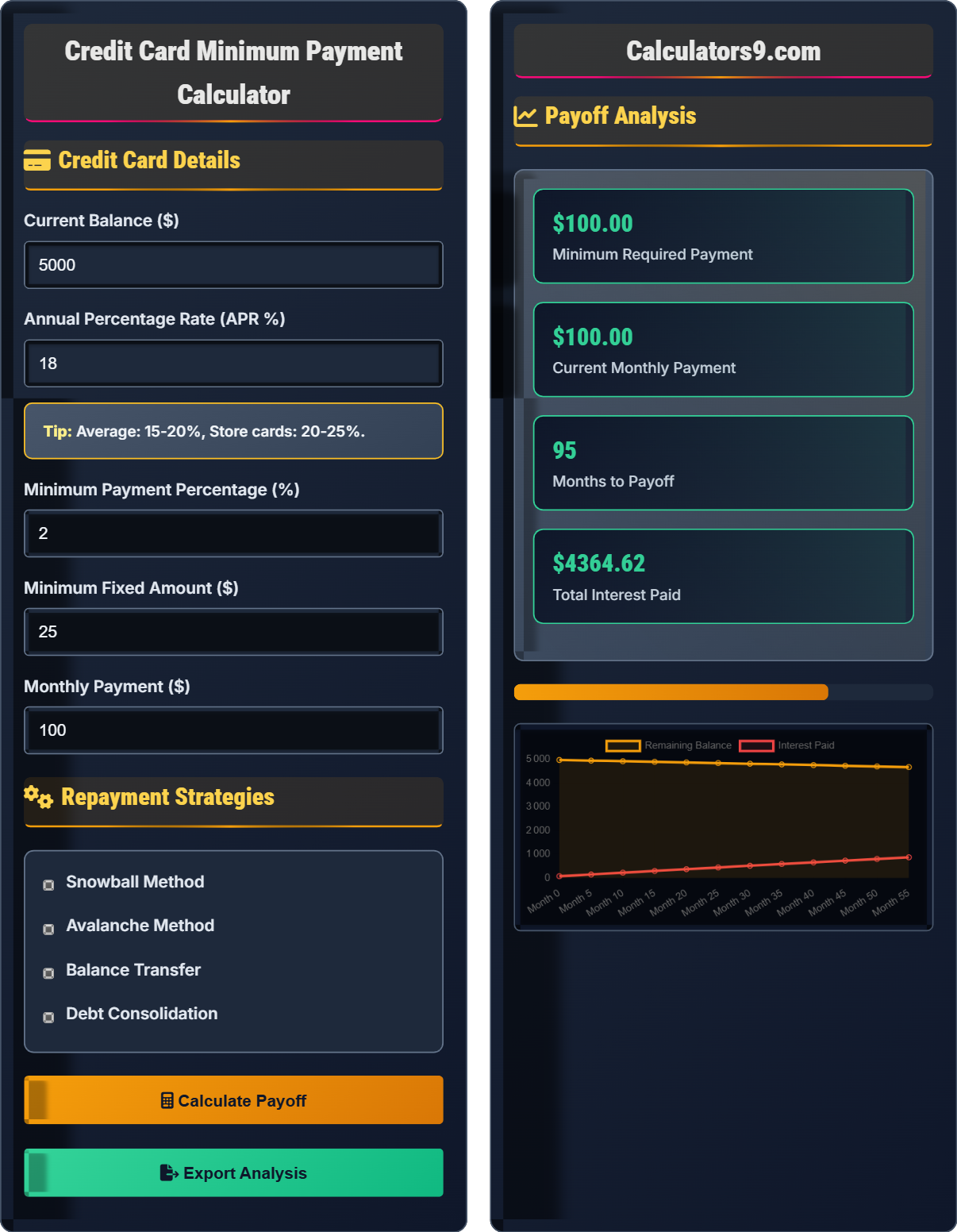
Example: For a $5,000 balance at 18% APR with 2% minimum payment:
Monthly rate: 18% ÷ 12 = 1.5%
Minimum payment: max($5,000 × 0.02, $25) = $100
Interest charge: $5,000 × 0.015 = $75
Principal paid: $100 - $75 = $25
At this rate, it would take approximately 19 years to pay off with $9,000+ in interest.
Credit Card Details
Repayment Strategies
Payoff Analysis
| Month | Payment | Principal | Interest | Balance |
|---|
Payment Comparison
Comprehensive Credit Card Guide
Credit card minimum payment is the smallest amount you're required to pay each month to keep your account in good standing. Paying only the minimum extends the repayment period significantly and results in paying much more in interest over time.
The standard credit card minimum payment calculation uses the following formula:
Where:
- \( \text{Balance} = \text{Current credit card balance} \)
- \( \text{Percentage} = \text{Minimum payment percentage (e.g., 2\%)} \)
- \( \text{Fixed Amount} = \text{Minimum fixed amount (e.g., \$25)} \)
- \( \text{Interest Charge} = \text{Balance} \times \frac{\text{APR}}{12} \)
Effective debt repayment involves several key strategies:
- Pay More Than Minimum: Increase monthly payments to reduce interest significantly
- Snowball Method: Pay minimums on all cards, extra on smallest balance first
- Avalanche Method: Pay minimums on all cards, extra on highest interest rate first
- Balance Transfer: Move high-interest debt to lower rate card (watch for fees)
- Debt Consolidation: Combine multiple debts into single loan with lower rate
- Pay Full Balance: Avoid interest charges entirely by paying in full monthly
- Understand Grace Period: No interest if balance paid in full by due date
- Monitor Credit Utilization: Keep below 30% of credit limit for good score
- Pay More Than Minimum: Minimum payments extend debt for decades
- Watch for Fees: Late fees, balance transfer fees, and annual fees
Credit Card Basics
Smallest required monthly payment to keep account in good standing.
\( \text{Minimum Payment} = \max(\text{Balance} \times \text{Percentage}, \text{Fixed Amount}) \)
Where payment = greater of percentage or fixed minimum.
- Minimum payments extend repayment significantly
- Early payments save more interest
- Interest is calculated monthly on balance
Repayment Strategies
Two popular debt repayment methods with different focuses.
- Pay more than minimum whenever possible
- Target highest interest rate debts first
- Consider balance transfer for large balances
- Consolidate multiple debts if beneficial
- Minimum payments mostly cover interest
- High APRs significantly increase total cost
- Balance transfers may have fees
- Consolidation requires good credit
Credit Card Learning Quiz
What percentage of a typical minimum payment goes toward interest versus principal in the early months of repayment?
The answer is B) 80-90% interest, 10-20% principal. In the early months of credit card repayment, the majority of each minimum payment goes toward interest charges rather than reducing the principal balance. This is because interest is calculated on the full outstanding balance, and minimum payments are typically set at a low percentage (often 2-3%) of the balance.
This concept explains why paying only the minimum extends repayment periods dramatically. With an 18% APR and a 2% minimum payment, a $5,000 balance would see $75 of a $100 payment going to interest and only $25 reducing the principal. This means it takes many payments just to reduce the balance enough for the principal portion to increase significantly.
Interest Charge: Cost of borrowing money calculated monthly
Principal: The actual debt amount owed
Minimum Payment: Smallest required monthly payment
• Minimum payments mostly cover interest initially
• Higher payments increase principal reduction
• Principal reduction accelerates over time
• Pay more than minimum to increase principal reduction
• Double your minimum payment to significantly reduce time
• Target highest interest rate cards first
• Believing minimum payments make significant progress
• Not understanding the interest-principal split
• Continuing minimum payments for extended periods
Calculate the minimum payment and first month's interest for a $4,500 balance at 22% APR with a minimum payment requirement of 3% of balance or $35, whichever is greater. Show your work.
Step 1: Calculate percentage-based minimum: $4,500 × 0.03 = $135
Step 2: Compare to fixed minimum: max($135, $35) = $135
Step 3: Calculate monthly interest rate: 22% ÷ 12 = 1.833%
Step 4: Calculate first month's interest: $4,500 × 0.01833 = $82.50
Step 5: Calculate principal portion: $135 - $82.50 = $52.50
Step 6: Calculate new balance: $4,500 - $52.50 = $4,447.50
Therefore, the minimum payment is $135, with $82.50 going to interest and $52.50 reducing principal.
This calculation demonstrates the two-tier minimum payment system: either a percentage of the balance or a fixed minimum, whichever is greater. The high APR of 22% results in significant monthly interest charges. Even with a relatively generous 3% minimum payment, $82.50 (61%) of the payment covers interest while only $52.50 (39%) reduces the principal.
APR: Annual Percentage Rate including interest charges
Minimum Payment Formula: max(balance × percentage, fixed amount)
Monthly Interest: APR divided by 12 months
• Convert annual rate to monthly for calculations
• Minimum is greater of percentage or fixed amount
• Interest is calculated on current balance
• Calculate monthly interest rate: APR ÷ 12
• Remember: min payment = max(percent × balance, fixed)
• Higher APRs result in more interest charges
• Forgetting to convert APR to monthly rate
• Not taking the maximum of percentage or fixed
• Calculating interest on original balance instead of current
Sarah has a $6,000 credit card balance at 19% APR with a minimum payment of 2% of balance or $25. If she only makes minimum payments, how long will it take to pay off the debt and how much total interest will she pay? (Hint: At 2% minimum payment, it takes approximately 20-25 years to pay off most balances)
Initial calculations:
Monthly rate: 19% ÷ 12 = 1.583%
Initial minimum: $6,000 × 0.02 = $120 (greater than $25)
First month interest: $6,000 × 0.01583 = $95
First month principal: $120 - $95 = $25
Using amortization calculations for minimum payment strategy:
It would take approximately 22 years (264 months) to pay off the debt
Total payments: Sum of all decreasing minimum payments ≈ $18,000
Total interest: $18,000 - $6,000 = $12,000
Key insight: Of the total $18,000 paid, only $6,000 goes to principal while $12,000 goes to interest charges.
Therefore, Sarah would take 22 years to pay off the debt and pay approximately $12,000 in interest.
This problem demonstrates the devastating effect of minimum payments on credit card debt. The high interest rate combined with the low minimum payment percentage means that most payments in the early years go entirely to interest. As the balance slowly decreases, the minimum payment also decreases, prolonging the repayment period. This creates a cycle where it takes decades to eliminate the debt.
Amortization: Gradual repayment of debt through regular payments
Compounding Interest: Interest charged on interest from previous periods
Payment Decrease: Minimum payments decrease as balance decreases
• Minimum payments decrease as balance decreases
• High APRs significantly extend repayment
• Interest compounds monthly on balance
• Never pay just minimum on high balances
• Consider balance transfer for large balances
• Calculate the true cost of minimum payments
• Underestimating the time required for minimum payments
• Not realizing minimum payments decrease over time
• Ignoring the total interest cost of minimum payments
Mike has a $8,000 credit card balance at 24% APR. He's been making minimum payments for 2 years. His credit score has improved, and he qualifies for a personal loan at 10% APR for 36 months. How much would he save in interest and time by consolidating his debt? Current minimum payment is 2.5% of balance or $30.
Current credit card scenario:
Monthly rate: 24% ÷ 12 = 2%
Current minimum: $8,000 × 0.025 = $200 (greater than $30)
Using amortization: Would take approximately 18 years, total interest ≈ $15,000
Debt consolidation scenario:
Personal loan: $8,000 at 10% APR for 36 months
Monthly payment: $8,000 × 0.00833 × (1.00833)^36 ÷ [(1.00833)^36 - 1] = $259.23
Total payments: $259.23 × 36 = $9,332.28
Total interest: $9,332.28 - $8,000 = $1,332.28
Savings comparison:
Time saved: 18 years - 3 years = 15 years
Interest saved: $15,000 - $1,332.28 = $13,667.72
Higher monthly payment: $259.23 - $200 = $59.23
Therefore, Mike would save approximately 15 years and $13,668 in interest by consolidating, though his monthly payment would increase by $59.
This demonstrates the significant benefits of debt consolidation when interest rates can be reduced. The 14 percentage point reduction in APR (from 24% to 10%) results in enormous savings. While the monthly payment increases slightly, the total cost and repayment time decrease dramatically. This strategy is most effective when you can secure a substantially lower interest rate and commit to the payment schedule.
Debt Consolidation: Combining multiple debts into single loan
Personal Loan: Unsecured loan for debt consolidation
Interest Rate Reduction: Lower APR results in significant savings• Consolidation only helps with lower rates
• Requires good credit for favorable terms
• Must stop using credit cards after consolidation
• Calculate break-even point for consolidation
• Ensure new payment fits budget
• Avoid accumulating new credit card debt
• Consolidating without changing spending habits
• Taking longer terms that increase total cost
• Not qualifying for sufficiently lower rates
Which of the following statements about debt repayment strategies is TRUE?
The answer is B) Avalanche method saves more money in interest. The avalanche method focuses on paying off the debt with the highest interest rate first while making minimum payments on others. This minimizes the total interest paid over time. The snowball method focuses on paying off the smallest balances first, which provides psychological wins but results in paying more interest overall.
Both strategies have their place in debt repayment. The avalanche method is mathematically optimal for saving money, as eliminating high-interest debt first reduces the total amount of interest that accrues. The snowball method is psychologically effective, as paying off smaller debts provides motivation to continue the repayment journey. Some people combine both approaches, using snowball for motivation while primarily following avalanche principles.
Snowball Method: Pay minimums, extra on smallest balance first
Avalanche Method: Pay minimums, extra on highest rate first
Psychological Motivation: Behavioral aspect of debt repayment
• Avalanche saves more money
• Snowball provides psychological wins
• Both require consistent payments
• Use avalanche for maximum savings
• Use snowball if motivation is challenging
• Consider hybrid approaches
• Confusing which method saves more money
• Not making consistent payments
• Accumulating new debt while paying off old debt
FAQ
Q: How do I determine if a balance transfer is worth it?
A: A balance transfer is worth considering if:
- You can qualify for a significantly lower interest rate (at least 5-10% lower)
- The balance transfer fee (typically 3-5%) is less than the interest savings
- You can pay off the balance before the promotional rate expires
- You won't accumulate new debt on the old card
For example, transferring $5,000 from 22% to 0% for 15 months with a 3% fee ($150):
Interest saved at 22% over 15 months: $5,000 × 0.22 ÷ 12 × 15 ≈ $1,375
Fee paid: $150
Net savings: $1,375 - $150 = $1,225
But you must pay off the balance within 15 months or face regular rates.
Q: What's the difference between the snowball and avalanche methods for multiple debts?
A: The two methods differ in their priority:
Snowball Method:
- Pay minimums on all debts
- Put extra money toward the smallest balance first
- Provides quick wins and psychological motivation
- Results in higher total interest paid
Avalanche Method:
- Pay minimums on all debts
- Put extra money toward the highest interest rate first
- Mathematically optimal for saving money
- May take longer to see first debt eliminated
For example, with debts of $2,000 at 25%, $5,000 at 15%, and $10,000 at 8%:
Snowball: Focus on $2,000 first (smallest)
Avalanche: Focus on $2,000 at 25% first (highest rate)
Avalanche saves more money, snowball provides motivation.