Emergency Fund Calculator
Build financial security • Plan safety net
Emergency Fund Formula:
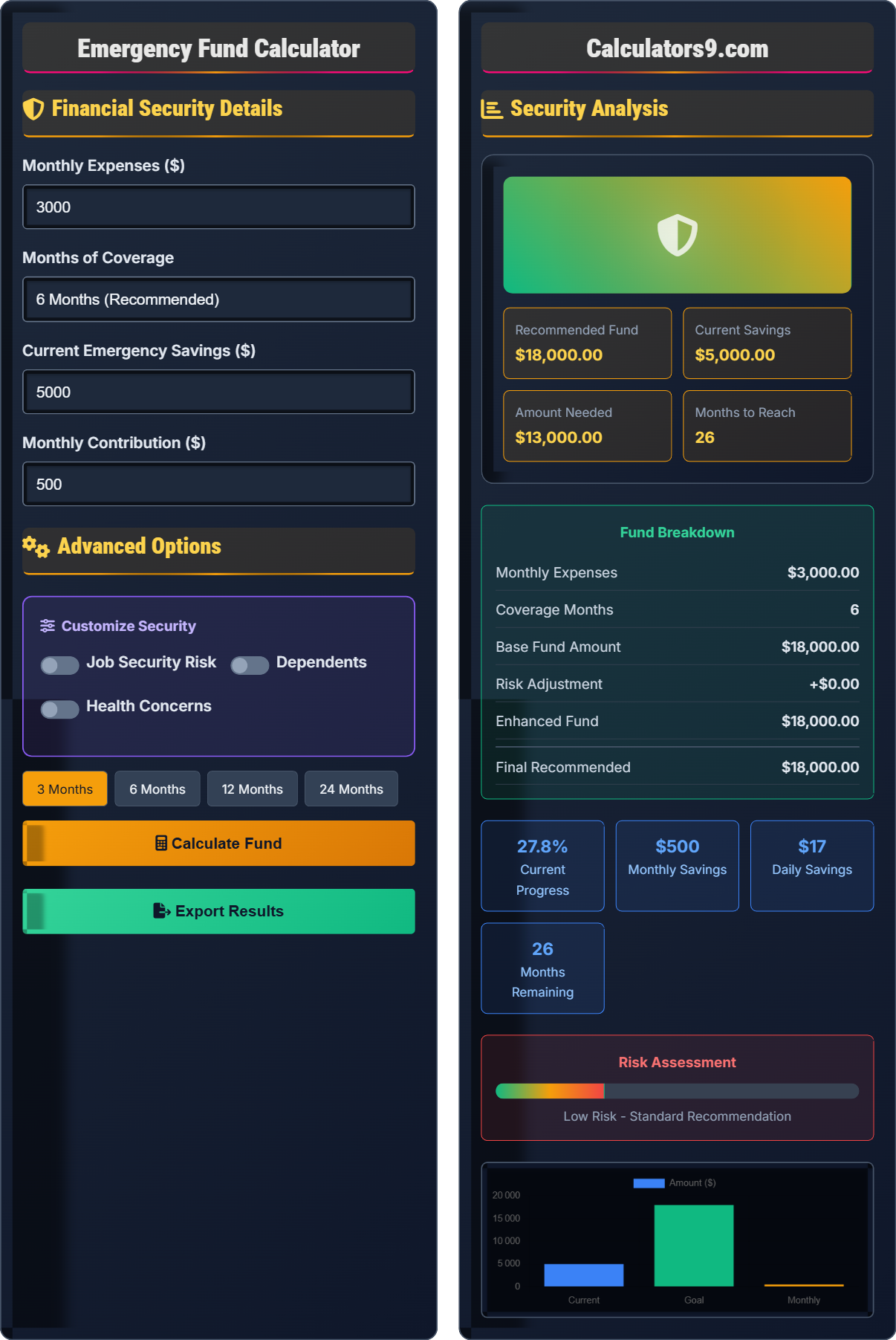
Show Calculator\( EF = M \times N \)
Where:
- \( EF \) = Emergency fund amount
- \( M \) = Monthly expenses
- \( N \) = Number of months (typically 3-6)
For enhanced security: \( EF = M \times (N + A) \)
Where A = Additional risk factor (0-2 months)
Example: Monthly expenses of $3,000 for 6 months:
\( EF = 3000 \times 6 = \$18,000 \)
With 1 additional month for risk: \( EF = 3000 \times 7 = \$21,000 \)
Thus, an ideal emergency fund is $21,000.
Financial Security Details
Advanced Options
Security Analysis
Emergency Fund Basics
An emergency fund is a reserve of money set aside specifically for unexpected expenses or financial emergencies such as job loss, medical bills, or major repairs.
\(EF = M \times N\)
Where EF=emergency fund, M=monthly expenses, N=months of coverage.
- Keep 3-6 months of expenses
- Use only for true emergencies
- Keep in liquid accounts
- Rebuild after use
Building Strategies
Systematic contributions and strategic placement ensure steady fund growth.
- Automate monthly contributions
- Use high-yield savings accounts
- Allocate tax refunds
- Reduce unnecessary expenses
- Account for personal risk factors
- Adjust for life changes
- Consider inflation
- Maintain accessibility
Emergency Fund Learning Quiz
What is the primary purpose of an emergency fund?
The answer is C) For unexpected expenses. An emergency fund is specifically designed to provide financial security during unforeseen circumstances such as job loss, medical emergencies, or major home/appliance repairs. It's meant to bridge the gap between income and expenses during crisis periods.
Understanding the distinct purpose of an emergency fund is crucial for proper financial planning. Unlike other savings goals (retirement, vacation, car purchase), an emergency fund serves as a financial safety net. It prevents the need to rely on high-interest debt during unexpected hardships.
Emergency Fund: Reserve money for unexpected expenses
Financial Security: Protection against financial hardship
Liquidity: Ability to access funds quickly
• Use only for true emergencies
• Maintain 3-6 months of expenses
• Keep funds liquid and accessible
• Separate from other savings accounts
• Automate monthly contributions
• Rebuild immediately after use
• Using for planned expenses
• Investing in volatile assets
• Not replenishing after use
If your monthly expenses are $2,800 and you want to build a 6-month emergency fund, what is the target amount? How much would you need to save monthly to reach this goal in 12 months?
Using the formula: \(EF = M \times N\)
Given:
- M = $2,800 (monthly expenses)
- N = 6 (months of coverage)
Step 1: Calculate emergency fund = $2,800 × 6 = $16,800
Step 2: Monthly savings needed = $16,800 ÷ 12 months = $1,400
Therefore, the target emergency fund is $16,800 and you'd need to save $1,400 monthly to reach it in 12 months.
This calculation demonstrates how to determine both the target amount and the monthly contribution needed. The formula EF = M × N is straightforward but requires accurate estimation of monthly expenses. Breaking down the total goal into monthly contributions makes the target more manageable.
Monthly Expenses: Total recurring costs per month
Emergency Fund Target: Total amount needed for securityMonthly Contribution: Amount to save each month
• Include all essential expenses
• Consider personal risk factors
• Adjust timeline based on income
• Use: EF = M × N
• Calculate monthly contribution: EF ÷ months
• Start with smaller goals if needed
• Excluding some monthly expenses
• Not accounting for taxes in calculations
• Setting unrealistic monthly targets
Sarah has monthly expenses of $3,500 and works in a volatile industry. She has 2 dependents and wants to build an emergency fund that accounts for her higher risk factors. If she adds 2 additional months of coverage beyond the standard 6 months, what should be her emergency fund target?
Step 1: Calculate standard fund = $3,500 × 6 = $21,000
Step 2: Calculate additional coverage = $3,500 × 2 = $7,000
Step 3: Calculate enhanced fund = $21,000 + $7,000 = $28,000
Alternatively: $3,500 × (6 + 2) = $3,500 × 8 = $28,000
Therefore, Sarah should aim for a $28,000 emergency fund.
This example shows how personal risk factors can justify a larger emergency fund. Job volatility and dependents increase financial vulnerability. The standard 3-6 month recommendation may not be sufficient for everyone. Adjusting for personal circumstances ensures adequate protection.
Personal Risk Factors: Individual circumstances affecting security
Enhanced Coverage: Additional months beyond standard
Financial Vulnerability: Susceptibility to hardship
• Standard: 3-6 months of expenses
• Adjust for personal risk factors
• Reassess regularly as circumstances change
• Consider: job stability, dependents, health
• Increase coverage for higher risk
• Review annually or after major life changes
• Using standard amount for all situations
• Not considering changing circumstances
• Setting insufficient coverage for dependents
John has monthly expenses of $4,000 and currently has $6,000 in emergency savings. He can contribute $800 per month to his emergency fund. If he wants to build a 6-month emergency fund, how many months will it take to reach his goal? (Hint: Calculate total goal first)
Step 1: Calculate total goal = $4,000 × 6 = $24,000
Step 2: Calculate remaining amount = $24,000 - $6,000 = $18,000
Step 3: Calculate months to reach goal = $18,000 ÷ $800/month = 22.5 months
Step 4: Round up to 23 months
Therefore, it will take John 23 months to reach his emergency fund goal.
This calculation shows how to determine the time needed to build an emergency fund given current savings and monthly contributions. The key is to first calculate the total target, subtract existing savings, then divide the remaining amount by monthly contributions. This helps set realistic timelines.
Timeline Calculation: Estimating time to reach goals
Monthly Contribution: Amount saved each month
Remaining Amount: Difference between goal and current
• Time = (Goal - Current) ÷ Monthly Savings
• Account for existing savings
• Adjust timeline if contributions change
• Use: Time = (Total - Current) ÷ Monthly
• Increase contributions to reduce time
• Consider lump-sum additions
• Forgetting to subtract existing savings
• Not accounting for changing income
• Setting unrealistic monthly targets
Where is the BEST place to keep an emergency fund?
The answer is C) High-yield savings account. An emergency fund needs to be liquid (easily accessible) and safe (no risk of loss). High-yield savings accounts offer FDIC insurance (up to limits) and immediate access while earning modest interest. Other options are either too risky or too illiquid for emergency purposes.
Emergency fund placement requires balancing three factors: safety, liquidity, and modest returns. The primary goal is preservation of capital, not growth. While returns may be modest, the security of knowing funds are available when needed is invaluable. The fund should be accessible without penalties or delays.
Liquidity: How quickly funds can be accessed
Safety: Protection against loss of principal
FDIC Insurance: Federal deposit insurance
• Prioritize safety over returns
• Maintain immediate access
• Avoid volatile investments
• Look for high-yield savings accounts
• Check FDIC insurance limits
• Avoid investment accounts for emergencies
• Investing in volatile assets
• Placing in illiquid investments
• Not considering insurance limits
FAQ
Q: How do I calculate my monthly expenses for the emergency fund?
A: Calculate your essential monthly expenses: housing, food, utilities, transportation, insurance, minimum debt payments, and other necessities. Use the formula: \(EF = M \times N\), where \(M\) is monthly expenses and \(N\) is months of coverage.
For example, if your essential expenses are $3,000 and you want 6 months of coverage:
\(EF = 3000 \times 6 = \$18,000\)
Don't include discretionary spending like entertainment or dining out.
Q: How many months should my emergency fund cover?
A: The standard recommendation is 3-6 months of expenses, but this depends on personal circumstances:
- 3-4 months: Stable job, few dependents
- 6-9 months: Variable income, dependents, job uncertainty
- 12+ months: High job volatility, self-employed
Consider your job security, income stability, and family situation when deciding.