Expense Categorizer
Organize expenses • Track spending
Expense Categorization Formula:
Show Calculator\( T_c = \sum_{i=1}^{n} E_i \)
\( P_c = \frac{T_c}{T_e} \times 100 \)
Where:
- \( T_c \) = Total expenses in category c
- \( E_i \) = Individual expense i in category c
- \( P_c \) = Percentage of total expenses in category c
- \( T_e \) = Total expenses across all categories
- \( n \) = Number of expenses in category c
Category Allocation: \( A_c = \frac{T_c}{T_e} \times 100 \)
Example: If you spent $1,200 on food and $4,000 total:
\( P_{food} = \frac{1200}{4000} \times 100 = 30\% \)
Food represents 30% of total expenses.
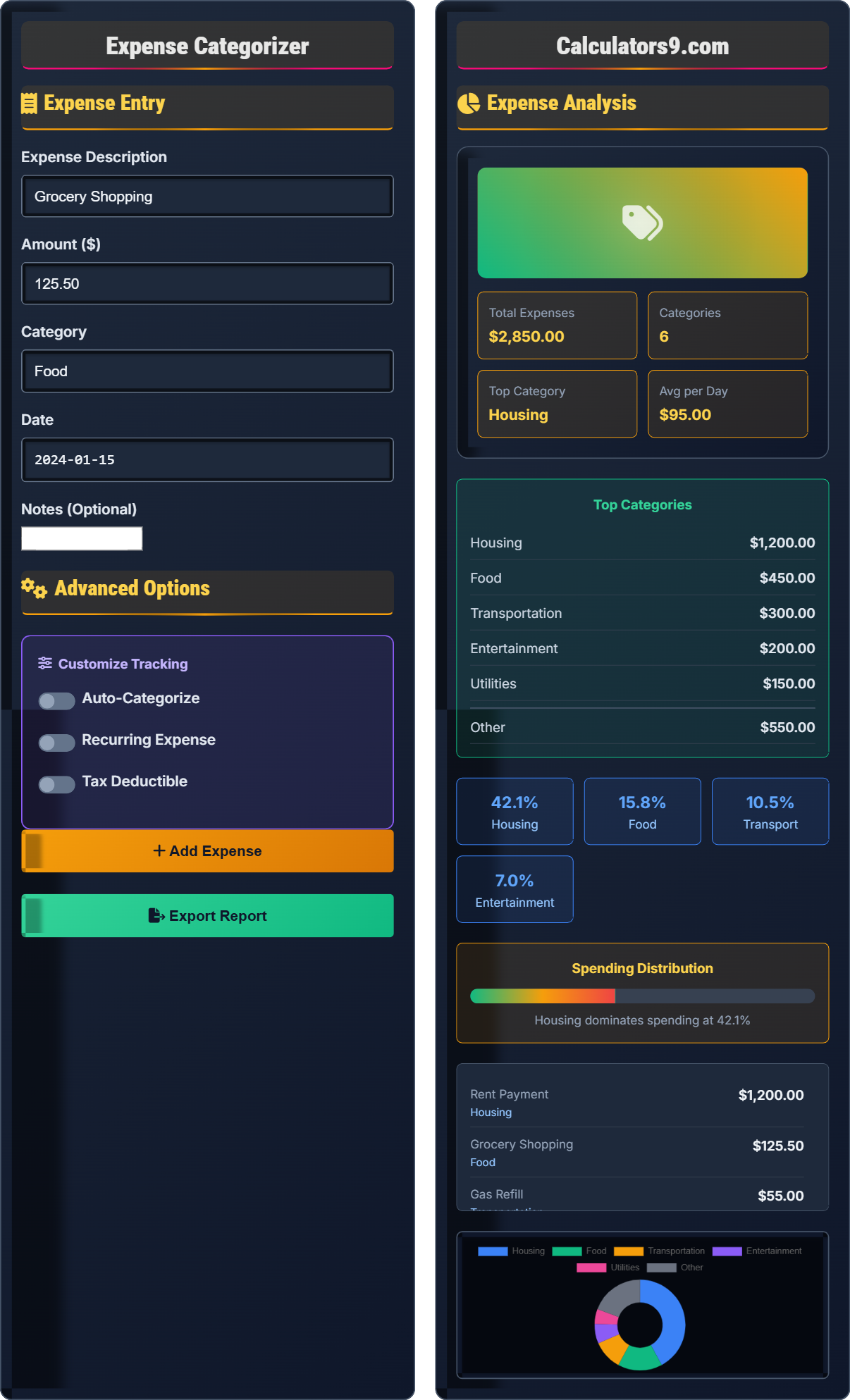
Expense Entry
Advanced Options
Expense Analysis
Expense Categorization Basics
Expense categorization is the process of organizing and classifying personal expenses into specific groups for budgeting and financial analysis purposes.
\(P_c = \frac{T_c}{T_e} \times 100\)
Where Pc=percentage of category, Tc=category total, Te=total expenses.
- Assign each expense to one category
- Use consistent category names
- Track regularly for accuracy
- Review categories periodically
Categorization Strategies
Use meaningful categories that reflect your spending patterns and budgeting needs.
- Housing (rent, mortgage, property taxes)
- Utilities (electric, gas, water, internet)
- Food (groceries, dining out)
- Transportation (gas, car payment, public transit)
- Healthcare (insurance, medications, copays)
- Entertainment (movies, subscriptions, hobbies)
- Personal Care (clothing, grooming, supplies)
- Debt Payment (credit cards, loans)
- Customize categories to your lifestyle
- Keep categories broad enough to be useful
- Subdivide large categories if needed
- Track annually for tax purposes
Expense Categorization Learning Quiz
Which category would be most appropriate for a monthly Netflix subscription?
The answer is B) Entertainment. Netflix is a streaming service for movies and TV shows, which falls under entertainment. This category helps track discretionary spending on leisure activities.
Proper categorization is crucial for accurate budgeting. Entertainment includes subscriptions, dining out, movies, hobbies, and other leisure activities. Correct categorization helps identify spending patterns and areas for potential reduction.
Entertainment: Discretionary spending on leisure
Subscription Services: Recurring payments for access
Discretionary Spending: Non-essential purchases
• Assign each expense to one category
• Use consistent category names
• Track regularly for accuracy
• Group similar expenses together
• Create custom categories if needed
• Review categories periodically
• Misclassifying subscription services
• Using inconsistent category names
• Not tracking all expenses
If your total monthly expenses are $3,000 and you spent $600 on food, what percentage of your expenses went to food? How would this be categorized in your budget?
Using the formula: \(P_c = \frac{T_c}{T_e} \times 100\)
Where:
- \(P_c\) = Percentage of category
- \(T_c\) = Total in category ($600 for food)
- \(T_e\) = Total expenses ($3,000)
Step 1: Calculate percentage = ($600 ÷ $3,000) × 100
Step 2: Calculate percentage = 0.2 × 100 = 20%
Therefore, 20% of expenses went to food, which is typically considered a needs category.
This calculation shows how to determine the percentage of total expenses in any category. Food typically represents 10-15% of total expenses in the 50/30/20 budgeting rule. At 20%, this might indicate room for optimization.
Category Percentage: Portion of total expenses
Budget Allocation: Percentage of income by category
Spending Pattern: How money is distributed
• Calculate percentages regularly
• Compare to budget guidelines
• Identify spending trends
• Use: Category % = (Category Amount ÷ Total) × 100
• Track percentages monthly
• Compare to budget targets
• Forgetting to multiply by 100 for percentage
• Not tracking all expenses in calculation
• Misclassifying category amounts
Sarah analyzed her monthly expenses and found she spent 35% on housing, 20% on food, 15% on transportation, and 30% on other categories. If her total monthly expenses are $4,000, how much did she spend on each category? Is her housing expense within recommended guidelines?
Step 1: Housing = $4,000 × 0.35 = $1,400
Step 2: Food = $4,000 × 0.20 = $800
Step 3: Transportation = $4,000 × 0.15 = $600
Step 4: Other = $4,000 × 0.30 = $1,200
Verification: $1,400 + $800 + $600 + $1,200 = $4,000 ✓
Housing analysis: The recommended guideline is 25-30% of expenses for housing. At 35%, Sarah's housing expense is above the recommended range, suggesting she might consider budget adjustments.
This example demonstrates how to convert percentages back to dollar amounts and compare spending to recommended guidelines. Housing expenses above 30% may indicate financial strain and suggest the need for budget review.
Recommended Guidelines: Suggested spending percentages
Budget Analysis: Reviewing spending patterns
Financial Strain: Difficulty meeting expenses
• Housing should be 25-30% of expenses
• Food should be 10-15% of expenses
• Transportation should be 10-15% of expenses
• Use: Dollar Amount = Total × Percentage
• Compare to budget guidelines
• Review quarterly for trends
• Confusing percentages with dollar amounts
• Not verifying total calculations
• Ignoring budget guidelines
John discovered that 45% of his $3,500 monthly expenses go to housing, which exceeds the recommended 30%. He wants to reduce his housing costs to the recommended level while maintaining the same total expenses. How much could he potentially redirect to other categories? (Hint: Calculate recommended housing amount)
Step 1: Current housing = $3,500 × 0.45 = $1,575
Step 2: Recommended housing = $3,500 × 0.30 = $1,050
Step 3: Amount to redirect = $1,575 - $1,050 = $525
John could redirect $525 per month to other categories like savings, entertainment, or debt reduction while staying within his total expense limit.
This scenario shows how to optimize spending by bringing categories in line with recommended guidelines. The excess housing spending could be redirected to other important financial goals like savings or debt reduction, improving overall financial health.
Category Optimization: Adjusting spending to guidelines
Spending Reallocation: Moving funds between categoriesFinancial Health: Overall fiscal well-being
• Keep housing under 30% of expenses
• Redirect excess to other goals
• Maintain total expense control
• Calculate potential savings from optimization
• Redirect funds to priority goals
• Monitor impact on overall budget
• Not optimizing high-percentage categories
• Forgetting to redistribute savings
• Not tracking the impact of changes
Which of the following is the BEST approach to categorizing expenses?
The answer is B) Use broad categories that reflect your spending. This approach provides meaningful insights without overwhelming complexity. Categories should be specific enough to identify spending patterns but broad enough to be manageable.
Effective categorization balances detail with usability. Too many categories become unwieldy, while too few don't provide actionable insights. The goal is to identify spending patterns and areas for improvement. Consistency in categorization is crucial for accurate tracking.
Meaningful Categories: Groups that provide insight
Spending Patterns: How money is typically spent
Categorization Balance: Detail vs. usability
• Maintain consistent categories
• Use categories that reflect your lifestyle
• Review and adjust as needed
• Start with 5-8 main categories
• Add subcategories if needed
• Review annually for relevance
• Creating too many categories
• Being inconsistent with classifications
• Not reviewing category relevance
FAQ
Q: How do I decide which category to assign an expense to?
A: Assign expenses based on their primary purpose:
- Needs: Housing, utilities, food, transportation
- Wants: Entertainment, dining out, shopping
- Financial: Savings, debt payments, investments
Use the formula: \(P_c = \frac{T_c}{T_e} \times 100\) to calculate what percentage each category represents. The goal is to identify patterns and make informed budgeting decisions.
Q: How often should I categorize and review my expenses?
A: Categorize expenses as they occur or at least weekly. Review your categorized expenses monthly to identify patterns and adjust your budget.
For analysis, calculate: \(A_c = \frac{T_c}{T_e} \times 100\) where \(A_c\) is the allocation percentage for category \(c\), \(T_c\) is the total for category \(c\), and \(T_e\) is total expenses.
Regular review helps maintain budget adherence and identify areas for improvement.