Financial Independence Date Calculator
Calculate your FIRE date • 2026 edition
FIRE Formula:
Show the calculator\( \text{FI Number} = \text{Annual Expenses} \times 25 \)
\( \text{Savings Rate} = \frac{\text{Income} - \text{Expenses}}{\text{Income}} \times 100 \)
\( \text{Years to FI} = \frac{\log(\text{FI Number}/\text{Current Savings})}{\log(1 + \text{Growth Rate})} \)
Where:
- \( \text{FI Number} = \text{Portfolio value needed for financial independence} \)
- \( \text{Annual Expenses} = \text{Yearly spending in retirement} \)
- \( \text{Growth Rate} = \text{Expected investment return (typically 7\%)} \)
- \( \text{Savings Rate} = \text{Percentage of income saved} \)
This formula calculates when you can achieve financial independence using the 4% rule. It determines the portfolio size needed and the time required to reach it based on your savings rate and investment growth.
Example: For annual expenses of $40,000:
FI Number: $40,000 × 25 = $1,000,000
With current savings of $100,000, 7% growth, and 20% savings rate:
Years to FI: log($1,000,000/$100,000) ÷ log(1.07) ≈ 34 years
At age 30, this means achieving FI at age 64.
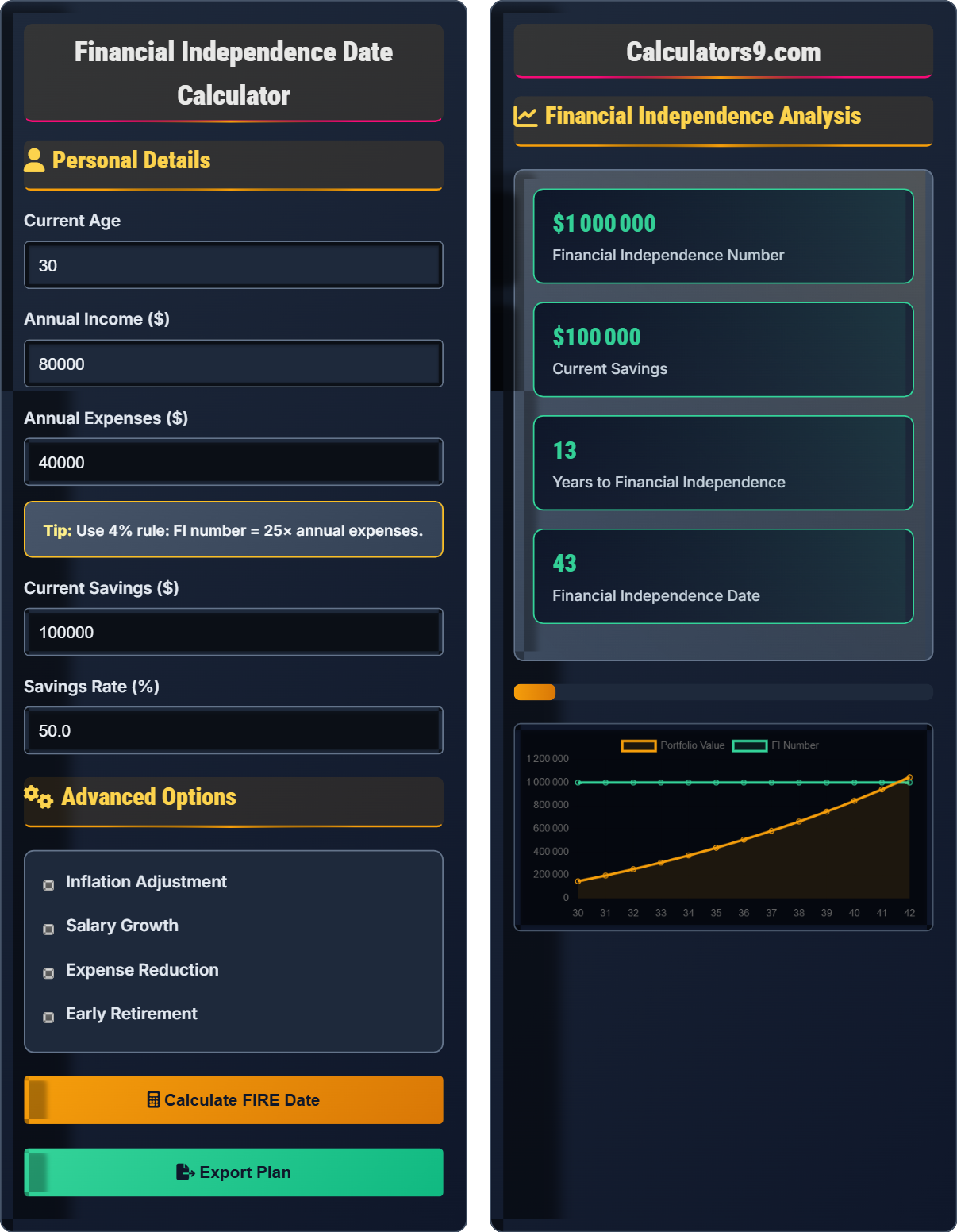
Personal Details
Advanced Options
Financial Independence Analysis
| Year | Savings Rate | Annual Savings | Portfolio Value | Income |
|---|
FI Strategies
Comprehensive Financial Independence Guide
Financial independence (FI) is the point at which you have enough invested assets to live indefinitely without needing to work for money. The FIRE (Financial Independence, Retire Early) movement focuses on achieving this goal as early as possible through aggressive saving and investing.
The standard FIRE calculation uses the following formula:
Where:
- \( \text{Annual Expenses} = \text{Yearly spending in retirement} \)
- \( \text{Multiplier} = 25 \) (based on the 4% rule)
- \( \text{Savings Rate} = \frac{\text{Income} - \text{Expenses}}{\text{Income}} \times 100 \)
- \( \text{Years to FI} = \text{Function of savings rate and investment growth} \)
Effective financial independence involves several key strategies:
- Maximize Savings Rate: Aim for 50%+ by minimizing expenses and increasing income
- Invest Consistently: Regular contributions to low-cost index funds
- Minimize Expenses: Reduce lifestyle inflation and focus on needs vs wants
- Optimize Tax Advantages: Use 401(k), IRA, and other tax-advantaged accounts
- Stay Disciplined: Maintain focus on long-term goals despite market volatility
- Use the 4% Rule: Withdraw 4% of portfolio annually in retirement
- Track Your Net Worth: Monitor progress monthly
- Automate Savings: Set up automatic transfers to investment accounts
- Focus on Percentages: Savings rate matters more than dollar amounts
- Plan for Healthcare: Healthcare costs are significant in early retirement
FI Basics
Having enough assets to live without working for money.
\( \text{FI Number} = \text{Annual Expenses} \times 25 \)
Where number = expenses × 25 (based on 4% rule).
- Higher savings rate = earlier FI
- Invest consistently for compound growth
- Minimize fees in investment accounts
FI Strategies
Safe withdrawal rate for sustainable retirement income.
- Maximize savings rate
- Invest in low-cost index funds
- Minimize lifestyle inflation
- Take advantage of tax-advantaged accounts
- Market volatility impacts portfolio
- Healthcare costs in early retirement
- Inflation affects purchasing power
- Sequence of returns risk
Financial Independence Learning Quiz
According to the 4% rule of financial independence, what multiplier should you use to calculate your FI number?
The answer is C) 25. The 4% rule suggests that you can safely withdraw 4% of your portfolio annually in retirement without running out of money. This means your FI number should be 25 times your annual expenses (since 1 ÷ 0.04 = 25).
The 4% rule is based on historical market returns and inflation data. It assumes a diversified portfolio of 75% stocks and 25% bonds. The rule has been shown to sustain portfolios for at least 30 years in most historical scenarios. If you spend $40,000 annually, you need $1,000,000 (25 × $40,000) to safely withdraw 4% ($40,000) each year.
4% Rule: Safe withdrawal rate for retirement portfolios
FI Number: Portfolio value needed for financial independence
Safe Withdrawal Rate: Annual percentage that can be withdrawn without depletion
• FI number = Annual expenses × 25
• Based on historical market performance
• Assumes 30+ year retirement period
• Use 3.5% rule for more conservative approach
• Consider sequence of returns risk
• Plan for healthcare costs in early retirement
• Using incorrect multiplier (not 25)
• Not accounting for inflation
• Ignoring healthcare costs in early retirement
Calculate the FI number and savings rate for someone with annual income of $100,000 and annual expenses of $40,000. Show your work.
Step 1: Calculate FI number using the 4% rule:
FI Number = Annual Expenses × 25 = $40,000 × 25 = $1,000,000
Step 2: Calculate annual savings:
Annual Savings = Annual Income - Annual Expenses = $100,000 - $40,000 = $60,000
Step 3: Calculate savings rate:
Savings Rate = (Annual Savings ÷ Annual Income) × 100 = ($60,000 ÷ $100,000) × 100 = 60%
Step 4: Calculate savings rate using alternative formula:
Savings Rate = [(Income - Expenses) ÷ Income] × 100 = [($100,000 - $40,000) ÷ $100,000] × 100 = 60%
Therefore, the FI number is $1,000,000 and the savings rate is 60%.
This calculation demonstrates the relationship between income, expenses, and savings rate. A 60% savings rate is exceptional and would allow for very early financial independence. The high savings rate means 60% of income is invested annually, accelerating portfolio growth significantly. This person is saving $60,000 per year toward their $1,000,000 goal.
FI Number: Portfolio value needed for financial independence
Savings Rate: Percentage of income saved annually
Annual Savings: Income minus expenses
• FI number = Annual expenses × 25
• Savings rate = (Income - Expenses) ÷ Income × 100
• Higher savings rates accelerate FI timeline
• Focus on increasing savings rate rather than absolute amounts
• Track expenses to identify reduction opportunities
• Automate savings to maintain consistency
• Forgetting to multiply expenses by 25
• Using expenses instead of income as denominator
• Not converting to percentage properly
Sarah earns $80,000 annually and spends $32,000 per year. If she increases her savings rate from 60% to 70%, how much faster will she reach financial independence? Assume 7% investment growth. (Hint: Higher savings rates significantly reduce FI timeline)
Current situation:
Annual expenses: $32,000
FI number: $32,000 × 25 = $800,000
Annual savings: $80,000 - $32,000 = $48,000
Savings rate: ($48,000 ÷ $80,000) × 100 = 60%
With 70% savings rate:
Annual savings: $80,000 × 0.70 = $56,000
Annual expenses: $80,000 - $56,000 = $24,000
FI number: $24,000 × 25 = $600,000
Using the approximate formula for years to FI:
With 60% savings rate: Approximately 16 years to reach $800,000
With 70% savings rate: Approximately 12 years to reach $600,000
Time saved: 16 - 12 = 4 years
Therefore, increasing savings rate from 60% to 70% reduces FI timeline by approximately 4 years.
This problem demonstrates the non-linear relationship between savings rate and FI timeline. Increasing savings rate from 60% to 70% has a dramatic impact on the FI timeline. The higher savings rate not only increases the amount saved annually but also reduces the FI number needed (due to lower expenses). This dual effect significantly accelerates the path to financial independence.
Savings Rate Impact: Non-linear effect on FI timeline
Compounding Effect: Benefits that increase over time
FI Timeline: Years required to reach financial independence
• Higher savings rates have exponential impact
• Small increases in savings rate matter significantly
• Both savings amount and FI number affect timeline
• Focus on increasing savings rate by 1-2% annually
• Track progress monthly to stay motivated
• Use the FI timeline as motivation for frugality
• Underestimating impact of small savings rate increases
• Not considering both savings amount and FI number
• Ignoring the compounding effect of higher savings rates
Mike has $50,000 saved and needs $1,000,000 for financial independence. He saves $20,000 annually. How much sooner will he reach FI if he achieves 8% investment growth instead of 6%? Calculate the difference in years to reach $1,000,000.
Scenario 1 (6% growth):
Using financial calculator or approximation: With $50,000 starting, $20,000 annual additions, and 6% growth, it takes approximately 25 years to reach $1,000,000.
Scenario 2 (8% growth):
With same starting amount and contributions but 8% growth, it takes approximately 21 years to reach $1,000,000.
Calculation using future value of annuity formula:
For 6%: FV = $50,000×(1.06)^n + $20,000×[((1.06)^n-1)/0.06] = $1,000,000
Solving for n ≈ 25 years
For 8%: FV = $50,000×(1.08)^n + $20,000×[((1.08)^n-1)/0.08] = $1,000,000
Solving for n ≈ 21 years
Time saved: 25 - 21 = 4 years
Therefore, achieving 8% growth instead of 6% saves approximately 4 years in reaching financial independence.
This problem demonstrates the significant impact of investment returns on the FI timeline. The 2 percentage point difference in annual returns compounds over time, resulting in a substantial difference in the number of years needed to reach the FI number. This highlights the importance of maintaining a diversified investment portfolio focused on long-term growth while keeping fees low.
Investment Growth: Annual return on investments
Compound Growth: Exponential increase over time
Future Value of Annuity: Value of series of equal payments
• Higher returns accelerate FI timeline
• Compound growth amplifies return differences
• Fees reduce effective returns significantly
• Focus on low-cost index funds to minimize fees
• Maintain appropriate asset allocation for your timeline
• Rebalance portfolio annually
• Not accounting for fees in return calculations
• Assuming past returns guarantee future returns
• Overconcentrating in risky investments
Which of the following FI variations focuses on achieving financial independence as early as possible?
The answer is C) FIRE (Financial Independence, Retire Early). FIRE specifically focuses on achieving financial independence as early as possible, typically in the 30s or 40s, followed by early retirement. The other variations are different approaches to FI:
- Lean FIRE: Minimalist approach with lower FI number
- Fat FIRE: Comfortable retirement with higher FI number
- Coast FIRE: Stopping contributions once FI number is reached
FIRE encompasses several different approaches to financial independence. While all aim to achieve FI, they differ in lifestyle and financial requirements. Lean FIRE allows for earlier retirement with lower savings requirements but requires a minimalist lifestyle. Fat FIRE provides more flexibility but requires larger savings. Coast FIRE focuses on reaching FI number early but not retiring until normal retirement age.
FIRE: Financial Independence, Retire Early movement
Lean FIRE: Minimalist approach to early retirement
Fat FIRE: Comfortable early retirement with high savings
• FIRE specifically emphasizes early retirement
• Different approaches suit different lifestyles
• All require high savings rates and disciplined investing
• Choose approach that fits your lifestyle preferences
• Plan for healthcare costs in early retirement
• Consider geographic arbitrage for lower costs
• Confusing FIRE with traditional retirement planning
• Not planning for healthcare in early retirement
• Underestimating the importance of high savings rates
FAQ
Q: How do I calculate my savings rate and why is it important for financial independence?
A: Your savings rate is calculated as:
\( \text{Savings Rate} = \frac{\text{Income} - \text{Expenses}}{\text{Income}} \times 100 \)
For example, if you earn $80,000 and spend $32,000:
Savings Rate = ($80,000 - $32,000) ÷ $80,000 × 100 = 60%
Savings rate is crucial because it directly determines your FI timeline. The higher your savings rate, the faster you'll reach FI. According to the FI equation, a 60% savings rate can lead to FI in approximately 16 years, while a 20% savings rate takes about 37 years. The relationship is non-linear - small increases in savings rate have exponential impact on the timeline.
Focus on increasing your savings rate through both increasing income and reducing expenses.
Q: What's the difference between Lean FIRE, Fat FIRE, and Coast FIRE?
A: These are different approaches to financial independence:
Lean FIRE:
- Minimalist approach focusing on low expenses
- Typically requires 15-20× annual expenses (vs 25× for traditional)
- Emphasizes frugality and cost optimization
- Allows for earlier retirement with lower savings requirements
Fat FIRE:
- Comfortable retirement with higher savings target
- Often 30-40× annual expenses or more
- Provides flexibility for travel, hobbies, and lifestyle
- Greater cushion against market downturns
Coast FIRE:
- Reach FI number early, then stop contributing
- Let investments grow passively until normal retirement
- Combines early achievement with delayed retirement
- Provides flexibility to work longer if desired
Each approach suits different personality types and lifestyle preferences.