Holiday Gift Budget Calculator
Plan your holiday spending • 2026 edition
Budget Formula:
Show the calculator\( \text{Total Budget} = \sum(\text{Individual Budgets}) \)
\( \text{Remaining Budget} = \text{Total Budget} - \text{Spent Amount} \)
Where:
- \( \text{Individual Budget} = \frac{\text{Total Budget}}{\text{Number of Recipients}} \)
- \( \text{Spent Amount} = \sum(\text{Gift Costs}) \)
- \( \text{Budget Utilization} = \frac{\text{Spent Amount}}{\text{Total Budget}} \times 100 \)
This formula helps allocate your holiday gift budget across recipients while tracking spending to avoid overspending. It ensures balanced distribution and financial control during the holiday season.
Example: For a total budget of $500 across 5 recipients:
Individual budget: $500 ÷ 5 = $100 per person
If you spend $350 so far:
Remaining budget: $500 - $350 = $150
Budget utilization: ($350 ÷ $500) × 100 = 70%
Thus, you have $150 remaining to spend with 70% of your budget utilized.
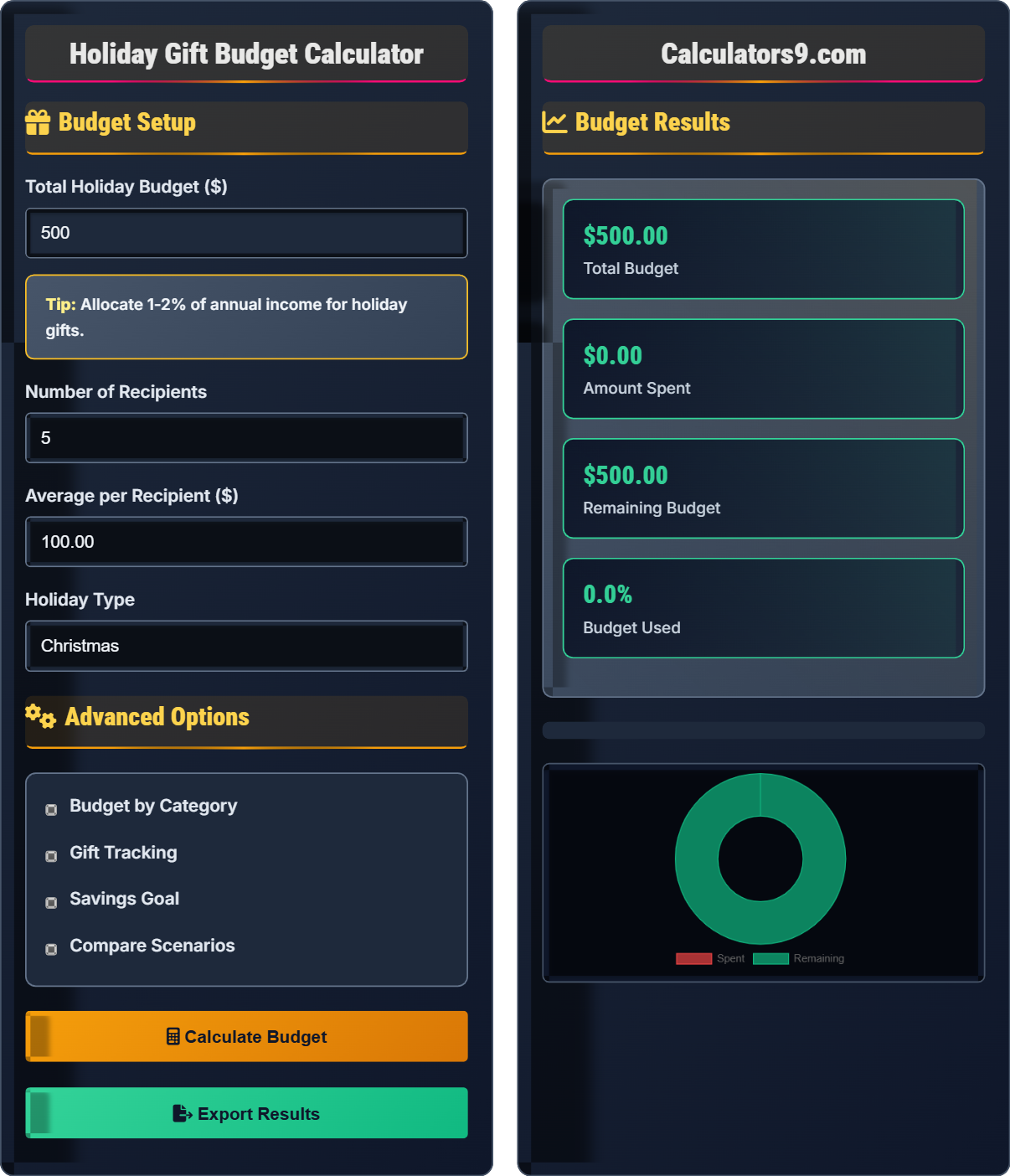
Budget Setup
Advanced Options
Budget Results
Comprehensive Holiday Budget Guide
Holiday budgeting is the practice of planning and allocating funds for gift purchases, decorations, travel, and other holiday-related expenses. Effective budgeting prevents overspending and financial stress during the holiday season, ensuring you can enjoy the festivities without post-holiday debt.
The standard holiday budget calculation uses the following formula:
Where:
- \( \text{Total Budget} = \text{Amount allocated for holiday spending} \)
- \( \text{Number of Recipients} = \text{People receiving gifts} \)
- \( \text{Remaining Budget} = \text{Total Budget} - \text{Spent Amount} \)
Effective holiday budgeting involves several key strategies:
- Set Limits: Determine maximum spending per person to prevent overspending
- Prioritize: Focus spending on closest relationships and most meaningful gifts
- Track Spending: Monitor expenses to stay within budget
- Start Early: Begin budgeting and shopping well in advance
- Plan Alternatives: Consider homemade gifts or experiences instead of expensive items
- Use Cash Envelopes: Allocate cash for different categories to prevent overspending
- Take Advantage of Sales: Shop during Black Friday, Cyber Monday, and other promotions
- DIY When Possible: Handmade gifts often have more sentimental value
- Set Up Automatic Savings: Start saving monthly months in advance
- Communicate Expectations: Discuss gift budgets with family to avoid pressure
Holiday Budget Basics
Planning and controlling holiday spending to avoid financial stress.
\( \text{Individual Budget} = \frac{\text{Total Budget}}{\text{Number of Recipients}} \)
Where budget = total allocated amount divided by recipients.
- Set limits before shopping begins
- Prioritize closest relationships
- Track spending in real-time
Budgeting Strategies
Distributing funds across different spending categories.
- Set per-person limits
- Prioritize relationships
- Shop sales strategically
- Consider alternatives
- Start saving early
- Communicate expectations
- Track expenses consistently
- Plan for unexpected costs
Holiday Budget Learning Quiz
According to financial experts, what percentage of annual income should be allocated for holiday gifts?
The answer is A) 1-2%. Financial experts recommend allocating 1-2% of your annual income for holiday gifts. This percentage helps ensure that holiday spending doesn't strain your overall financial health and allows for adequate savings in other areas.
The 1-2% rule provides a benchmark for proportional spending that scales with your income level. For someone earning $50,000 annually, this means a holiday gift budget of $500-$1,000. For someone earning $100,000, it's $1,000-$2,000. This approach maintains consistent financial discipline regardless of income level.
Annual Income: Total earnings from all sources over one year
Proportional Budgeting: Allocating funds as a percentage of income
Financial Health: Overall stability and sustainability of finances
• Holiday spending should be proportional to income
• 1-2% allows for flexibility without financial strain
• Adjust based on family size and circumstances
• Calculate your percentage: (Holiday budget ÷ Annual income) × 100
• Start saving monthly: Divide annual target by 12
• Set up automatic transfers to holiday fund
• Spending too high a percentage of income on gifts
• Not planning ahead for holiday expenses
• Overspending to keep up with others' expectations
Calculate the individual gift budget for each recipient if your total holiday budget is $800 and you have 8 recipients. Show your work.
Step 1: Use the formula: Individual Budget = Total Budget ÷ Number of Recipients
Step 2: Substitute values: Individual Budget = $800 ÷ 8
Step 3: Calculate: Individual Budget = $100
Therefore, you can allocate $100 per recipient while staying within your budget.
This calculation helps establish spending limits before shopping begins. By dividing your total budget evenly among recipients, you ensure fairness and prevent overspending. However, you can adjust individual allocations based on relationship closeness or special circumstances while keeping the total under budget.
Individual Budget: Maximum amount to spend per recipient
Total Budget: Overall amount allocated for holiday spending
Number of Recipients: People who will receive gifts
• Calculate per-person limits before shopping
• Total spending cannot exceed total budget
• Adjust for special circumstances within total budget
• Round to convenient amounts (e.g., $25, $50, $100)
• Prioritize closer relationships with higher allocations
• Track spending to stay within individual limits
• Starting to shop without predetermined limits
• Spending more on some recipients than budget allows
• Forgetting to account for shipping or wrapping costs
Sarah has a $600 holiday budget for 6 people. She has already spent $250 on gifts. How much does she have remaining, and what percentage of her budget has she used? How much can she spend per remaining person?
Step 1: Calculate remaining budget = Total budget - Amount spent = $600 - $250 = $350
Step 2: Calculate budget utilization = (Amount spent ÷ Total budget) × 100 = ($250 ÷ $600) × 100 = 41.67%
Step 3: Calculate remaining per person = Remaining budget ÷ Number of remaining recipients = $350 ÷ 6 = $58.33
Therefore, Sarah has $350 remaining (41.67% of her budget used) and can spend approximately $58.33 per remaining person.
This problem demonstrates real-time budget tracking, which is essential for staying within limits. By calculating both remaining funds and utilization percentage, Sarah can make informed decisions about future purchases. The per-person calculation helps her allocate the remaining budget fairly among recipients.
Remaining Budget: Funds left to spend after purchases
Budget Utilization: Percentage of budget already spent
Real-time Tracking: Monitoring expenses as they occur
• Track spending immediately after each purchase
• Calculate remaining allocation regularly
• Adjust future spending based on current utilization
• Use a spreadsheet or app to track expenses
• Set alerts when reaching 50% and 75% of budget
• Keep receipts to verify spending accuracy
• Forgetting to track purchases immediately
• Not recalculating remaining per-person amounts
• Underestimating shipping or tax costs
Mike has a $1,000 holiday budget that he wants to divide as follows: 60% for gifts, 15% for decorations, 15% for travel, and 10% for charitable giving. Calculate how much he should allocate to each category and explain how this strategy helps with budget control.
Gifts: $1,000 × 0.60 = $600
Decorations: $1,000 × 0.15 = $150
Travel: $1,000 × 0.15 = $150
Charitable Giving: $1,000 × 0.10 = $100
Verification: $600 + $150 + $150 + $100 = $1,000 ✓
This category budgeting strategy helps with control by preventing overspending in any single area and ensuring balanced allocation across all holiday expenses.
Category budgeting prevents the common problem of overspending in one area at the expense of another. By allocating specific percentages to each category, Mike ensures that gifts don't consume his entire budget, leaving funds for decorations, travel, and charitable giving. This approach provides mental accounting boundaries that help maintain financial discipline.
Category Budgeting: Allocating funds to specific spending categories
Mental Accounting: Treating money differently based on its source or purpose
Percentage Allocation: Distributing funds based on predetermined percentages
• Categories should reflect your priorities
• Percentages must total 100%
• Track spending within each category separately
• Use separate envelopes or accounts for each category
• Adjust percentages based on your lifestyle
• Review and adjust allocations if circumstances change
• Not accounting for all potential holiday expenses
• Allocating too much to one category
• Forgetting to include taxes and shipping costs
Which of the following is the MOST effective strategy for staying within your holiday budget?
The answer is B) Set spending limits for each recipient before shopping. Establishing predetermined limits creates accountability and prevents impulse purchases that exceed your budget. This strategy ensures that total spending remains within acceptable parameters.
Pre-planning spending limits leverages behavioral economics principles by creating psychological barriers to overspending. When you know exactly how much you can spend per person, you're more likely to make thoughtful purchasing decisions. This approach also prevents the stress of trying to calculate remaining amounts while shopping, allowing you to focus on finding meaningful gifts within your constraints.
Spending Limits: Maximum amounts designated for specific purchases
Pre-planning: Setting financial parameters before making purchases
Psychological Barriers: Mental restrictions that influence spending behavior
• Decide spending limits before beginning to shop
• Write down or record your limits for accountability
• Include shipping, taxes, and wrapping in your calculations
• Create a gift list with predetermined amounts
• Use a budgeting app to track spending in real-time
• Shop with cash or debit to avoid overspending
• Starting to shop without any spending plan
• Using credit cards without tracking spending
• Waiting until last minute and making rushed decisions
FAQ
Q: How do I determine how much to spend on each person's gift?
A: The simplest method is to divide your total gift budget by the number of recipients: \( \text{Individual Budget} = \frac{\text{Total Budget}}{\text{Number of Recipients}} \)
However, you can adjust based on relationships:
- Closeness: Allocate more to immediate family and close friends
- Age: Children often receive more expensive gifts
- Income: Consider reciprocal gifting expectations
- Special occasions: Milestone birthdays or anniversaries may warrant more
For example, if your total budget is \( \$500 \) for 5 people, the baseline is \( \$100 \) each. You might then adjust: parents get \( \$120 \), spouse gets \( \$120 \), kids get \( \$80 \) each, totaling \( \$400 \), with \( \$100 \) left for other recipients or experiences.
Q: What's the difference between a holiday budget and a holiday savings plan?
A: A holiday budget is the amount you plan to spend during the holiday season. A holiday savings plan is the systematic approach to accumulating those funds beforehand.
The relationship is: \( \text{Savings Plan} = \frac{\text{Holiday Budget}}{\text{Months Until Holiday}} \)
For example, if your holiday budget is \( \$1,000 \) and there are 10 months until the holidays, your monthly savings target is \( \$100 \).
A budget answers "How much will I spend?" while a savings plan answers "How do I accumulate the funds?" Both are essential for financial peace of mind during the holiday season.