Income Tax Estimator
Estimate taxes • Plan finances
Income Tax Formula:
Show Calculator\( TI = GI - D - PE \)
\( T = \sum_{i=1}^{n} (BI_i \times TR_i) \)
\( AT = T - TC \)
Where:
- \( TI \) = Taxable Income
- \( GI \) = Gross Income
- \( D \) = Deductions
- \( PE \) = Personal Exemptions
- \( BI_i \) = Income in bracket i
- \( TR_i \) = Tax Rate in bracket i
- \( T \) = Total Tax Before Credits
- \( TC \) = Tax Credits
- \( AT \) = After-Tax Income
Federal Tax Brackets: Progressive tax rates applied to income brackets
Example: Single filer with $50,000 income:
10% on first $11,000 = $1,100
12% on next $30,775 = $3,693
22% on remaining $8,225 = $1,810
Total estimated tax = $6,603
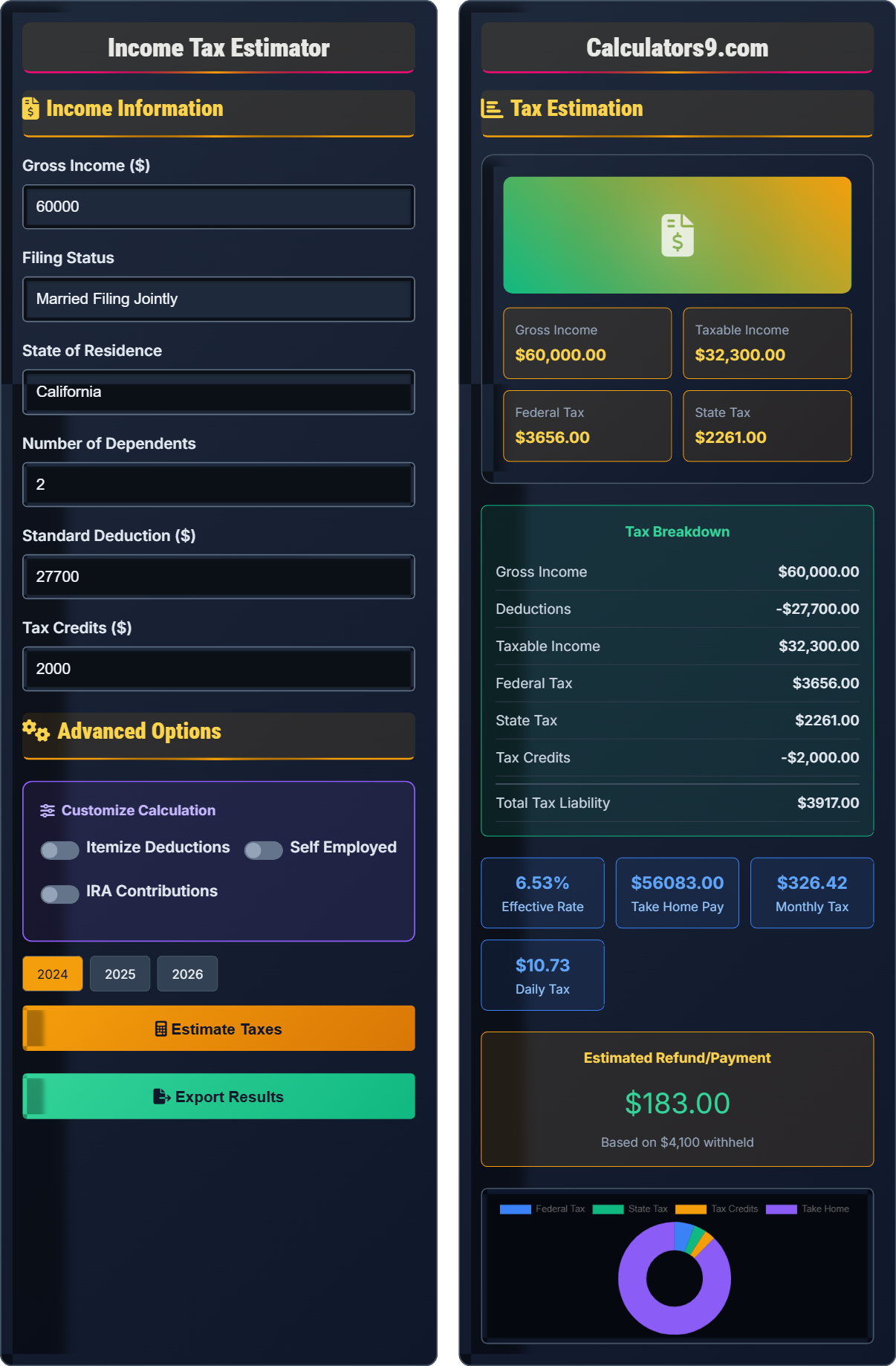
Income Information
Advanced Options
Tax Estimation
Income Tax Basics
Income tax is a tax levied on individuals' and businesses' income, profits, and gains by federal and state governments.
\(TI = GI - D\)
Where TI=taxable income, GI=gross income, D=deductions.
- Progressive tax rates apply
- Deductions reduce taxable income
- Credits reduce tax liability
- File annually by April 15
Tax Planning Strategies
Plan ahead to minimize tax liability through deductions, credits, and tax-advantaged accounts.
- Maximize deductions
- Utilize tax credits
- Contribute to retirement accounts
- Harvest tax losses
- Time income strategically
- Annual tax brackets
- State tax variations
- Dependency exemptions
- Alternative minimum tax
Income Tax Estimation Learning Quiz
What is the formula for calculating taxable income?
The answer is B) Gross Income - Deductions. Taxable income is calculated by subtracting allowable deductions from gross income. This determines the amount subject to taxation.
Taxable income is the foundation of tax calculation. It represents the portion of your income that is actually taxed after deductions. Understanding this distinction helps in planning tax strategies and optimizing deductions to reduce taxable income.
Taxable Income: Income subject to taxation
Gross Income: Total income before deductions
Deductions: Amounts subtracted from gross income
• Taxable Income = Gross Income - Deductions
• Deductions reduce taxable amount
• Tax rates apply to taxable income
• Remember: Gross Income - Deductions
• Higher deductions = lower taxable income
• Tax rates apply to taxable income
• Confusing gross with taxable income
• Forgetting to subtract deductions
• Applying tax rates to gross income
If someone has a gross income of $50,000 and total deductions of $12,000, what is their taxable income? If the tax rate is 15%, what would be their estimated tax liability?
Taxable Income = Gross Income - Deductions
Taxable Income = $50,000 - $12,000 = $38,000
Estimated Tax = Taxable Income × Tax Rate
Estimated Tax = $38,000 × 0.15 = $5,700
Therefore, taxable income is $38,000 and estimated tax is $5,700.
This calculation demonstrates the basic tax formula. First, determine taxable income by subtracting deductions from gross income. Then apply the tax rate to the taxable amount. This is a simplified example; real tax calculation uses progressive brackets.
Taxable Income: Income subject to tax
Tax Liability: Total tax owed
Progressive Tax: Higher rates for higher incomes
• Calculate taxable income first
• Apply tax rates to taxable income
• Real taxes use bracketed rates
• Use: Taxable Income = Gross - Deductions
• Tax = Taxable Income × Rate
• Consider progressive brackets
• Applying rates to gross income
• Forgetting to subtract deductions
• Not accounting for progressive rates
A single taxpayer has $45,000 in taxable income in 2024. Using the federal tax brackets (10% on income up to $11,000, 12% on income from $11,001 to $44,725), what is their federal tax liability?
Step 1: Tax on first $11,000 at 10% = $11,000 × 0.10 = $1,100
Step 2: Taxable income remaining = $45,000 - $11,000 = $34,000
Step 3: Tax on next $33,725 at 12% = $33,725 × 0.12 = $4,047
Step 4: Total tax = $1,100 + $4,047 = $5,147
Therefore, federal tax liability is $5,147.
This example shows how progressive tax brackets work. Income is taxed at different rates depending on which bracket it falls into. Each bracket only applies to the income within that range, not the entire amount.
Progressive Tax: Higher rates for higher income
Tax Bracket: Income range with specific rate
Marginal Rate: Rate on highest income
• Each bracket applies only to its income range
• Higher brackets don't affect lower income
• Calculate each bracket separately
• Calculate bracket by bracket
• Only tax income within each bracket
• Sum all bracket calculations
• Applying highest rate to all income
• Not calculating brackets separately
• Forgetting to sum bracket amounts
John has a tax liability of $8,000 before credits. He has two options: $2,000 in itemized deductions or $2,000 in tax credits. Which option saves him more money? How much would each save? (Hint: Deductions reduce taxable income, credits reduce tax liability directly)
Option 1 - Deductions:
If deductions reduce taxable income by $2,000, and marginal tax rate is 22%
Tax savings = $2,000 × 0.22 = $440
New tax liability = $8,000 - $440 = $7,560
Option 2 - Credits:
Tax credits reduce liability dollar-for-dollar
Tax savings = $2,000
New tax liability = $8,000 - $2,000 = $6,000
Tax credits save $2,000 - $440 = $1,560 more than deductions.
This demonstrates the significant difference between tax deductions and credits. Credits are more valuable because they reduce tax liability directly. Deductions only reduce taxable income, with the tax benefit depending on the marginal tax rate.
Tax Deduction: Reduces taxable income
Tax Credit: Reduces tax liability directly
Marginal Rate: Rate on next dollar earned
• Credits are more valuable than deductions
• Deductions depend on tax rate
• Credits reduce liability dollar-for-dollar
• Prioritize tax credits over deductions
• Deduction savings = Deduction × Marginal Rate
• Credit savings = Full credit amount
• Confusing credits with deductions
• Not understanding value difference
• Forgetting marginal tax rate effect
Which of the following is the BEST strategy for minimizing tax liability?
The answer is B) Maximize legitimate deductions and credits. This is the legal and ethical way to minimize tax liability by taking advantage of all available tax benefits provided by law.
Effective tax planning involves using legal methods to reduce tax liability. This includes contributing to tax-advantaged accounts, claiming all eligible deductions, and utilizing available tax credits. Always consult with a tax professional for personalized advice.
Tax Planning: Legal strategies to minimize tax
Legitimate Deductions: Legally allowed expense reductions
Tax Credits: Direct tax liability reductions
• Use legal tax benefits only
• Document all deductions
• File accurately and timely
• Contribute to retirement accounts
• Track business expenses
• Consider charitable donations
• Claiming illegitimate deductions
• Not tracking expenses
• Missing available credits
FAQ
Q: What's the difference between tax deductions and tax credits?
A: The key difference is how they reduce your tax:
- Deductions: Reduce your taxable income. Tax savings = Deduction amount × Marginal tax rate
- Credits: Reduce your tax liability dollar-for-dollar. Tax savings = Full credit amount
Formula for deduction value: \(TV = D \times MR\), where \(TV\) is tax value, \(D\) is deduction amount, and \(MR\) is marginal rate.
For example, with a 22% tax rate, a $1,000 deduction saves $220, while a $1,000 credit saves $1,000.
Q: How do progressive tax brackets work?
A: Progressive tax brackets mean higher income is taxed at higher rates. Each bracket only applies to income within that range.
Formula: \(T = \sum_{i=1}^{n} (BI_i \times TR_i)\), where \(T\) is total tax, \(BI_i\) is bracket income, and \(TR_i\) is bracket rate.
Example for $50,000 single filer:
- 10% on first $11,000 = $1,100
- 12% on next $33,725 = $4,047
- 22% on remaining $5,275 = $1,161
- Total tax = $6,308
Only the highest portion is taxed at 22%, not the entire income.