Retirement Savings Gap Calculator
Calculate your retirement readiness • 2026 edition
Retirement Gap Formula:
Show the calculator\( \text{Retirement Need} = \text{Annual Retirement Income} \times \text{Retirement Duration} \)
\( \text{Retirement Gap} = \text{Retirement Need} - \text{Current Savings} - \text{Future Contributions} \)
Where:
- \( \text{Annual Retirement Income} = \text{Pre-retirement Income} \times 80\% \)
- \( \text{Retirement Duration} = \text{Life expectancy} - \text{Retirement age} \)
- \( \text{Future Contributions} = \text{Annual Contribution} \times \text{Growth Factor} \)
This formula calculates the difference between your retirement savings goal and your current financial position. It helps identify how much more you need to save to maintain your desired lifestyle in retirement.
Example: For a 35-year-old earning $70,000 planning to retire at 65 with 25 years of retirement:
Annual retirement need: $70,000 × 0.8 = $56,000
Total retirement need: $56,000 × 25 = $1,400,000
If currently saved $50,000 with $5,000 annual contributions at 7% growth:
Future value of contributions: $5,000 × [(1.07)^30 - 1] / 0.07 = $472,304
Retirement gap: $1,400,000 - $50,000 - $472,304 = $877,696
Therefore, you have an $877,696 gap to bridge.
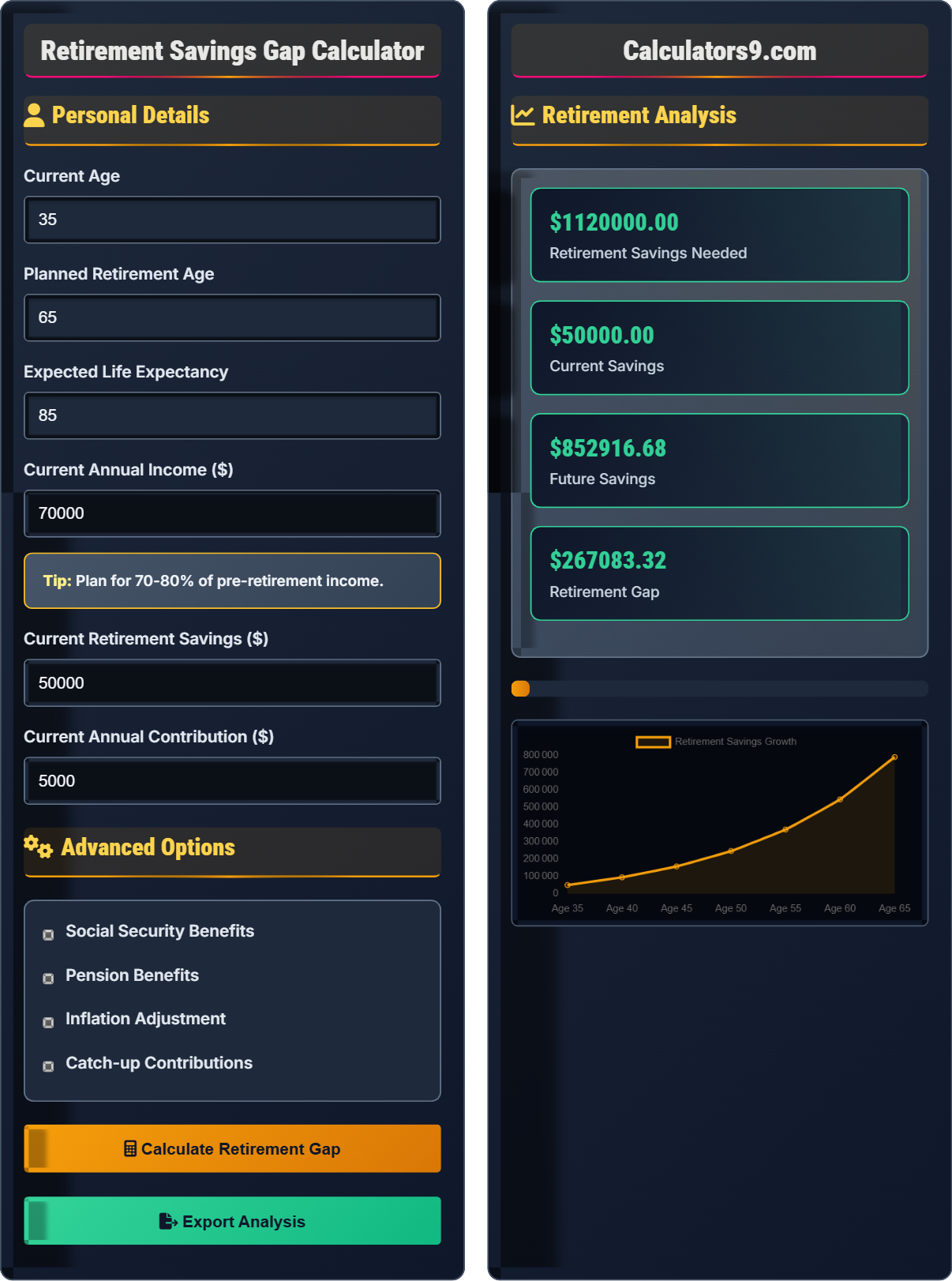
Personal Details
Advanced Options
Retirement Analysis
| Category | Amount | Percentage | Impact |
|---|
Recommendations
Comprehensive Retirement Planning Guide
Retirement planning is the process of determining retirement income goals and the actions and decisions necessary to achieve those goals. It involves identifying sources of income, calculating expenses, implementing a savings program, and managing assets and risk. The goal is to ensure financial security during retirement years.
The standard retirement gap calculation uses the following formula:
Where:
- \( \text{Retirement Need} = \text{Annual Retirement Income} \times \text{Retirement Duration} \)
- \( \text{Annual Retirement Income} = \text{Pre-retirement Income} \times 80\% \)
- \( \text{Future Contributions} = \text{Annual Contribution} \times \text{Growth Factor} \)
Effective retirement planning involves several key strategies:
- Start Early: Take advantage of compound growth over decades
- Maximize Employer Match: Contribute enough to get full company match
- Diversify Investments: Spread risk across asset classes
- Increase Contributions: Boost savings rate as income grows
- Minimize Fees: Choose low-cost investment options
- Follow the 4% Rule: Withdraw 4% of portfolio annually in retirement
- Use Catch-up Contributions: Additional $7,500 for ages 50+ in 2023
- Consider Roth Conversions: Pay taxes now for tax-free withdrawals later
- Delay Social Security: Increase benefits by 8% per year until age 70
- Plan for Healthcare: Healthcare costs can be significant in retirement
Retirement Planning Basics
Process of preparing for financial independence after leaving the workforce.
\( \text{Retirement Gap} = \text{Retirement Need} - \text{Current Savings} - \text{Future Contributions} \)
Where need = annual income × retirement duration.
- Start saving as early as possible
- Contribute at least enough for employer match
- Plan for 70-80% of pre-retirement income
Planning Strategies
Withdrawal strategy for sustainable retirement income.
- Maximize employer matches
- Use tax-advantaged accounts
- Increase contributions annually
- Minimize investment fees
- Healthcare costs in retirement
- Longevity risk (living longer than expected)
- Market volatility impact
- Inflation effects on purchasing power
Retirement Planning Learning Quiz
According to financial experts, what percentage of pre-retirement income should you aim to replace in retirement?
The answer is B) 70-80%. Financial experts recommend replacing 70-80% of pre-retirement income in retirement. This accounts for reduced work-related expenses (commuting, business clothes, lunch out) but maintains a similar lifestyle. The exact percentage varies based on individual circumstances.
The 70-80% rule provides a practical benchmark for retirement planning. It recognizes that retirees often have lower expenses (no work commute, business attire, or lunch out) but still need to maintain their lifestyle. However, some expenses may increase in retirement (healthcare, travel, hobbies), balancing out the reduced work-related costs.
Income Replacement Ratio: Percentage of pre-retirement income needed in retirement
Retirement Lifestyle: Standard of living maintained during retirement years
Work-Related Expenses: Costs eliminated when no longer working
• 70-80% is a general guideline
• Adjust based on personal spending patterns
• Account for healthcare costs in planning
• Track your current expenses to estimate retirement needs
• Consider lifestyle changes when calculating replacement rate
• Plan for unexpected expenses in retirement
• Assuming retirement expenses will be significantly lower
• Not accounting for healthcare costs
• Using 100% replacement rate unnecessarily
Calculate the retirement gap for a 40-year-old earning $80,000 annually planning to retire at 65 with a life expectancy of 85. They currently have $40,000 saved and contribute $6,000 annually. Assume 7% investment growth. Show your work.
Step 1: Calculate retirement duration = Life expectancy - Retirement age = 85 - 65 = 20 years
Step 2: Calculate annual retirement need = Current income × 80% = $80,000 × 0.8 = $64,000
Step 3: Calculate retirement need = Annual retirement need × Retirement duration = $64,000 × 20 = $1,280,000
Step 4: Calculate years until retirement = Retirement age - Current age = 65 - 40 = 25 years
Step 5: Calculate future value of current savings = $40,000 × (1.07)^25 = $40,000 × 5.427 = $217,080
Step 6: Calculate future value of contributions = $6,000 × [(1.07)^25 - 1] / 0.07 = $6,000 × 63.249 = $379,494
Step 7: Calculate retirement gap = Retirement need - Current savings future value - Contributions future value = $1,280,000 - $217,080 - $379,494 = $683,426
Therefore, the retirement gap is approximately $683,426.
This problem demonstrates the comprehensive approach to retirement gap analysis. It incorporates multiple financial concepts: time value of money, compound growth, and future value calculations. The 25-year investment period allows current savings to grow significantly, but the gap remains substantial, highlighting the importance of consistent saving and investment growth.
Time Value of Money: Money available today is worth more than future money
Compound Growth: Exponential increase where growth builds on previous growth
Future Value: Value of money at a future date considering growth
• Calculate retirement duration accurately
• Account for growth on current savings
• Use compound growth formulas for accuracy
• Use financial calculators for complex future value calculations
• Consider multiple scenarios (conservative, moderate, aggressive)
• Factor in Social Security and pension benefits when available
• Not accounting for growth on current savings
• Using simple addition instead of compound growth formulas
• Forgetting to factor in the time value of money
Sarah is 45 years old with $70,000 in retirement savings, contributing $8,000 annually. She plans to retire at 65 with a life expectancy of 87. Her current income is $90,000. If she expects $30,000 annually in Social Security benefits, how much will this reduce her retirement savings gap?
Without Social Security:
Retirement duration: 87 - 65 = 22 years
Annual retirement need: $90,000 × 0.8 = $72,000
Retirement need: $72,000 × 22 = $1,584,000
Years until retirement: 65 - 45 = 20 years
Future value of current savings: $70,000 × (1.07)^20 = $70,000 × 3.870 = $270,900
Future value of contributions: $8,000 × [(1.07)^20 - 1] / 0.07 = $8,000 × 40.995 = $327,960
Gap without SS: $1,584,000 - $270,900 - $327,960 = $985,140
With Social Security:
Reduced retirement need: ($72,000 - $30,000) × 22 = $42,000 × 22 = $924,000
Gap with SS: $924,000 - $270,900 - $327,960 = $325,140
Reduction in gap: $985,140 - $325,140 = $660,000
Therefore, Social Security reduces Sarah's retirement gap by approximately $660,000.
This problem demonstrates the significant impact of Social Security benefits on retirement planning. By reducing the annual income needed from savings, Social Security dramatically decreases the required retirement corpus. This shows why it's important to factor in all potential income sources when calculating retirement gaps and planning accordingly.
Social Security: Federal program providing retirement benefits
Income Replacement: Sources of income during retirement years
Retirement Corpus: Total savings needed for retirement
• Account for all income sources in retirement planning
• Social Security can significantly reduce savings needs
• Factor in timing of benefit collection
• Estimate Social Security benefits using SSA.gov calculator
• Consider delayed retirement benefits for increased payments
• Plan for spousal benefits if applicable
• Not including Social Security in retirement calculations
• Overestimating benefit amounts
• Forgetting to account for inflation adjustments
Mark is 52 years old with $100,000 saved, contributing $6,500 annually to his 401(k). He plans to retire at 67 with life expectancy to 85. His current income is $120,000. If he increases his contributions to $14,000 annually after age 55 (catch-up contributions), how much will this reduce his retirement gap compared to continuing at $6,500?
Scenario 1 (Continue $6,500):
Retirement duration: 85 - 67 = 18 years
Annual retirement need: $120,000 × 0.8 = $96,000
Retirement need: $96,000 × 18 = $1,728,000
Years until retirement: 67 - 52 = 15 years
Future value of current savings: $100,000 × (1.07)^15 = $100,000 × 2.759 = $275,900
Future value of contributions: $6,500 × [(1.07)^15 - 1] / 0.07 = $6,500 × 25.129 = $163,339
Gap (Scenario 1): $1,728,000 - $275,900 - $163,339 = $1,288,761
Scenario 2 (Increase to $14,000 after age 55):
3 years at $6,500: $6,500 × [(1.07)^3 - 1] / 0.07 × (1.07)^12 = $6,500 × 3.215 × 2.252 = $46,908
12 years at $14,000: $14,000 × [(1.07)^12 - 1] / 0.07 = $14,000 × 17.888 = $250,432
Total future value of contributions: $46,908 + $250,432 = $297,340
Gap (Scenario 2): $1,728,000 - $275,900 - $297,340 = $1,154,760
Reduction in gap: $1,288,761 - $1,154,760 = $134,001
Therefore, catch-up contributions reduce Mark's retirement gap by approximately $134,001.
This problem demonstrates the power of catch-up contributions for older workers. Starting at age 55, individuals can contribute significantly more to retirement accounts, which can make a substantial difference in retirement readiness. The additional $7,500 annually ($14,000 - $6,500) over 12 years, with compound growth, results in a meaningful reduction of the retirement gap.
Catch-up Contributions: Additional annual contributions allowed for age 50+
Age 50 Limit: Special provision for older workers to boost savings
Compounding Effect: Growth on growth over time
• Catch-up contributions allowed at age 50+
• Significant impact due to compounding
• Can help close retirement gaps
• Maximize catch-up contributions when eligible
• Consider working longer to increase savings
• Look for additional income sources in later years
• Forgetting catch-up contribution limits
• Not taking advantage of age 50+ provisions
• Underestimating the impact of additional contributions
Which investment allocation strategy is most appropriate for retirement planning?
The answer is C) Age-appropriate allocation that becomes more conservative over time. This approach, known as "glide path" or "target-date funds," starts with more growth-oriented investments when retirement is distant and gradually shifts to more conservative investments as retirement approaches. This balances growth potential with risk reduction.
Age-appropriate allocation recognizes that risk tolerance changes over time. When retirement is decades away, there's time to recover from market downturns, so growth investments are appropriate. As retirement nears, preserving capital becomes more important than seeking growth, so conservative investments are preferred. This approach optimizes returns while managing risk throughout the savings period.
Asset Allocation: Distribution of investments across asset classes
Target-Date Funds: Mutual funds that adjust allocation based on target retirement date
Risk Tolerance: Ability to withstand investment losses
• Risk tolerance decreases as retirement approaches
• Growth investments are appropriate for long-term goals
• Preserve capital as retirement date nears
• Use target-date funds for simplicity
• Rebalance portfolio annually
• Minimize fees in retirement accounts
• Keeping aggressive investments too close to retirement
• Being overly conservative from the start
• Not adjusting strategy as retirement approaches
FAQ
Q: How do I determine how much to save for retirement each year?
A: Financial experts recommend saving 10-15% of your annual income for retirement. For example, if you earn $70,000 annually:
Conservative: $70,000 × 10% = $7,000 per year
Moderate: $70,000 × 12% = $8,400 per year
Aggressive: $70,000 × 15% = $10,500 per year
Start with what you can manage and increase contributions annually. If your employer offers a 401(k) match, contribute at least enough to capture the full match—it's free money!
The earlier you start, the less you need to save annually due to compound growth. For instance, starting at age 25 instead of 35 can reduce your required annual savings by almost 40% to reach the same retirement goal.
Q: What's the difference between traditional and Roth retirement accounts?
A: Key differences between traditional and Roth accounts:
Traditional Accounts (401k, Traditional IRA):
- Tax deduction for contributions (reduces taxable income now)
- Taxable withdrawals in retirement
- Required Minimum Distributions (RMDs) start at age 73
- Beneficial if you expect to be in a lower tax bracket in retirement
Roth Accounts (Roth IRA, Roth 401k):
- No tax deduction for contributions (paid with after-tax dollars)
- Tax-free withdrawals in retirement (including growth)
- No RMDs during owner's lifetime
- Beneficial if you expect to be in a higher tax bracket in retirement
Many financial planners recommend having both types for tax diversification in retirement, allowing you to manage your tax liability by choosing which account to withdraw from in any given year.