Savings Goal Planner
Achieve financial goals • Plan ahead
Savings Goal Formula:
Show Calculator\( P = \frac{FV}{(1 + r)^t} \)
\( PMT = \frac{FV \times r}{(1 + r)^t - 1} \)
Where:
- \( P \) = Present value (amount needed today)
- \( FV \) = Future value (savings goal)
- \( PMT \) = Periodic payment (monthly savings)
- \( r \) = Periodic interest rate
- \( t \) = Number of periods
Simple Savings: \( PMT = \frac{FV}{t} \)
Example: $10,000 goal in 24 months with 3% annual interest:
\( r = \frac{0.03}{12} = 0.0025 \)
\( PMT = \frac{10000 \times 0.0025}{(1.0025)^{24} - 1} = \frac{25}{0.0618} = \$404.53 \)
Monthly savings required: $404.53
Goal Details
Advanced Options
Goal Analysis
Savings Goal Basics
A savings goal is a specific financial target with a defined amount and timeframe. It provides direction and motivation for consistent saving.
\(PMT = \frac{FV \times r}{(1 + r)^t - 1}\)
Where PMT=monthly payment, FV=goal amount, r=rate, t=months.
- Set specific, measurable goals
- Establish realistic timeframes
- Calculate required monthly savings
- Track progress regularly
Planning Strategies
SMART goals (Specific, Measurable, Achievable, Relevant, Time-bound) maximize success rates.
- Define your goal clearly
- Set a realistic timeframe
- Calculate monthly savings needed
- Choose appropriate savings vehicle
- Automate contributions
- Monitor and adjust as needed
- Consider inflation impact
- Account for interest earnings
- Plan for emergencies
- Review goals regularly
Savings Goal Planning Quiz
What does SMART stand for in effective goal setting?
The answer is B) Specific, Measurable, Achievable, Relevant, Time-bound. SMART goals provide a framework for creating effective financial objectives. Each element ensures the goal is well-defined and attainable.
SMART goal-setting is fundamental to financial success. Specific means clearly defining the goal. Measurable means having quantifiable criteria. Achievable means the goal is realistic. Relevant means it aligns with broader financial objectives. Time-bound means setting a deadline.
SMART Goals: Framework for effective goal setting
Specific: Clearly defined objective
Measurable: Quantifiable criteria
• Define goals clearly
• Set measurable targets
• Ensure goals are realistic
• Remember: S-M-A-R-T
• Write goals down
• Review regularly
• Setting vague goals
• Not establishing deadlines
• Creating unrealistic targets
If you want to save $15,000 in 36 months with no interest, how much should you save each month? What if you earn 2% annual interest compounded monthly?
Without interest:
Monthly savings = $15,000 ÷ 36 = $416.67
With 2% annual interest:
Periodic rate: r = 0.02 ÷ 12 = 0.00167
Formula: \(PMT = \frac{FV \times r}{(1 + r)^t - 1}\)
\(PMT = \frac{15000 \times 0.00167}{(1.00167)^{36} - 1} = \frac{25.05}{0.0618} = \$405.34\)
Therefore, save $416.67 monthly without interest, or $405.34 with 2% interest.
This calculation demonstrates how interest affects required savings. The formula accounts for compound interest, meaning monthly contributions earn interest, reducing the required monthly amount. The difference ($11.33) shows the power of compound interest over time.
Compound Interest: Interest on interest
Future Value: Target amount to achieve
Periodic Payment: Amount saved each period
• Interest reduces required monthly savings
• More frequent compounding is better
• Longer timeframes reduce monthly requirements
• Use: PMT = FV ÷ months (simple case)
• Account for interest when possible
• Start early to leverage compounding
• Not accounting for interest earnings
• Forgetting to convert annual to monthly rate
• Not adjusting for compounding frequency
Sarah wants to save $20,000 for a car in 2 years. If inflation averages 3% annually, how much will she actually need to save to maintain purchasing power? What is her monthly savings requirement assuming 1.5% annual interest?
Step 1: Calculate future value needed with inflation
\(FV = PV \times (1 + i)^t = 20000 \times (1.03)^2 = 20000 \times 1.0609 = \$21,218\)
Step 2: Calculate monthly savings with interest
Periodic rate: r = 0.015 ÷ 12 = 0.00125
Periods: t = 24 months
\(PMT = \frac{21218 \times 0.00125}{(1.00125)^{24} - 1} = \frac{26.52}{0.0304} = \$872.37\)
Therefore, Sarah needs $21,218 to maintain purchasing power, requiring $872.37 monthly.
This example shows how inflation erodes purchasing power over time. Sarah's goal of $20,000 today will require $21,218 in two years to buy the same car. Accounting for inflation ensures savings goals maintain their intended value. Interest earnings partially offset inflation impact.
Inflation: Decrease in purchasing power
Present Value: Today's value of future amount
Future Value: Amount needed in future
• Account for inflation in long-term goals
• Higher inflation requires higher savings
• Interest earnings help offset inflation
• Adjust for inflation in long-term goals
• Use higher-yielding accounts
• Consider inflation-protected securities
• Ignoring inflation impact
• Using today's prices for future goals
• Not adjusting for compounding interest
Mike has been saving $300 per month for 6 months toward a $15,000 vacation in 3 years. He now realizes he needs $18,000 due to increased travel costs. If he continues saving $300 monthly for 30 more months, how much more does he need to save monthly to reach his new goal? (Hint: Calculate his current savings and remaining amount)
Step 1: Calculate current savings = $300 × 6 = $1,800
Step 2: Calculate remaining amount needed = $18,000 - $1,800 = $16,200
Step 3: Calculate monthly requirement for remaining amount
Assuming 2% annual interest: r = 0.02/12 = 0.00167, t = 30 months
\(PMT = \frac{16200 \times 0.00167}{(1.00167)^{30} - 1} = \frac{27.05}{0.0512} = \$528.32\)
Step 4: Additional monthly savings needed = $528.32 - $300 = $228.32
Therefore, Mike needs to save an additional $228.32 monthly.
This scenario demonstrates the importance of regularly reviewing and adjusting savings plans. As goals change or circumstances evolve, savings strategies must adapt. Mike's original plan would have fallen short by over $3,000, highlighting the need for periodic reassessment of financial goals.
Goal Adjustment: Modifying savings plans
Regular Review: Periodic goal assessment
Financial Adaptation: Changing strategies as needed
• Review goals regularly
• Adjust plans as circumstances change
• Recalculate requirements when goals change
• Review goals quarterly
• Adjust for life changes
• Recalculate when goals change
• Not adjusting for goal changes
• Forgetting to recalculate requirements
• Sticking to outdated plans
Which of the following is the BEST approach to achieving savings goals?
The answer is B) Set up automatic transfers to savings. Automatic transfers ensure consistent savings, remove temptation to spend, and take advantage of compound interest. This systematic approach is the most reliable way to achieve savings goals.
Automated savings removes behavioral barriers to saving. The "pay yourself first" principle ensures savings happen before spending. Automatic transfers make saving effortless and consistent, which is crucial for long-term success. This approach leverages human psychology by making saving the default option.
Automated Savings: Scheduled automatic transfers
Pay Yourself First: Prioritizing savings
Systematic Saving: Consistent regular contributions
• Automate savings when possible
• Pay yourself first
• Consistency beats timing
• Set up automatic transfers
• Treat savings as bill payment
• Start with small amounts
• Waiting for perfect timing
• Spending available money first
• Not automating savings
FAQ
Q: How do I calculate how much to save monthly for a specific goal?
A: For simple calculations: \(PMT = \frac{FV - PV}{t}\), where \(PMT\) is monthly payment, \(FV\) is future value (goal), \(PV\) is present value (current savings), and \(t\) is time in months.
For compound interest: \(PMT = \frac{FV \times r}{(1 + r)^t - 1}\), where \(r\) is the periodic interest rate.
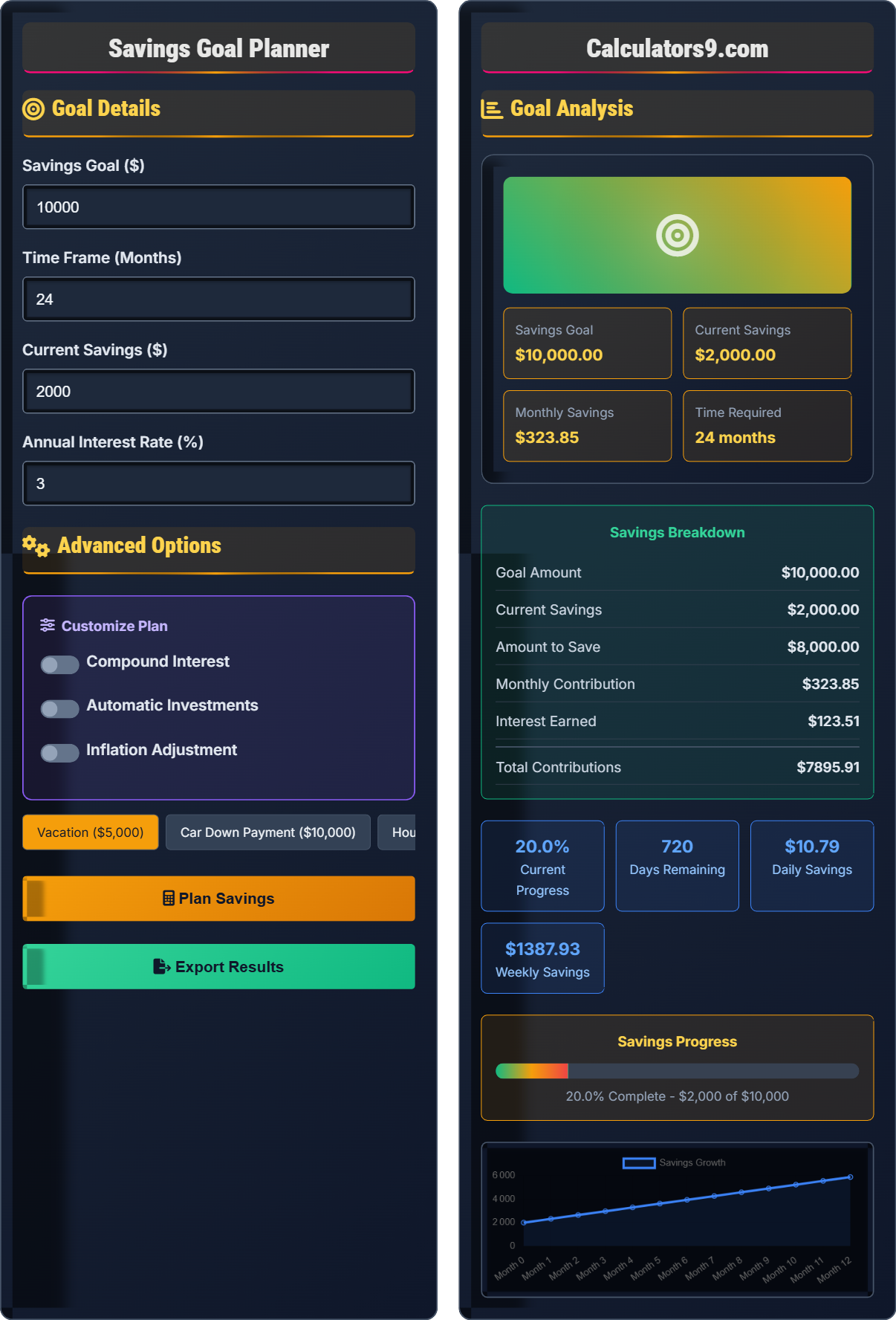
Example: $10,000 goal in 24 months with $2,000 saved and 3% annual interest:
- \(r = \frac{0.03}{12} = 0.0025\)
- \(PMT = \frac{(10000 - 2000) \times 0.0025}{(1.0025)^{24} - 1} = \frac{20}{0.0618} = \$323.62\)
Monthly savings required: $323.62
Q: How should I prioritize multiple savings goals?
A: Prioritize goals based on urgency and importance:
- Emergency fund: 3-6 months expenses
- High-priority goals: Near-term deadlines
- Long-term goals: Retirement, education
Use the formula to calculate required monthly savings for each goal, then allocate based on priority. For example, if you need $500/month for goal A and $300/month for goal B, but can only save $600/month, prioritize goal A first.