Side Hustle Profit Calculator
Calculate your extra income potential • 2026 edition
Profit Formula:
Show the calculator\( \text{Net Profit} = (\text{Revenue} - \text{Expenses}) - \text{Taxes} \)
Where:
- \( \text{Revenue} = \text{Price per unit} \times \text{Units sold} \)
- \( \text{Expenses} = \text{Fixed costs} + \text{Variable costs} \)
- \( \text{Taxes} = \text{Net Income} \times \text{Tax rate} \)
- \( \text{Profit Margin} = \frac{\text{Net Profit}}{\text{Revenue}} \times 100 \)
This formula calculates the profitability of a side hustle by subtracting all costs (fixed and variable) and taxes from total revenue. It helps determine whether the side hustle is financially viable and sustainable.
Example: For a side hustle generating $2,000/month in revenue with $500/month in expenses and a 15% tax rate:
Gross Profit: $2,000 - $500 = $1,500
Taxes: $1,500 × 0.15 = $225
Net Profit: $1,500 - $225 = $1,275
Profit Margin: ($1,275 ÷ $2,000) × 100 = 63.75%
Thus, the side hustle yields a net profit of $1,275 per month with a healthy 63.75% profit margin.
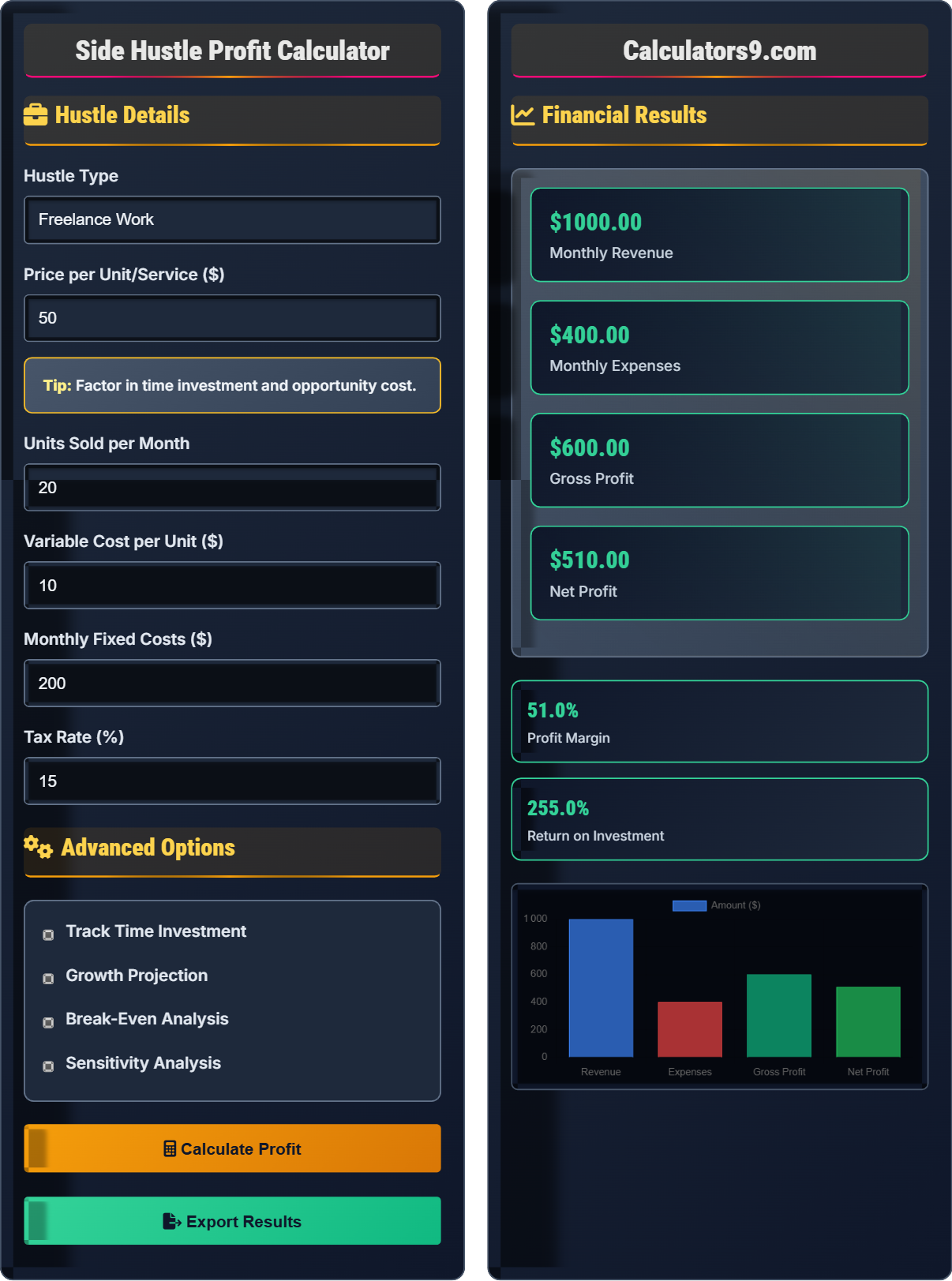
Hustle Details
Advanced Options
Financial Results
| Item | Amount | % of Revenue |
|---|
Projected growth over 12 months: $1,800.00
Comprehensive Side Hustle Guide
A side hustle is a secondary job or business venture that generates additional income beyond your primary employment. It can range from freelancing and selling products online to providing services like tutoring or consulting. Side hustles offer flexibility and the potential to build wealth incrementally while maintaining your main career.
The standard profit calculation for a side hustle uses the following formula:
Where:
- \( \text{Revenue} = \text{Price per unit} \times \text{Units sold} \)
- \( \text{Expenses} = \text{Fixed costs} + \text{Variable costs} \)
- \( \text{Profit Margin} = \frac{\text{Net Profit}}{\text{Revenue}} \times 100 \)
Your side hustle profit typically includes four key components:
- Revenue: Money earned from sales or services provided
- Variable Costs: Expenses that change with volume (materials, shipping, etc.)
- Fixed Costs: Consistent expenses regardless of volume (tools, software, rent)
- Taxes: Self-employment tax and income tax obligations
- Start Small: Begin with minimal investment and scale based on success
- Track Expenses: Keep detailed records for tax deductions and profitability analysis
- Focus on Demand: Choose hustles aligned with market needs
- Automate Where Possible: Use tools to reduce time investment
- Reinvest Profits: Put earnings back into growing the business
Side Hustle Basics
Secondary income-generating activity alongside primary employment.
\( \text{Net Profit} = (\text{Revenue} - \text{Expenses}) - \text{Taxes} \)
Where revenue = price × units, expenses = fixed + variable costs.
- Time investment affects profitability
- Higher margins are better for sustainability
- Tax implications reduce net profit
Profitability Strategies
Percentage of revenue remaining after all expenses are deducted.
- Raise prices strategically
- Reduce variable costs
- Scale operations efficiently
- Focus on high-margin products
- Market demand limits pricing
- Time is valuable resource
- Tax planning is essential
- Competition affects margins
Side Hustle Learning Quiz
Which of the following best describes the difference between fixed and variable costs in a side hustle?
The answer is B) Fixed costs remain constant regardless of volume, variable costs change with volume. Fixed costs (like rent for workspace or subscription fees) stay the same whether you sell 10 or 100 items. Variable costs (like materials or packaging) increase as you produce more units.
Understanding the difference between fixed and variable costs is crucial for calculating break-even points and profit margins. Fixed costs don't change with activity level, so the more units you sell, the lower the fixed cost per unit becomes. Variable costs scale directly with production, affecting your profit margin per unit.
Fixed Costs: Expenses that remain constant regardless of production volume
Variable Costs: Expenses that change proportionally with production volume
Break-even Point: The quantity at which total revenue equals total costs
• Fixed costs per unit decrease as volume increases
• Variable costs per unit typically remain constant
• Total costs = Fixed costs + (Variable cost per unit × Units produced)
• Remember: Fixed = "Forever Constant"
• Variable costs fluctuate with business activity
• High fixed costs require higher volumes to achieve profitability
• Confusing fixed costs with variable costs in calculations
• Forgetting that fixed costs per unit decrease with higher volume
• Not accounting for all variable costs in pricing decisions
Calculate the net profit for a side hustle that generates $3,000 in revenue with $800 in fixed costs, $600 in variable costs, and faces a 20% tax rate. Show your work.
Step 1: Calculate total expenses = Fixed costs + Variable costs = $800 + $600 = $1,400
Step 2: Calculate gross profit = Revenue - Expenses = $3,000 - $1,400 = $1,600
Step 3: Calculate taxes = Gross profit × Tax rate = $1,600 × 0.20 = $320
Step 4: Calculate net profit = Gross profit - Taxes = $1,600 - $320 = $1,280
Therefore, the net profit is $1,280.
This problem demonstrates the sequential nature of profit calculation. First, we subtract all expenses from revenue to get gross profit. Then, we calculate taxes on the profit amount. Finally, we subtract taxes from gross profit to arrive at net profit. This approach ensures we account for all costs and obligations.
Gross Profit: Revenue minus cost of goods sold/expenses
Net Profit: Gross profit minus taxes and other obligations
Tax Rate: Percentage of profit owed to government
• Always calculate taxes on profit, not revenue
• Expenses are subtracted before calculating taxes
• Net profit represents actual take-home earnings
• Remember: Revenue → Expenses → Gross Profit → Taxes → Net Profit
• Tax obligations reduce net profitability significantly
• Track all expenses for tax deduction purposes
• Calculating taxes on revenue instead of profit
• Forgetting to subtract all expenses before calculating profit
• Misunderstanding the order of operations in profit calculation
Sarah starts a handmade jewelry business. She sells each piece for $45, with variable costs of $15 per piece. Her monthly fixed costs are $600. How many pieces must she sell to break even each month?
Step 1: Calculate contribution margin per unit = Selling price - Variable cost = $45 - $15 = $30
Step 2: Calculate break-even point = Fixed costs ÷ Contribution margin per unit = $600 ÷ $30 = 20 units
Step 3: Verify: Revenue at 20 units = $45 × 20 = $900
Expenses at 20 units = Fixed costs + (Variable cost × Units) = $600 + ($15 × 20) = $600 + $300 = $900
Therefore, Sarah must sell 20 pieces to break even each month.
Break-even analysis determines the minimum sales volume needed to cover all costs. The contribution margin represents how much each sale contributes to covering fixed costs. Once fixed costs are covered, additional sales become pure profit. This analysis is critical for setting realistic sales targets.
Break-even Point: Sales volume where total revenue equals total costs
Contribution Margin: Revenue per unit minus variable cost per unit
Fixed Costs: Costs that don't change with sales volume
• Break-even = Fixed costs ÷ Contribution margin per unit
• Contribution margin = Price per unit - Variable cost per unit
• Sales above break-even generate profit
• Higher contribution margins mean lower break-even points
• Reduce fixed costs to lower break-even requirements
• Focus on products with higher contribution margins
• Including taxes in break-even calculations (they occur after break-even)
• Confusing variable costs with fixed costs
• Forgetting to verify the calculation with actual revenue and expenses
Mike runs a freelance graphic design business charging $75 per project with variable costs of $25 per project. His monthly fixed costs are $800. He currently completes 30 projects per month. If he raises his price by 20% but expects a 15% decrease in projects, what will be the impact on his monthly net profit? (Assume 25% tax rate)
Current scenario:
Revenue = $75 × 30 = $2,250
Variable costs = $25 × 30 = $750
Total costs = $800 + $750 = $1,550
Gross profit = $2,250 - $1,550 = $700
Taxes = $700 × 0.25 = $175
Net profit = $700 - $175 = $525
New scenario:
New price = $75 × 1.20 = $90
New volume = 30 × 0.85 = 25.5 ≈ 26 projects
Revenue = $90 × 26 = $2,340
Variable costs = $25 × 26 = $650
Total costs = $800 + $650 = $1,450
Gross profit = $2,340 - $1,450 = $890
Taxes = $890 × 0.25 = $222.50
New net profit = $890 - $222.50 = $667.50
Difference = $667.50 - $525 = $142.50 increase in net profit
Therefore, raising prices results in a $142.50 increase in monthly net profit.
This demonstrates the non-linear relationship between price, volume, and profit. When demand is inelastic (customers willing to pay more), increasing prices can boost profits even if volume decreases. However, if demand is elastic (customers sensitive to price), price increases may significantly reduce volume and overall profit. The key is understanding your market's price sensitivity.
Price Elasticity: How sensitive demand is to price changes
Profit Margin: Percentage of revenue that remains as profit
Volume-Price Trade-off: Relationship between price changes and sales volume
• Higher prices don't always mean higher profits
• Consider customer price sensitivity when pricing
• Volume and price changes compound their effect on profit
• Test price changes on a small scale first
• Monitor competitor pricing regularly
• Consider value-based pricing over cost-plus pricing
• Assuming higher prices always lead to higher profits
• Not considering the impact of volume changes on fixed cost allocation
• Forgetting to factor in taxes when comparing profit scenarios
Which of the following factors is MOST important when determining the viability of a side hustle?
The answer is C) Market demand for the product/service. Without sufficient market demand, no amount of effort, time, or investment will result in a profitable side hustle. Demand is the foundation upon which all successful businesses are built. While the other factors are important, they're meaningless without customers willing to purchase your offering.
Market demand validation is the first step in any business venture. Before investing time, energy, and resources, it's essential to confirm that people want what you're offering. This validation can come through market research, pre-orders, surveys, or testing initial products with a small audience. A side hustle with high demand can overcome many challenges, while one without demand will struggle regardless of other advantages.
Market Demand: The desire and ability of consumers to purchase a product or service
Opportunity Cost: The value of the next best alternative forgone
Scalability: Ability to grow without proportionally increasing resources
• Demand validation comes before business development
• A good idea isn't necessarily a viable business
• Customer willingness to pay confirms demand existence
• Test demand with a minimum viable product (MVP)
• Survey potential customers before launching
• Look for existing solutions to validate market need
• Falling in love with ideas without validating demand
• Assuming everyone needs your solution
• Building a product without confirming market interest
FAQ
Q: How do I determine if my side hustle is profitable enough to continue?
A: To determine if your side hustle is profitable enough, calculate your net profit margin and consider your time investment:
Net Profit Margin = (Net Profit ÷ Revenue) × 100
As a general rule, aim for at least a 15-20% net profit margin after all expenses and taxes. Additionally, calculate your effective hourly wage by dividing net profit by hours worked. If your side hustle pays less than minimum wage when factoring in time spent, it may not be worth continuing.
Consider the formula: Hourly Rate = Net Profit ÷ Hours Invested
If you invest 20 hours per week and earn $400 in net profit, your effective hourly rate is $20/hour. Compare this to your opportunity cost and decide if the time investment is worthwhile.
Q: Should I focus on high-volume, low-margin or low-volume, high-margin products?
A: The choice between high-volume/low-margin and low-volume/high-margin depends on your capacity, competition, and business model.
High-volume, low-margin works well when:
- You can automate or scale operations
- Market is price-sensitive
- Fixed costs are high relative to variable costs
Low-volume, high-margin works well when:
- You offer unique or specialized products/services
- Time investment is significant
- Competition is limited
For example, if your fixed costs are $500/month and you sell a $50 item with $10 variable cost (80% margin), you need 13 sales to break even. If you sell a $20 item with $15 variable cost (25% margin), you need 100 sales to break even. High-margin items require fewer sales to achieve profitability.