Subscription Auditor
Track subscriptions • Optimize costs
Subscription Cost Formula:
Show Calculator\( SC = \sum_{i=1}^{n} C_i \)
\( SA = SC \times 12 \)
\( SS = \sum_{i=1}^{n} (C_i \times M_i) \)
Where:
- \( SC \) = Monthly subscription costs
- \( C_i \) = Cost of subscription i
- \( SA \) = Annual subscription cost
- \( SS \) = Potential savings
- \( M_i \) = Months subscription i continues
- \( n \) = Number of subscriptions
Annual Cost: \( AC = Monthly\ Cost \times 12 \)
Example: 5 subscriptions at $10 each monthly:
\( SC = 5 \times \$10 = \$50\ per\ month \)
\( SA = \$50 \times 12 = \$600\ per\ year \)
Total annual cost is $600.
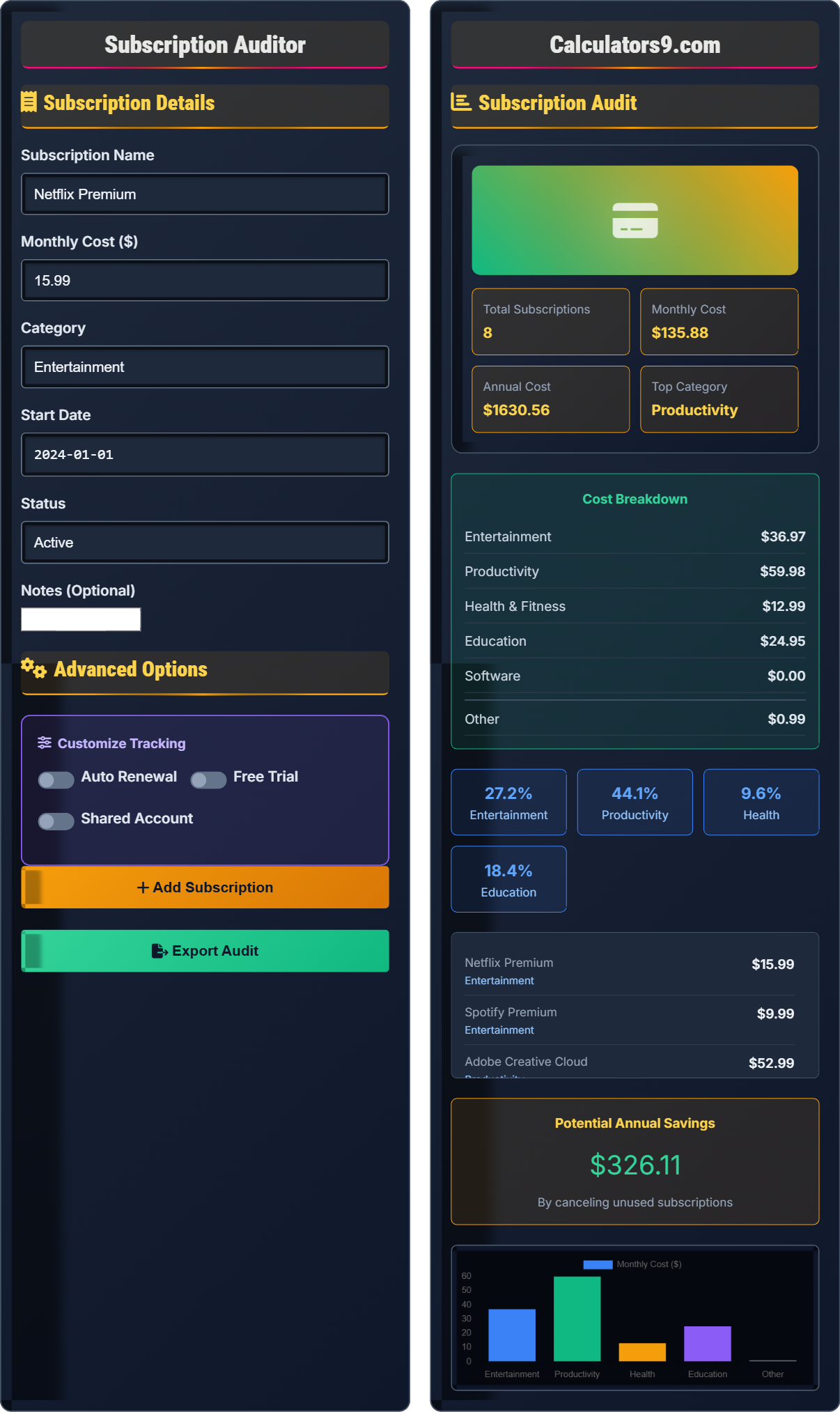
Subscription Details
Advanced Options
Subscription Audit
Subscription Auditing Basics
Subscription auditing is the process of reviewing and analyzing all recurring payments to identify unnecessary expenses and optimize costs.
\(SA = \sum_{i=1}^{n} (C_i \times 12)\)
Where SA=annual cost, Ci=monthly cost of subscription i.
- Track all recurring payments
- Review monthly statements
- Cancel unused subscriptions
- Optimize shared accounts
Optimization Strategies
Identify and eliminate unnecessary subscriptions to reduce monthly expenses.
- Compile complete subscription list
- Assess usage frequency
- Cancel unused services
- Share accounts when possible
- Negotiate better rates
- Switch to annual plans
- Review annually for changes
- Check trial periods
- Monitor for price increases
- Track free alternatives
Subscription Auditing Learning Quiz
What is the primary benefit of tracking all subscriptions?
The answer is B) To identify and eliminate unused subscriptions. Tracking subscriptions helps discover services you're paying for but not using, allowing you to cancel them and reduce monthly expenses.
Many people unknowingly pay for subscriptions they no longer use. Regular auditing reveals these hidden costs and provides opportunities for immediate savings. This is a key component of effective personal financial management.
Subscription Auditing: Process of reviewing recurring payments
Unused Subscriptions: Services paid for but not used
Hidden Costs: Expenses not immediately obvious
• Track all recurring payments
• Review regularly for changes
• Cancel unused services promptly
• Check bank statements monthly
• Use subscription tracking tools
• Set calendar reminders for reviews
• Forgetting about trial subscriptions
• Not canceling properly
• Ignoring small recurring charges
If you have 6 subscriptions costing $10, $15, $12, $8, $20, and $5 monthly, what is your total monthly cost and annual cost?
Monthly cost: $10 + $15 + $12 + $8 + $20 + $5 = $70
Annual cost: $70 × 12 = $840
Using the formula: \(SA = \sum_{i=1}^{n} (C_i \times 12)\)
Where SA = Annual cost, Ci = monthly cost of subscription i
Therefore, monthly cost is $70 and annual cost is $840.
This calculation shows how small monthly subscriptions can add up to significant annual costs. The formula SA = Σ(Ci × 12) sums all individual monthly costs and multiplies by 12 to get the annual total. This demonstrates the importance of tracking even small recurring charges.
Monthly Cost: Total of all subscriptions per month
Annual Cost: Total of all subscriptions per year
Recurring Charges: Regular automatic payments
• Sum all monthly costs first
• Multiply by 12 for annual total
• Include all recurring services
• Use: Annual Cost = Monthly Cost × 12
• Track all recurring payments
• Calculate annually to see true cost
• Forgetting to include all subscriptions
• Not accounting for annual billing
• Missing trial-to-paid conversions
Sarah discovered she has 8 subscriptions totaling $150 monthly, but she only actively uses 5 of them worth $100. If she cancels the unused subscriptions, how much will she save annually? What percentage of her subscription budget was wasted?
Unused subscription cost: $150 - $100 = $50 monthly
Annual savings: $50 × 12 = $600
Percentage wasted: ($50 ÷ $150) × 100 = 33.33%
Therefore, Sarah will save $600 annually, which represents 33.33% of her subscription budget.
This example demonstrates the significant impact of unused subscriptions. By canceling services she wasn't using, Sarah reduces her monthly expenses by 33% and saves $600 annually. Regular audits help identify these opportunities for immediate savings.
Unused Subscriptions: Paid services not being used
Cost Optimization: Reducing unnecessary expensesAnnual Savings: Yearly cost reduction
• Calculate monthly waste first
• Multiply by 12 for annual savings
• Express as percentage of total
• Calculate: Unused Amount = Total - Used
• Annual Savings = Monthly Savings × 12
• Waste % = (Unused ÷ Total) × 100
• Not identifying truly unused services
• Forgetting to calculate annual impact
• Not expressing savings as percentage
John pays $15.99 for a premium streaming service individually, but his friend suggests sharing the account with 3 other people. If the shared plan costs $20, how much will John save monthly and annually by sharing? What percentage of his original cost does this represent? (Hint: Calculate individual vs. shared cost)
Original monthly cost: $15.99
Shared monthly cost: $20 ÷ 4 = $5.00
Monthly savings: $15.99 - $5.00 = $10.99
Annual savings: $10.99 × 12 = $131.88
Percentage savings: ($10.99 ÷ $15.99) × 100 = 68.73%
Therefore, John will save $10.99 monthly and $131.88 annually, representing 68.73% savings.
This scenario shows how shared accounts can dramatically reduce subscription costs. By splitting the cost with others, John saves almost 70% of his original expense. Sharing is especially beneficial for services that support multiple users.
Shared Accounts: Multiple users on one subscription
Cost Per User: Individual share of group cost
Group Discounts: Savings from bulk pricing
• Calculate cost per user in shared plans
• Compare to individual costs
• Consider privacy implications
• Calculate: Shared Cost = Total ÷ Users
• Compare individual vs. shared options
• Consider setup and maintenance
• Not calculating per-person cost
• Forgetting to compare to individual plans
• Ignoring setup requirements
How often should you conduct a subscription audit?
The answer is C) Quarterly or annually. Regular audits (every 3-12 months) help catch trial-to-paid conversions, price increases, and subscriptions you no longer use. Monthly reviews are too frequent, while annual reviews may miss opportunities for savings.
Effective subscription management requires regular review. Quarterly audits allow you to catch changes like price increases or new subscriptions, while annual reviews help with budget planning. The key is consistency rather than frequency.
Regular Audits: Consistent review schedule
Trial Conversions: Free trials becoming paid
Price Monitoring: Watching for increases
• Conduct audits regularly
• Monitor for price changes
• Review before renewals
• Set calendar reminders
• Review during bank statement checks
• Audit before budget planning
• Never conducting audits
• Forgetting about automatic renewals
• Not monitoring price changes
FAQ
Q: How do I find all my subscriptions?
A: Check your bank and credit card statements for recurring charges. Look for:
- Monthly subscription services
- App store purchases
- Online service fees
- Membership renewals
Use the formula: \(SC = \sum_{i=1}^{n} C_i\) where \(SC\) is total monthly subscription cost, \(C_i\) is cost of subscription \(i\), and \(n\) is number of subscriptions.
This systematic approach helps identify all recurring payments.
Q: How can I reduce my subscription costs effectively?
A: Effective subscription cost reduction strategies include:
- Cancel unused services
- Share accounts with family/friends
- Switch to annual plans for discounts
- Use free alternatives when available
- Negotiate better rates
Calculate potential savings: \(SA = \sum_{i=1}^{n} (C_i \times 12)\) where \(SA\) is annual savings, \(C_i\) is monthly cost reduction for subscription \(i\).
Regular audits ensure continued optimization.