Vacation Savings Planner
Plan your dream trip budget • 2026 edition
Savings Formula:
Show the calculator\( \text{Monthly Savings} = \frac{\text{Total Vacation Cost} - \text{Current Savings}}{\text{Months Until Departure}} \)
\( \text{Savings Rate} = \frac{\text{Monthly Savings}}{\text{Monthly Income}} \times 100 \)
Where:
- \( \text{Total Vacation Cost} = \sum(\text{Expense Categories}) \)
- \( \text{Months Until Departure} = \text{Departure Date} - \text{Today} \)
- \( \text{Savings Goal} = \text{Total Vacation Cost} - \text{Current Savings} \)
This formula calculates the monthly savings required to reach your vacation budget goal. It ensures you can afford your trip without financial stress by planning ahead and setting achievable monthly savings targets.
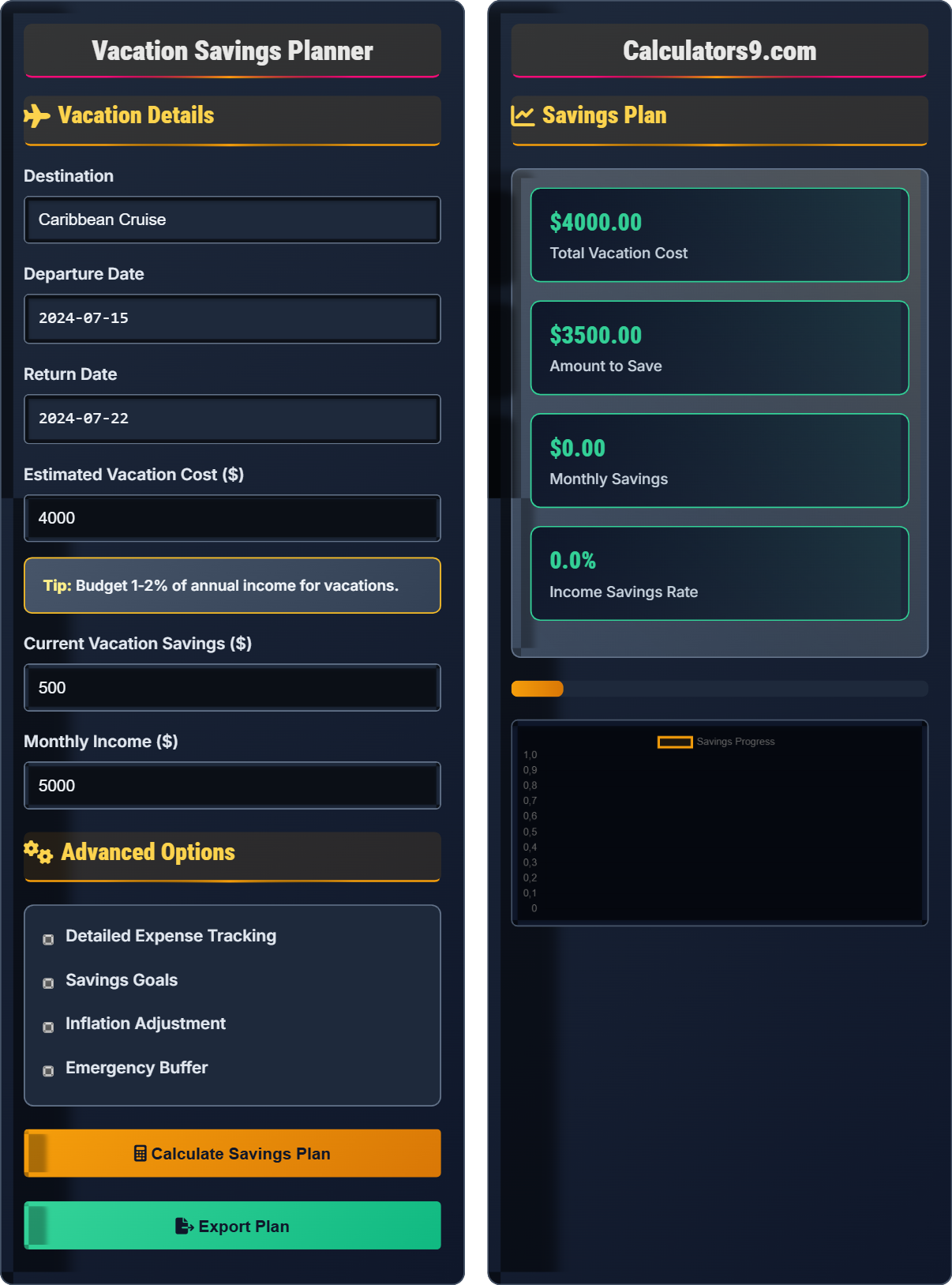
Example: For a $4,000 vacation in 10 months with $500 currently saved:
Savings needed: $4,000 - $500 = $3,500
Monthly savings: $3,500 ÷ 10 = $350
If monthly income is $5,000:
Savings rate: ($350 ÷ $5,000) × 100 = 7%
Therefore, you need to save $350 per month (7% of income) to reach your goal.
Vacation Details
Advanced Options
Savings Plan
| Month | Starting Balance | Savings Added | Ending Balance |
|---|
Savings Timeline
Comprehensive Vacation Savings Guide
Vacation savings planning is the process of setting aside money systematically to fund future travel experiences. It involves estimating trip costs, determining a timeline, and creating a consistent savings strategy to reach your travel goals without financial stress.
The standard vacation savings calculation uses the following formula:
Where:
- \( \text{Total Vacation Cost} = \text{Sum of all estimated expenses} \)
- \( \text{Months Until Departure} = \text{Time from today until trip date} \)
- \( \text{Savings Rate} = \frac{\text{Monthly Savings}}{\text{Monthly Income}} \times 100 \)
Effective vacation savings involves several key strategies:
- Automate Savings: Set up automatic transfers to vacation fund
- Round Up Purchases: Add spare change to vacation fund
- Cut Unnecessary Expenses: Redirect coffee, entertainment, or subscription money
- Use Windfalls: Tax refunds, bonuses, or gifts for vacation savings
- Set Milestones: Celebrate reaching savings benchmarks
- Research Costs: Investigate destination prices before setting budget
- Book Early: Secure better rates for flights and accommodations
- Travel Off-Peak: Save significantly by avoiding peak seasons
- Use Travel Rewards: Leverage credit card points and miles
- Create an Emergency Fund: Set aside 10% for unexpected expenses
Vacation Savings Basics
Systematic approach to saving money for travel experiences.
\( \text{Monthly Savings} = \frac{\text{Total Cost} - \text{Current Savings}}{\text{Months Until Departure}} \)
Where cost = sum of all expected expenses.
- Start saving well in advance
- Account for all expenses
- Include emergency buffer
Savings Strategies
Percentage of income allocated to vacation savings.
- Automate monthly transfers
- Redirect unnecessary expenses
- Use round-up methods
- Save windfalls immediately
- Don't compromise emergency fund
- Factor in inflation
- Research destination costs
- Plan for unexpected expenses
Vacation Savings Learning Quiz
According to financial experts, what percentage of annual income should be allocated for vacation savings?
The answer is B) 3-5%. Financial experts recommend allocating 3-5% of your annual income for vacation savings. This percentage provides enough for meaningful trips while maintaining financial stability and allowing for other savings goals.
The 3-5% rule provides a balanced approach to vacation savings that scales with your income level. For someone earning $50,000 annually, this means $1,500-$2,500 for vacations. For someone earning $100,000, it's $3,000-$5,000. This proportional approach ensures that vacation savings remain manageable regardless of income level while still allowing for quality travel experiences.
Annual Income: Total earnings from all sources over one year
Savings Rate: Percentage of income allocated to savings
Financial Stability: Overall health of personal finances
• Vacation savings should complement, not compete with, other savings goals
• 3-5% allows for flexibility based on personal circumstances
• Adjust based on vacation frequency and destination
• Calculate your percentage: (Vacation budget ÷ Annual income) × 100
• Start with 3% and increase as your finances allow
• Set up automatic transfers to vacation fund
• Allocating too high a percentage that impacts other savings
• Not accounting for inflation in vacation costs
• Forgetting to include all vacation-related expenses
Calculate the monthly savings required if your vacation costs $3,600, you currently have $600 saved, and your trip is 6 months away. Show your work.
Step 1: Calculate amount to save = Total cost - Current savings = $3,600 - $600 = $3,000
Step 2: Calculate monthly savings = Amount to save ÷ Months until departure = $3,000 ÷ 6 = $500
Step 3: Calculate savings rate = (Monthly savings ÷ Monthly income) × 100
If monthly income is $4,000: Savings rate = ($500 ÷ $4,000) × 100 = 12.5%
Therefore, you need to save $500 per month to reach your goal in 6 months.
This calculation demonstrates the inverse relationship between time and monthly savings requirements. With only 6 months to save $3,000, you need to set aside $500 monthly. If you had 12 months instead, you'd only need $250 monthly. This highlights the importance of starting vacation savings early to reduce monthly financial pressure.
Monthly Savings: Amount to save each month toward vacation goal
Time Value of Money: How time affects savings requirements
Savings Rate: Percentage of income dedicated to savings
• Earlier planning reduces monthly savings requirements
• Current savings reduce total amount to save
• Savings rate should fit within your budget
• Start saving as soon as you know your travel dates
• Use the time factor to adjust your timeline
• Consider adjusting vacation plans if savings rate is too high
• Starting to save too late before trip
• Not accounting for current savings in calculations
• Setting unrealistic monthly savings targets
Emma plans a $2,800 vacation in 8 months. She has $400 saved. If she adds a 15% emergency buffer to her total vacation cost, how much should she save monthly, and what percentage of her $3,500 monthly income will this represent?
Step 1: Calculate emergency buffer = Total cost × Buffer percentage = $2,800 × 0.15 = $420
Step 2: Calculate adjusted total cost = Original cost + Buffer = $2,800 + $420 = $3,220
Step 3: Calculate amount to save = Adjusted cost - Current savings = $3,220 - $400 = $2,820
Step 4: Calculate monthly savings = Amount to save ÷ Months until departure = $2,820 ÷ 8 = $352.50
Step 5: Calculate savings rate = (Monthly savings ÷ Monthly income) × 100 = ($352.50 ÷ $3,500) × 100 = 10.07%
Therefore, Emma should save $352.50 monthly (10.07% of income) to cover her vacation and emergency buffer.
This problem demonstrates the importance of including an emergency buffer in vacation planning. The 15% buffer significantly increases the total required savings, from $2,400 to $2,820, which in turn increases the monthly savings requirement. This buffer protects against unexpected expenses during the trip, such as medical emergencies, flight delays, or currency fluctuations.
Emergency Buffer: Extra funds reserved for unexpected expenses
Adjusted Total Cost: Original cost plus contingency funds
Financial Protection: Safeguards against unexpected costs
• Emergency buffers typically range from 10-20% of total cost
• Buffers provide peace of mind during travel
• Include buffer when calculating monthly savings
• Use 10% for domestic trips, 15-20% for international
• Keep buffer funds in easily accessible account
• Consider travel insurance as additional protection
• Forgetting to include emergency buffer in calculations
• Setting buffer too low for international travel
• Not adjusting monthly savings for the buffer amount
David plans a vacation for 18 months from now with a current estimated cost of $5,000. If inflation is expected to average 3% annually, how much should he budget for the trip, and what monthly savings will he need if he currently has $800 saved? Assume his monthly income is $6,000.
Step 1: Calculate inflation-adjusted cost using compound growth formula:
Future cost = Present cost × (1 + inflation rate)years
Since 18 months = 1.5 years: Future cost = $5,000 × (1.03)1.5 = $5,000 × 1.0453 = $5,226.50
Step 2: Calculate amount to save = Future cost - Current savings = $5,226.50 - $800 = $4,426.50
Step 3: Calculate monthly savings = Amount to save ÷ Months until departure = $4,426.50 ÷ 18 = $245.92
Step 4: Calculate savings rate = (Monthly savings ÷ Monthly income) × 100 = ($245.92 ÷ $6,000) × 100 = 4.1%
Therefore, David should budget $5,226.50 and save $245.92 monthly (4.1% of income).
This problem illustrates the impact of inflation on future travel costs. Even with a modest 3% annual inflation rate, the $5,000 vacation grows to $5,226.50 over 18 months. This adjustment ensures that David's savings will maintain their purchasing power when he travels. The inflation adjustment is particularly important for long-term travel planning.
Inflation: General increase in prices over time
Future Value: Value of money at a future date considering inflation
Purchasing Power: Amount of goods/services money can buy
• Higher inflation rates require larger adjustments
• Longer timeframes amplify inflation effects
• Include inflation in long-term travel planning
• Use 2-3% for stable economies, 4-5% for volatile ones
• Research destination-specific inflation rates
• Consider booking early to lock in current prices
• Ignoring inflation for long-term travel plans
• Using simple interest instead of compound growth
• Not adjusting savings calculations for inflation
Which of the following is the MOST effective strategy for building a vacation fund quickly?
The answer is B) Set up automatic transfers on payday. This strategy ensures consistent savings by treating vacation funds like a bill that must be paid first. Automating transfers removes the temptation to spend money on other things and builds the habit of prioritizing travel savings.
Automatic transfers leverage behavioral psychology by making savings effortless and habitual. When money is automatically moved to a vacation fund on payday, before other expenses compete for it, you're more likely to successfully build your travel fund. This "pay yourself first" principle is fundamental to successful financial planning and ensures that vacation savings become a priority rather than an afterthought.
Automatic Transfers: Scheduled transfers between accounts
Pay Yourself First: Prioritizing savings before other expenses
Behavioral Economics: How psychology influences financial decisions
• Treat vacation savings like a non-negotiable bill
• Automate transfers to remove decision-making
• Start with small amounts and increase gradually
• Schedule transfers on your payday
• Use a separate vacation account to avoid temptation
• Increase amounts during salary increases or bonuses
• Waiting until month-end when money is tight
• Relying on willpower instead of systems
• Using credit cards for vacation expenses
FAQ
Q: How do I determine how much to budget for different vacation expense categories?
A: A common vacation budget breakdown is:
- Transportation: 30-40% of total budget
- Accommodation: 25-35% of total budget
- Food & Dining: 20-30% of total budget
- Activities: 10-20% of total budget
- Shopping: 5-10% of total budget
For a $3,000 vacation:
Transportation: $900-$1,200
Accommodation: $750-$1,050
Food: $600-$900
Activities: $300-$600
Shopping: $150-$300
These percentages can be adjusted based on your destination and travel style. International destinations often require higher transportation budgets, while luxury resorts may shift more toward accommodation costs.
Q: What's the difference between vacation savings and vacation budgeting?
A: Vacation savings is the process of accumulating funds before your trip, while vacation budgeting is the plan for how to spend those funds during your trip.
The relationship is: \( \text{Savings Plan} = \frac{\text{Budgeted Expenses}}{\text{Time Until Trip}} \)
For example, if your vacation budget is \( \$4,000 \) and you have 8 months until your trip, your savings plan would be \( \$500 \) per month.
Savings planning happens before the trip, while budgeting guides your spending during the trip. Both are essential for financial peace of mind during travel.