1% Rule Checker
Real estate investment evaluation • 2026 analysis
1% Rule Formula:
Show the checker\( \text{Monthly Rent} \geq \frac{\text{Purchase Price}}{100} \)
Where:
- Monthly Rent = Expected monthly rental income
- Purchase Price = Total cost of the property
The 1% rule is a quick evaluation method for rental properties that suggests the monthly rent should equal or exceed 1% of the purchase price. This ensures the property generates sufficient cash flow to cover expenses and provide profit.
Example: For a property purchased at $200,000, the monthly rent should be at least $2,000 (1% of $200,000) to meet the 1% rule criteria.
Properties meeting this threshold are considered potentially profitable, though investors should also consider other factors like market conditions, property condition, and location.
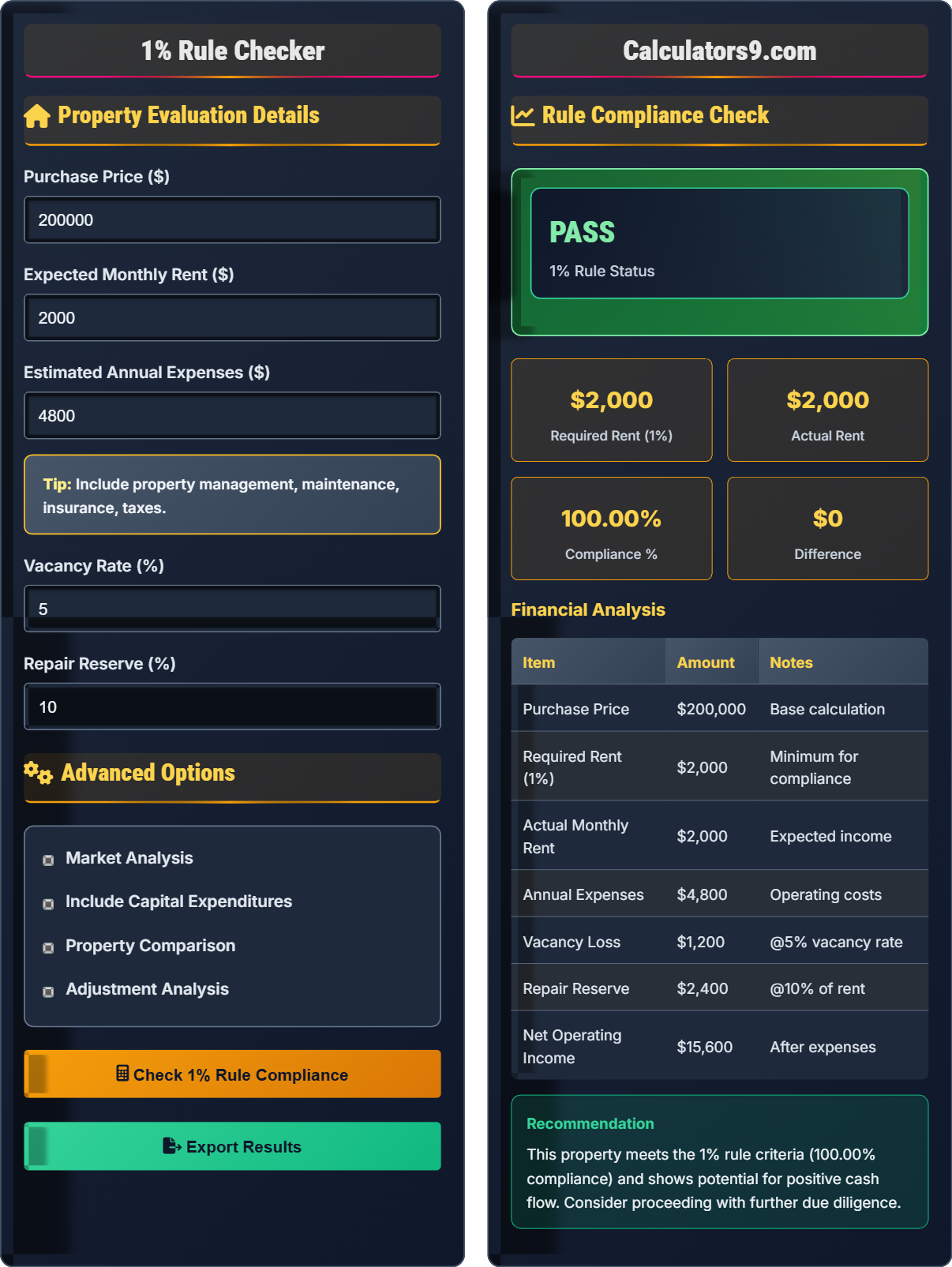
Property Evaluation Details
Advanced Options
Rule Compliance Check
Financial Analysis
| Item | Amount | Notes |
|---|---|---|
| Purchase Price | $200,000 | Base calculation |
| Required Rent (1%) | $2,000 | Minimum for compliance |
| Actual Monthly Rent | $2,000 | Expected income |
| Annual Expenses | $4,800 | Operating costs |
| Vacancy Loss | $1,200 | @5% vacancy rate |
| Repair Reserve | $2,400 | @10% of rent |
| Net Operating Income | $21,600 | After expenses |
Investment Visualization
1% Rule Investment Guide
The 1% rule is a simple evaluation method used by real estate investors to quickly assess the potential profitability of a rental property. According to this rule, the monthly rental income should equal or exceed 1% of the purchase price of the property.
For example, if a property costs $200,000, the monthly rent should be at least $2,000 (1% of $200,000) to meet the 1% rule criteria. This ensures the property generates sufficient cash flow to cover expenses and provide profit.
The 1% rule calculation uses the following formula:
Where:
- Monthly Rent = Expected monthly rental income
- Purchase Price = Total cost of the property
The 1% rule provides a quick screening tool for rental properties:
- Meets Rule (≥1%): Property passes initial screening
- Near Rule (0.9-1%): May still be viable with careful analysis
- Below Rule (<0.9%): Likely poor cash flow potential
- Exceeds Rule (>1.2%): Potentially excellent investment opportunity
Remember that the 1% rule is just an initial screening tool and should be combined with other analyses.
- Use as initial filter: Screen properties before deeper analysis
- Consider market variations: Some markets may require adjustments
- Factor in property condition: Properties needing repairs may need higher returns
- Combine with other metrics: Use alongside cash-on-cash return and cap rate
- Account for appreciation potential: Consider long-term value growth
Investment Metrics Comparison
Quick screening tool; other metrics provide deeper analysis.
\(CoC = \frac{\text{Annual Pre-Tax Cash Flow}}{\text{Total Cash Invested}} \times 100\%\)
Measures return on actual cash invested.
- 1% Rule is quick screening method
- CoC considers actual cash invested
- Cap Rate is unlevered metric
- 1% Rule focuses on rent-to-price ratio
1% Rule Learning Quiz
According to the 1% rule, what should be the minimum monthly rent for a property purchased at $180,000?
The answer is B) $1,800. According to the 1% rule, the monthly rent should equal or exceed 1% of the purchase price. For a $180,000 property: 1% of $180,000 = $1,800. Therefore, the minimum monthly rent should be $1,800 to meet the 1% rule criteria.
The 1% rule is a straightforward calculation that helps investors quickly assess whether a property has the potential to generate adequate cash flow. The formula is simply: Required Monthly Rent = Purchase Price ÷ 100. This creates a benchmark that ensures the property generates enough income to cover expenses and provide profit.
1% Rule: Monthly rent should equal or exceed 1% of purchase price
Quick Screening: Initial evaluation method for rental properties
Cash Flow Potential: Ability to generate positive monthly income
• Required Rent = Purchase Price ÷ 100
• Actual Rent ≥ Required Rent = Passes Rule
• Rule is initial screening, not final decision
• Divide purchase price by 100 to find required rent
• Use as first filter for property evaluation
• Combine with other metrics for full analysis
• Forgetting that the rule requires 1% of purchase price
Calculate whether a property meets the 1% rule with the following details: Purchase price $250,000, expected monthly rent $2,200. Show your work and state whether the property passes the rule.
Step 1: Calculate required monthly rent for 1% rule compliance
Required Rent = Purchase Price ÷ 100
Required Rent = $250,000 ÷ 100 = $2,500
Step 2: Compare actual rent to required rent
Actual Rent = $2,200
Required Rent = $2,500
Since $2,200 < $2,500, the property does NOT meet the 1% rule.
Step 3: Calculate compliance percentage
Compliance = (Actual Rent ÷ Required Rent) × 100%
Compliance = ($2,200 ÷ $2,500) × 100% = 88%
Therefore, the property fails the 1% rule with 88% compliance.
This calculation demonstrates how the 1% rule works as a screening tool. The property in question falls short of the required rent by $300 per month, indicating it may not generate sufficient cash flow to cover expenses and provide profit. While this doesn't automatically disqualify the property, it signals the need for more careful analysis of expenses and potential returns.
Compliance Percentage: Actual rent as a percentage of required rent
Screening Tool: Method to quickly evaluate property potential
Cash Flow Adequacy: Sufficient income to cover all expenses
• Calculate required rent first
• Compare actual to required
• Calculate compliance percentage
• Always divide purchase price by 100
• Calculate compliance percentage for context
• Consider market conditions for adjustments
• Reversing the comparison (comparing required to actual incorrectly)
• Forgetting to calculate compliance percentage
• Assuming failure means property is worthless
Sarah is evaluating two properties using the 1% rule. Property A costs $220,000 with expected rent of $2,500/month. Property B costs $180,000 with expected rent of $1,700/month. Which property performs better according to the 1% rule?
Property A Analysis:
Required Rent = $220,000 ÷ 100 = $2,200
Actual Rent = $2,500
Compliance = ($2,500 ÷ $2,200) × 100% = 113.6%
Property A passes the 1% rule with 113.6% compliance.
Property B Analysis:
Required Rent = $180,000 ÷ 100 = $1,800
Actual Rent = $1,700
Compliance = ($1,700 ÷ $1,800) × 100% = 94.4%
Property B fails the 1% rule with 94.4% compliance.
Therefore, Property A performs better according to the 1% rule.
This comparison demonstrates how the 1% rule can quickly differentiate between properties. Property A not only meets the 1% rule but exceeds it by 13.6%, suggesting stronger cash flow potential. Property B falls short of the required threshold, indicating it may struggle to generate adequate returns. However, investors should consider other factors beyond the 1% rule.
Relative Performance: Comparing investment potential between properties
Cash Flow Strength: Degree to which rent exceeds required amount
Investment Screening: Process of evaluating property viability
• Calculate required rent for each property
• Compare actual rent to required rent
• Calculate compliance percentages for comparison
• Calculate compliance percentages for direct comparison
• Higher compliance indicates better potential
• Consider multiple metrics for full evaluation
• Comparing only absolute rent amounts without considering purchase prices
• Not calculating compliance percentages for context
• Relying solely on 1% rule for final decisions
Tom finds a property in a high-demand market priced at $280,000 with expected rent of $2,500/month. The property fails the 1% rule (89% compliance). Should Tom still consider this property? Explain your reasoning considering market factors.
While the property technically fails the 1% rule (required rent: $2,800, actual: $2,500), Tom should consider additional factors:
Positive factors in high-demand markets:
- Appreciation potential may exceed cash flow shortfall
- Low vacancy rates could provide more consistent income
- Property values likely to increase over time
- High tenant demand may allow rent increases
Negative factors:
- Lower cash flow during ownership
- Less margin for unexpected expenses
- Higher risk if market conditions change
Conclusion: Tom should consider the property but with adjusted expectations and thorough analysis of appreciation potential, market trends, and exit strategy.
This question highlights the limitations of the 1% rule as a standalone metric. While the rule provides a useful screening tool, it doesn't account for market conditions, appreciation potential, or other investment factors. In high-demand markets, properties may command premium prices that don't meet the 1% rule but still provide value through appreciation or other benefits.
Market Conditions: Local economic factors affecting property values
Appreciation Potential: Future increase in property value
Investment Strategy: Approach to property acquisition and management
• 1% rule is screening tool, not absolute requirement
• Consider market-specific factors
• Analyze multiple metrics together
• Adjust rule expectations for different markets
• Factor in appreciation potential for high-demand areas
• Consider rental market trends
• Treating 1% rule as absolute requirement
• Ignoring market-specific conditions
• Not considering appreciation alongside cash flow
Which of the following is a limitation of the 1% rule?
The answer is B) It doesn't consider location or market conditions. The 1% rule is a simple calculation that only compares purchase price to expected rent. It doesn't account for location quality, neighborhood growth prospects, local market conditions, property appreciation potential, or other important investment factors that can significantly impact the investment's success.
The 1% rule is intentionally simple, which makes it a quick screening tool but also limits its analytical depth. While it provides a useful starting point for evaluating rental properties, investors must supplement it with other analyses that consider location, market trends, appreciation potential, and other critical factors. The rule works best when used as part of a comprehensive evaluation process.
Screening Tool: Initial evaluation method to filter properties
Location Factors: Geographic and neighborhood characteristics
Comprehensive Analysis: Multi-factor investment evaluation
• 1% rule is initial screening method
• Combine with other metrics and analyses
• Consider location and market factors separately
• Use 1% rule as first filter only
• Always perform additional due diligence
• Factor in location quality separately
• Making final investment decisions based solely on 1% rule
• Not considering location quality
• Ignoring market trends and conditions
FAQ
Q: Is the 1% rule applicable in all real estate markets?
A: The 1% rule serves as a useful baseline across markets, but its applicability varies significantly based on local conditions:
Markets where 1% rule works well:
- Mid-tier cities with moderate property values
- Areas with stable rental demand
- Markets with balanced supply and demand
Markets where 1% rule may be challenging:
- High-cost metropolitan areas (e.g., San Francisco, New York)
- Markets with rapidly appreciating property values
- Areas with exceptionally high rental yields
In expensive markets, investors might adjust to a 0.8% or 0.7% rule, while in high-yield markets, they might look for 1.2% or higher. The key is understanding your local market dynamics and adjusting expectations accordingly while maintaining the principle of adequate cash flow coverage.
Q: How does the 1% rule compare to other real estate investment metrics?
A: The 1% rule serves as a quick screening tool, but should be used alongside other metrics:
1% Rule: Quick rent-to-price ratio check
Formula: \( \text{Monthly Rent} \geq \frac{\text{Purchase Price}}{100} \)
Cash-on-Cash Return: Measures return on actual cash invested
Formula: \( CoC = \frac{\text{Annual Pre-Tax Cash Flow}}{\text{Total Cash Invested}} \times 100\% \)
Cap Rate: Measures return on total property value
Formula: \( Cap\ Rate = \frac{\text{Net Operating Income}}{\text{Property Value}} \times 100\% \)
Each metric serves different purposes: the 1% rule is ideal for initial screening due to its simplicity, while cash-on-cash return and cap rate provide deeper insights into profitability and investment performance. Successful investors use multiple metrics together for comprehensive analysis.