Home Affordability Estimator
Calculate your home budget • 2026 rates
\( \text{Max Home Price} = \frac{\text{Gross Monthly Income} \times 0.28 - \text{Monthly Debt Payments}}{\text{Monthly Payment Factor}} \times 1000 \)
Where:
- \( 0.28 \) = 28% of gross income for housing costs
- \( \text{Monthly Payment Factor} \) = Calculated based on interest rate and loan term
- \( \text{Monthly Debt Payments} \) = All recurring monthly debts
This formula calculates the maximum home price you can afford based on standard lending ratios. Lenders typically recommend that housing costs don't exceed 28% of gross monthly income.
Example: For a monthly income of $8,000 with $1,000 in monthly debt payments and a payment factor of 5.37 (for 4.5% interest over 30 years):
\( \text{Max Home Price} = \frac{8000 \times 0.28 - 1000}{5.37} \times 1000 = \frac{2240 - 1000}{5.37} \times 1000 = \frac{1240}{5.37} \times 1000 \approx \$231,000 \)
Thus, the maximum affordable home price is approximately $231,000.
Income & Expenses
Advanced Options
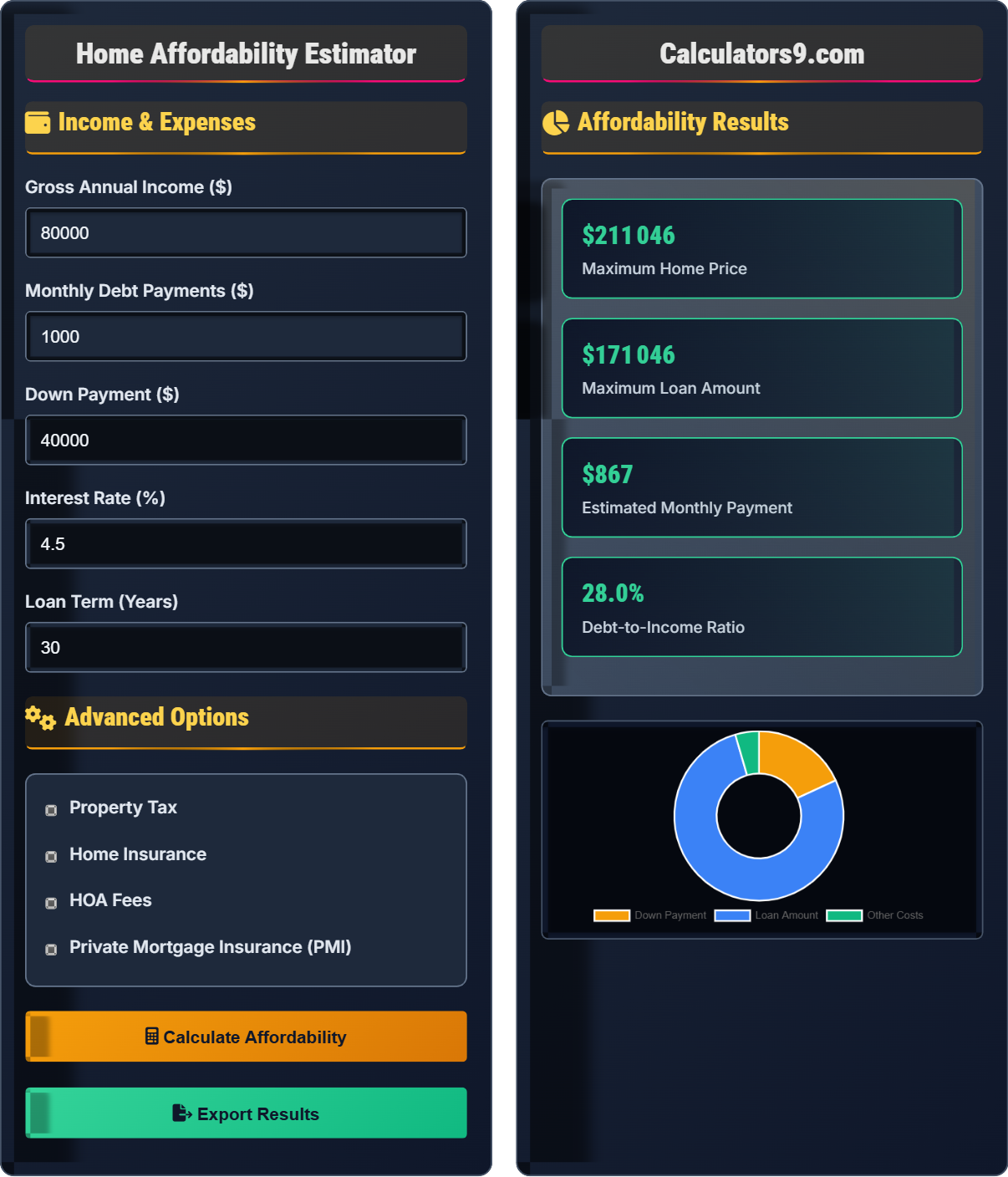
Affordability Results
| Category | Amount | Percentage |
|---|---|---|
| Down Payment | $40,000 | 17.3% |
| Loan Amount | $191,000 | 82.7% |
| Total Home Price | $231,000 | 100% |
| Ratio | Value | Recommended | Status |
|---|---|---|---|
| Housing Ratio | 21.4% | <28% | Good |
| Debt-to-Income | 22% | <36% | Excellent |
| Front-End Ratio | 12.8% | <28% | Excellent |
Comprehensive Affordability Guide
Home affordability is determined by your ability to comfortably manage mortgage payments along with your other financial obligations. Lenders use standardized ratios to evaluate your capacity to repay a loan. The general rule is that your housing expenses shouldn't exceed 28% of your gross monthly income, and your total debt shouldn't exceed 36%.
The standard calculations for home affordability:
Where:
- Gross Monthly Income = Annual Income ÷ 12
- Housing costs include principal, interest, taxes, insurance, and HOA fees
- Debt includes all recurring monthly obligations
Several factors influence how much home you can afford:
- Down Payment: Larger down payments reduce loan amount and may eliminate PMI
- Credit Score: Higher scores qualify for better interest rates
- Interest Rates: Even small differences significantly impact monthly payments
- Other Expenses: Property taxes, insurance, and HOA fees affect affordability
- Save for larger down payment: Reduces loan amount and potentially eliminates PMI
- Improve credit score: Qualify for better interest rates
- Pay down debt: Improve debt-to-income ratio
- Consider longer loan terms: Lower monthly payments but more interest over time
- Shop around: Compare lenders for best rates and terms
Affordability Basics
Ability to manage mortgage payments alongside other financial obligations.
Housing costs ≤ 28% of gross income, total debt ≤ 36% of gross income.
Example: $80k annual income = $6,667 monthly income. Max housing: $1,867/month.
- Keep housing costs under 28% of gross income
- Total debt under 36% of gross income
- Save for 20% down to avoid PMI
Affordability Factors
Larger down payments reduce loan amount and monthly payments.
- Calculate gross monthly income
- Determine maximum housing payment (28%)
- Subtract other monthly debts
- Calculate maximum loan amount
- Add down payment for max home price
- Factor in property taxes
- Include home insurance
- Account for HOA fees
- Consider maintenance costs
Affordability Learning Quiz
According to conventional lending standards, what should your housing expenses not exceed as a percentage of your gross monthly income?
The answer is B) 28%. According to conventional lending standards, housing expenses should not exceed 28% of your gross monthly income. This is known as the front-end ratio or housing ratio. This rule helps ensure that borrowers can comfortably manage their housing costs alongside other living expenses.
The 28% rule is one of the fundamental principles of mortgage lending. It's designed to ensure that borrowers have enough income left over after paying for housing to cover other essential expenses like food, transportation, healthcare, and savings. While some lenders may approve loans with higher ratios, 28% is considered the standard threshold for financial stability.
Front-End Ratio: Housing expenses ÷ Gross monthly income
Back-End Ratio: Total debt ÷ Gross monthly income
Gross Income: Total income before taxes and deductions
• Front-end ratio should be ≤ 28% of gross monthly income
• Back-end ratio should be ≤ 36% of gross monthly income
• These ratios help ensure financial stability
• Remember the 28/36 rule: 28% for housing, 36% for total debt
• Calculate your ratios before house hunting to set realistic expectations
• Forgetting to include property taxes and insurance in housing expenses
• Not accounting for all monthly debt obligations
• Ignoring the impact of interest rates on affordability
A family has an annual gross income of $96,000 and monthly debt payments of $1,200. They plan to make a 20% down payment and can afford to spend 25% of their gross monthly income on housing. Calculate the maximum home price they can afford at a 4.25% interest rate for 30 years. Show your work.
Step 1: Calculate gross monthly income
Gross monthly income = $96,000 ÷ 12 = $8,000
Step 2: Calculate maximum housing payment
Maximum housing payment = $8,000 × 0.25 = $2,000
Step 3: Verify debt-to-income ratio
Total debt payment = Housing + Other debts = $2,000 + $1,200 = $3,200
DTI ratio = $3,200 ÷ $8,000 = 0.40 = 40%
Step 4: Calculate payment factor for 4.25% interest over 30 years
Using mortgage formula: M = P[r(1+r)^n]/[(1+r)^n-1]
Monthly rate = 4.25% ÷ 12 = 0.0035417, n = 360
Payment factor ≈ $4.92 per $1,000 of loan
Step 5: Calculate maximum loan amount
Maximum loan = ($2,000 ÷ $4.92) × $1,000 = $406,504
Step 6: Calculate maximum home price
If down payment is 20%, then loan is 80% of home price
Home price = $406,504 ÷ 0.80 = $508,130
Note: The DTI ratio of 40% exceeds the recommended 36%, so this family may need to consider a smaller home or pay down debt.
This problem demonstrates the multi-step process of calculating home affordability. First, we determine the maximum housing payment based on income. Then we check if the combined housing and debt payments stay within acceptable ratios. Finally, we use the payment factor to convert the maximum housing payment into a maximum loan amount, which gives us the maximum home price when we account for the down payment percentage.
Debt-to-Income (DTI) Ratio: Total monthly debt payments ÷ Gross monthly income
Payment Factor: Monthly payment per $1,000 of loan principal
Loan-to-Value (LTV): Loan amount ÷ Property value
• Housing expenses should be ≤ 28% of gross income
• Total debt should be ≤ 36% of gross income
• Lower down payments may require PMI
• Always calculate DTI ratio before house hunting
• Consider all housing costs (taxes, insurance, HOA)
• Forgetting to include all debt obligations in DTI calculation
• Not accounting for property taxes and insurance in housing costs
• Ignoring the impact of down payment percentage on loan amount
FAQ
Q: How much house can I afford if my annual income is $100,000 and I have $500 in monthly debt payments?
A: Based on standard lending guidelines, with an annual income of $100,000:
Gross monthly income: $100,000 ÷ 12 = $8,333
Maximum housing payment (28% rule): $8,333 × 0.28 = $2,333
Remaining for housing after other debts: $2,333 - $500 = $1,833
Assuming a 30-year loan at 4.5% interest: The payment factor is approximately $5.07 per $1,000 of loan principal.
Maximum loan amount: ($1,833 ÷ $5.07) × $1,000 = $361,538
With a 20% down payment: Maximum home price = $361,538 ÷ 0.80 = $451,923
So you could potentially afford a home in the range of $450,000-$475,000, depending on your down payment and other factors. Note that this is a rough estimate and actual qualification depends on credit score, employment history, and other factors.
Q: How does a larger down payment affect how much house I can afford?
A: A larger down payment significantly increases your home buying power in several ways:
1. Direct Increase in Purchase Power: Every dollar of down payment is a dollar less you need to borrow. If you have $100,000 for down payment instead of $50,000, you can afford a home that's $50,000 more expensive, assuming the same loan amount.
2. Elimination of PMI: Putting 20% down typically eliminates Private Mortgage Insurance (PMI), which can save $100-300 per month. This frees up money for a higher loan amount.
3.Better Interest Rates: Lenders often offer better rates for larger down payments because they represent lower risk. Even a 0.125% rate improvement can save thousands over the loan term.
4. Lower Monthly Payments: With a larger down payment, your monthly mortgage payment decreases, allowing you to potentially qualify for a more expensive home within the same housing expense limits.
For example, on a $300,000 home, a 20% down payment ($60,000) versus a 10% down payment ($30,000) would require a loan of $240,000 versus $270,000, respectively. The lower loan amount results in a lower monthly payment, freeing up budget for a more expensive home.