Amortization Schedule
Calculate mortgage payments • 2026 edition
\( M = P \frac{r(1+r)^n}{(1+r)^n - 1} \)
Where:
- \( M \) = monthly payment
- \( P \) = loan principal (initial loan amount)
- \( r \) = monthly interest rate (annual rate ÷ 12)
- \( n \) = total number of payments (loan term in years × 12)
Each payment is split between interest and principal. Early payments are mostly interest, later payments are mostly principal.
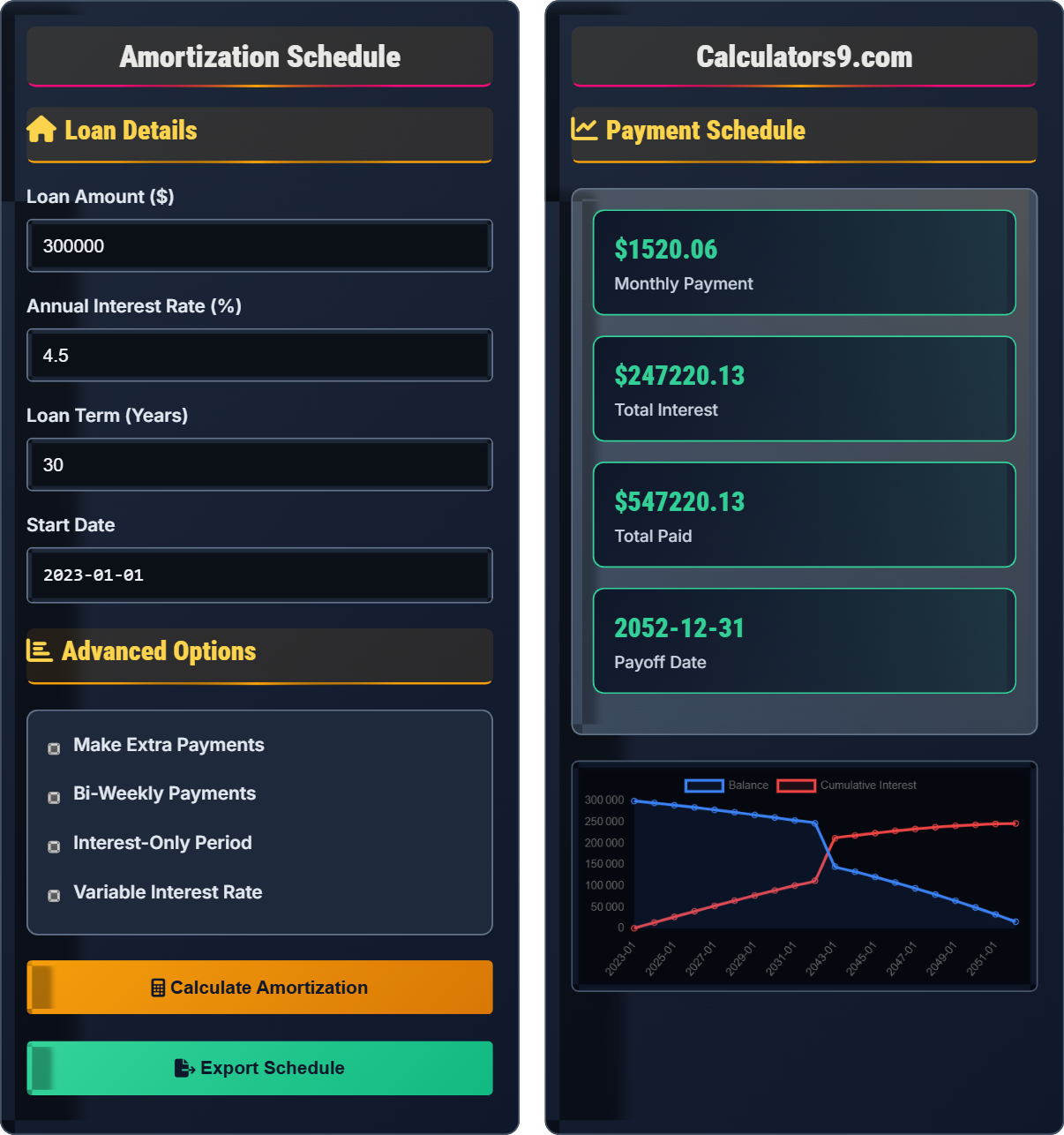
Example: For a $300,000 loan at 4.5% annual interest for 30 years:
Monthly interest rate: \( r = \frac{4.5\%}{12} = 0.00375 \)
Total payments: \( n = 30 \times 12 = 360 \)
Monthly payment: \( M = 300{,}000 \times \frac{0.00375(1+0.00375)^{360}}{(1+0.00375)^{360} - 1} \approx \$1{,}520 \)
First payment: Interest ≈ $1,125, Principal ≈ $395
Last payment: Interest ≈ $8, Principal ≈ $1,512
Loan Details
Advanced Options
Payment Schedule
| Payment # | Date | Payment | Principal | Interest | Total Interest | Balance |
|---|
| Year | Total Payments | Total Principal | Total Interest | Remaining Balance | Principal % |
|---|
Comprehensive Amortization Guide
Amortization is the process of paying off a debt over time through regular payments. Each payment covers both interest charges and a portion of the principal balance. Early payments are primarily interest, while later payments are primarily principal.
The standard amortization formula calculates the fixed monthly payment:
Where:
- \(M\) = Monthly payment
- \(P\) = Principal loan amount
- \(r\) = Monthly interest rate (annual rate ÷ 12)
- \(n\) = Total number of payments (loan term in years × 12)
Knowing how your payments are allocated helps with:
- Prepayment Decisions: Extra payments reduce principal and save interest
- Tax Planning: Interest is often tax-deductible
- Refinancing Timing: Understand when to refinance
- Equity Building: Track home equity growth
- Make Extra Payments: Reduces principal faster, saving thousands in interest
- Bi-Weekly Payments: Pay half your monthly payment every two weeks
- Round Up Payments: Round monthly payment to the next hundred
- Annual Lump Sum: Apply bonus or tax refund to principal
Amortization Basics
Gradual repayment of loan through regular installments.
\(M = P\frac{r(1+r)^n}{(1+r)^n-1}\)
Where M=monthly payment, P=loan amount, r=monthly rate, n=payments.
- Interest calculated on remaining balance
- Early payments save more interest
- Small extra payments = big savings
Payment Strategies
Early payments are mostly interest, later payments are mostly principal.
- Extra principal payments
- Bi-weekly payments
- Annual lump sum payments
- Refinancing to shorter term
- Check for prepayment penalties
- Verify extra payments go to principal
- Consider opportunity cost of extra payments
- Track interest tax deductions
Amortization Learning Quiz
In a standard 30-year fixed mortgage, what happens to the allocation of your monthly payment between principal and interest over time?
The answer is B) Early payments are mostly interest, later payments are mostly principal. In the beginning of a mortgage, the loan balance is highest, so interest charges are highest. As you pay down the principal, the interest component decreases and the principal component increases. This is the fundamental principle of amortization.
Interest is calculated on the remaining loan balance. At the start of the loan, your balance is highest (the full loan amount), so your interest charge is highest. As you make payments, you're slowly reducing the principal balance, which means less interest accrues each month. The monthly payment stays the same, but the proportion allocated to principal gradually increases.
Principal: The original loan amount being repaid
Interest: The cost of borrowing money
Amortization: Gradual repayment of loan through regular payments
• Interest is calculated on remaining balance
• Early payments have higher interest portions
• Later payments have higher principal portions
• Make extra payments early in the loan term for maximum interest savings
• Understand that tax deductions are highest in early years
• Thinking that payments are evenly split between principal and interest
• Not realizing that early payments are mostly interest
You have a $250,000 mortgage at 4.0% annual interest for 30 years. Calculate the monthly payment and determine how much of the first payment goes to interest and how much to principal. Then calculate how much of the 120th payment (after 10 years) goes to principal. Show your work.
Step 1: Calculate monthly payment
Using the formula: \(M = P\frac{r(1+r)^n}{(1+r)^n-1}\)
Where: P = $250,000, r = 4.0%/12 = 0.003333, n = 30×12 = 360
\(M = 250{,}000 \times \frac{0.003333(1+0.003333)^{360}}{(1+0.003333)^{360}-1}\)
\(M = 250{,}000 \times \frac{0.003333 \times 3.310}{3.310-1} = 250{,}000 \times \frac{0.01103}{2.310} = 250{,}000 \times 0.004774 = \$1{,}193.54\)
Step 2: First payment breakdown
Interest = Principal Balance × Monthly Rate
Interest = $250,000 × 0.003333 = $833.25
Principal = Monthly Payment - Interest
Principal = $1,193.54 - $833.25 = $360.29
Step 3: 120th payment breakdown
After 119 payments, principal balance ≈ $217,500
Interest = $217,500 × 0.003333 = $725.00
Principal = $1,193.54 - $725.00 = $468.54
Conclusion: The first payment has $833.25 in interest and $360.29 in principal, while the 120th payment has $725.00 in interest and $468.54 in principal. Notice how the principal portion increases over time.
This example demonstrates the fundamental principle of amortization. The monthly payment remains constant, but the allocation between principal and interest changes dramatically over time. Initially, most of your payment goes to interest, but as the loan matures, more of each payment goes toward reducing the principal. This is why making extra payments early in the loan term is so beneficial.
Amortization: Repayment of loan through scheduled payments
Principal Balance: Remaining loan amount to be paid
Monthly Rate: Annual interest rate divided by 12
• Interest is always calculated on remaining balance
• Monthly payment remains constant in fixed-rate mortgages
• Principal portion increases over time
• Use online calculators to verify manual calculations
• Consider making extra payments early in loan term
• Confusing annual and monthly interest rates
• Forgetting to convert percentages to decimals
• Miscalculating the number of payments
FAQ
Q: How do extra principal payments affect my amortization schedule?
A: Extra principal payments have a significant positive impact on your amortization schedule:
Immediate Effects:
- Reduces the principal balance immediately
- Decreases the amount of interest charged in future payments
- Accelerates equity buildup in your home
Long-term Benefits:
- Reduces total interest paid over the life of the loan
- Shortens the effective loan term
- Allows you to pay off the mortgage earlier
Example: On a $300,000, 30-year mortgage at 4.5%, making an extra $100 payment toward principal each month would:
- Save approximately $32,000 in interest over the life of the loan
- Pay off the mortgage about 2.5 years earlier
- Reduce the total number of payments from 360 to about 330
It's important to specify that extra payments should be applied to principal rather than advanced payments to ensure maximum benefit.
Q: What's the difference between bi-weekly payments and making 13 payments per year?
A: Both strategies result in making an extra payment per year, but they work differently:
Bi-weekly Payments:
- Pay half of your monthly payment every two weeks
- Results in 26 half-payments = 13 full payments per year
- Provides consistent acceleration of principal paydown
- Some lenders offer this as a formal program
Manual 13th Payment:
- Make 12 regular monthly payments
- Add an extra payment once per year (e.g., tax refund)
- Still results in 13 payments per year
- Less frequent but equally effective
Financial Impact: Both approaches save similar amounts of interest and reduce the loan term. Bi-weekly payments provide more consistent principal reduction throughout the year, while annual extra payments provide a larger impact when made early in the year.
Example Calculation: On a $300,000, 30-year mortgage at 4.5%, both strategies would save approximately $32,000 in interest and shorten the loan by about 2.5 years compared to making 12 payments per year.