Cash-on-Cash Return Calculator
Real estate investment ROI • 2026 analysis
Cash-on-Cash Return Formula:
Show the calculator\( CoC = \frac{\text{Annual Pre-Tax Cash Flow}}{\text{Total Cash Invested}} \times 100\% \)
Where:
- CoC = Cash-on-Cash Return (percentage)
- Annual Pre-Tax Cash Flow = Annual Rental Income - Annual Expenses
- Total Cash Invested = Down Payment + Closing Costs + Renovation Costs
This formula measures the annual return on the actual cash invested in a real estate property, expressed as a percentage. It's a key metric for real estate investors to evaluate investment performance.
Example: If you invest $50,000 in cash to purchase a property and receive $6,000 in annual pre-tax cash flow, your cash-on-cash return would be:
\( CoC = \frac{\$6,000}{\$50,000} \times 100\% = 12\% \)
Thus, the investor would achieve a 12% cash-on-cash return on their investment.
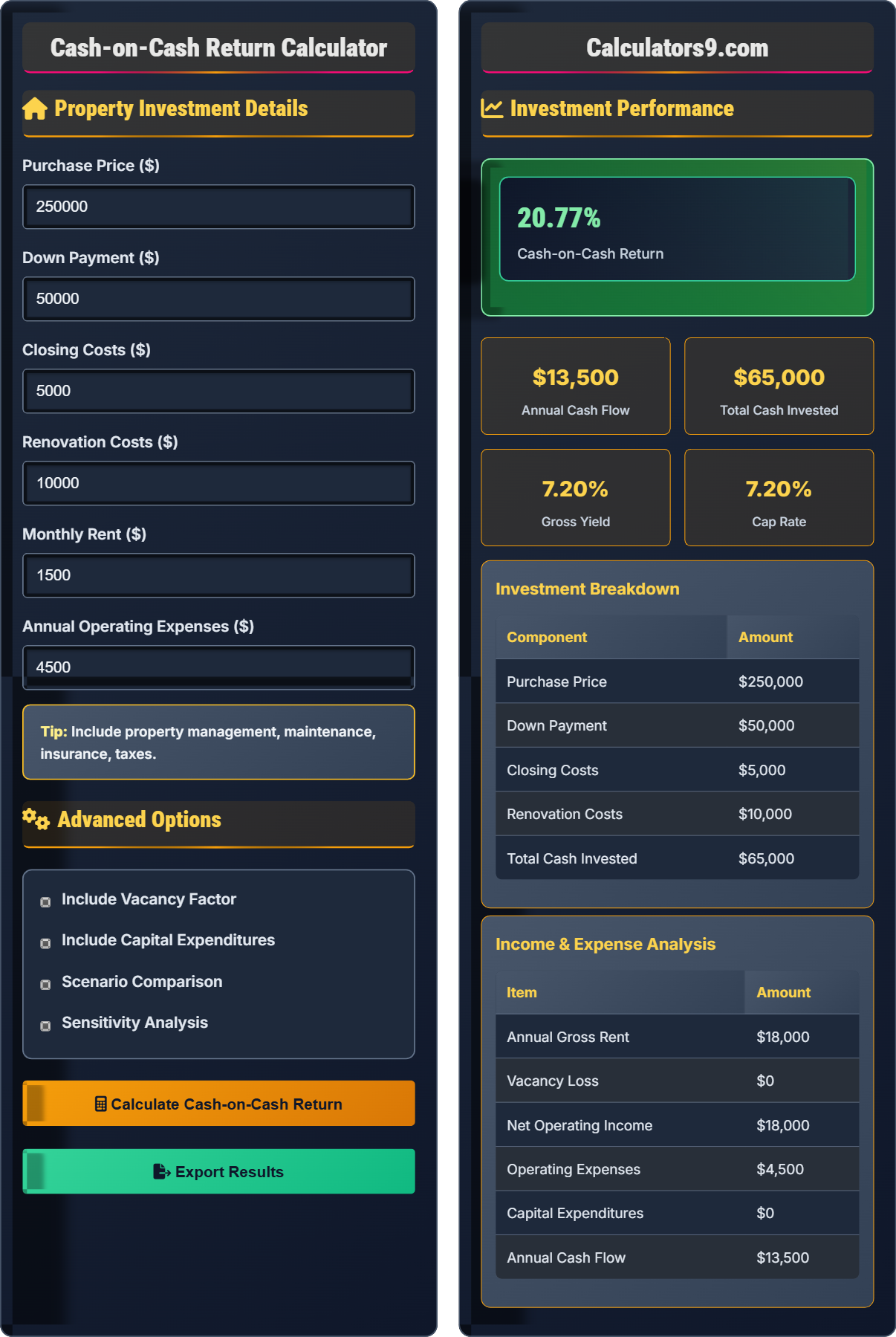
Property Investment Details
Advanced Options
Investment Performance
Investment Breakdown
| Component | Amount |
|---|---|
| Purchase Price | $250,000 |
| Down Payment | $50,000 |
| Closing Costs | $5,000 |
| Renovation Costs | $10,000 |
| Total Cash Invested | $65,000 |
Income & Expense Analysis
| Item | Amount |
|---|---|
| Annual Gross Rent | $18,000 |
| Vacancy Loss | $0 |
| Net Operating Income | $18,000 |
| Operating Expenses | $4,500 |
| Capital Expenditures | $0 |
| Annual Cash Flow | $13,500 |
Investment Visualization
Cash-on-Cash Return Guide
Cash-on-cash return is a real estate investment metric that measures the annual return on the actual cash invested in a property. Unlike other return metrics, it focuses specifically on the cash flow generated relative to the cash invested, making it particularly useful for leveraged investments.
The metric is especially valuable for comparing different investment opportunities because it normalizes returns based on the actual cash invested rather than the total property value.
The standard cash-on-cash return calculation uses the following formula:
Where:
- CoC = Cash-on-Cash Return percentage
- Annual Pre-Tax Cash Flow = Annual rental income minus operating expenses
- Total Cash Invested = Down payment plus closing costs plus renovation costs
Cash-on-cash return benchmarks vary by market and investment strategy:
- 8% or below: Conservative or safer markets
- 8-12%: Average market performance
- 12-15%: Good investment opportunity
- 15%+: Excellent investment opportunity
However, these benchmarks can vary significantly based on location, property type, and market conditions.
- Focus on cash flow: Prioritize properties with positive monthly cash flow for consistent returns
- Consider appreciation potential: Balance immediate cash flow with long-term appreciation prospects
- Factor in vacancy rates: Account for periods when the property may be unoccupied
- Include all expenses: Don't overlook property management, maintenance, and capital expenditures
- Monitor market trends: Adjust expectations based on local market conditions
Investment Metrics Comparison
Cash-on-cash return considers leverage; cap rate does not.
\(Cap Rate = \frac{\text{Net Operating Income}}{\text{Property Value}} \times 100\%\)
Where NOI excludes debt service.
- Cash-on-cash measures return on cash invested
- Cap rate measures return on total property value
- Cash-on-cash accounts for financing
- Cap rate is unlevered metric
Cash-on-Cash Return Learning Quiz
Which of the following is included in the "Total Cash Invested" calculation for cash-on-cash return?
The answer is C) Down payment + Closing costs + Renovation costs. The "Total Cash Invested" in cash-on-cash return calculations includes all the actual cash outlays required to acquire and prepare the property for rental, including down payment, closing costs, and any initial renovation or improvement costs.
Understanding what constitutes "Total Cash Invested" is crucial because it forms the denominator in the cash-on-cash return calculation. Including only the down payment would understate the actual cash required and overstate the return. This metric specifically measures return on the actual cash invested, not the total property value.
Total Cash Invested: The sum of down payment, closing costs, and renovation costs required to acquire and prepare the property
Cash-on-Cash Return: Annual pre-tax cash flow divided by total cash invested
Leverage: Using borrowed money to finance the property purchase
• Total Cash Invested includes all upfront cash costs
• Does not include borrowed money (mortgage)
• Renovation costs are part of the initial investment
• Remember: Cash Invested = Down Payment + Closing Costs + Renovations
• Don't include mortgage payments in the cash invested calculation
• Including mortgage payments in the cash invested calculation
• Forgetting to include closing costs and renovation expenses
• Using purchase price instead of actual cash invested
Calculate the cash-on-cash return for a property with the following details: Purchase price $200,000, down payment $40,000, closing costs $3,000, renovation costs $7,000, monthly rent $1,200, annual expenses $3,600. Show your work.
Using the cash-on-cash return formula: \(CoC = \frac{\text{Annual Pre-Tax Cash Flow}}{\text{Total Cash Invested}} \times 100\%\)
Step 1: Calculate Total Cash Invested = Down Payment + Closing Costs + Renovation Costs
=$40,000 + $3,000 + $7,000 = $50,000
Step 2: Calculate Annual Pre-Tax Cash Flow = Annual Rent - Annual Expenses
=($1,200 × 12) - $3,600 = $14,400 - $3,600 = $10,800
Step 3: Calculate Cash-on-Cash Return = ($10,800 ÷ $50,000) × 100%
= 0.216 × 100% = 21.6%
Therefore, the cash-on-cash return is 21.6%.
This calculation demonstrates how cash-on-cash return provides insight into the efficiency of your cash investment. Notice that the return is quite high (21.6%) because we're only measuring against the actual cash invested ($50,000), not the total property value ($200,000). This is why CoC is particularly useful for leveraged investments.
Annual Pre-Tax Cash Flow: Annual rental income minus operating expenses
Total Cash Invested: Sum of down payment, closing costs, and renovation expenses
Leverage Effect: The impact of using borrowed money to amplify returns
• Calculate annual figures for consistency
• Include all operating expenses in the calculation
• Don't subtract mortgage payments from cash flow
• Always convert monthly rents to annual amounts
• Include all operating expenses (insurance, taxes, maintenance)
• Remember that CoC doesn't consider appreciation
• Forgetting to convert monthly rent to annual amounts
• Including mortgage payments in the expense calculation
• Using purchase price instead of cash invested in the denominator
Sarah is comparing two investment properties. Property A costs $300,000 with a $60,000 down payment, monthly rent of $2,000, and annual expenses of $6,000. Property B costs $250,000 with a $50,000 down payment, monthly rent of $1,800, and annual expenses of $5,400. Which property offers a better cash-on-cash return?
Property A Calculation:
Total Cash Invested = $60,000 (assuming no additional costs)
Annual Cash Flow = ($2,000 × 12) - $6,000 = $24,000 - $6,000 = $18,000
Cash-on-Cash Return = ($18,000 ÷ $60,000) × 100% = 30%
Property B Calculation:
Total Cash Invested = $50,000 (assuming no additional costs)
Annual Cash Flow = ($1,800 × 12) - $5,400 = $21,600 - $5,400 = $16,200
Cash-on-Cash Return = ($16,200 ÷ $50,000) × 100% = 32.4%
Therefore, Property B offers a better cash-on-cash return of 32.4% compared to Property A's 30%.
This comparison shows why cash-on-cash return is valuable for comparing different investment opportunities. Even though Property A generates more absolute cash flow ($18,000 vs $16,200), Property B provides a better return on the cash invested (32.4% vs 30%). This demonstrates that the most profitable property in absolute terms isn't necessarily the best investment when considering return on cash invested.
Investment Efficiency: The return generated per dollar of cash invested
Relative Performance: Comparing investments based on their return characteristics
Opportunity Cost: The potential benefit lost when choosing one investment over another
• Compare CoC returns to evaluate investment efficiency
• Higher CoC indicates better return on cash invested
• Consider other factors beyond CoC for investment decisions
• Calculate CoC for all potential investments
• Compare CoC alongside other metrics like appreciation potential
• Consider risk-adjusted returns when making comparisons
• Focusing only on absolute cash flow rather than return on investment
• Not accounting for differences in risk between properties
• Ignoring market conditions when comparing CoC returns
Mike is purchasing a $400,000 property with 20% down ($80,000). If he increases his down payment to 25% ($100,000), how does this affect his cash-on-cash return if his annual cash flow remains at $15,000? Calculate both scenarios and explain the impact.
Scenario 1 (20% down):
Total Cash Invested = $80,000
Annual Cash Flow = $15,000
Cash-on-Cash Return = ($15,000 ÷ $80,000) × 100% = 18.75%
Scenario 2 (25% down):
Total Cash Invested = $100,000
Annual Cash Flow = $15,000
Cash-on-Cash Return = ($15,000 ÷ $100,000) × 100% = 15.00%
Increasing the down payment from 20% to 25% decreases the cash-on-cash return from 18.75% to 15.00%, a reduction of 3.75 percentage points.
This example illustrates the trade-off between leverage and cash-on-cash return. By putting more money down, Mike reduces his leverage and consequently reduces his cash-on-cash return. However, he also reduces his risk and monthly mortgage payments. The CoC formula clearly shows that increasing the denominator (cash invested) while keeping the numerator (cash flow) constant will decrease the overall return percentage.
Leverage: Using borrowed money to increase potential returns
Down Payment Ratio: Percentage of purchase price paid in cash
Risk-Return Trade-off: Higher potential returns usually come with higher risk
• More leverage typically increases CoC return (all else equal)
• Higher down payments reduce leverage and CoC return
• Consider risk tolerance alongside CoC returns
• Use CoC to evaluate the impact of different financing strategies
• Balance CoC return with personal risk tolerance
• Consider the stability of cash flows when evaluating leverage
• Assuming more leverage always leads to better outcomes
• Not considering the impact of higher leverage on risk
• Focusing solely on CoC without considering other factors
Which of the following would DECREASE the cash-on-cash return of a real estate investment?
The answer is C) Increasing operating expenses. Increasing operating expenses would decrease the annual cash flow (numerator in the CoC formula), which would decrease the overall cash-on-cash return. Higher operating expenses mean more money is spent on property management, maintenance, insurance, taxes, etc., leaving less cash flow for the investor.
This question tests understanding of how different factors affect the cash-on-cash return formula. Increasing expenses reduces cash flow, which directly reduces the return. Conversely, increasing rent (A) would increase cash flow, reducing down payment (B) would decrease the denominator, and decreasing vacancy rate (D) would increase effective rental income—all of which would increase the CoC return.
Operating Expenses: Ongoing costs to operate and maintain the property
Effective Rental Income: Potential rent minus vacancy losses
Net Operating Income: Effective rental income minus operating expenses
• Higher expenses decrease cash flow and CoC return
• Higher income increases cash flow and CoC return
• Lower cash invested increases CoC return
• Control expenses to maximize cash flow
• Research market rents to optimize income
• Consider all operating expenses in your calculations
• Underestimating operating expenses in projections
• Not accounting for maintenance and repair costs
• Overlooking property management fees
FAQ
Q: What's the difference between cash-on-cash return and cap rate?
A: The main difference lies in how they treat financing:
Cash-on-Cash Return: Measures return on the actual cash invested, including leverage effects. Formula: \( CoC = \frac{\text{Annual Pre-Tax Cash Flow}}{\text{Total Cash Invested}} \times 100\% \)
Cap Rate: Measures return on the total property value, excluding financing considerations. Formula: \( Cap\ Rate = \frac{\text{Net Operating Income}}{\text{Property Value}} \times 100\% \)
For example, if you buy a $200,000 property with $40,000 down and get a $160,000 loan, and generate $12,000 in annual cash flow:
Cash-on-Cash Return = $12,000 ÷ $40,000 = 30%
Cap Rate = $12,000 ÷ $200,000 = 6%
As you can see, cash-on-cash return is much higher due to leverage.
Q: What is a good cash-on-cash return for real estate investments?
A: Cash-on-cash return benchmarks vary by market and investment strategy:
- 8% or below: Conservative markets or value-add opportunities
- 8-12%: Average market performance
- 12-15%: Good investment opportunity with reasonable risk
- 15%+: Excellent opportunity, but may involve higher risk
However, these benchmarks depend on several factors:
- Local market conditions and growth prospects
- Property type and condition
- Economic stability of the area
- Your risk tolerance and investment goals
Remember that higher returns often come with higher risk, so consider the quality of the investment opportunity alongside the CoC return.