Down Payment Saver
Calculate your savings plan • 2026 edition
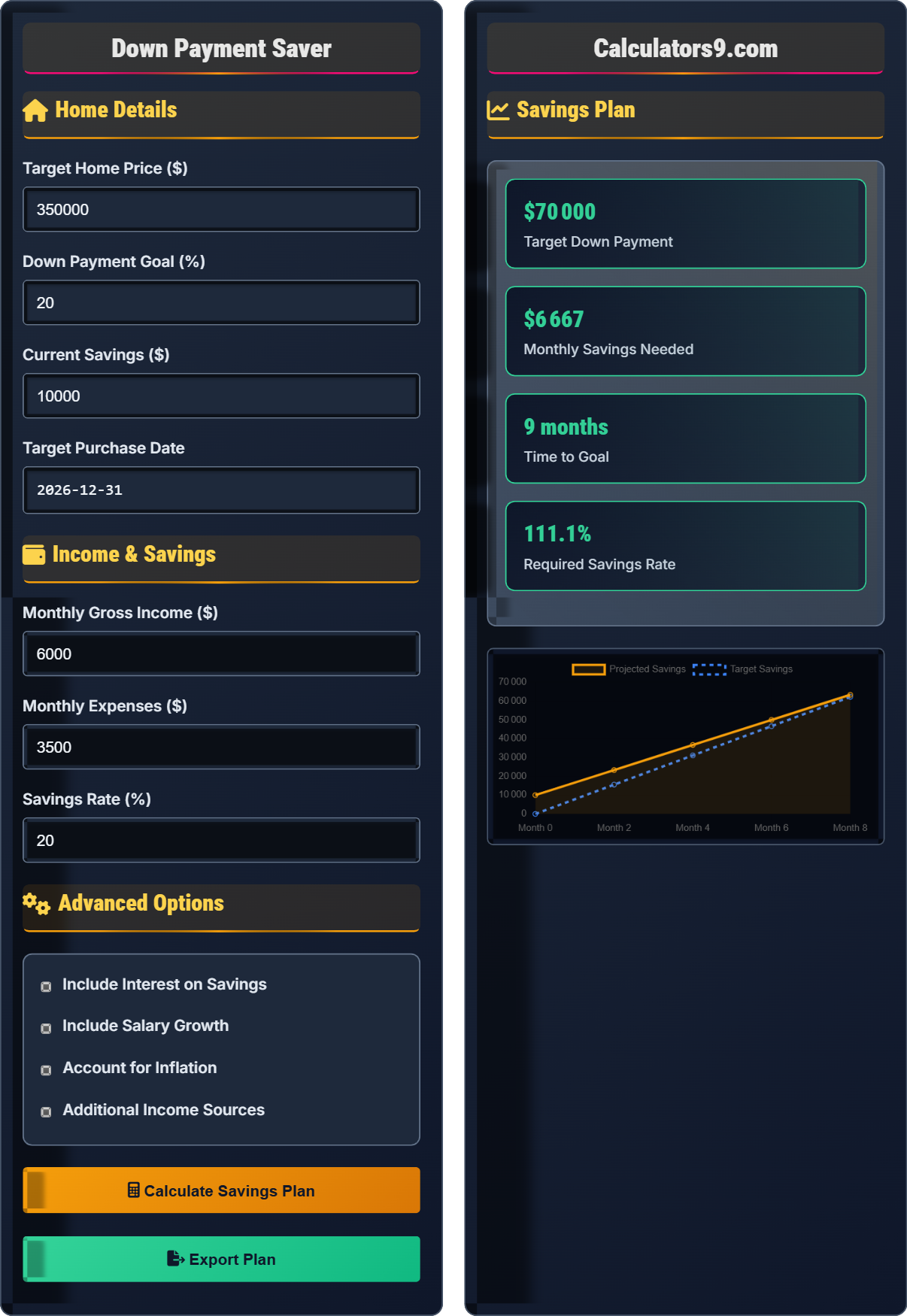
\( \text{Monthly Savings} = \frac{\text{Target Down Payment} - \text{Current Savings}}{\text{Months Until Purchase}} \)
Where:
- \( \text{Target Down Payment} = \text{Home Price} \times \text{Down Payment Percentage} \)
- \( \text{Months Until Purchase} = \text{Years Until Purchase} \times 12 \)
- \( \text{Required Savings Rate} = \frac{\text{Monthly Savings}}{\text{Gross Monthly Income}} \times 100 \)
This formula calculates the monthly savings needed to reach your down payment goal. It considers your target home price, desired down payment percentage, current savings, and time horizon.
Example: For a $350,000 home with 20% down payment goal in 3 years:
Target down payment: $350,000 × 0.20 = $70,000
If starting with $10,000 in savings: $70,000 - $10,000 = $60,000 needed
Time period: 3 years × 12 months = 36 months
Monthly savings required: $60,000 ÷ 36 = $1,667
Thus, you would need to save approximately $1,667 per month for 3 years.
Home Details
Income & Savings
Advanced Options
Savings Plan
| Item | Amount | Percentage |
|---|---|---|
| Target Home Price | $350,000 | 100% |
| Target Down Payment (20%) | $70,000 | 20% |
| Current Savings | $10,000 | 14% |
| Amount to Save | $60,000 | 86% |
| Monthly Savings Required | $1,667 | - |
| Year | Target | Saved | Progress | Monthly Savings |
|---|---|---|---|---|
| Year 1 | $20,000 | $20,000 | 33% | $1,667 |
| Year 2 | $40,000 | $40,000 | 67% | $1,667 |
| Year 3 | $60,000 | $60,000 | 100% | $1,667 |
Comprehensive Down Payment Guide
A down payment is the portion of the home's purchase price that you pay upfront in cash. The remainder is financed through a mortgage. Down payments are typically expressed as a percentage of the home's purchase price. A larger down payment reduces your monthly mortgage payments and may help you avoid private mortgage insurance (PMI).
The basic calculation for determining your down payment needs:
To determine monthly savings requirements:
Increasing your down payment percentage provides several advantages:
- Lower Monthly Payments: Reduces the principal amount borrowed
- Eliminate PMI: Avoid monthly private mortgage insurance premiums
- Better Interest Rates: Lenders often offer better rates for larger down payments
- Increased Equity: Start with more ownership stake in your home
- Improved Approval Odds: Demonstrates financial responsibility
- Automate Savings: Set up automatic transfers to a dedicated account
- Round-Up Method: Round purchases up to the nearest dollar and save the difference
- Side Income: Use gig economy jobs or sell items to boost savings
- Budget Optimization: Reduce discretionary spending temporarily
- Windfall Strategy: Apply bonuses, tax refunds, or gifts directly to savings
Down Payment Basics
Cash payment made upfront when purchasing a home, typically 3-20% of purchase price.
\( \text{Down Payment} = \text{Home Price} \times \text{Percentage} \)
Example: $300,000 home × 20% = $60,000 down payment.
- 20% down avoids PMI
- Minimum 3-5% for FHA loans
- Higher down = lower monthly payments
Savings Strategies
Percentage of income dedicated to saving for down payment.
- Determine target down payment
- Subtract current savings
- Divide by months until purchase
- Calculate required savings rate
- Keep emergency fund separate
- Consider tax implications
- Factor in closing costs
- Account for moving expenses
Down Payment Learning Quiz
What is the primary advantage of making a 20% down payment instead of a 10% down payment on a home purchase?
The answer is B) Avoid private mortgage insurance (PMI). Making a 20% down payment is the traditional threshold that allows borrowers to avoid PMI, which is typically required for down payments less than 20%. PMI protects the lender in case of default and adds to the borrower's monthly costs.
Private Mortgage Insurance (PMI) is a significant monthly expense that can add hundreds of dollars to a mortgage payment. For example, on a $300,000 loan, PMI could cost $150-300 per month, totaling $1,800-3,600 annually. Over a 30-year loan term, this could amount to tens of thousands of dollars. The 20% down payment rule is designed to demonstrate sufficient equity in the property to eliminate the need for this insurance.
Down Payment: Cash payment made upfront when purchasing a home
PMI: Private Mortgage Insurance - required for down payments <20%
Loan-to-Value (LTV): Ratio of loan amount to property value
• 20% down payment typically avoids PMI
• PMI can cost 0.3-1.5% of loan amount annually
• Higher down payments may qualify for better interest rates
• Use the "20% rule" as a savings target
• Consider gift funds from family members
• Underestimating the impact of PMI on monthly payments
• Forgetting to account for closing costs alongside down payment
You want to buy a $400,000 home in 4 years with a 20% down payment. You currently have $25,000 saved. Calculate your monthly savings requirement. If your monthly gross income is $7,000, what percentage of income would you need to save monthly? Is this achievable?
Step 1: Calculate target down payment
Target down payment = $400,000 × 0.20 = $80,000
Step 2: Calculate amount still needed
Amount needed = $80,000 - $25,000 = $55,000
Step 3: Calculate time period in months
Time period = 4 years × 12 months = 48 months
Step 4: Calculate monthly savings required
Monthly savings = $55,000 ÷ 48 = $1,146
Step 5: Calculate required savings rate
Savings rate = ($1,146 ÷ $7,000) × 100 = 16.4%
Conclusion: You would need to save approximately $1,146 per month, which represents 16.4% of your gross monthly income. This is challenging but achievable for many people by reducing discretionary spending and increasing income through side work.
This calculation demonstrates the relationship between home price, down payment percentage, time horizon, and required savings rate. The key insight is that saving 20% of a home's price requires significant discipline and planning. The 16.4% savings rate is quite high—most financial experts recommend saving 10-15% of income for retirement, so adding this to savings goals would require careful budgeting.
Savings Rate: Percentage of income dedicated to saving
Gross Income: Total income before taxes and deductions
Time Value of Money: Money today is worth more than money tomorrow
• Higher down payment reduces monthly mortgage
• More time allows for smaller monthly savings
• Consider compound interest when saving
• Automate savings to make it consistent
• Use high-yield savings accounts for better returns
• Not accounting for compound interest on savings
• Forgetting to factor in closing costs
• Underestimating the impact of inflation
FAQ
Q: How long does it typically take to save for a down payment?
A: The time to save for a down payment varies significantly based on several factors:
Average time ranges:
- 20% down payment: 3-7 years for most people
- 10% down payment: 1.5-4 years
- 5% down payment: 6 months-2 years
Factors affecting savings timeline:
- Income level: Higher earners can save faster
- Expenses: Lower expenses mean more available for savings
- Home price: More expensive areas require longer savings periods
- Starting savings: Those with existing savings reach goals faster
- Savings rate: People saving 20%+ of income reach goals quicker
Recent surveys indicate that first-time homebuyers typically save for 3-5 years, with median down payment amounts ranging from $30,000-$50,000 depending on location.
Q: What are some legitimate sources for down payment funds?
A: There are several legitimate sources for down payment funds that lenders typically accept:
Personal Sources:
- Savings accounts: Primary source for most buyers
- Investment accounts: Stocks, bonds, retirement funds (with penalties)
- Proceeds from sale: Sale of vehicles, collectibles, or other assets
Family Assistance:
- Gift funds: From parents, grandparents, siblings (requires documentation)
- Loans from family: Structured as promissory notes
- Co-signing: Family member helps qualify for larger loan
Programs and Grants:
- First-time buyer programs: State and local assistance programs
- Employer grants: Some employers offer homeownership assistance
- Non-profit organizations: Down payment assistance programs
Important: Most lenders require documentation showing funds have been in your account for at least 30-60 days to verify they're not borrowed funds.