Flip Profit Estimator
House flipping calculator • 2026 analysis
Flip Profit Formula:
Show the estimator\( \text{Profit} = \text{ARV} - (\text{Purchase Price} + \text{Renovation Costs} + \text{Carrying Costs}) \)
Where:
- ARV = After Repair Value
- Purchase Price = Acquisition cost of the property
- Renovation Costs = Total cost of repairs and improvements
- Carrying Costs = Holding costs during renovation (financing, utilities, insurance, etc.)
The flip profit formula calculates the potential profit from a house flipping project by subtracting all costs from the expected selling price. ARV (After Repair Value) is the estimated value of the property after renovations are completed.
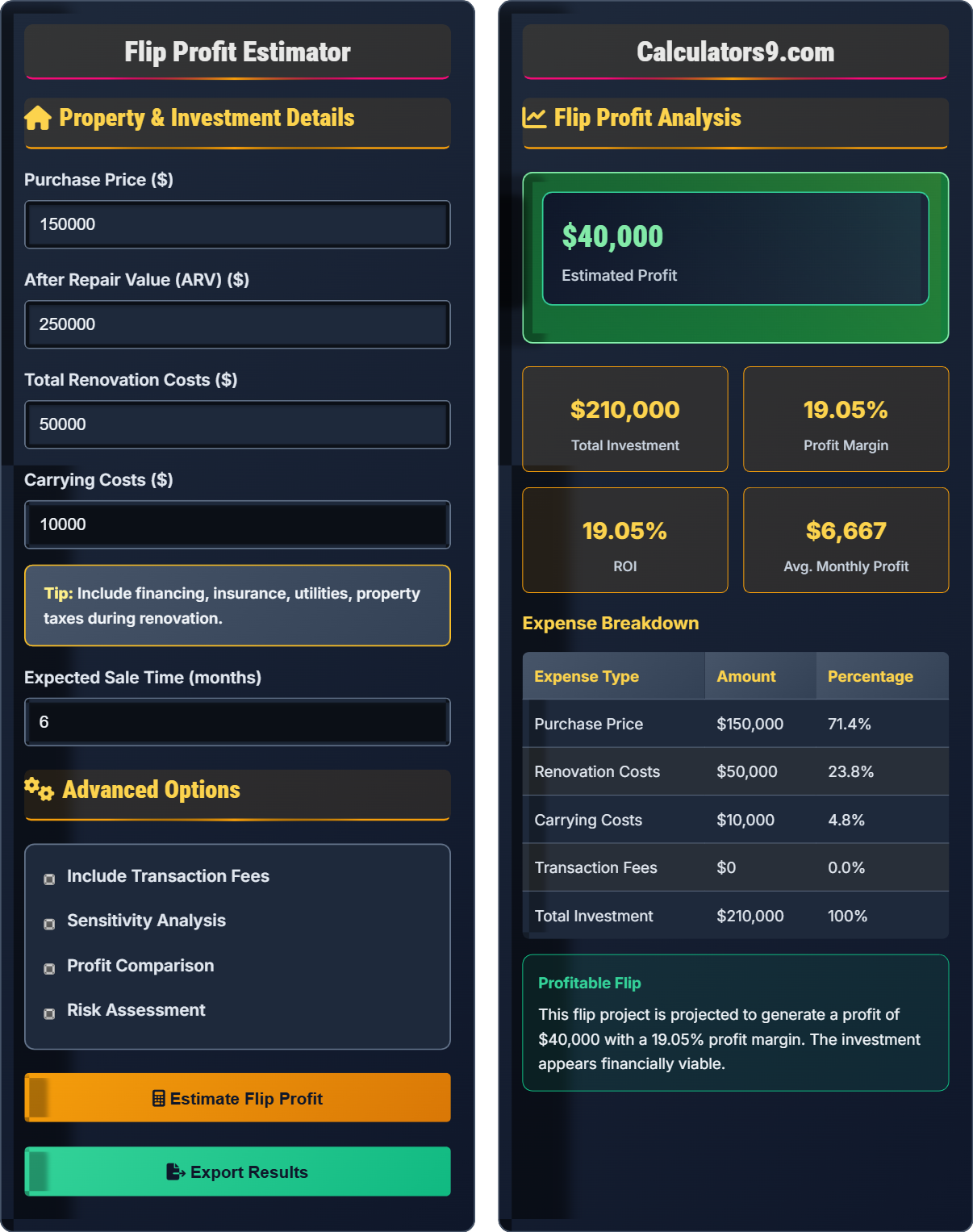
Example: If you purchase a property for $150,000, spend $50,000 on renovations, incur $10,000 in carrying costs, and sell for $250,000 (ARV), your profit would be:
\( \text{Profit} = \$250,000 - (\$150,000 + \$50,000 + \$10,000) = \$40,000 \)
Thus, the expected profit from this flip would be $40,000.
Property & Investment Details
Advanced Options
Flip Profit Analysis
Expense Breakdown
| Expense Type | Amount | Percentage |
|---|---|---|
| Purchase Price | $150,000 | 68.8% |
| Renovation Costs | $50,000 | 22.9% |
| Carrying Costs | $10,000 | 4.6% |
| Transaction Fees | $8,000 | 3.7% |
| Total Investment | $218,000 | 100% |
Flip Profit Visualization
House Flipping Investment Guide
House flipping is a real estate investment strategy where an investor purchases a property, renovates it, and sells it for a profit. The goal is to add value through improvements and sell the property for more than the total investment (purchase price + renovation costs + carrying costs).
Successful house flipping requires careful analysis of purchase price, renovation costs, market conditions, and timing. The 70% rule is often used as a guideline: Purchase Price ≤ 70% of ARV - Estimated Renovation Costs.
The standard flip profit calculation uses the following formula:
Where:
- ARV = After Repair Value (expected selling price after renovations)
- Purchase Price = Acquisition cost of the property
- Renovation Costs = Total cost of repairs and improvements
- Carrying Costs = Holding costs during renovation (financing, utilities, insurance, etc.)
- Transaction Fees = Costs associated with buying and selling (commissions, closing costs, etc.)
Key metrics for evaluating flip profitability:
- Profit Margin: Profit as a percentage of total investment
- ROI: Return on investment for the entire project
- Profit per Month: Average monthly profit during holding period
- 70% Rule: Purchase price should not exceed 70% of ARV minus renovation costs
Generally, a profitable flip should aim for at least a 15-20% profit margin, though this varies by market and investor goals.
- Follow the 70% rule: Purchase price ≤ 70% of ARV - Renovation costs
- Focus on location: Buy in desirable neighborhoods with growth potential
- Control renovation costs: Budget carefully and stick to it
- Time the market: Sell when market conditions are favorable
- Plan for contingencies: Budget for unexpected repairs and delays
Flipping Metrics Comparison
Guideline for maximum purchase price based on ARV and renovation costs.
\( \text{Max Purchase Price} = 0.7 \times \text{ARV} - \text{Renovation Costs} \)
Helps ensure adequate profit margin after all expenses.
- Consider all costs in calculations
- Research ARV thoroughly
- Budget for contingencies
- Factor in time value of money
Flip Profit Learning Quiz
What is the profit for a flip project with: Purchase Price = $120,000, ARV = $200,000, Renovation Costs = $40,000, Carrying Costs = $8,000?
The answer is B) $32,000. Using the flip profit formula: Profit = ARV - (Purchase Price + Renovation Costs + Carrying Costs). Profit = $200,000 - ($120,000 + $40,000 + $8,000) = $200,000 - $168,000 = $32,000.
The flip profit calculation is fundamental to house flipping. The formula subtracts all costs (purchase price, renovation costs, carrying costs, and transaction fees) from the expected selling price (ARV). It's important to include ALL costs in the calculation to get an accurate profit projection. Missing any cost will lead to an inflated profit estimate.
ARV (After Repair Value): Expected property value after renovations
Carrying Costs: Expenses during renovation period
Renovation Costs: Total cost of repairs and improvements
• Include ALL costs in the calculation
• Profit = ARV - Total Investment
• Research ARV accurately
• Add 10% contingency to renovation budget
• Research comparable sales for ARV
• Include financing costs in carrying costs
• Forgetting to include carrying costs
• Underestimating renovation costs
• Overestimating ARV
According to the 70% rule, what is the maximum purchase price for a property with an ARV of $300,000 and renovation costs of $60,000?
Using the 70% rule formula: Maximum Purchase Price = 0.7 × ARV - Renovation Costs. Maximum Purchase Price = 0.7 × $300,000 - $60,000 = $210,000 - $60,000 = $150,000. Therefore, the maximum purchase price should be $150,000 to maintain a healthy profit margin according to the 70% rule.
The 70% rule is a fundamental guideline in house flipping that helps investors determine the maximum amount they should pay for a property. It ensures that after renovation costs, there's still sufficient room for profit. The rule assumes that renovation costs will typically be 20-30% of the ARV, leaving 10-20% for profit.
70% Rule: Guideline for maximum purchase price
Profit Margin: Percentage of profit relative to investment
Safe Investment: Following conservative guidelines
• Max Purchase = 0.7 × ARV - Renovation Costs
• Provides buffer for unexpected expenses
• Helps ensure adequate profit
• Use 65% rule for riskier markets
• Use 75% rule for safe markets
• Always research ARV carefully
• Applying rule without adjusting for market conditions
• Not accounting for all renovation costs
• Overestimating ARV
Sarah purchases a property for $180,000, spends $50,000 on renovations, incurs $12,000 in carrying costs, and sells it for $280,000. What is her profit margin?
Step 1: Calculate total investment = Purchase Price + Renovation Costs + Carrying Costs
=$180,000 + $50,000 + $12,000 = $242,000
Step 2: Calculate profit = ARV - Total Investment
=$280,000 - $242,000 = $38,000
Step 3: Calculate profit margin = (Profit ÷ Total Investment) × 100%
=($38,000 ÷ $242,000) × 100% = 15.7%
Therefore, Sarah's profit margin is 15.7%.
Profit margin is a key metric in house flipping that expresses the return as a percentage of the total investment. It allows for comparison between different projects regardless of size. A 15.7% profit margin is considered reasonable for house flipping, though experienced flippers often aim for 20% or higher. The calculation requires including ALL costs in the denominator.
Profit Margin: Profit as percentage of total investment
Total Investment: Sum of all project costs
Performance Metric: Measure of investment efficiency
• Include all costs in total investment
• Profit margin = (Profit ÷ Total Investment) × 100%
• Compare to market benchmarks
• Aim for 15-20% minimum profit margin
• Track margins across projects
• Factor in time value of money
• Excluding carrying costs from total investment
• Using selling price instead of total investment as denominator
• Not accounting for all project expenses
Mike is considering a flip with: Purchase Price $160,000, ARV $250,000, Renovation Costs $45,000, Carrying Costs $10,000. He estimates a 15% chance that renovation costs will overrun by 25%. How should this affect his decision?
Base case profit: $250,000 - ($160,000 + $45,000 + $10,000) = $35,000
Worst case scenario (25% cost overrun):
New renovation costs = $45,000 × 1.25 = $56,250
New profit = $250,000 - ($160,000 + $56,250 + $10,000) = $23,750
With a 15% probability of cost overrun, Mike should factor in this risk. The expected value of the project considering risk is:
Expected Profit = (0.85 × $35,000) + (0.15 × $23,750) = $29,750 + $3,562.50 = $33,312.50
Mike should ensure the project remains profitable even with potential cost overruns.
This question introduces risk assessment into flip analysis. Cost overruns are common in renovation projects, so wise investors plan for contingencies. Building a contingency fund (typically 10-20% of renovation budget) helps protect against unexpected expenses. The risk-adjusted profit calculation provides a more realistic expectation of returns.
Contingency Planning: Budgeting for unexpected expenses
Cost Overrun: Expenses exceeding initial budget
Risk Assessment: Evaluating potential negative outcomes
• Always budget for contingencies
• Consider worst-case scenarios
• Plan for potential delays and cost increases
• Add 10-20% contingency to renovation budget
• Get multiple contractor bids
• Research permit costs beforehand
• Not planning for cost overruns
• Underestimating renovation complexity
• Ignoring potential delays and additional costs
Which of the following is NOT a critical success factor in house flipping?
The answer is C) Perfect market timing. While market conditions matter, house flipping is primarily about adding value through renovations and selling for more than the total investment. A well-executed flip can be profitable even in a slower market if the investor follows proper guidelines (like the 70% rule), controls costs, and accurately estimates ARV. Perfect market timing is less critical than proper execution.
While market timing can enhance returns, it's not as critical as other factors in house flipping. The core of successful flipping is buying below market value, adding value through renovations, and selling at market value. This approach works in various market conditions. The other factors—accurate ARV estimation, budget control, and location—are fundamental to the basic math of house flipping.
ARV Estimation: Critical for determining profit potential
Budget Control: Essential for maintaining profit margins
Location Selection: Foundation for value creation
• Focus on value addition over market timing
• Accurate cost estimation is crucial
• Location determines base value potential
• Master the 70% rule first
• Develop relationships with reliable contractors
• Build a network of professionals
• Overemphasizing market timing
• Underestimating renovation costs
• Not researching ARV thoroughly
FAQ
Q: What is the 70% rule and how do I apply it in house flipping?
A: The 70% rule is a fundamental guideline in house flipping that helps determine the maximum amount you should pay for a property:
Formula: \( \text{Max Purchase Price} = 0.7 \times \text{ARV} - \text{Renovation Costs} \)
Where ARV is the After Repair Value. For example, if a property's ARV is $200,000 and renovation costs are $40,000, the maximum purchase price should be:
$200,000 × 0.7 - $40,000 = $140,000 - $40,000 = $100,000
This rule ensures you leave room for profit after all expenses. The 70% represents the maximum percentage of ARV you should spend on the purchase price and renovation combined, leaving 30% for profit and other costs. Adjust the percentage based on market conditions: use 65% for riskier markets or 75% for safer ones.
Q: What are the typical carrying costs in a house flip?
A: Carrying costs are expenses incurred during the holding period of a flip and typically include:
- Financing costs: Interest on acquisition loan or line of credit
- Property taxes: Prorated taxes during renovation period
- Insurance: Property insurance during renovation
- Utilities: Water, electricity, gas if needed during renovation
- HOA fees: If applicable
- Inspections/permits: Any ongoing inspection fees
These costs can add up quickly, especially if the renovation takes longer than expected. A general rule is to budget 2-5% of the purchase price for carrying costs, but this can vary significantly based on location, loan terms, and project duration. For a $150,000 purchase, carrying costs might range from $3,000 to $7,500 for a 6-month project.