GRM Calculator
Gross Rent Multiplier • 2026 analysis
Gross Rent Multiplier (GRM) Formula:
Show the calculator\( GRM = \frac{\text{Property Value}}{\text{Gross Annual Rental Income}} \)
Where:
- GRM = Gross Rent Multiplier
- Property Value = Current market value of the property
- Gross Annual Rental Income = Total annual rental income before expenses
The Gross Rent Multiplier is a simple ratio used in commercial real estate to evaluate the relationship between a property's price and its rental income. It helps investors quickly compare properties and estimate their value.
Example: If a property is valued at $500,000 and generates $50,000 in annual rental income, the GRM would be:
\( GRM = \frac{\$500,000}{\$50,000} = 10 \)
This means the property costs 10 times its annual rental income.
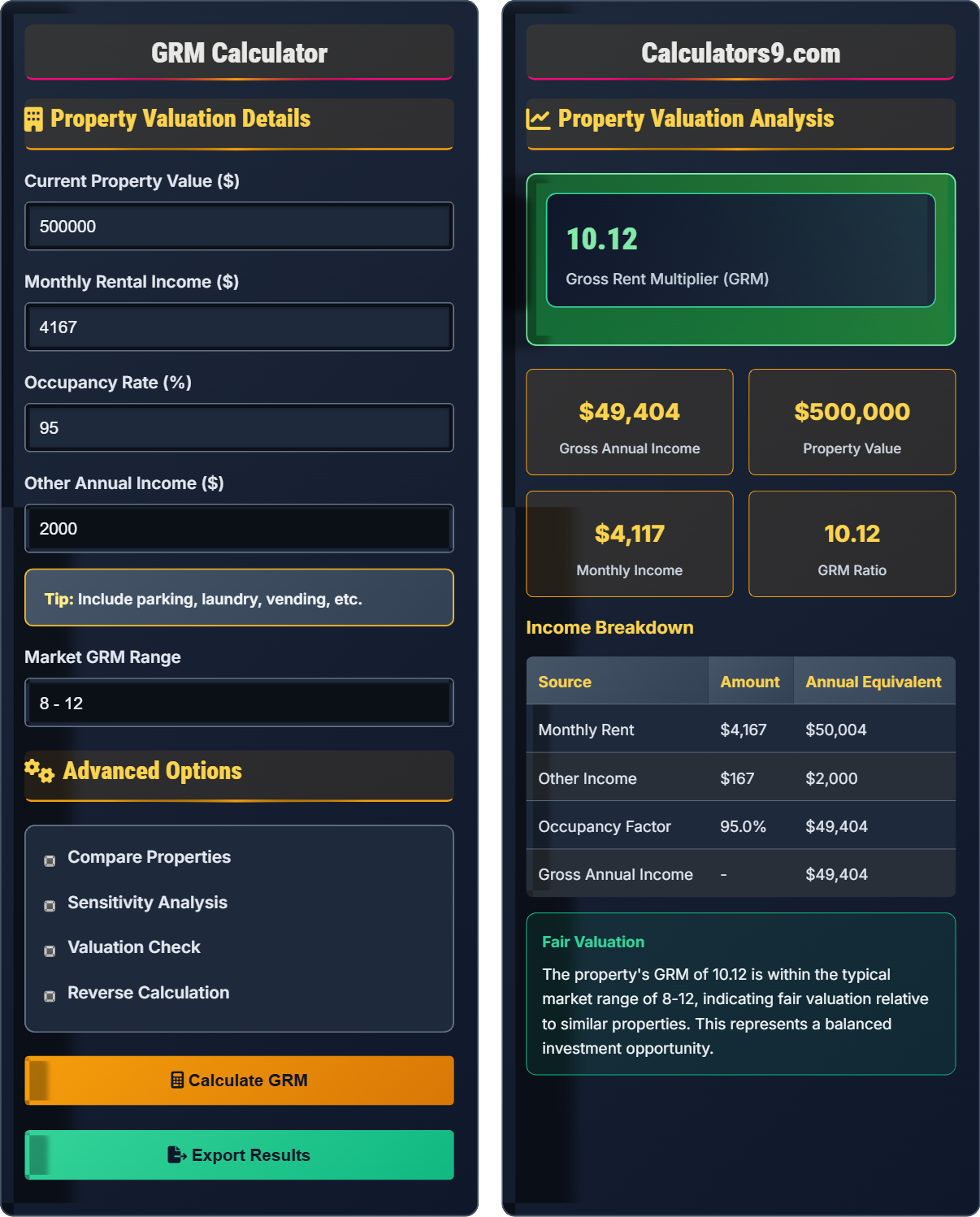
Property Valuation Details
Advanced Options
Property Valuation Analysis
Income Breakdown
| Source | Amount | Annual Equivalent |
|---|---|---|
| Monthly Rent | $4,167 | $50,004 |
| Other Income | $167 | $2,000 |
| Occupancy Factor | 95% | $49,404 |
| Gross Annual Income | - | $52,004 |
GRM Visualization
Gross Rent Multiplier Guide
The Gross Rent Multiplier (GRM) is a simple ratio used in commercial real estate to evaluate the relationship between a property's price and its rental income. It's calculated by dividing the property's value by its gross annual rental income.
GRM provides a quick way to compare properties and determine if a property is overpriced or underpriced relative to similar properties in the market. It's particularly useful for investors who want to quickly screen properties before conducting more detailed analysis.
The standard GRM calculation uses the following formula:
Where:
- GRM = Gross Rent Multiplier
- Property Value = Current market value of the property
- Gross Annual Rental Income = Total annual rental income before expenses
GRM interpretation varies by market and property type:
- Low GRM (6-8): Potentially undervalued property
- Average GRM (8-12): Fair market value
- High GRM (12+): Potentially overvalued property
Lower GRMs typically indicate better investment opportunities, as the property costs less relative to its rental income. However, context is important as some markets naturally have higher GRMs due to factors like location desirability or appreciation potential.
- Use as screening tool: Quickly compare multiple properties
- Consider market context: Adjust expectations based on local market conditions
- Combine with other metrics: Use alongside cash-on-cash return and cap rate
- Factor in property condition: Properties needing repairs may justify higher GRMs
- Account for appreciation potential: High GRMs may be acceptable for appreciating markets
GRM vs Other Metrics
GRM uses gross income; Cap Rate uses net operating income.
\(Cap Rate = \frac{\text{Net Operating Income}}{\text{Property Value}} \times 100\%\)
Cap Rate considers operating expenses; GRM does not.
- GRM is simpler to calculate
- Cap Rate accounts for operating expenses
- GRM doesn't consider vacancy or expenses
- Both measure income relative to value
GRM Learning Quiz
What is the GRM for a property valued at $400,000 with monthly rental income of $3,000?
The answer is A) 11.11. To calculate GRM, we use the formula: GRM = Property Value ÷ Gross Annual Rental Income. First, convert monthly rent to annual: $3,000 × 12 = $36,000. Then: GRM = $400,000 ÷ $36,000 = 11.11. Therefore, the property costs 11.11 times its annual rental income.
The GRM calculation is straightforward but requires careful attention to units. The formula divides property value by annual rental income, so if you're given monthly rent, you must first convert it to annual by multiplying by 12. The resulting GRM tells you how many years of rental income it would take to pay for the property at its current price.
Gross Rent Multiplier (GRM): Ratio of property value to annual rental income
Gross Annual Rental Income: Total rental income before expenses
Property Value: Current market value of the property
• Convert monthly rent to annual income
• GRM = Property Value ÷ Annual Rental Income
• Lower GRMs indicate potentially better deals
• Always convert to annual income first
• Remember: GRM ignores expenses and vacancy
• Compare to market average for context
• Using monthly rent instead of annual rent in the calculation
• Confusing GRM with Cap Rate calculation
• Forgetting that GRM doesn't account for expenses
A property has a GRM of 8, while similar properties in the area have GRMs ranging from 10-12. What does this suggest about the property?
A GRM of 8 is significantly lower than the market range of 10-12, suggesting the property may be undervalued relative to its rental income potential. This could indicate:
1. The property is priced below market value
2. It offers better income potential than comparable properties
3. It may be a good investment opportunity
However, investors should investigate why the GRM is lower, as it could also indicate issues with the property, location, or tenants that aren't immediately apparent.
GRM interpretation depends on market context. A lower GRM generally indicates better value, as you're paying less for each dollar of rental income. However, the reason for the lower GRM is crucial - it could indicate an excellent opportunity or underlying issues with the property. The GRM should always be evaluated alongside other factors like property condition, location, tenant quality, and market trends.
Undervalued Property: Property priced below its intrinsic value
Market Context: Local market conditions affecting valuations
Investment Opportunity: Property offering favorable risk-return profile
• Lower GRMs generally indicate better value
• Always compare to market averages
• Investigate reasons for unusual GRMs
• Research market GRMs in the area
• Consider why GRM differs from market average
• Look for consistent patterns across similar properties
• Assuming lower GRM always means better deal without investigation
• Not comparing to market averages
• Ignoring property-specific factors affecting GRM
Sarah is comparing two properties: Property A costs $600,000 with monthly rent of $5,000. Property B costs $500,000 with monthly rent of $4,000. Which property has a better GRM?
Property A Calculation:
Annual Rent = $5,000 × 12 = $60,000
GRM = $600,000 ÷ $60,000 = 10.00
Property B Calculation:
Annual Rent = $4,000 × 12 = $48,000
GRM = $500,000 ÷ $48,000 = 10.42
Property A has a better GRM of 10.00 compared to Property B's 10.42, indicating Property A costs less relative to its rental income.
This comparison demonstrates how GRM provides a standardized way to compare properties of different sizes and prices. Despite Property A having a higher purchase price, it actually offers better value relative to rental income (lower GRM). Property B, while cheaper in absolute terms, costs more relative to its rental income. This shows why GRM is valuable for comparing investment opportunities across different price points.
Standardized Comparison: Normalizing metrics for different properties
Relative Value: Value assessment compared to alternatives
Investment Efficiency: Return per unit of investment
• Calculate annual rent for both properties
• Compare GRMs directly
• Lower GRM indicates better value
• Always convert to same units (annual income)
• Compare GRMs directly across properties
• Consider property condition in addition to GRM
• Comparing absolute prices instead of ratios
• Using different time periods for income calculations
• Not considering property differences beyond GRM
Mike finds a property with a GRM of 14 in a market where typical GRMs range from 8-10. The seller claims the property is worth it due to strong appreciation potential. How should Mike evaluate this claim?
Mike should approach this with caution:
1. The property's GRM of 14 is significantly higher than the market average of 8-10, indicating it costs 40-75% more relative to its rental income than comparable properties.
2. While appreciation potential is a valid consideration, it's speculative and doesn't guarantee returns.
3. Mike should investigate why the GRM is so high - it could be due to:
- Premium location factors
- Superior property condition or amenities
- Long-term tenant agreements
- Market mispricing
4. Mike should demand strong evidence for appreciation claims and consider whether the higher price is justified by non-income factors.
This scenario highlights the importance of understanding GRM in market context. A significantly higher GRM than market average typically indicates overvaluation. While appreciation potential is a factor, it's speculative and shouldn't be the sole justification for a much higher price. Investors should require concrete evidence supporting premium pricing and consider whether the property offers tangible benefits that justify the higher cost.
Market Context: Local market conditions affecting valuations
Appreciation Potential: Future increase in property value
Speculative Investment: Investment based on future expectations
• High GRM needs strong justification
• Compare to market averages
• Require evidence for premium pricing
• Demand specific evidence for appreciation claims
• Research market trends and comparables
• Consider risk-adjusted returns
• Accepting appreciation claims without evidence
• Ignoring market context when GRM is high
• Confusing speculation with analysis
Which of the following is a limitation of using GRM for property evaluation?
The answer is B) It doesn't account for operating expenses. The GRM calculation uses gross annual rental income without subtracting operating expenses like property management, maintenance, insurance, taxes, and other costs. This means two properties with the same GRM could have very different net returns if their operating expenses differ significantly.
The GRM is intentionally simple, which makes it a quick screening tool but also limits its analytical depth. By using gross income, it doesn't account for operational differences between properties. A property with high operating expenses would have lower net returns despite having the same GRM as a property with low expenses. This is why GRM should be used alongside other metrics like Cap Rate and Cash-on-Cash Return.
Gross Income: Income before any deductions
Operating Expenses: Costs to operate and maintain the property
Net Returns: Income after operating expenses
• GRM uses gross income only
• Doesn't account for expenses
• Combine with other metrics for full analysis
• Use GRM as initial screening tool
• Follow up with expense analysis
• Calculate Cap Rate for expense consideration
• Assuming properties with same GRM have same returns
• Not considering expense differences
• Relying solely on GRM for investment decisions
FAQ
Q: How does GRM differ from Cap Rate, and when should I use each?
A: Both GRM and Cap Rate measure income relative to property value, but they differ in their approach:
Gross Rent Multiplier (GRM):
Formula: \( GRM = \frac{\text{Property Value}}{\text{Gross Annual Rental Income}} \)
Uses gross income (before expenses), simpler calculation, doesn't account for operating costs.
Cap Rate:
Formula: \( Cap\ Rate = \frac{\text{Net Operating Income}}{\text{Property Value}} \times 100\% \)
Uses net income (after operating expenses), accounts for property operations, more comprehensive measure.
Use GRM for quick comparisons and initial screening of properties. Use Cap Rate when you need to understand the property's operational performance and true income potential after expenses. GRM is ideal for preliminary analysis, while Cap Rate is better for final investment decisions.
Q: What is considered a good GRM in commercial real estate?
A: GRM benchmarks vary significantly by market, property type, and location:
Generally accepted ranges:
- 6-8: Potentially undervalued or in emerging markets
- 8-12: Typical range for most markets
- 12-15: Potentially overvalued or in premium markets
- 15+: Significantly overvalued or exceptional circumstances
However, these benchmarks are market-dependent. In expensive metropolitan areas, GRMs of 12-15 might be normal, while in secondary markets, GRMs of 8-10 might be standard. The key is comparing your property's GRM to similar properties in the same submarket rather than relying on national averages.