Mortgage Payment Calculator
Fast payment calculator • 2026 rates
\( M = P \frac{r(1+r)^n}{(1+r)^n - 1} \)
Where:
- \( M \) = monthly payment
- \( P \) = loan principal (total loan amount)
- \( r \) = monthly interest rate (annual rate divided by 12, in decimal form)
- \( n \) = total number of monthly payments (loan term in years × 12)
This formula calculates the fixed monthly payment required to fully pay off a mortgage over the loan term, taking into account compound interest.
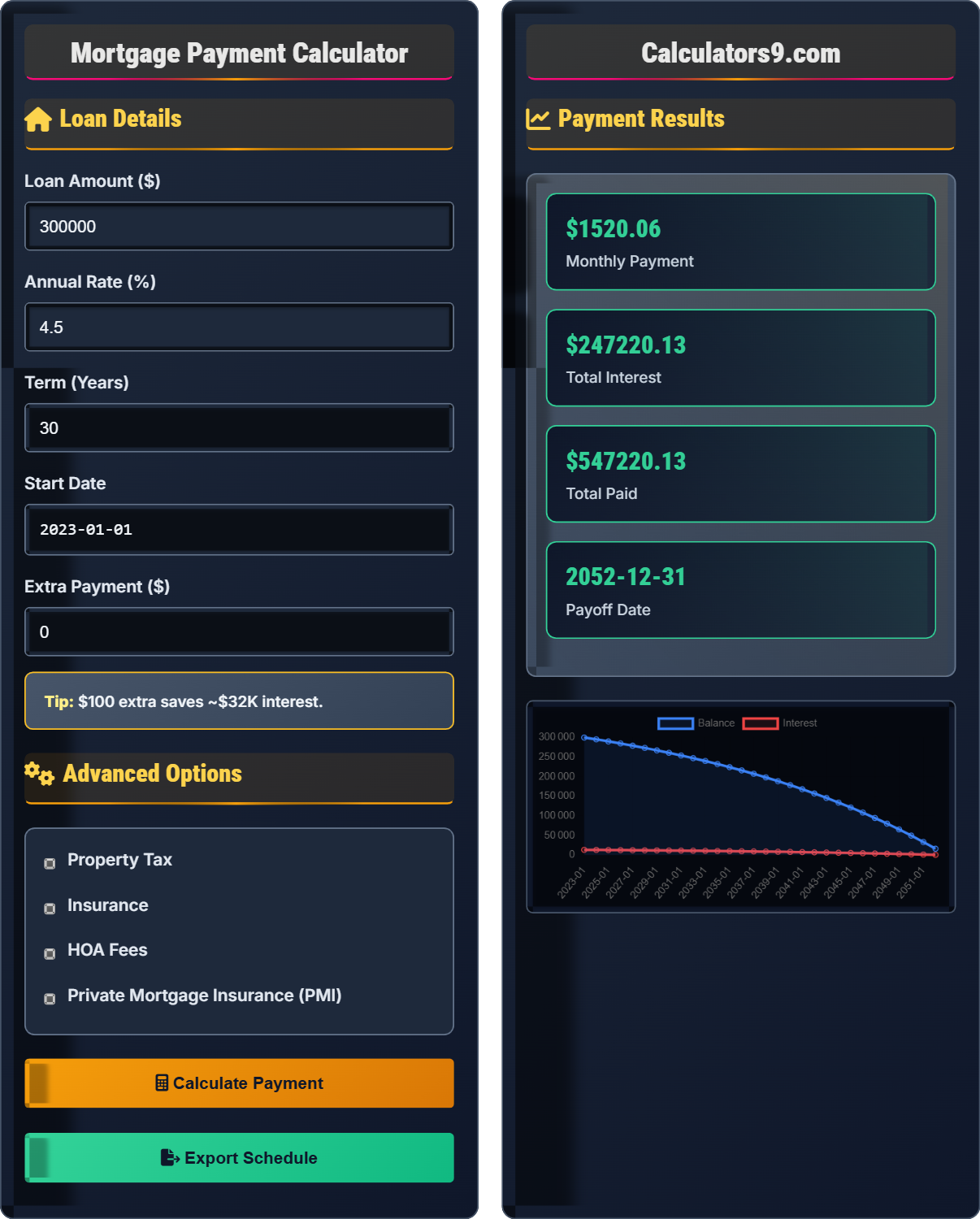
Example: For a loan of \( P = \$300{,}000 \) at an annual interest rate of 4.5% over 30 years:
Monthly interest rate: \( r = \frac{4.5\%}{12} = 0.00375 \)
Total payments: \( n = 30 \times 12 = 360 \)
Monthly payment:
\( M = 300{,}000 \times \frac{0.00375(1+0.00375)^{360}}{(1+0.00375)^{360} - 1} \approx \$1{,}520 \)
Thus, the borrower would pay approximately $1,520 per month for 30 years.
Loan Details
Advanced Options
Payment Results
| Month | Payment | Principal | Interest | Balance |
|---|
| Year | Total | Principal | Interest | Balance |
|---|
Comprehensive Mortgage Guide
A mortgage is a loan specifically used to purchase real estate. The borrower receives funds from a lender to buy a property and agrees to repay the loan over a specified period, typically 15-30 years. The property itself serves as collateral for the loan, meaning if the borrower fails to make payments, the lender can foreclose on the property.
The standard mortgage payment calculation uses the following formula:
Where:
- \(M\) = Monthly payment
- \(P\) = Principal loan amount
- \(r\) = Monthly interest rate (annual rate divided by 12)
- \(n\) = Total number of payments (loan term in years multiplied by 12)
Your monthly mortgage payment typically includes four components (often remembered by the acronym PITI):
- Principal: Portion that reduces the outstanding loan balance
- Interest: Cost of borrowing money, paid to the lender
- Taxes: Property taxes paid to local governments
- Insurance: Homeowners insurance and possibly private mortgage insurance (PMI)
- Make extra payments: Reduces principal faster, saving thousands in interest over the loan term
- Bi-weekly payments: Pay half your monthly payment every two weeks, resulting in one extra payment per year
- Round up payments: Round your monthly payment up to the nearest hundred dollars
- Refinance: If rates drop significantly, refinancing can reduce your monthly payment
- Shorter loan term: While monthly payments increase, total interest paid decreases substantially
Mortgage Basics
Loan for real estate with property as collateral.
\(M = P\frac{r(1+r)^n}{(1+r)^n-1}\)
Where M=monthly payment, P=loan amount, r=monthly rate, n=payments.
- Interest calculated on remaining balance
- Early payments save more interest
- Small rate changes = big savings
Strategies
Early payments are mostly interest, later payments are mostly principal.
- Round up payments
- Extra annual payment
- Bi-weekly payments
- Apply windfalls
- PMI if down <20%
- Tax deductibility
- No prepayment penalties
- APR vs interest rate
Mortgage Learning Quiz
Which of the following is NOT included in a typical monthly mortgage payment?
The answer is D) Groceries. A typical mortgage payment includes Principal (the portion that pays down the loan), Interest (the cost of borrowing), Property Taxes, and Insurance (often called PITI). Groceries are personal expenses unrelated to the mortgage.
Understanding the components of a mortgage payment is crucial because many people underestimate their housing costs. The PITI acronym (Principal, Interest, Taxes, Insurance) helps remember all the parts. Principal and interest go to the lender, while taxes and insurance are escrowed for local authorities and insurance companies.
PITI: Principal, Interest, Taxes, and Insurance - the four components of a mortgage payment
Principal: The original loan amount being repaid
Interest: The cost of borrowing money
• Mortgage payments typically include both principal and interest
• Property taxes and insurance are often included in monthly payments
• Personal expenses like groceries are not part of mortgage payments
• Remember PITI: Principal, Interest, Taxes, Insurance
• Use the mnemonic "Paying Interest Takes Income" to remember the components
• Confusing mortgage payments with total housing costs (which include utilities, maintenance, etc.)
• Forgetting that property taxes and insurance are included in most mortgage payments
You are considering a $250,000 mortgage at 4.25% annual interest for 30 years. Calculate the monthly payment, total interest paid, and explain how making an extra $200 payment each month would affect the loan. Show your work.
Step 1: Calculate monthly payment
Using the formula: \(M = P\frac{r(1+r)^n}{(1+r)^n-1}\)
Where: P = $250,000, r = 4.25%/12 = 0.0035417, n = 30×12 = 360
\(M = 250{,}000 \times \frac{0.0035417(1+0.0035417)^{360}}{(1+0.0035417)^{360}-1}\)
\(M = 250{,}000 \times \frac{0.0035417 \times 3.850}{3.850-1} = 250{,}000 \times \frac{0.01363}{2.850} = 250{,}000 \times 0.00478 = \$1{,}195\)
Step 2: Calculate total interest
Total payments: $1,195 × 360 = $430,200
Total interest: $430,200 - $250,000 = $180,200
Step 3: Effect of extra $200 monthly
With extra $200, monthly payment becomes $1,395. This additional $200 goes directly toward principal reduction, accelerating the loan payoff. Using an amortization calculator, this would reduce the loan term to approximately 23 years and save about $54,000 in interest.
This problem demonstrates the power of compound interest in mortgages. In the early years, most of each payment goes toward interest rather than principal. By adding extra payments, you reduce the principal balance faster, which reduces the amount of interest charged in subsequent months. This creates a snowball effect that significantly shortens the loan term and saves substantial interest.
Amortization: Gradual repayment of loan through regular installments
Principal: Original loan amount
Interest: Cost of borrowing money
• Early payments reduce interest more than late payments
• Extra principal payments directly reduce interest charges
• Mortgage interest is tax-deductible in many cases
• Use the "Rule of 78s" to estimate interest savings
• Consider bi-weekly payments for automatic extra payments
• Confusing annual and monthly interest rates
• Forgetting to convert percentage to decimal
• Miscounting number of payments (years × 12)
FAQ
Q: How do making extra mortgage payments save money over time?
A: Making extra payments directly reduces the principal balance of your mortgage. Since interest is calculated on the remaining principal, paying extra reduces the amount of interest accrued over time.
For example, on a 30-year mortgage of \( P = \$300{,}000 \) at an annual interest rate of 4.5%, the standard monthly payment is approximately \( M \approx \$1{,}520 \). If you pay an additional \( \$100 \) per month, the total interest paid over the life of the loan decreases by roughly \( \$32{,}000 \), and you could pay off the loan several years earlier.
Mathematically, if \( P_n \) is the remaining principal after \( n \) months, paying extra reduces \( P_{n+1} \) faster:
\( P_{n+1} = P_n + P_n \cdot r - (M + E) \)
Where \( E \) is the extra monthly payment and \( r \) is the monthly interest rate. This formula shows that the extra payment goes directly toward reducing the principal, which compounds savings on interest over time.
Q: What's the difference between interest rate and APR?
A: The interest rate is the cost of borrowing the principal loan amount, expressed as a percentage. It determines your monthly payment but doesn't include other costs.
The Annual Percentage Rate (APR) is a broader measure that includes the interest rate plus other costs such as origination fees, discount points, and other lender charges. APR represents the true annual cost of credit.
For example, if you have a mortgage with a 4.5% interest rate but pay $3,000 in fees on a $300,000 loan, the APR might be closer to 4.55%. The APR is always higher than the interest rate (unless there are no additional fees).
When comparing loan offers, focus on the APR as it provides a more accurate picture of the total cost of the loan over time.