PMI Calculator
Calculate mortgage insurance costs • 2026 edition
\( \text{Monthly PMI} = \text{Loan Amount} \times \left(\frac{\text{PMI Rate}}{12}\right) \)
Where:
- \( \text{Loan Amount} = \text{Home Price} - \text{Down Payment} \)
- \( \text{PMI Rate} = \text{Annual Rate} \) typically ranges from 0.3% to 1.5% of loan amount
- \( \text{PMI Elimination Threshold} = \text{Loan-to-Value reaches 80%} \)
PMI is required when the down payment is less than 20% of the home's value. It protects the lender if the borrower defaults on the loan.
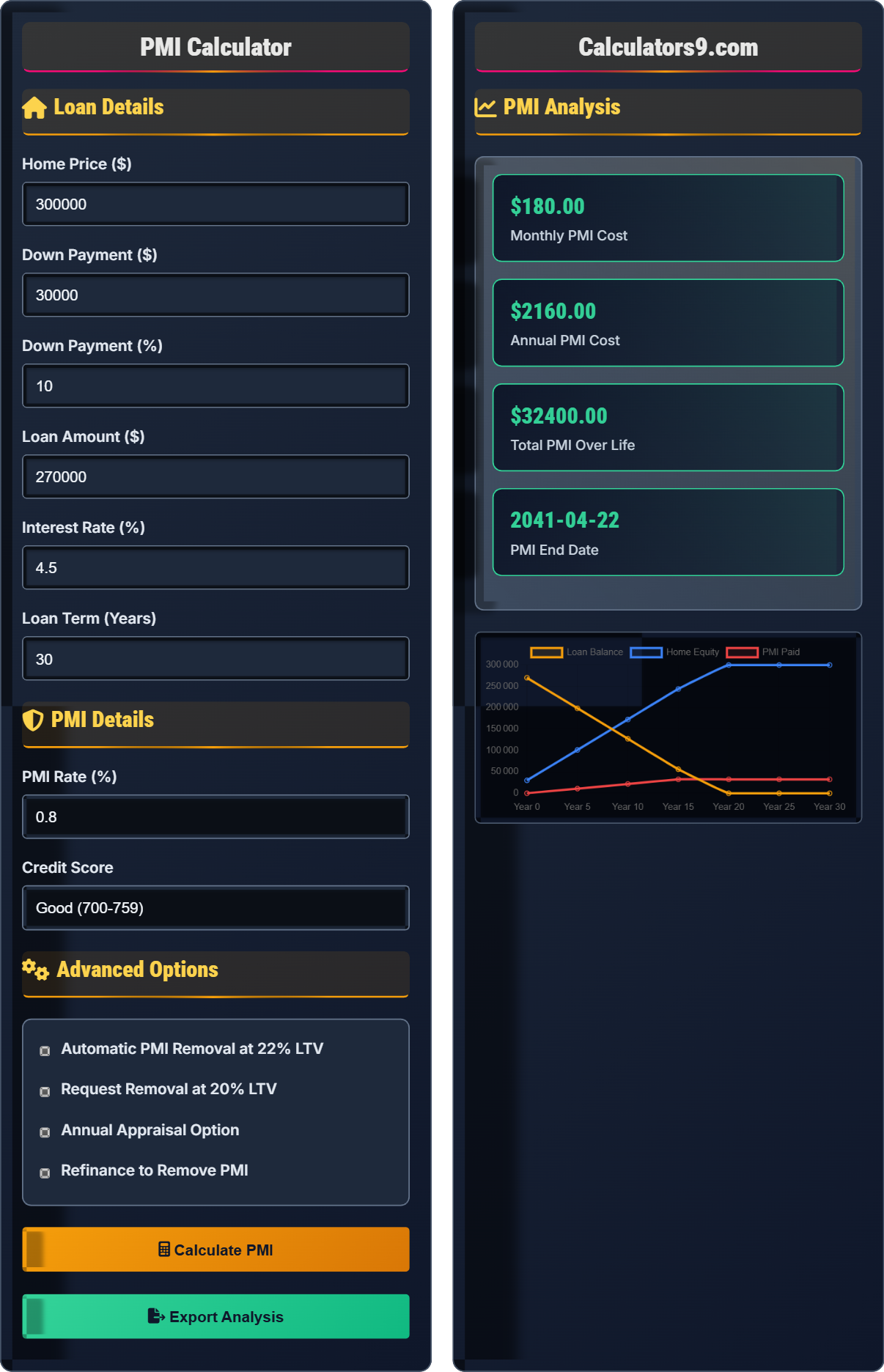
Example: For a $300,000 home with 10% down payment ($30,000):
Loan amount: $300,000 - $30,000 = $270,000
If PMI rate is 0.8% annually: $270,000 × 0.008 = $2,160 annually
Monthly PMI: $2,160 ÷ 12 = $180
PMI continues until the loan-to-value ratio reaches 80% (when equity reaches 20%).
Loan Details
PMI Details
Advanced Options
PMI Analysis
| Year | Loan Balance | Equity | LTV Ratio | PMI Status |
|---|---|---|---|---|
| 1 | $265,000 | $5,000 | 88.3% | Required |
| 5 | $250,000 | $20,000 | 83.3% | Required |
| 10 | $230,000 | $40,000 | 76.7% | Required |
| 15 | $205,000 | $65,000 | 68.3% | Removed |
| Method | Status | Timeline | Requirements |
|---|---|---|---|
| Automatic Removal | Pending | Year 15 | Reach 22% LTV |
| Request Removal | Pending | Year 12 | Reach 20% LTV |
| Annual Appraisal | Optional | Year 10 | Home value increase |
| Refinance | Available | Any time | 20% equity |
Comprehensive PMI Guide
Private Mortgage Insurance (PMI) is insurance that protects the lender in case a borrower defaults on their mortgage. It's typically required when the down payment is less than 20% of the home's purchase price. The borrower pays for this insurance, which allows them to secure financing with a smaller down payment.
The PMI calculation follows this formula:
PMI rates vary based on several factors including credit score, loan-to-value ratio, and loan type.
PMI rates are influenced by several factors:
- Credit Score: Higher scores result in lower PMI rates
- Down Payment: Smaller down payments increase PMI rates
- Loan Type: Conventional loans vs. government-backed loans
- Loan Term: 30-year vs. 15-year loans
- Property Type: Primary residence vs. investment property
- Make Extra Principal Payments: Increase equity faster
- Wait for Home Appreciation: Natural value increase reduces LTV
- Improve Credit Score: Better score for next refinance
- Consider Lender-Paid PMI: Roll into interest rate instead
- Explore Piggyback Loans: Second loan to avoid PMI
PMI Basics
Insurance protecting lenders when down payment is less than 20%.
\( \text{Monthly PMI} = \text{Loan Amount} \times \left(\frac{\text{PMI Rate}}{12}\right) \)
Example: $270,000 loan × 0.8% = $180 monthly PMI.
- Required for down payments <20%
- Can be removed at 20% equity
- Automatic at 22% LTV
Elimination Strategies
Ratio of loan amount to property value.
- Automatic cancellation at 22% LTV
- Request removal at 20% LTV
- Annual appraisal option
- Refinance to eliminate
- No late payments in past year
- Home value must support equity claim
- Property must be owner-occupied
- Loan must be current
PMI Learning Quiz
When is PMI typically required on a conventional mortgage?
The answer is B) When down payment is less than 20%. PMI is typically required when the down payment is less than 20% of the home's purchase price. This requirement applies to conventional mortgages and serves as protection for the lender in case the borrower defaults on the loan.
The 20% down payment threshold is a critical milestone in mortgage financing. When borrowers make a down payment of 20% or more, they are considered to have sufficient equity in the property to protect the lender's interests. Below this threshold, lenders view the loan as riskier because there's less equity to absorb potential losses if the borrower defaults. PMI acts as a substitute for the missing equity.
PMI: Private Mortgage Insurance - insurance for lenders
LTV: Loan-to-Value ratio - loan amount divided by property value
Equity: Portion of property owned free and clear
• PMI required when down payment <20%
• PMI can be removed when equity reaches 20%
• Automatic removal at 22% LTV by law
• Save for 20% down to avoid PMI entirely
• Make extra principal payments to build equity faster
• Confusing PMI with property insurance
• Forgetting that PMI benefits the lender, not the borrower
You purchase a $350,000 home with a 15% down payment. Calculate the monthly PMI if the PMI rate is 0.9% annually. Also determine how much you would pay in PMI over the first 10 years of the loan. Show your work.
Step 1: Calculate down payment
Down payment = $350,000 × 0.15 = $52,500
Step 2: Calculate loan amount
Loan amount = $350,000 - $52,500 = $297,500
Step 3: Calculate annual PMI
Annual PMI = $297,500 × 0.009 = $2,677.50
Step 4: Calculate monthly PMI
Monthly PMI = $2,677.50 ÷ 12 = $223.13
Step 5: Calculate PMI over 10 years
Total PMI for 10 years = $223.13 × 12 × 10 = $26,775.60
Conclusion: The monthly PMI would be approximately $223.13, and over the first 10 years, you would pay about $26,776 in PMI.
This calculation demonstrates how PMI can add significantly to the cost of homeownership. In this example, the borrower pays nearly $27,000 in PMI over just the first decade. This is money that doesn't go toward building equity in the home. The example shows why saving for a larger down payment (at least 20%) can be financially beneficial in the long run, even though it requires more upfront capital.
Loan-to-Value (LTV): Loan amount divided by property value
Equity: Value of property owned outright
Principal: Original loan amount
• PMI rate varies based on credit score and LTV
• Higher down payments result in lower PMI rates
• PMI can be eliminated when equity reaches 20%
• Consider piggyback loans to avoid PMI
• Monitor home value for potential early removal
• Forgetting that PMI doesn't build equity
• Not planning for PMI removal when possible
FAQ
Q: Can I get rid of PMI before reaching the 20% equity threshold?
A: In most cases, PMI cannot be removed until you reach the 20% equity threshold, but there are exceptions:
Automatic Cancellation: By federal law, PMI must be automatically canceled when your loan-to-value ratio (LTV) reaches 78% (meaning you have 22% equity in the home), provided you're current on payments.
Request Cancellation: You can request PMI removal when your LTV reaches 80% (20% equity), but the lender may require:
- Proof that the loan is current
- Confirmation that there are no other liens on the property
- A home appraisal to verify value
- Written request for PMI removal
Special Circumstances: Some lenders may allow earlier removal if you can demonstrate significant home value appreciation through a new appraisal. However, this is at the lender's discretion and may come with additional requirements.
It's important to note that you must meet all requirements and follow the proper procedure with your lender to have PMI removed.
Q: How does credit score affect PMI rates?
A: Credit score has a direct impact on PMI rates - higher credit scores result in lower PMI rates:
PMI Rate Tiers Based on Credit Score:
- Excellent (760+): Lowest PMI rate tier, typically 0.3-0.5% annually
- Good (700-759): Moderate rate, typically 0.5-0.7% annually
- Fair (650-699): Higher rate, typically 0.7-1.0% annually
- Poor (600-649): Highest rate, typically 1.0-1.5% annually
Example Calculation: For a $250,000 loan:
- With excellent credit: $250,000 × 0.004 = $1,000 annually ($83/month)
- With poor credit: $250,000 × 0.012 = $3,000 annually ($250/month)
- Difference: $1,200 annually ($2,000 over 5 years)
This demonstrates that improving your credit score before purchasing can save thousands in PMI costs. The relationship between credit score and PMI rate reflects the lender's assessment of default risk - higher credit scores indicate lower risk, resulting in lower insurance premiums.