Property Tax Calculator
Calculate real estate taxes • 2026 edition
\( \text{Annual Property Tax} = \text{Assessed Value} \times \text{Tax Rate} \)
Where:
- \( \text{Assessed Value} = \text{Market Value} \times \text{Assessment Ratio} \)
- \( \text{Tax Rate} = \text{Millage Rate} \div 1000 \)
- \( \text{Monthly Payment} = \frac{\text{Annual Property Tax}}{12} \)
This formula calculates property taxes based on the assessed value of your property and the local tax rate. Assessment ratios vary by jurisdiction, typically ranging from 10% to 100% of market value.
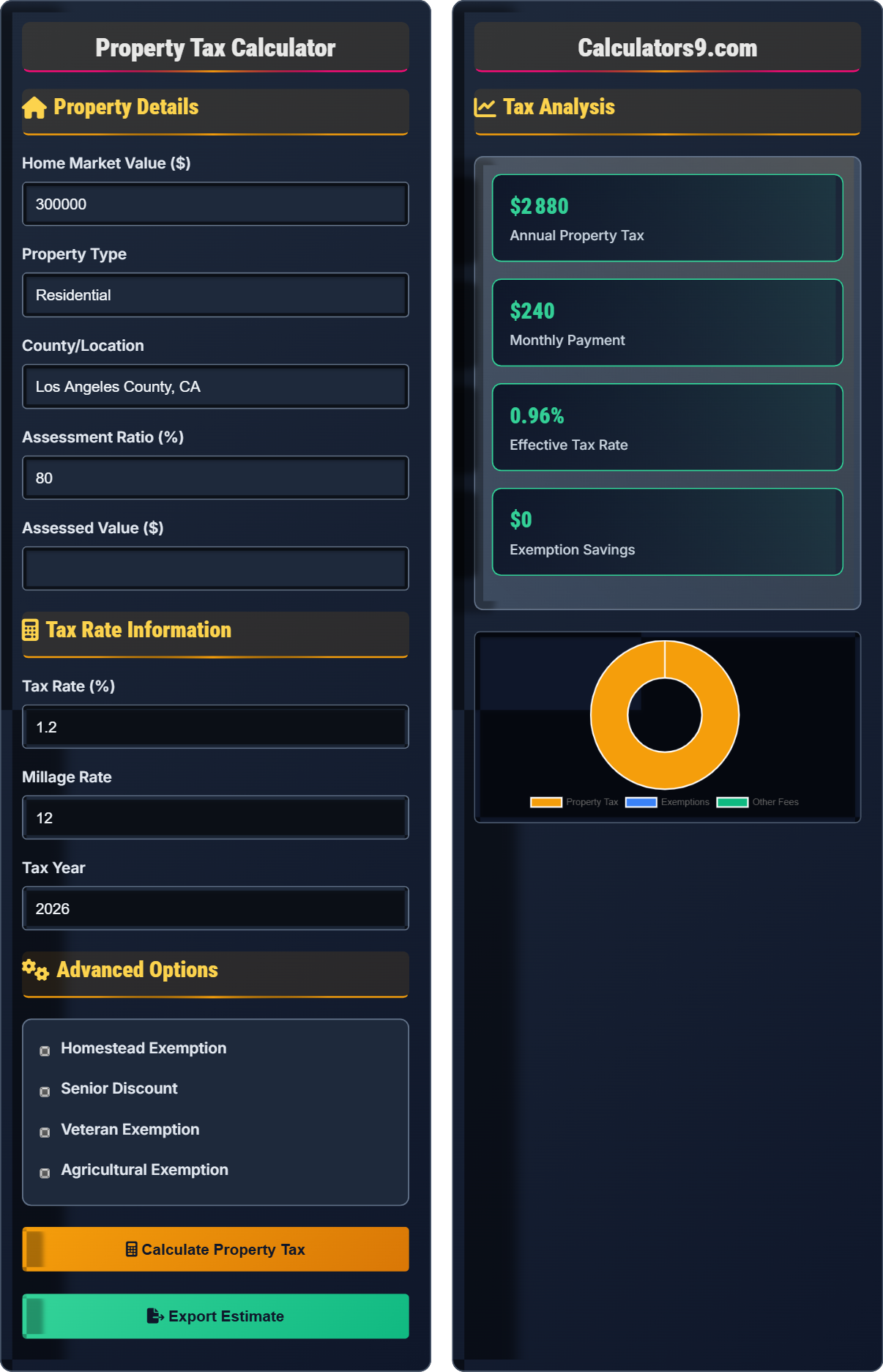
Example: For a $300,000 home with 80% assessment ratio and 1.2% tax rate:
Assessed Value: $300,000 × 0.80 = $240,000
Annual Property Tax: $240,000 × 0.012 = $2,880
Monthly Payment: $2,880 ÷ 12 = $240
Thus, the annual property tax would be $2,880 or $240 per month.
Property Details
Tax Rate Information
Advanced Options
Tax Analysis
| Component | Value | Amount | % of Total |
|---|---|---|---|
| Market Value | $300,000 | - | - |
| Assessment Ratio | 80% | - | - |
| Assessed Value | $240,000 | - | - |
| Tax Rate | 1.2% | - | - |
| Annual Tax | - | $2,880 | 100% |
| Monthly Tax | - | $240 | 8.3% |
| Location | Tax Rate | Annual Tax | Monthly Tax |
|---|---|---|---|
| Los Angeles, CA | 1.15% | $2,760 | $230 |
| Orange County, CA | 1.25% | $2,940 | $245 |
| Chicago, IL | 2.25% | $5,400 | $450 |
| Miami, FL | 0.95% | $2,280 | $190 |
| Houston, TX | 2.15% | $5,160 | $430 |
Comprehensive Property Tax Guide
Property taxes are local taxes levied on real estate by municipalities, counties, and school districts. They fund public services like schools, police, fire departments, roads, and parks. Property taxes are typically calculated as a percentage of the property's assessed value.
The standard property tax calculation uses the following formula:
Where:
- \( \text{Assessed Value} = \text{Market Value} \times \text{Assessment Ratio} \)
- \( \text{Tax Rate} = \text{Millage Rate} \div 1000 \)
- \( \text{Assessment Ratio} = \text{Percentage of market value used for taxation} \)
Several factors influence your property tax bill:
- Market Value: Property appraisals and local market conditions
- Assessment Ratio: Varies by jurisdiction (10%-100% of market value)
- Tax Rate: Set by local government and varies by location
- Exemptions: Homestead, senior, veteran, agricultural exemptions
- Property Class: Residential, commercial, industrial tax rates differ
- Appeal Assessment: Challenge if you believe assessment is too high
- Apply for Exemptions: Homestead, senior, veteran, disability
- Consider Agricultural Use: Lower rates for qualifying land use
- Time Improvements: Large improvements may trigger reassessment
- Neighborhood Advocacy: Work with neighbors to influence local budgets
Tax Fundamentals
Local taxes on real estate used to fund public services.
\( \text{Annual Tax} = \text{Assessed Value} \times \text{Tax Rate} \)
Example: $240,000 × 1.2% = $2,880 annual tax.
- Taxes based on assessed value
- Assessment ratios vary by location
- Exemptions reduce taxable value
Tax Strategies
Assessed value is typically less than market value.
- Appeal high assessments
- Apply for exemptions
- Consider land use changes
- Time improvements strategically
- Participate in local budget processes
- Appeal deadlines are strict
- Documentation is required
- Exemption qualifications vary
- Local rules differ significantly
Property Tax Learning Quiz
If a property has a market value of $400,000 and an assessment ratio of 75%, what is the assessed value?
The answer is A) $300,000. The assessed value is calculated as: Market Value × Assessment Ratio = $400,000 × 0.75 = $300,000. The assessment ratio determines what percentage of the market value is used for tax calculation purposes.
The assessment ratio is a crucial concept in property taxation. It represents the percentage of market value that is subject to taxation. Not all jurisdictions tax 100% of market value - many use ratios like 75%, 80%, or 100%. Understanding this distinction helps property owners anticipate their tax obligations and compare taxes across different locations.
Market Value: Fair market value of property
Assessment Ratio: Percentage of market value used for taxation
Assessed Value: Value used to calculate property taxes
• Assessed Value = Market Value × Assessment Ratio
• Assessment ratios vary by jurisdiction
• Not all locations tax 100% of market value
• Research assessment ratios in your area
• Compare assessed values to recent sales
• Confusing market value with assessed value
• Assuming all locations tax 100% of market value
• Not accounting for assessment ratios in calculations
You own a home with a market value of $350,000. The local assessment ratio is 85%, and the tax rate is 1.4%. Additionally, you qualify for a homestead exemption of $25,000. Calculate your annual property tax. Show your work.
Step 1: Calculate assessed value
Assessed Value = Market Value × Assessment Ratio
Assessed Value = $350,000 × 0.85 = $297,500
Step 2: Apply homestead exemption
Taxable Value = Assessed Value - Homestead Exemption
Taxable Value = $297,500 - $25,000 = $272,500
Step 3: Calculate annual property tax
Annual Property Tax = Taxable Value × Tax Rate
Annual Property Tax = $272,500 × 0.014 = $3,815
Step 4: Calculate monthly payment
Monthly Payment = $3,815 ÷ 12 = $317.92
Conclusion: Your annual property tax would be $3,815, or approximately $318 per month. The homestead exemption saved you $350 annually ($25,000 × 1.4% = $350).
This problem demonstrates the impact of exemptions on property tax bills. The homestead exemption reduced the taxable value by $25,000, resulting in a $350 annual savings. This shows how understanding available exemptions can lead to meaningful tax savings. The calculation also highlights the three-step process: determine assessed value, apply exemptions, then calculate tax on the remaining amount.
Exemption: Reduction in taxable value
Taxable Value: Assessed value minus exemptions
Millage Rate: Tax rate per thousand dollars of assessed value
• Exemptions reduce taxable value
• Tax is calculated on net assessed value
• Apply exemptions before calculating tax
• Always apply for available exemptions
• Track exemption renewal deadlines
• Applying exemptions after calculating tax
• Forgetting to convert percentages to decimals
• Not accounting for all available exemptions
FAQ
Q: Why do property taxes vary so much between different cities?
A: Property tax variations between cities occur due to several factors:
Local Budget Needs: Cities with higher spending requirements (schools, infrastructure, services) need higher tax rates.
Property Values: Areas with higher property values can generate more revenue at lower rates.
Other Revenue Sources: Cities with significant business tax revenue may keep residential rates lower.
Demographics: Communities with older residents may have different funding priorities.
State Laws: Some states limit property tax increases through "tax caps."
Historical Factors: Past decisions about funding sources affect current rates.
For example, a home valued at $300,000 would have vastly different tax bills in New Jersey (2.21% average rate) vs. Hawaii (0.28% average rate). The same property would pay about $6,630 annually in NJ vs. $840 in HI.
Q: How can I appeal my property assessment if I think it's too high?
A: Appealing your property assessment involves several steps:
Research Process:
- Obtain your assessment notice and review the details
- Compare your assessment to similar nearby properties
- Check for factual errors in property records (bedrooms, square footage, lot size)
- Gather evidence of recent sales of comparable properties
Appeal Process:
- Contact your local assessment office to understand their process
- File appeal within required timeframe (usually 30-60 days after notice)
- Submit evidence supporting your case
- Attend hearing if required
- Consider hiring a professional if property value is significant
Success Factors:
- Strong comparable sales data
- Clear evidence of over-assessment
- Well-organized presentation
- Meeting all deadlines
Successful appeals can reduce your assessment by 5-20%, providing significant long-term savings. However, the process varies by jurisdiction, so research your local requirements.