Education Tax Credit Calculator
AOTC & LLC estimator • 2026 rules
Education Tax Credit Formula:
Show the calculator\( \text{AOTC} = \min(\text{Qualified Expenses}, \$4{,}000) \times 25\% + \text{Additional Amount} \)
Where:
- Qualified Expenses = Tuition, fees, and course materials
- Base Credit = 100% of first $2,000 + 25% of next $2,000
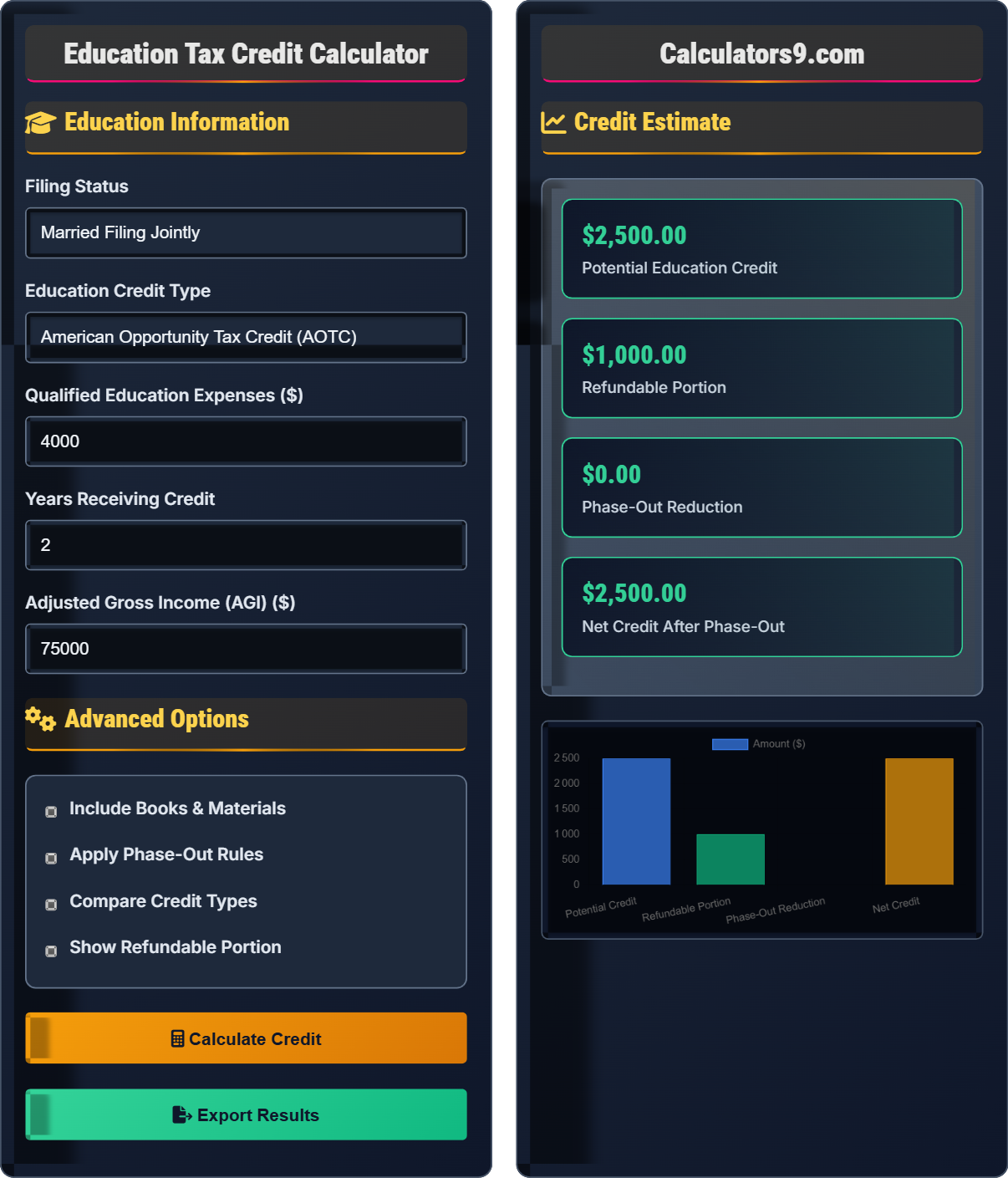
- Refundable Portion = Up to $1,000 of AOTC
- Phase-out Threshold = AGI > $80,000 ($160,000 joint)
- Phase-out Rate = $5 reduction per $1,000 of excess AGI
This formula calculates the American Opportunity Tax Credit (AOTC) for undergraduate education expenses.
Example: For a single filer with $3,500 in qualified expenses and AGI of $75,000:
Credit = ($2,000 × 100%) + ($1,500 × 25%) = $2,000 + $375 = $2,375
Since AGI is below threshold, no phase-out applies.
Refundable portion: Up to $1,000 of the $2,375 credit.
Education Information
Advanced Options
Credit Estimate
| Component | Amount | Description |
|---|
| Credit Type | Calculation | Amount | Eligibility |
|---|
Education Tax Credit Guide
Education tax credits help reduce the cost of higher education by providing tax benefits for qualified education expenses. There are two main education credits: the American Opportunity Tax Credit (AOTC) and the Lifetime Learning Credit (LLC). These credits can significantly reduce your tax liability or provide a refund in some cases.
The AOTC provides up to $2,500 per eligible student for the first four years of higher education. The credit is calculated as:
Where:
- First $2,000 of qualified expenses: 100% credit
- Next $2,000 of qualified expenses: 25% credit
- Maximum credit: $2,500 per eligible student
- Refundable portion: Up to $1,000
Education credits begin to phase out at specific income thresholds:
- American Opportunity Tax Credit: $80,000 AGI ($160,000 joint)
- Lifetime Learning Credit: $59,000 AGI ($118,000 joint)
- Phase-out Rate: $5 reduction per $1,000 of excess AGI
Both credits are completely phased out at $90,000 AGI ($180,000 joint) for AOTC and $71,000 AGI ($142,000 joint) for LLC.
- Choose the Right Credit: AOTC offers more per student but LLC has broader eligibility
- Time Expenses: Plan when to incur expenses to maximize credits
- Combine Credits: Use AOTC for first 4 years, LLC for graduate studies
- Plan Income: Consider income timing to stay below phase-out thresholds
- Track Expenses: Keep detailed records of all qualified expenses
Credit Basics
Tax credits for qualified education expenses that reduce tax liability.
\(AOTC = (\$2{,}000 \times 100\%) + (\$2{,}000 \times 25\%)\)
Where AOTC=American Opportunity Tax Credit.
- AOTC: $2,500 max per student
- LLC: $2,000 max per return
- Only one credit per student per year
Planning Strategies
AOTC has up to $1,000 refundable portion regardless of tax liability.
- Time expenses to stay below thresholds
- Maximize above-the-line deductions
- Consider tax-loss harvesting
- Defer income if possible
- AOTC for first 4 years only
- LLC for unlimited years
- Cannot claim both for same student
- Required enrollment criteria
Education Tax Credit Learning Quiz
What is the maximum American Opportunity Tax Credit (AOTC) per eligible student?
The answer is C) $2,500. The American Opportunity Tax Credit provides up to $2,500 per eligible student for the first four years of higher education. This is calculated as 100% of the first $2,000 of qualified expenses plus 25% of the next $2,000 of qualified expenses.
The AOTC calculation structure is important to understand: it's not simply a percentage of expenses. Instead, it has a tiered approach with different rates for different expense ranges. This makes the credit more valuable for students with higher education expenses but caps the maximum benefit at $2,500 per student.
American Opportunity Tax Credit (AOTC): Tax credit for first four years of post-secondary education
Qualified Expenses: Tuition, fees, and required course materials
Refundable Credit: Credit that can result in a refund even if no tax is owed
• Maximum $2,500 per eligible student
• First $2,000 at 100%, next $2,000 at 25%
• Limited to first four years of education
• Remember: $2,000×100% + $2,000×25% = $2,500 max
• AOTC is partially refundable up to $1,000
• Confusing AOTC maximum with LLC maximum
• Thinking the credit is simply a percentage of expenses
• Not understanding the tiered calculation structure
Calculate the AOTC for a single student with $3,500 in qualified expenses and whose parents have AGI of $75,000. Show your work.
Step 1: Calculate base credit
• First $2,000 × 100% = $2,000
• Next $1,500 × 25% = $375
• Base credit = $2,000 + $375 = $2,375
Step 2: Apply phase-out rules
• AOTC phase-out threshold for single = $80,000
• AGI = $75,000 (below threshold)
• No phase-out reduction applies
Step 3: Final credit = $2,375
Step 4: Refundable portion = minimum($1,000, $2,375) = $1,000
Therefore, the family could claim a $2,375 AOTC, with $1,000 being refundable.
This example demonstrates the tiered calculation method of the AOTC. The credit is not a simple percentage of expenses but rather has different rates for different expense ranges. Since the AGI is below the phase-out threshold, the full credit is available. The refundable portion is limited to $1,000 or the actual credit amount, whichever is smaller.
Phase-Out Threshold: Income level above which the credit begins to be reduced
Adjusted Gross Income (AGI): Income before deductions and exemptions
Base Credit: The initial credit amount before any reductions
• AOTC: First $2,000 at 100%, next $2,000 at 25%
• Phase-out begins at $80K AGI ($160K joint)
• $1,000 refundable portion maximum
• Remember the two-tier calculation: $2,000×100% + $2,000×25%
• Check if AGI is below phase-out threshold first
• Calculating the credit as a simple percentage of total expenses
• Forgetting the refundable portion limitation
• Misapplying phase-out rules when not needed
Jane is married filing jointly with AGI of $175,000 and has $4,000 in qualified education expenses for her daughter. Calculate her AOTC after applying phase-out rules. What is the refundable portion?
Step 1: Calculate base credit
• First $2,000 × 100% = $2,000
• Next $2,000 × 25% = $500
• Base credit = $2,000 + $500 = $2,500
Step 2: Apply phase-out rules
• AOTC phase-out threshold for joint = $160,000
• Excess AGI = $175,000 - $160,000 = $15,000
• Phase-out multiplier = $15,000 ÷ $1,000 = 15 (round up any fraction)
• Phase-out reduction = 15 × $5 = $75
Step 3: Calculate final credit
• Final credit = $2,500 - $75 = $2,425
Step 4: Calculate refundable portion
• Refundable portion = minimum($1,000, $2,425) = $1,000
Therefore, Jane's AOTC is $2,425, with $1,000 being refundable.
This example demonstrates how phase-out works when AGI exceeds the threshold. The credit is reduced proportionally based on how much income exceeds the threshold. The phase-out rate is $5 for every $1,000 of excess AGI. The refundable portion remains $1,000 since it's limited to the actual credit amount.
Phase-Out Rate: The rate at which the credit is reduced ($5 per $1,000 of excess AGI)
Refundable Portion: The portion of the credit that can result in a refund
Excess AGI: AGI above the phase-out threshold
• Phase-out reduces credit by $5 per $1,000 of excess AGI
• Round up fractions of $1,000 when calculating reduction
• Refundable portion limited to $1,000 maximum
• Always round up excess AGI when calculating phase-out
• Remember AOTC refundable portion is capped at $1,000
• Forgetting to round up excess AGI to nearest $1,000
• Calculating refundable portion greater than $1,000
• Using wrong phase-out threshold for filing status
Mark is a graduate student with $8,000 in qualified education expenses and AGI of $65,000. Which education credit would be more beneficial for him: AOTC or LLC? Calculate both and explain your recommendation.
American Opportunity Tax Credit (AOTC):
• AOTC is only available for first four years of post-secondary education
• Since Mark is a graduate student, he is not eligible for AOTC
Lifetime Learning Credit (LLC):
• LLC = 20% of qualified expenses up to $10,000
• LLC = 20% × $8,000 = $1,600
Phase-out calculation for LLC:
• LLC phase-out threshold for single = $59,000
• Excess AGI = $65,000 - $59,000 = $6,000
• Phase-out multiplier = $6,000 ÷ $1,000 = 6 (round up)
• Phase-out reduction = 6 × $5 = $30
• Final LLC = $1,600 - $30 = $1,570
Therefore, Mark should claim the Lifetime Learning Credit of $1,570, as he is not eligible for AOTC as a graduate student.
This example highlights the key differences between AOTC and LLC. The AOTC is only available for the first four years of post-secondary education, making it unavailable for graduate students. The LLC, however, has no limit on years of eligibility, making it suitable for continuing education at any level. Understanding eligibility requirements is crucial when choosing between credits.
Eligibility Requirements: Criteria that must be met to claim a tax credit
Graduate Student: Student pursuing advanced degree beyond bachelor's level
Credit Selection: Choosing the most beneficial credit based on circumstances
• AOTC: First 4 years of post-secondary education only
• LLC: Any year of education, any level
• Cannot claim both for same student in same year
• Undergraduates: Consider AOTC first (higher credit)
• Graduate students: LLC is the only option
• Always check eligibility before calculating
• Trying to claim AOTC for graduate students
• Not understanding the difference in eligibility requirements
• Claiming both credits for the same student in the same year
Which of the following expenses would qualify for the American Opportunity Tax Credit?
The answer is A) Tuition and required course materials. The American Opportunity Tax Credit covers tuition, fees, and required course materials. Room and board, transportation, and optional equipment do not qualify as they are not directly required for enrollment or attendance at an eligible educational institution.
Understanding what constitutes "qualified expenses" is crucial for education tax credits. Only expenses that are required for enrollment or attendance at an eligible educational institution qualify. This typically includes tuition, mandatory fees, and required course materials. Living expenses, travel costs, and optional items do not qualify, even if they are education-related.
Qualified Expenses: Expenses that meet IRS requirements for tax credits
Required Course Materials: Books, supplies, and equipment required for enrollment
Eligible Educational Institution: Accredited college, university, or vocational school
• Qualified expenses include tuition and required materials
• Room and board do not qualify
• Items must be required for enrollment/attendance
• Keep receipts for all educational expenses
• Verify if materials are "required" not "recommended"
• Ask school for list of required expenses
• Including room and board in qualified expenses
• Counting optional equipment as required materials
• Not verifying if items are truly required
FAQ
Q: Can I claim both AOTC and LLC in the same year for different students?
A: Yes, you can claim different education credits for different students in the same tax year. For example, if you have one child in their first year of college and another in graduate school, you could claim the American Opportunity Tax Credit (AOTC) for the undergraduate student and the Lifetime Learning Credit (LLC) for the graduate student.
However, you cannot claim both credits for the same student in the same tax year. The rule is that only one education credit can be claimed per student per year.
Q: What's the difference between AOTC and LLC for graduate students?
A: Graduate students are not eligible for the American Opportunity Tax Credit (AOTC), which is only available for the first four years of post-secondary education. However, graduate students can claim the Lifetime Learning Credit (LLC).
Key differences for graduate students:
- LLC: 20% of first $10,000 of qualified expenses = up to $2,000 maximum
- Eligibility: No limit on years, any level of education
- Refundable: No refundable portion (non-refundable only)
- Phase-out: Begins at $59,000 AGI ($118,000 joint)
For graduate students, LLC is the only education credit option available.